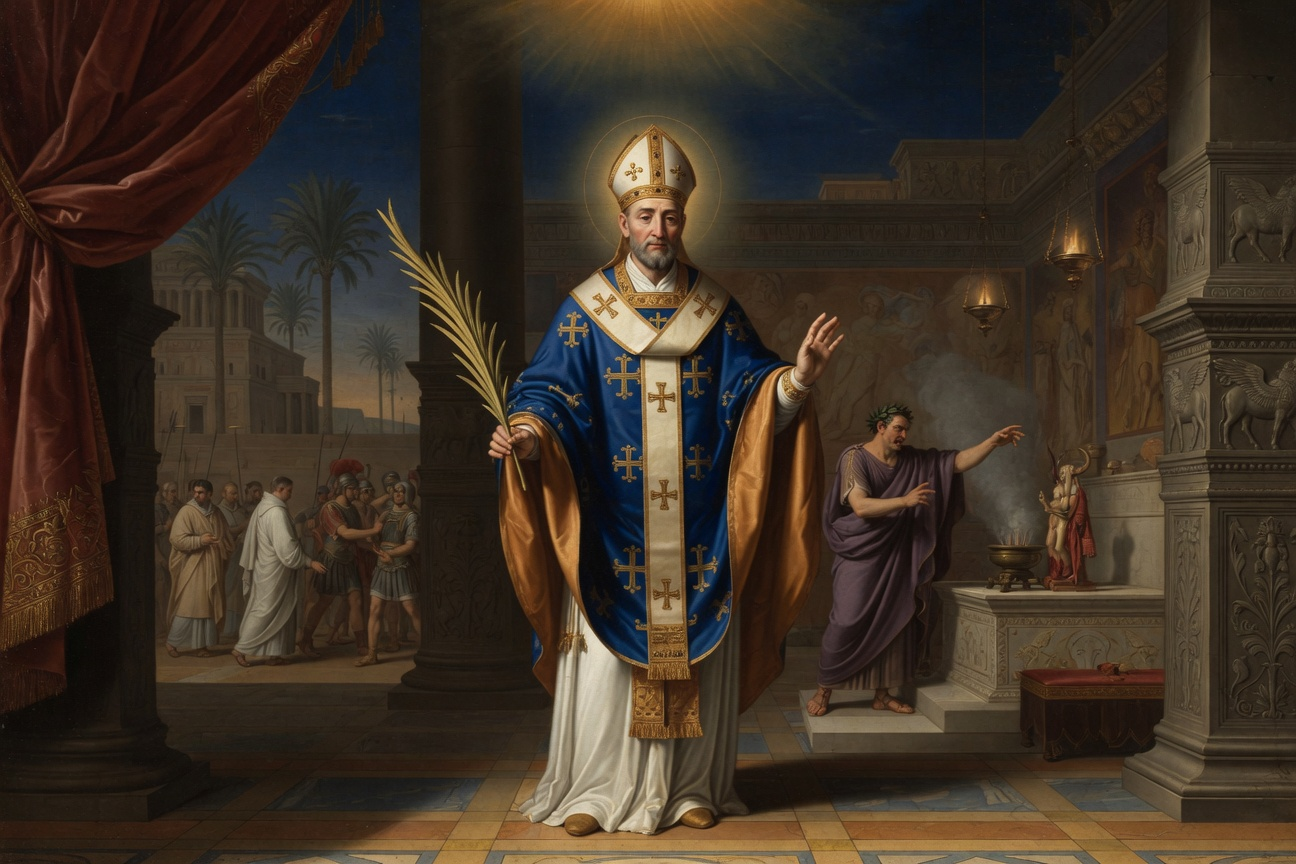
Bishop of Babylon in the 3rd century, Polychronius was arrested with his clergy under Emperor Decius. Having refused to sacrifice to idols and maintaining a heroic silence during his trial, he died from blows struck to his mouth. His body was secretly buried by Saints Abdon and Sennen.
Guided reading
5 reading sections
SAINT POLYCHRONIUS, MARTYR
Context and arrest
Under the reign of Emperor Decius in the 3rd century, Polychronius, Bishop of Babylon, was arrested with his priests and deacons for refusing to sacrifice to idols.
"I will give you words and a wisdom which none of your adversaries will be able to withstand or contradict." Luke, XXI, 15.
Saint Polychronius, whom the Roman Martyrology comm Saint Polychrone Martyr whose body was buried by Abdon and Sennen. emorates today, was Bishop of Babylon, in Chaldea or Persia, where he flourished in the 3rd century, under the empire of Decius. This emperor, having made him self Dèce Roman emperor responsible for the persecution of Christians in 250. master of this country by force of arms, cruelly persecuted the Christians; and, knowing that Polychronius was their Father, and as it were their leader, he had him seized along with Parmenius, Hel ymas, and Parménius Priest and companion in martyrdom of Polychronius. Chrysotelus, priests, and Luke and Mucius, deacons. All these Saints were led to the temple of the idols, to offer them incense and to acknowledge their divinity; but Polychronius, speaking for all the others, replied: "As for us, we offer ourselves as a sacrifice to Our Lord Jesus Christ, and we will never bow down before the demon, nor before these idols, which are fashioned by the hands of men." The emperor, transported with rage, had them thrown into prison and referred their case to the judgment of one of his praetors, named Apollo Valerian.
The Interrogation and the Sacred Silence
Before the praetor Apollo Valerian, Polychronius remains silent, while the priest Parmenius justifies this attitude with an evangelical word, leading to the removal of his own tongue.
The latter, having the Martyrs appear before his tribunal, addressed the holy Bishop and spoke to him in these terms: "Are you that sacrilegious Polychronius who despises the gods and the commandments of the princes?" The holy prelate answered him nothing; the emperor, who was attending this interrogation, said to the clergy of Polychronius: "What! Does your prince remain silent?" Then the priest Parmenius replied: "Our Father has not remained silent without reason, but he has done so to obey the commandment of Our Lord Jesus Christ, who said to his Apostles: Beware of casting pearls before swine, lest, trampling them underfoot, they turn and rend you."
The tyrant, hearing this, was deeply irritated; he commanded that the tongue be torn from him who had spoken in such a way: which was executed, and nevertheless the priest, le prêtre Priest and companion in martyrdom of Polychronius. although he had his tongue cut out, did not cease to cry out to the holy prelate: "My blessed Father Polychronius, pray for me, because I see the Holy Spirit who reigns in you and who, sealing your sacred mouth, pours into mine a sweetness of honey."
The martyrdom of Polychronius
Still refusing to sacrifice, Polychronius is struck to death on the mouth. His body is secretly taken away and buried by the Persian lords Abdon and Sennen.
Decius commanded Polychronius to sacrifice to the gods, in order to enjoy, by this means, his friendship and to render himself worthy of his favors; but, as the holy Bishop did not answer him a word, he had him struck so cruelly on the mouth that this blessed Martyr, raising his eyes to heaven, rendered his soul to God in the pains of this torture. Decius had his body thrown before the temple of Saturn; the following night, two illustrious Persian lords Abdon 3rd-century Persian martyr. , Ab don an Sennen Persian martyr, companion of Saint Abdon. d Sennen, who were secretly Christians, took it away and buried it with honor near the city of Babylon.
The martyrdom of the companions
The remaining priests and deacons undergo various tortures which they miraculously overcome before being beheaded. Abdon and Sennen ensure their burial at the risk of their lives.
As for the other Saints, priests and deacons, the emperor had them dragged after him, loaded with irons and chains; but as they all broke of their own accord, this prince, attributing this miracle to the illusions of magic, had them tormented on the rack; while their limbs were being stretched, they cried out to Parmenius to pray to Our Lord to give them patience. Then, this holy priest, although deprived of his tongue, replied: "May God, the Father of Our Lord Jesus Christ, give you the consolation of His divine Spirit, who reigns for all ages"; and they replied: "Amen."
Decius, hearing this, became more irritated than ever, and ordered them to be thrown into the fire; but it was without effect, and a voice was heard from heaven saying: "Come to me, you who are humble of heart."
Finally, they were beheaded, and their bodies thrown into the refuse heap; they were guarded by soldiers, and a very express prohibition was made against giving them burial; but this did not prevent the courageous lords Abdon and Sennen from rendering them the same duties they had rendered to the holy bishop Polychronius: which earned them the crown of martyrdom themselves.
Sources and chronology
The account is based on the works of Surius, Baronius, and the Venerable Bede, placing the martyrdom between 251 and 253 AD.
The martyrdom of Saint Polychronius and his companions is reported by Surius, in his fourth volume, on August 10; and C ardinal Baronius cardinal Baronius Cardinal and hagiographer who fixed the feast day on October 8. makes an ample record of it in his Remarks on the Martyrology, on February 17, the day on which Saint Polychronius endured death for Jesus Christ . The venerabl vécubable Bida Anglo-Saxon monk and historian, primary source for the narrative. e Bede, Genard, and Ado did not forget him in their Martyrologies. There are various opinions regarding the year of his triumph; Baronius marks it in the year 253. Rollandas holds it to be the year 251.
Annexes & related entities
Structured data for exploration: events, miracles, quotes, places, attributes, patronages, and important entities cited in the text.
Key Events
- Episcopate in Babylon under Emperor Decius
- Arrested with his clergy during the persecution
- Refusal to sacrifice to idols before the emperor
- Interrogation by the praetor Apollo Valerian
- Martyrdom by flogging on the mouth until death
- Secret burial by Abdon and Sennen
Miracles
- Companions' chains breaking by themselves
- Celestial voice calling the martyrs
- Parmenius continuing to speak despite having his tongue cut out
Quotes
-
As for us, we offer ourselves as a sacrifice to Our Lord Jesus Christ, and we will never bow before the demon, nor before these idols, which are fashioned by the hands of men.
Saint Polychronius before Decius