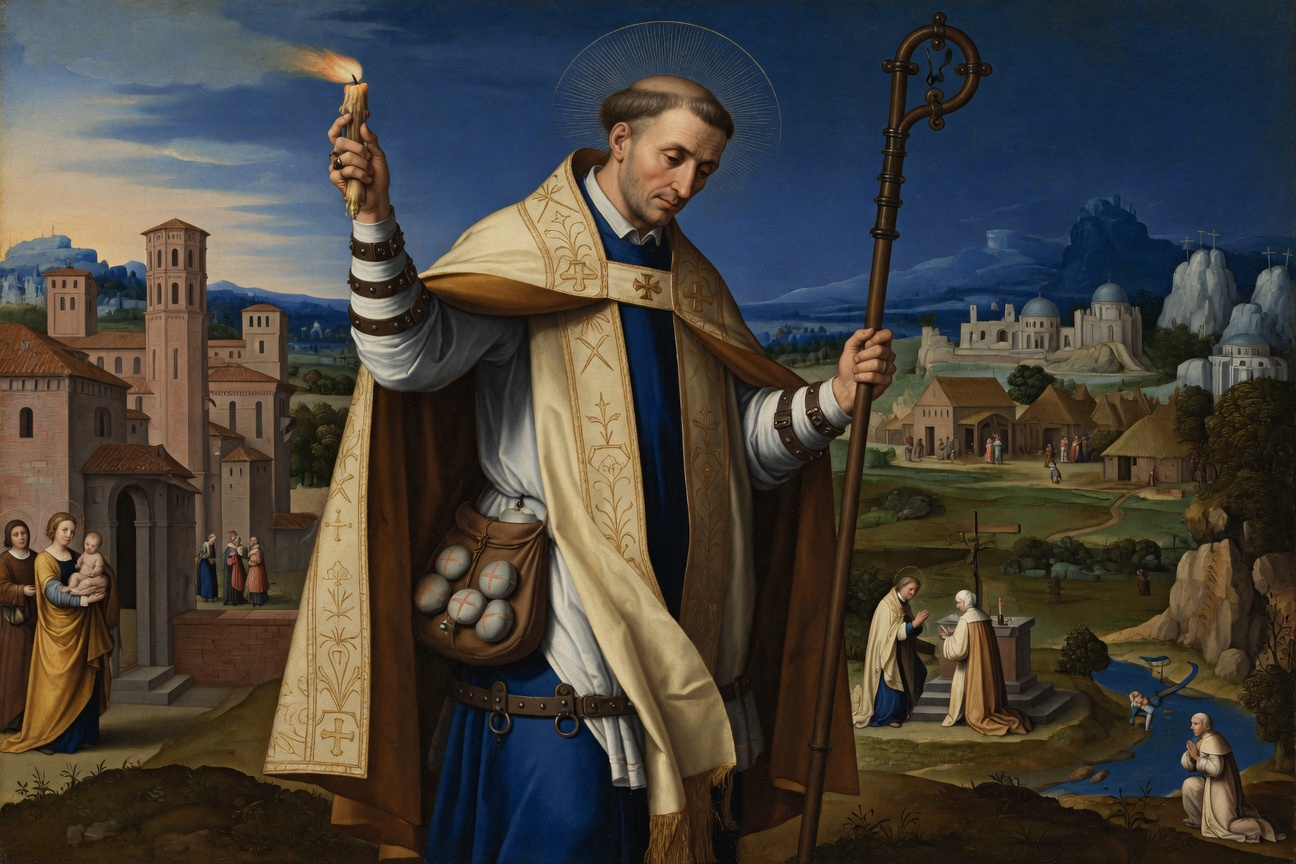
Born in Toulouse and active in the 8th century, Saint Silvin renounced marriage to evangelize Morinie. A great pilgrim, he visited Jerusalem and Rome, practicing extreme austerities such as wearing iron rings. He died in 718 at Auchy after a life of charity and miracles.
Guided reading
8 reading sections
SAINT SILVIN, REGIONARY BISHOP
Sources and historical context
The text is based on a primitive biography written by Antenor, a disciple of Silvin, which was later corrected in the 9th century by the abbess Leutwithe.
"For here we have no lasting city, but we seek the city that is to come." Heb. xiii, 14. Around the year 718, Saint Silvin, who cast a bright light upon the 7th century through the greatness of his holiness, died the death of the righteous near the monastery of Auchy-les-Moines, not far from Hesdin. A certain bishop named Antenor, a very r eligiou Anténor Bishop, author of the first life of Saint Silvin and his disciple. s man but little versed in literature, endeavored to collect memoirs on the life of Silvin, desiring to honor him after his death as he had done during his life; he wished to preserve for posterity all that he had learned of the holiness of this personage. This work remained in oblivion until the time of Leutwithe, abbess of Auchy. Thi s woman r Leutwithe Abbess of Auchy who had the style of the biography of Silvin corrected. ediscovered the life of Saint Silvin in the midst of the archives; after perusing it, she noticed many errors and inaccuracies of language. Full of devotion for Saint Silvin, she had Antenor's style corrected, while preserving the meaning of the details. This primitive author was a contemporary and disciple of the holy bishop. We shall provide here the translation of this life composed by Antenor and corrected by an anonymous author of the 9th century.
Origins and political context
Born in Toulouse, Silvin lived during the reigns of Charles Martel and Chilperic, witnessing the conflicts between the mayor of the palace and Ragenfrid.
"In our time" — we translate the ancient legend literally — "in our time there arose by divine permission, in the regions of the South, an example of justice and admirable holiness in the person of one named Silvin, bishop and confessor of Jesus Christ. He was placed between an age that is no more and an age that is not yet, to unite in himself the merits of the Saints who preceded him and to become the model for those who were to follow him.
The noble land of Toulouse gave birth to Toulouse Episcopal see of Erembert. Silvin; the land of Thérouan ne possessed him. pays de Thérouanne Episcopal see of Saint Folquin. He was illustrious by his birth, more illustrious by his faith and his holiness according to the order of God. Having appeared in the time of the first King Char premier roi Charles (Martel) Mayor of the palace, possible ancestor of the saint. les (Ma rtel) and Chilpéric King of Austrasia under whose reign the abbey was founded. of Chilperic, he live d until the battl bataille de Vincy Military conflict marking the chronology of the saint's life. e of Vincy between Charles and Ragenfrid, mayor of the palace, in which a horrible carnage took place and where Ragenfrid took flight.
Renunciation and mission in Thérouanne
After renouncing marriage for the ideal of chastity, Silvin went to Thérouanne to evangelize the region.
In his youth, he married a young girl; but having come to himself and guided by the counsels of supreme wisdom, he renounced this alliance, to imitate in perfect chastity the Son of the Virgin, to whom all that is pure is pleasing. He yielded to the memory of this word of the Gospel: 'Everyone who has left house, or brothers, or sisters, or father, or mother, or wife for my name's sake, shall receive a hundredfold here below and eternal life hereafter.'
Led by the divine hand, to increase the merit of his holiness and to save a great number of souls, he went to the part of the West, to the land of Thérouanne, where he won many people to God.
Asceticism and great pilgrimages
Silvin leads a life of poverty and charity, undertaking journeys to the tombs of the saints, to Rome, and to the Holy Land.
« He assiduously received strangers and pilgrims into his house as if they were Jesus himself, washing their feet, feeding them, and clothing them according to his means.
« He took pleasure in pouring out his wealth into the bosom of the poor. Without worrying about the morrow, obedient to the precept of the Gospel, which says that 'sufficient unto the day is the evil thereof,' he despised the world and lived by rising above all the perishable things of the earth, loving God with all his strength and aspiring only to immortality. He used a horse only on his travels, not for comfort, but because of the weakness of his body, which reached an extreme old age.
« He undertook several pilgrimages for the love of the Almighty, visiting the tombs of the Saints, pouring out prayers there, not wishing to leave any righteous person without involving them in the end of his journey here below, without seeking support in their prayers: persuaded that one must surround oneself with the help of others to attain eternal glory, since it is written that it is difficult for a man alone to be saved.
« Not only did he visit in his pilgrimages the provinces that are bounded by the Ocean, but he also crossed the seas and went to that land where our Savior Jesus Christ took human form and spent his life. After traveling through various places, h e arrived at that mo montagne du Golgotha Holy city where the Cross was lost and subsequently recovered. untain of Golgotha called Calvary, where our Savior was crucified by the infidel Jews and the Roman soldiers. He then came to the banks of the Jordan where the Lord was baptized, sanctifying our baptism; he washed himself in the waters of the river, joyful and taking on a new life, happy to have been able to fulfill a desire that was the most ardent of his heart!
Pastoral Ministry and Foundations
A devoted bishop, he preached penance, ransomed captives, and founded two churches at Maunice and Saint-Remy-Campagne.
"He honored the temples of the Saints with great veneration, having torches burned within their precincts, celebrating the sacred mysteries there, and offering the sacrifice of prayer. He loved priests, respected monks, and watched over virgins to teach them to preserve until the end the treasure of chastity of spirit and heart; he preached every day in the presence of the clergy and the people in the most perfect manner, exhorting all sinners to penance, and ceaselessly imploring divine mercy for their sins. As a minister of Jesus Christ, he listened to the confession of the people, gave them counsel, instructed them in the ways of salvation, and exhorted them never to abandon the paths of justice, telling everyone that the yoke of the Lord was sweet and light, that there was nothing more useful than to serve Him, who gave an eternal kingdom to those who love Him with all their mind, with all their heart, and with all their strength; that it was true folly to obey Satan, who can promise his servants only eternal punishment and fires that will never be extinguished.
"He consecrated to God all that he possessed, and he never attributed the good he accomplished to his own merit, but to divine goodness. In place of the perishable goods of life, he attached himself to those of eternity. He built on his estates, to the glory of Almighty God and the Saint whose name he bore, two churches, one in a place called Maunice, the other at Saint-Remy-Campagne, in Artois, so that the praises of God might be perpetually celebrated there.
"He ransomed several Christian captives in distant lands; he also gave freedom to several slaves, after having instructed them in the principles of the faith and marked them with the sign of the cross. It was Silvin's custom, when the sick came to him, to pray to God for them in the depths of his heart and to heal their souls; then he offered them baths and other blessed remedies, such as sanctified oil; and after having given them Holy Communion, he sent them back to their homes in a more satisfactory state than if they had never been afflicted by illness."
Mortifications and desire for martyrdom
For forty years, he imposed upon himself a strict Eucharistic regimen and physical macerations, aspiring without attaining to bloody martyrdom.
He practiced great austerities. For forty years he took no other bread than the Eucharistic bread, contenting himself with a few herbs and fruits. Having never worn sumptuous clothing, he only used precious garments sometimes in the oblation of the holy sacrifice. He was dressed in simple and coarse clothes, observing this oracle of the Holy Spirit: 'Do not dress magnificently'; and this other: 'Those who are softly clothed dwell in the palaces of kings'. He fought for his prince with haircloth and ashes, and not with ornaments mixed with gold and precious stones. He never took his sleep on a prepared bed, but on wood or on the bare earth. To be able to enslave his body, he treated it like a useless slave: he surrounded his limbs for several days with iron circles, macerating his flesh with these instruments devoured by rust; he acted thus in memory of Jesus Christ who expired on his cross, attached by iron nails to the wood of his sacrifice. He was seen carrying enormous stones to Rome and depositing them as a trophy before the doors o f th Rome Birthplace of Maximian. e Basilica of Saint Peter.
He often desired, to render to God what he had received from Him, to win the crown of martyrdom; but persecutions having ceased, he found no one, in the midst of the triumphs of the faith in the Church, who could put him to death. He also aspired to the solitary life and to the contemplation of God through the abandonment of human things. His continual infirmities set limits to his desires: he became the equal of the martyrs through the torments to which he subjected his limbs, and his astonishing abstinence placed him in the rank of the heroes of the desert.
Passing and burial at Auchy
Silvin dies on a Saturday evening after an angelic vision and is buried at the monastery of Auchy in the presence of the monks of Centulle.
« We must now recount how this blessed soul left the prison of his body to enter the abode of glory. Towards the end of his life, he felt himself seized by illness and consumed by fever. The more his body was overwhelmed, the more he exalted his creator, sustained by these words of the Apostle: « When I am weak, then I am strong ». When he felt his end approaching, he had the holy mysteries celebrated before him and the psalms sung, receiving the body of the Lord while marking himself with the sign of the cross.
« He warned those who surrounded him to always keep in their thoughts the day of their death, to flee from sin, and to advance holily in the paths of life. Accustomed to praising his redeemer during the days of his existence, he persevered in these sentiments until his death. On the evening of Saturday, he saw a troop of angels running to meet him. Fortified by this celestial vision, he said in a loud voice to all those present: « The angels are coming to us! The angels are coming to us!... » and he immediately gave up his spirit. No one formed the slightest doubt about his entry into the heavens by the hands of the angels who had come to take him. The day of the Sabbath or of rest on which he died marked the eternal rest which he enjoys in glory.
« A great number of priests, clerics, and holy women attended his funeral. The singing of sacred hymns was interrupted by the tears shed over the death of such a holy pontiff. His servants and those close to him wept even more than the others, saying that they would never find such a faithful protector. The people shed tears on earth, and the angels rejoiced in heaven; the former believed they had lost a father, and they found a protector.
« A messenger was sent to the monastery of Centulle, not far from Auchy, where Saint Silvin made his habitua l residence, to invit monastère de Centulle Monastery whose monks attended the funeral of Silvin. e the monks to attend his funeral. The religious of Centulle responded to this invitation. Thus the holy bishop Silvin descended to the tomb accompanied by all the Orders to whom he had given such touching examples during his life. The holy pontiff was buried in the monastery of Auchy to the singing of hymns, the scent of aromatics, and with the greatest veneration.
Cult, miracles, and iconography
His tomb was enriched by the noble Sicherde; miracles of healing confirm his holiness, often represented by a torch.
"After the office of the dead, the lord Adalscar and Assiglia (Ogules), his wife, of the noble race of the Franks, gave a great feast to those who had attended the funeral, in order to restore the strength of the travelers. They built in the monastery of Auchy a basilica in honor of the Mother of God. Before the arrival of Saint Silvin, this monastery had been raised by them for their daughter Sicherde , who to Sicherde Nun and benefactress of the tomb of Saint Silvin. ok the holy religious habit there. After the death of Silvin, Sicherde adorned this church with crowns and lamps; she enriched the tomb of the Saint with gold and precious stones, had the curved staff that supported his fal tering steps i bâton recourbé Relic of the saint preserved in gold and silver. n his old age encased in gold and silver, and placed it in this holy dwelling."
Several miracles are reported that Saint Silvin performed during his life and after his death; one notes especially a blind woman who recovered her sight, possessed persons delivered, and an infinity of sick people healed. These various miracles have given rise to as many diverse representations of the Saint.
He has also been painted with a torch in his hand, to signify that he rekindled that of the fait h in Mo Morinie Historical region corresponding to the former diocese of Thérouanne. rinia.
Annexes & related entities
Structured data for exploration: events, miracles, quotes, places, attributes, patronages, and important entities cited in the text.
Key Events
- Born in Toulouse
- Renunciation of marriage for chastity
- Evangelization of the region of Thérouanne
- Pilgrimage to Jerusalem and baptism in the Jordan
- Pilgrimage to Rome
- Construction of churches in Maunice and Saint-Remy-Campagne
- Died at the monastery of Auchy-les-Moines
Miracles
- Healing of a blind woman
- Deliverance of the possessed
- Multiple healings through sanctified oil and prayer
Quotes
-
The angels are coming to us! The angels are coming to us!...
Last words reported by Anténor