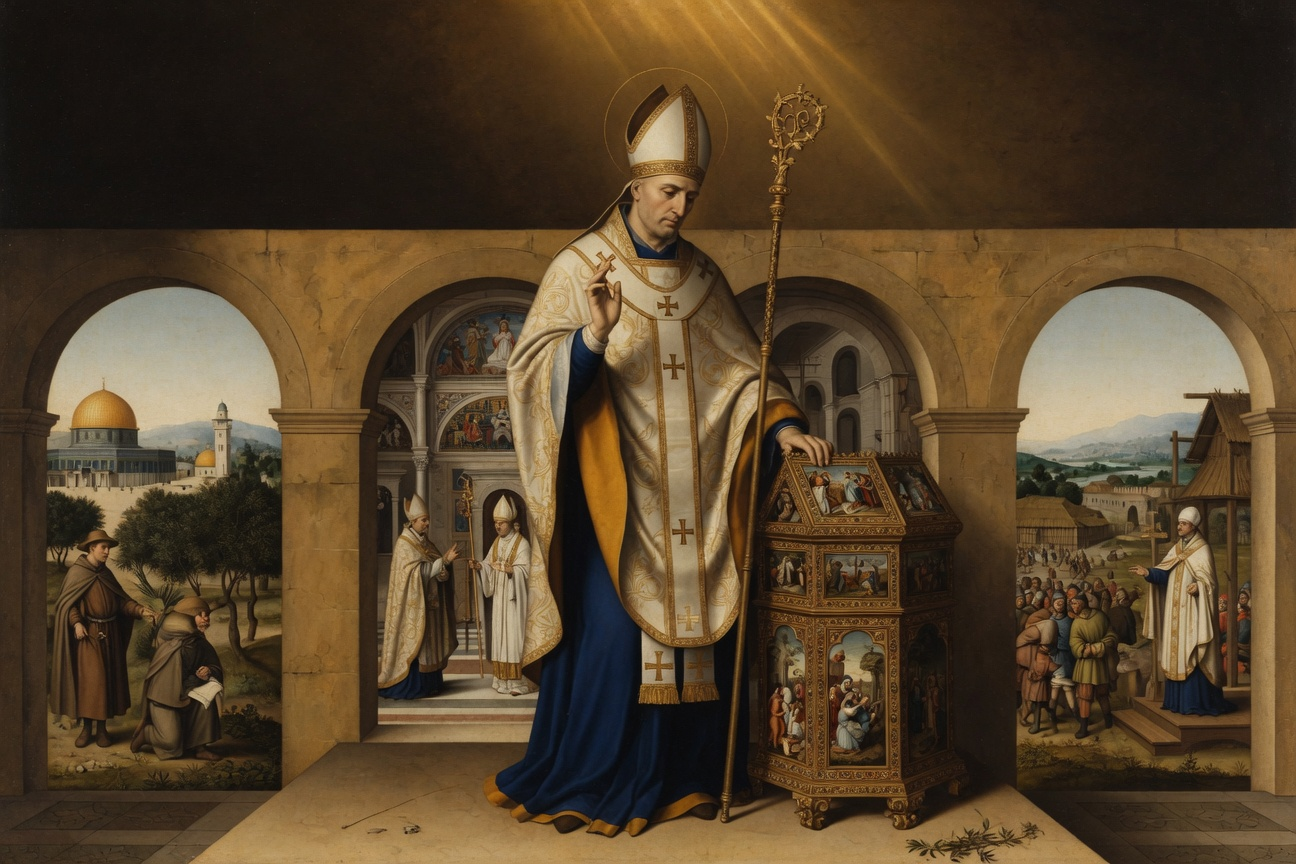
Saint Silvin was an 8th-century regional bishop and disciple of Antener, who preached in Gaul-Belgica following a pilgrimage to the Holy Land. Although his origins are disputed between Toulouse and Brabant, he died at Auchy in 716. His relics were the subject of a miraculous translation to the Abbey of Saint-Bertin, where the bells rang of their own accord to mark his desire to remain there.
Guided reading
5 reading sections
PATRIE ET RELIQUES DE SAINT SILVIN.
Sources and debates on origins
The text relies on the account of Antener, a disciple of Silvin, while highlighting historical uncertainties regarding his birthplace, which oscillates between Toulouse, Scotland, and Brabant.
Such is the authentic life of Sa int Silvin c saint Silvin Saint whose body was fraudulently substituted for that of Prudent by the people of Dijon. omposed, as we have already said, by Antener , his d Anténer Disciple of Saint Silvin and author of his original biography. isciple, and revised, in the 12th century, by the care of Leuthwithe, abbess of Auchy . The Auchy Site of the abbey associated with the cult of Silvin and the place of his death. re is no mention in this life of Silvin's promotion to the episcopate. It must be assumed that, since the author gives him the title of bishop, he was raised to this dignity in Rome, after his return from the Holy Land. Authors have varied greatly regarding this bishop. Melanus makes him born in Thérouanne; an a ncient man Thérouanne Episcopal see of Saint Folquin. uscript life gives him Scotland as his homeland; some have made him a descendant of Pepin and Plectrude; others have made him bishop of Thérouanne, and also of Toulouse. Accord ing to M Toulouse Episcopal see of Erembert. . Salvan, who believes he is the echo of the generally accepted sentiment, Silvin was born in the territory of Toulouse.
Episcopate and geographical analysis
Silvin is described as an itinerant regional bishop. A textual analysis suggests that he originated from Doesburg in Gaul-Belgica rather than Toulouse.
Plausible evidence leads the Bollandists to believe that he was bor n in Does Doesbourg Town in Brabant identified by the Bollandists as his probable birthplace. burg, in Brabant. This city, one of the oldest in the country, bore the name Thoas in the early centuries, which may have caused it to be confused with Tholosa. There is one word, only one, in the legend that we wish to point out—it has not yet been—as supporting this latter opinion: "Led by the divine hand," says Antener, "he went to the part of the West, to the country of Thérouanne." Why this expression part and this other West? Thérouanne is not to the West of Toulouse, but to the North, whereas it is to the West of Doesburg. This word part clearly indicates that Silvin inhabited the country upon which Thérouanne depended, that is to say, Gaul-Belgica. He was a regional bishop, that is to say, having no particular see, but destined by the Apostolic See to preach the Gospel in various places. His death is fixed at February 15, 716.
Translations of the relics and the miracle of the bells
After several transfers linked to the Norman invasions, his remains arrived at Saint-Bertin, where a miracle of bells ringing on their own confirmed his desire to remain there.
During the time of the Norman insurrection in the 12th century, the body of Saint Silvin was transported to the castle of Héristal, near Liège, from there to the castle of Dijon in Burgundy, and then to the abbey of Bèze, where his relics partially remained. In 951, Arnulf, the first Count of Flanders, had the body of Saint Silvin transported from the monastery of Bèze to Saint-Omer, in the abbey of Sit Saint-Bertin Burial place of Saint Folquin. hieu or Saint-Bertin. The rather curious history of this last translation was reported to us by John Iperius, abbot of Saint-Bertin. "At that time," he says, "Arnulf the Elder brought the body of the blessed Silvin of Auchy to this place; he received it as a pledge, on the condition that if, by the appointed day and before the monastery bells indicated the hour of Prime, it was not redeemed, the body of the Saint would remain at Saint-Bertin. On the fixed day, the monks of Auchy came with the agreed price to redeem the sacred deposit; but they stopped for the night at Thérouanne, and the next day they did not leave until a little late. As they approached Sithieu, they heard the bells of Saint-Bertin ringing for Prime; they immediately spurred their horses, arrived at the convent, and offering the agreed price, they demanded the body of the holy bishop, while claiming that the hour for the ringing of Prime had been anticipated. The abbot replied that it was already late, and that no one had been guilty of such a fraud. After asking who had rung the bells for Prime, they went to the bell tower and saw the bells moving by themselves by a miracle, God thus making it known that the blessed Silvin had chosen this house as the place of his perpetual rest. Witnesses to this prodigy, the monks of Auchy returned to their monastery. Such are the words of Iperius. According to another version, the monks of Saint-Bertin rose later than usual that day, and although the bells had rung for Prime, it was recognized that no one had moved them. Whatever the truth of this miracle, the monastery of Auchy could not recover the body of Saint Silvin.
Solemn recognition in the 16th century
In 1516, the opening of the reliquary revealed an intact body and allowed for the gift of a distinguished relic (the jawbone) to the abbey of Auchy.
But on August 5, 1516, Father Antoine de Berges, the famous abbot of Saint-Bertin, made a solemn visitation of the body of Saint Silvin. On the same day, in a solemn procession, the bodies of Saint Tron and Saint Libert were raised; Mass was sung, to the sound of organs and bells, in honor of Saint Silvin, believed to be the bishop of Toulouse. After Mass, the doors of the choir having been closed because of the immense crowd of people, the abbot displayed the holy relics. At the insistence of Oli vier, Auchy Site of the abbey associated with the cult of Silvin and the place of his death. abbot of Auchy, the reliquary of Saint Silvin was opened; a sweet odor was immediately exhaled. The holy body was then seen in its entirety, and the abbot having detached the lower jawbone to offer it as a tribute to the religious of Auchy, Abbot Olivier prostrated himself, vested in his sacred ornaments, and having received this precious treasure amidst the tears of the entire assembly, carried it like a rich trophy to Auchy, where Saint Silvin had died.
Final translations to Senlis
The body was finally transferred to Senlis, in the church of Saint-Fraimbaul, where it remained until the end of the 18th century.
The continuators of Godescard add that, since then, the body of Saint Silvin was taken to Senlis Senlis Birthplace and episcopal see of the saint. , where it was kept in the collegiate church of Saint-Fraimbaul until the end of the 18th century.
Annexes & related entities
Structured data for exploration: events, miracles, quotes, places, attributes, patronages, and important entities cited in the text.
Key Events
- Journey to the Holy Land
- Elevation to the episcopate in Rome
- Preaching in Gaul-Belgica as a regionary bishop
- Died in Auchy in 716
- Miraculous translation of his relics to Saint-Bertin
Miracles
- Bells of Saint-Bertin ringing by themselves to retain the relics
- Sweet fragrance emanating from the reliquary upon its opening in 1516
Quotes
-
Guided by the divine hand, he went to the part of the West, to the land of Thérouanne
Anténer