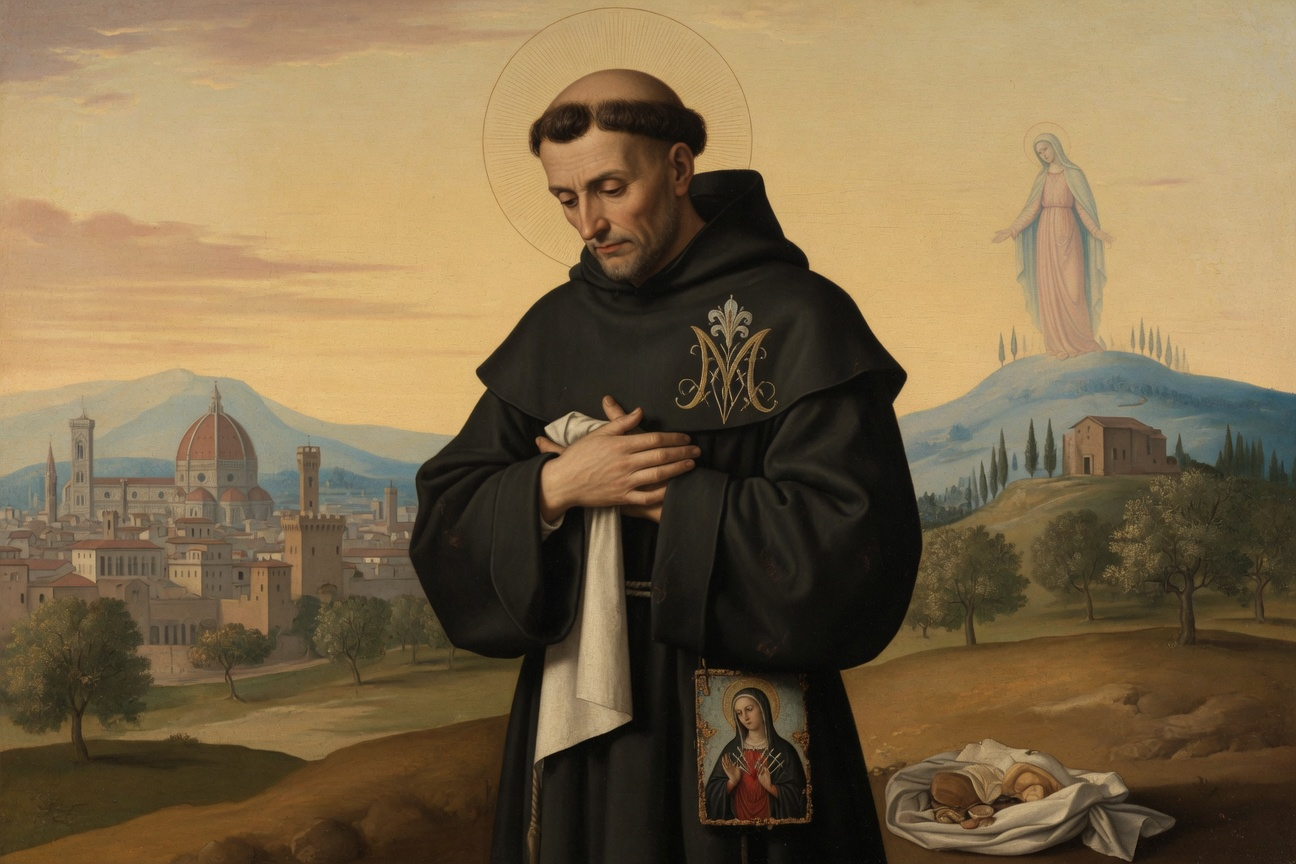
Blessed Alexis Falconieri
ONE OF THE SEVEN FOUNDERS OF THE SERVITE ORDER
One of the seven founders of the Servite Order
A 13th-century Florentine merchant, Alexis Falconieri founded the Order of the Servants of Mary with six companions following a vision of the Virgin in 1233. Settled on Mount Senario, they adopted a life of austerity and prayer under the Rule of Saint Augustine. Out of humility, Alexis refused the priesthood to dedicate himself to the most modest tasks and to begging for his community.
Guided reading
5 reading sections
BLESSED ALEXIS FALCONIERI,
ONE OF THE SEVEN FOUNDERS OF THE SERVITE ORDER
The call of the seven founders
In 1233, seven Florentine merchants of the Laudesi society receive a vision of the Virgin inviting them to leave the world for a life of perfection.
13th century. Look upon it as a very probable sign of your saint if you persevere in invoking Mary every day. B. Alain de la Roche, Part. IV, serv. I, c. 24. Mount Senario, about nine miles from Florence, was so called because of the goodness of the air and its pleasant temperature, as one might say Mons sani aeris; but it deserves this name even more for the atmosphere of grace and peace that souls have breathed there since the Queen of Heaven made it the dwelling of her servants: I speak of the Order of Servites, one of the most beautiful flowers to have blossomed in the garden of the Church. Saint Philip Benizi is not its stem, as the Rev. Fr. Hélyot clearly demonstrates; this Order recognizes as its founders seven merchants of Florence named, by ancient writers, Bonfils Monaldi, Bonagiunta Monetti, Amédée Amidei, Manetto del l'Antella, Uguccioni, Sostegno di Sostegni, and Alexis Falconieri; but it appears th at some changed t Alexis Falconieri One of the seven founders of the Order of Servites, characterized by his great humility. heir names upon renouncing the world, following the practice of religious, as Father Giani remarks in his Annales, where he names them Bonfils Monaldi, John Monetti, Benedict del l'Antella, Bartholomew Amédée, Ricouère-Lippe Uguccion, Gerardin Sostegni, and Alexis Falconieri. Most of them came from the best families of Tuscany. All seven had enlisted under the banner of the Blessed Virgin, and were part of a society which, under the title of Laudesi, had the goal of singing the praises of this holy Mother of God, of reciting her office, and of honoring her by all sorts of means. They were, to fulfill this obligation, in their oratory on the day of the Assumption of Our Lady, in the year 1233, and among them was noted Alexis Falconieri, whose feast we celebrate today: the Blessed Virgin appeared to each of them and exhorted them to renounce the world to embrace a more perfect way of life. They communicated this marvelous vision to one another, and faithful to the voice of their queen, they united and began by selling their goods and distributing them to the poor: which they did, however, only after having consulted the Bishop of Florence, Aringo. This holy prelate, having confirmed them in their good purpose and exho rted them not to delay in évêque de Florence, Aringo Bishop of Florence who supported and guided the seven founders. obeying the orders of heaven, permitted them to have an oratory and an altar to have Mass celebrated in the place they deemed appropriate; he declared himself their protector, and, as they wished to live only on alms, he permitted them to ask for them in the city and its surroundings; after which they retired first to a wretched house, outside the city walls, in a place called the Champ-de-Mars, whether it had been given to them or they had purchased it. It was there that, stripping themselves of their worldly clothes and the senatorial robe that had made them respected as members of the Republic, whose highest dignities they had filled, they dressed as those do who no longer aspire to be anything but members of the heavenly city; they clothed themselves in a poor ash-colored habit, and, no longer knights of the earth, but of heaven, they armed their bodies with hairshirts, cilices, and iron chains, to prepare themselves to sustain the battles that the devil would surely wage against them; Bonfils Monaldi, as the eldest, commanded this generous troop. To better succeed in their project of extending the reign of Jesus Christ under the protection of his holy Mother, they returned to the Bishop of Florence to receive his blessing and new instructions. They were no sooner entered into the city than the people looked upon them with admiration, surprised to see rich and opulent persons thus trampling underfoot dignities and wealth, seeking no other treasure than poverty, no other greatness than humility. One was even more surprised when one heard children who were at the breast cry out, pointing at them with their fingers: "Behold the servants of the Virgin!" This prodigy caused Bishop Aringo to advise them not to change this name, which had been given to them miraculously, and which was confirmed to them when, returning to Florence to receive the alms upon which they lived, the children called them so again. They remained about a year in their first retreat; but the world they were fleeing followed them there, attracted by the brilliance of their holiness; this made them resolve to seek a solitude to be more hidden from men.
The miraculous name
Infants miraculously designate the seven companions as the "servants of the Virgin," a name they retain upon the advice of Bishop Aringo.
Mount Senario, of which we spoke at the beginning, seemed favorable to their design; Bishop Aringo gave them a portion of this mountain, which belonged to his church. These holy founders began by having a church built there, the first stone of which was laid by the Bishop of Florence, who wished on this occasion to give them further marks of his esteem; in the vicinity of this oratory, they built small wooden cells separated from one another. Having chosen the poverty of the Cross as their portion, they lived there in such great contempt for the world and such great innocence of manners that they appeared more like angels on earth than men. At first, they had no concern for drink, food, or clothing, content with the roots and herbs that the mountain provided them: their principal nourishment was, moreover, to sing the praises of the Blessed Virgin. But Bonfilius Monaldi, who, in his capacity as superior, was obliged to watch over the preservation of his brothers, seeing that they could not withstand such great austerities, believed that it was necessary to have recourse to the alms of the faithful to sustain them, and he sent John Monetti and our Blessed Alexis Falconieri to Florence.
The establishment at Mount Senario
The founders retired to Mount Senario to live in extreme poverty, subsisting on alms and prayer.
The latter professed a particular humility, which prevented him from receiving Holy Orders when his companions had obtained permission for them; he never wished to be employed in anything but the lowest offices; thus, he received as a favor the order to beg for alms in Florence; he returned every day to Mount Senario, located more than two leagues from Florence. As it was often impossible to make this journey twice a day in inclement weather, the Servites obtained a small hospice at the gates of Florence where two or three of them stayed, which has since become the famous monastery of the Annunziata in Florence. Cardinal Geoffrey of Châtillon, who served as legate for Pope cardinal Geoffroy de Châtillon Cardinal and papal legate who visited and reformed the customs of the solitaries. Gregory IX in Tuscany and Lombardy, wi shed to visit th pape Grégoire IX Pope who attested to the miracles of Bruno. e solitaries of Mount Senario. During his stay there, he moderated their great austerities somewhat; having noticed that some kept a very strict silence for a long time, others spent several months in dreadful caves, and others would eat only roots, he advised them to all have the same observance and uniform exercises. Taking advantage of this advice, they asked the Bishop of Florence to prescribe a rule for them. While this prelate was deliberating on the matter, the Blessed Virgin, who had already favored her new servants with several visions, appeared to them again, showing them a black habit that she commanded them to wear in memory of the passion of her Son; she also presented to them, says Father Archangelo Grani, the Rule of Saint Augustine. It is in memory of this apparition, which occurred on Good Friday in the year 1239, that the religious of this Order are accustomed to perform, on that day, a ceremony they call the funeral of Jesus Christ; the next day, Holy Saturday, they perform another which they call the coronation of the Blessed Virgin. They thus received from the hands of the bishop a habit such as their divine Mother desired, along with the Rule of Saint Augustine. Such were the marvelous beginnings of the Order of Servites, which made great progress under the government of Saint Philip Benizi. Our holy founders, after having won numerous victories over the devil and the world under the banner of Mary, went to rec saint Philippe Béniti Spiritual master and companion of Andrew Dotti. eive from her hand the crown due to their merits.
The adoption of the rule and the habit
Under the influence of Cardinal Geoffrey of Châtillon and following a vision in 1239, the order adopted the Rule of Saint Augustine and a black habit in memory of the Passion.
The cult of Blessed Alexis Falconieri was approved by Pope Cleme nt XI on Decemb pape Clément XI Pope who authorized the public cult of Salvador of Horta. er 4, 1717, and that of his six companions on July 3, 1725.
Recognition and symbolism
The cult of Alexis Falconieri was approved in 1717 by Clement XI. Iconography depicts them before Our Lady of the Seven Sorrows with the emblem of the Order.
The seven founders of the Order of the Servants of Mary are depicted Ordre des Serviteurs de Marie Mendicant religious order to which the blessed belongs. kneeling before an image of Our Lady of the Seven Sorrows. They are also recognized by the emblem of the Order, which consists of a large M formed by a lily with three flowering branches or two branches falling on both sides of the central stem.
One may consult the authors who have written on the origin of the Servite Order in Father Hillyot, who has been of great service to us for this summary.
Annexes & related entities
Structured data for exploration: events, miracles, quotes, places, attributes, patronages, and important entities cited in the text.
Key Events
- Member of the Laudesi society in Florence
- Apparition of the Virgin on August 15, 1233
- Distribution of goods to the poor after consultation with Bishop Aringo
- Retreat to the Champ-de-Mars and then to Monte Senario
- Foundation of the Order of Servites (Servants of Mary)
- Apparition of the Virgin on Good Friday 1239 for the rule and the habit
- Refused holy orders out of humility to remain a simple mendicant friar
Miracles
- Testimony of nursing infants crying out: 'Behold the servants of the Virgin!'
- Multiple apparitions of the Blessed Virgin to guide the foundation
Quotes
-
Behold the servants of the Virgin!
Children of Florence (oral tradition reported)