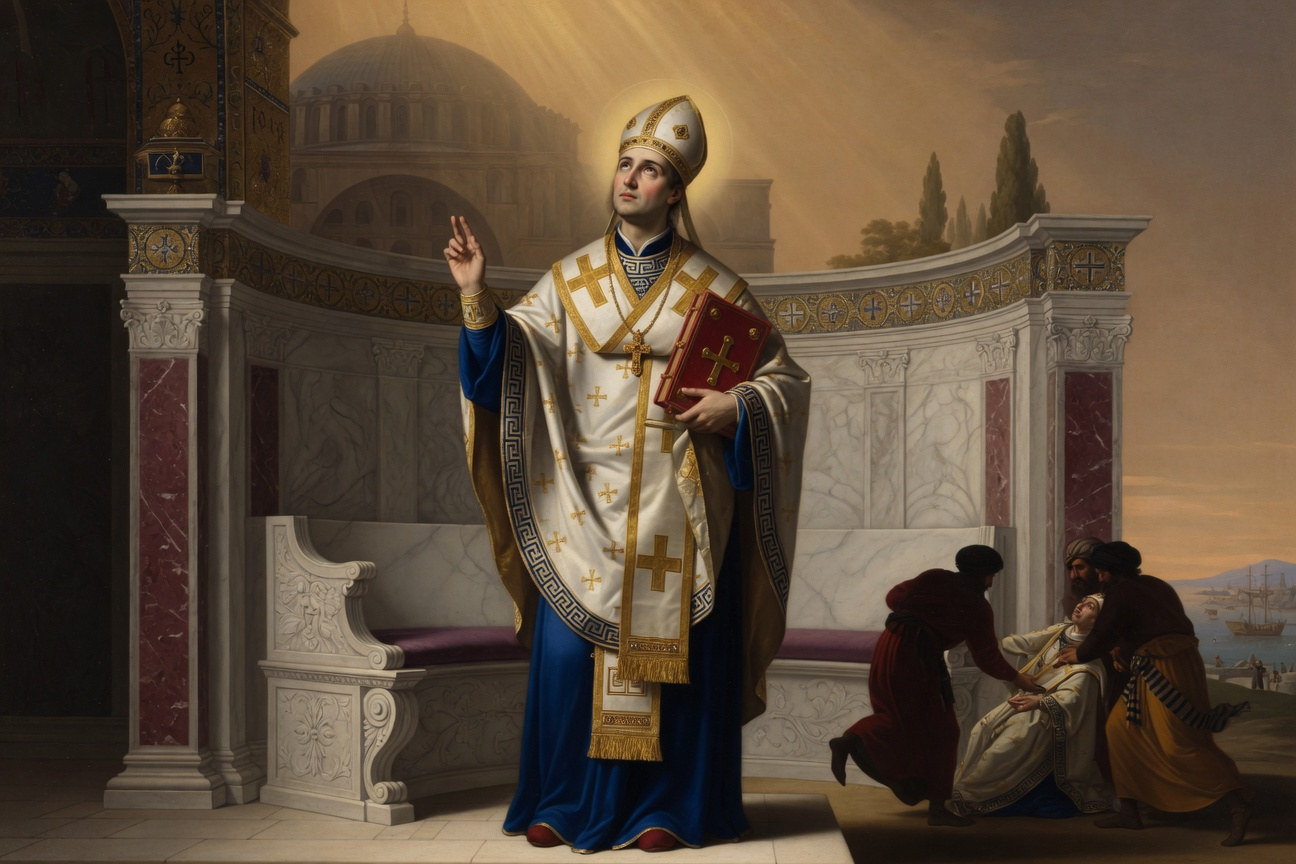
Elected Patriarch of Constantinople in 447, Flavian firmly opposed the simony of the court and the heresy of Eutyches. Victim of a cabal led by the eunuch Chrysaphius and Patriarch Dioscorus, he was savagely beaten during the Council of Ephesus in 449. He died shortly after in exile from his wounds, before being rehabilitated by the Council of Chalcedon.
Guided reading
6 reading sections
SAINT FLAVIAN, PATRIARCH OF CONSTANTINOPLE
Election and court intrigues
Elected Archbishop of Constantinople in 447, Flavian immediately opposed the corruption of the eunuch Chrysaphius by refusing to practice simony.
As a general rule, persecution is the lot of the righteous; one must not complain of it, since heaven is bought at this price. Morts., v, 10. Flavia Flavien Bishop of Constantinople martyred by the Eutychians. n, priest and treasurer of the church of Constantinople, was elected its archbishop in 447, after the death of Saint Proclus. This election displeas ed the eunu Chrysaphius Eunuch and chamberlain to Emperor Theodosius, principal antagonist of Flavian. ch Chrysaphius, chamberlain to the Emperor Theodosius the Younger. This minister, prejudiced against Flavian, conceived from that moment the design of ruining him. He induced the weak emperor, of whose mind he had become the absolute master, to ask him for some gift for his ordination. The holy pastor, in accordance with what was then practiced in the Church, sent the prince eulogies or blessed bread, as a sign of peace and communion. Chrysaphius, who had his own designs, had him told that he should send a gift of another kind. Flavian, a declared enemy of everything that even had the appearance of simony, replied firmly that the revenues of the Church were intended for other uses, and that they should be employed solely for the glory of God and the relief of the poor. The eunuch, irritated by such a generous response, resolved to keep no more measures and to set in motion every imaginable device to have Flavian deposed; but as he knew him to be protected by P ulcheria, Pulchérie Byzantine empress, wife of Marcian. the emperor's sister, who held all the authority, he worked first to remove this princess from affairs. He then persuaded Theodosius, by means of the Empress Eudocia, to demand that the archbishop ordain Pulcheria a deaconess. Flavian's refusal to lend himself to their intrigues appeared a crime to the enemies he had at court; and they did not fail to paint it in the blackest colors. Our Saint having subsequently condemned the errors of Eutyches, a relative of Chrysaphius, the latter became furious and gave way to all the excesses into which a man who follows the impulses of the most implacable hatred can fall.
The condemnation of Eutyches
Flavian presided over a council in 448 that condemned the heresy of Eutyches, who denied the dual nature of Christ, despite the latter's political support.
Eutyches Eutychès Heresiarch whose errors were condemned by the councils. was a priest and abbot of three hundred monks near Constantinople. He had built a sort of reputation for himself through a disciplined life; but, in reality, he was merely an ignorant and proud man, very stubborn in his own ideas. An excessive zeal against Nestorius, who denied the unity of person in Jesus Christ, cast him into the opposite error, and he went so far as to teach that there is only one nature in Jesus Christ. Eusebius of Dorylaeum, formerly his friend, accused him in a council assembled by Flavian in 448. The Fathers of this council issued several summonses to the accused, to which he did not respond; he eventually appeared, but he entered followed by two court officials and a troop of soldiers. When the bishops asked him to account for his faith on the point in question, he declared that he recognized only one nature in Jesus Christ; and as they sought to show him the impiety of his doctrine, he replied that he had not come to dispute, but only to give an account of his faith. The council immediately pronounced anathema upon him and deposed him. Flavian pronounced the sentence, which was subscribed to by thirty-three bishops and twenty-three abbots, eighteen of whom were priests. Eutyches, seeing himself condemned, said in a low voice to his guards that he was appealing to the bishops of Rome, Jerusalem, and Egypt. At the same time, h e wrote a saint Léon Pope who maintained close correspondence with Constantine and the Gallic bishops. captious letter to Pope Saint Leo to prejudice him against the Council of Constantinople; but this letter did not produce the effect he expected. Saint Leo did not fall into the trap; he was informed of the true state of affairs by Flavian, who sent him an exact account of everything that had transpired. He then wrote a very beautiful letter to our Saint, in which he explained with as much clarity as solidity the dogma contested by the new heresiarch. This letter was later inserted into the acts of the Council of Chalcedon, which solemnly condemned the errors of Eutyches.
The Plot of Dioscorus
Chrysaphius allies himself with Dioscorus of Alexandria to organize a new council at Ephesus in order to rehabilitate Eutyches and ruin Flavian.
However, the emperor, solicited by Chrysaphius, ordered a revision of the acts of the council assembled by Flavian in Constantinople, and a synod was held for this purpose in the month of April of the following year. It was composed of thirty bishops, ten of whom had attended the council of Constantinople. Thalassius of Caesarea presided over it, as Flavian would have been regarded as both judge and party. The examination that was conducted turned to the confusion of Eutyches and served only to bring into greater light the justice of the proceedings of the Archbishop of Constantinople. The latter, having subsequently been accused by his enemies of favoring Nestorianism, fully justified himself by presenting to the emperor a profession of faith in which he condemned the impious doctrine of Nestorius and Eutyches. Chrysaphius, whose plans had been disconcerted, was not discouraged; he set other mechanisms in motio Dioscore Patriarch of Alexandria, responsible for the violent deposition of Flavian. n to achieve his ends. He wrote to Dioscorus, Patriarch of Alexandria, a man of an impetuous and violent character, to promise him his friendship and protection if he would take up the defense of Eutyches and league with him against Flavian and Eusebius of Dorylaeum. Once he had secured the patriarch, he worked to win over the Empress Eudocia, and he succeeded all the more easily as that princess was delighted to have an opportunity to mortify Pulcheria, whom she knew to be attached to the holy archbishop. The intrigue being well tied, the emperor was persuaded to assemble a council at Ephesus in order, it was said, to end all disputes. Theodosius, seduced, thought only of the convocation of this council, the alleged necessity of which had been exaggerated to him; he ordered Dioscorus to come and preside over it, and to bring with him ten metropolitans of his jurisdiction, ten other bishops, and the archimandrite Barsumas, who was entirely devoted to the enemies of Flavian. The other patriarchs and Pope Saint Leo were also invited to the council, but the latter received the emperor's letter only very late: he nevertheless sent four legates to represent him. These legates were Julius, Bishop of Puteoli; Renatus, a priest, who died on the way; Hilary, a deacon; and Dulcitius, a notary. They were bearers of a letter to Flavian, in which Saint Leo demonstrated the ignorance of Eutyches and established the Catholic doctrine in the most solid and luminous manner.
The Robber Council of Ephesus and the Martyrdom
The Council of Ephesus of 449 turned to violence; Flavian was deposed, savagely assaulted by Dioscorus and his partisans, and died of his wounds in exile.
It was on August 8, 449, that the Council of Ephesus opene d, known in eccl concile d'Éphèse A synod marked by violence where Flavian was condemned. esiastical history as the Robber Council, because of the violence committed there. One hundred and thirty bishops from Egypt and the East were present. Eutyches also came to Ephesus with two of the emperor's officers and a troop of soldiers. It was easy to see, from the beginning of the council, that everything would be done by cabal and that Eutyches had a powerful party there. The Pope's legates were not even given the freedom to read the letters they carried. Finally, after long disputes, Dioscorus pronounced a sentence of deposition against Flavian and Eusebius of Dorylaeum. The legates of Saint Leo protested against this sentence, and the deacon Hilary, among others, said aloud Contradicitur (it is opposed). This Latin word was inserted into the acts of the council. When Dioscorus began to read the sentence, several bishops threw themselves at his feet and implored him in the most pressing terms not to proceed; but far from being swayed, he stood up and called for the emperor's commissioners. The doors having been immediately opened, Proclus, proconsul of Asia, entered with a company of soldiers holding chains, clubs, and swords. Most of the bishops, frightened at the sight of such a spectacle, subscribed to everything that Dioscorus and those of his party wanted; only the Pope's legates, always unshakeable, protested until the end against these unheard-of acts of violence. One of them was put in prison. The deacon Hilary, after escaping with great difficulty, took the road to the West and finally arrived in Rome. As for Flavian, he appealed to the Holy See against the sentence pronounced against him and handed the act of his appeal to the Pope's legates. Dioscorus was so irritated by this that he threw himself upon the Saint with Barsumas and several other people of his party. They knocked him to the ground and mistreated him so severely with kicks that he died shortly after at Epipe, where he had been exiled.
Rehabilitation and posterity
After the fall of Chrysaphius, Empress Pulcheria had the remains of Flavian transferred to Constantinople, while the Council of Chalcedon proclaimed him a saint.
The impious Dioscorus did not stop there: he even had the insolence, in concert with two bishops of Egypt, to excommunicate Pope Saint Leo; but God did not permit the triumph of injustice to last long. The emperor having finally opened his eyes, Chrysaphius, the author of so many evils, was disgraced, then condemned to death. Eudoxia herself was forced to retire to Jerusalem. The recall of Pulcheria to the court produced this happy revolution. The following year, this princess having ascended the throne after the death of Theodosius, ordered that the body of our Saint be solemnly transferred to Constantinople, and interred with the archbishops his predecessors. Saint Leo, informed of all that had happened at Ephesus, had written to Flavian to console him, but the latter was dead when the letter arrived. He had also written in his favor to Theodosius, to Pulcheria, and to the clergy of Constantinople. T he general council held at Chalced concile général tenu à Chalcédoine Ecumenical council confirmed by Hilary. on in 454 placed Flavian among the Saints and martyrs, and rendered great honors to his memory; it also restored Eusebius of Dorylaeum to his see. Pope Hilary, who ha Le pape Hilaire Legate of Pope Leo at Ephesus, later pope himself. d been the legate of Saint Leo at Ephesus, had such veneration for the holy archbishop of Constantinople that he had his martyrdom depicted in the church he founded in honor of the Savior's cross.
Cult and relics
The feast of Saint Flavian is set for February 18, the date of the translation of his relics, some of which are preserved in Italy at Recanati and Julia-Nova.
The martyrdom of Saint Flavian occurred in the month of August of the year 449; nevertheless, the Church celebrates his feast only in the month of February, during which the translation of his body, of which we have spoken, took place. The Roman Martyrology and the Menologion of the Greeks mention it on the 18th of that same month, where one may see the learned remarks of Cardinal Baronius. A good portion of his relics were brought to Italy. One of his arms is religiously preserve d in the Récanati Location where an arm of the saint is preserved. cathedral church of Recanati, in the March of Ancona, and his sacred head with several signifi cant bones Julia-Nova Place where the head and bones of the saint are preserved. rest at Julia-Nova, in the Kingdom of Naples.
Taken from the chronicles and histories of Cedrenus, Evagrius, Theophanes, etc. See Baronius, the Bollandists, vol. III, Feb., p. 71; Fleury, vol. XXVII and XXVIII; Quesnel, on the works of Saint Leo, vol. II, diss. I; Father Cacciari, on the works of the same Father, reprinted in Rome in 1755, vol. III, diss. 4, de Eurychiana hœres, vol. I, c. 2, p. 222; c. 6, p. 303; c. 5, p. 385.
Annexes & related entities
Structured data for exploration: events, miracles, quotes, places, attributes, patronages, and important entities cited in the text.
Key Events
- Election as Archbishop of Constantinople in 447
- Condemnation of Eutyches at the Council of Constantinople in 448
- Opposition to the intrigues of the eunuch Chrysaphius
- Unjust deposition during the 'Robber Council of Ephesus' in 449
- Physical assault by Dioscorus and his supporters
- Died in exile in Hypaepa from his wounds
- Solemn translation of his body to Constantinople by Pulcheria
Quotes
-
The revenues of the Church are intended for other uses, and they must be employed solely for the glory of God and the relief of the poor.
Response to Chrysaphius