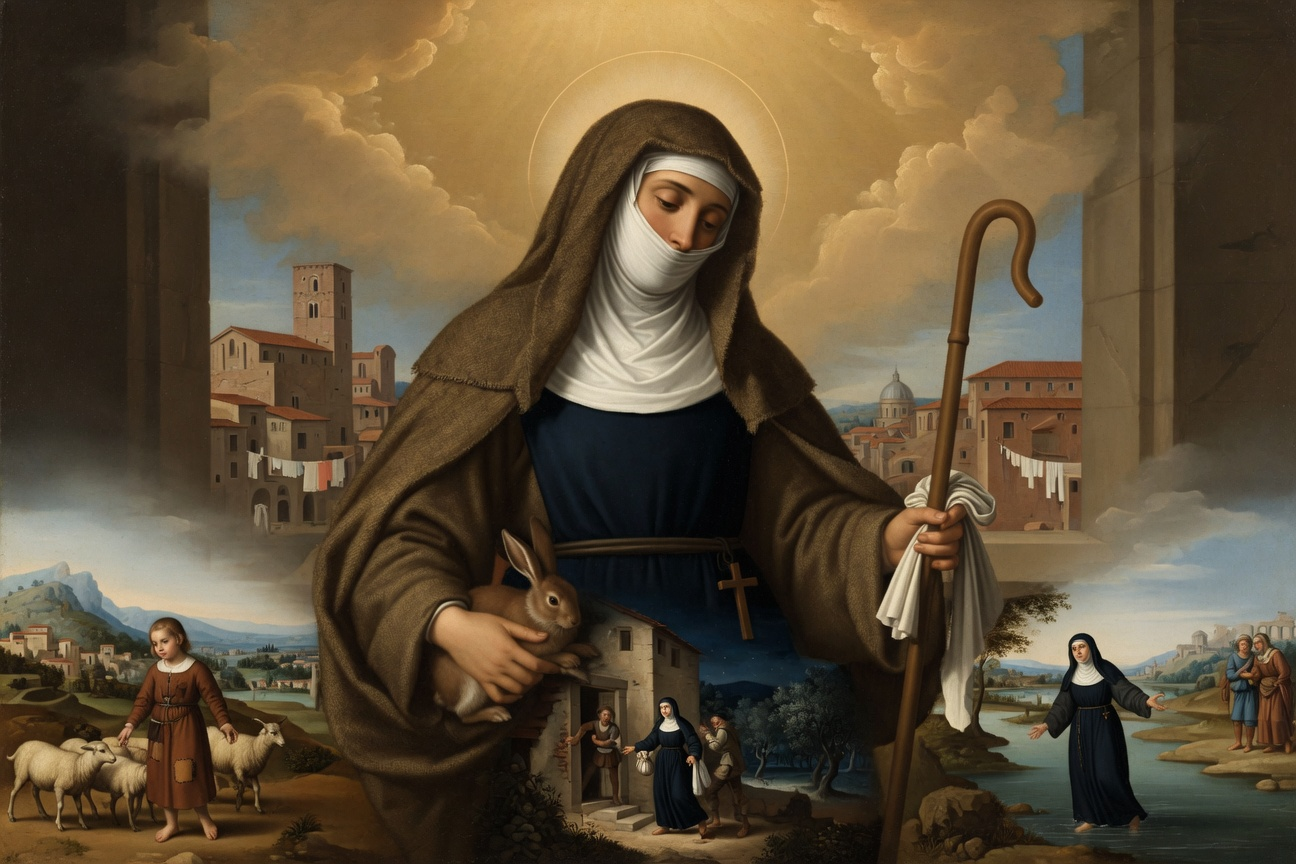
Born poor in Tuscany, Oringa refused marriage to dedicate herself to God, fleeing her family to become a servant in Lucca and Rome. After several pilgrimages and miracles, she founded a monastery under the Rule of Saint Augustine in her native land. Nicknamed Cristina for her piety, she died at 73 after a life of great humility.
Guided reading
6 reading sections
THE B. ORINGA, KNOWN AS CRISTINA OF SANTA CROCE
Youth and early piety
Born in Santa Croce in Tuscany, Oringa led a humble and pious life as a shepherdess, cultivating rigorous chastity and a disdain for worldly adornments.
It was in Santa Croce, a small town in Tuscany near Florence, that Oringa wa s born Oringa Tuscan saint, shepherdess then servant, founder of a monastery. , later known as Christiana of Santa Croce. Her parents were poor and, from her childhood, she tended the flocks. But while watching over the oxen and cows, she knew very well how to elevate her soul and converse with the King of Heaven. Her means to achieve this noble goal were prayer and meditation. While the animals entrusted to her care grazed on the grass of the fields, her soul communed with God and found in Him a heavenly nourishment. Now, when a child, or an adolescent, or a young person frequents people of high rank with distinguished manners, they soon become polished and distinguished like them; for the soul, the heart, and the character are easily shaped by the soul and character of those who surround us and whose society we habitually frequent. Therefore, necessarily, when an ingenuous person, living far from the world and the corruptions of the century, converses only with God, they must gather from this divine conversation something holy and angelic. This is what happened to Saint Christiana. She was so chaste and so pure that, when she heard an indecent word, she felt the urge to vomit; and such was the effect of this virtuous disgust that she sometimes became ill from it. She therefore made it a habit, when she was obliged to be somewhere where impure discourse was held, to cover her ears, although this conduct often drew mockery upon her. She loved to be alone; but when she was obliged to go out, she constantly lowered her eyes so as not to see things that could have troubled the purity of her soul. She was very beautiful, and she did exactly the opposite of what most young girls do in such cases: instead of adorning herself, she used artificial means to dull the skin of her face and to mask its beauty. Moreover, her words and her whole being were so grave and so reserved that no one would have dared, in her presence, to permit a licentious act, as happens only too often when young libertines find themselves with beautiful and frivolous young people.
Flight and life of service in Lucca
Orphaned, she fled a forced marriage, miraculously crossed a river, and arrived in Lucca guided by a hare, where she entered the service of a virtuous man.
Having become an orphan at an early age, she fell under the guardianship of her brothers. When she was of age, they wanted to force her to marry; but the mistreatment they subjected her to could not change her resolutions. Oringa remained faithful to the commitment she had made to have no other spouse than Jesus Christ. To fulfill this design more surely, she fled. But then a river appeared before her; full of confidence, the young girl advanced anyway and, with the help of God, crossed it on dry ground. Full of trust in God who had just saved her, the poor girl continued on her way without knowing exactly where she was going. Lost in the middle of a vast meadow, the darkness of night surprised her there; she fell asleep meditating on eternal truths, amidst the perfumes of the flowers with which the plain was enameled; — a flower herself, more sweet and pure than all the others. — A timid hare came to take refuge near her, as if to say to her: Poor dove, entrust yourself with me to the care of Providence. The next day, Oringa followed the tracks of her nocturnal companion, who served as her guide to lead her on her path. This path led to Lucca. Arriving in the city, she entered t he serv Lucques City in Italy where Saint Zita lived and died. ice of a virtuous man from whom she asked only for common food and coarse clothing, then a little freedom; this freedom she used to begin that life of penance which she led until her death. She walked barefoot and took no more food than the size of a walnut, just enough not to let herself die of hunger. Although she knew neither how to read nor write, she astonished the most learned with the wisdom of her answers on the highest questions of religion, for the Holy Spirit enlightened her mind with the brightest lights.
Pilgrimages and divine protection
After resisting temptations, she traveled to Monte Gargano under the protection of the Archangel Saint Michael, then to Rome in the service of the noble Margaret.
The demon then began to tempt her: nothing opens the entrance of a soul like pride. Oringa took refuge at the feet of the Arc hangel Saint Michael, archange saint Michel Archangel who appeared to Joan to reveal her mission. from whom she found powerful help against her fierce enemy. In her gratitude, the pious virgin wished to make a pilgrimage to Monte Gargano, consecrat ed to this Mont-Gargan Site of a famous apparition and church dedication to Saint Michael. leader of the heavenly hosts. Having set out with some companions, they were diverted from their path by wretches who meditated on surprising them and who tried to assault their honor. The invoked Archangel appeared to them in the form of a young deacon, delivered them from these aggressors, brought them back to the true path, had them rest near a spring, served them exquisite food to strengthen them, then disappeared, leaving them in the joy of their hearts to complete their journey. The holiness of Oringa had attracted the sympathy of the inhabitants of Lucca; this caused her humility to suffer greatly; she resolved to escape public esteem by flight. She left for Rome, and in that city she became acquainted wit h a Rome Birthplace of Maximian. rich and pious widow named Margaret, who took her into her service. Oringa was f orced to l Marguerite Wealthy and pious widow of Rome who employed Oringa. eave her old clothes to buy more beautiful ones, because of the rank of her mistress; but a few days later, having met a young woman who was almost naked, she gave her these clothes that she had only accepted out of obedience, and took back those she had left behind. No reproach was made to her, for she had already known how to make herself esteemed and loved by Margaret, who had made her her companion and friend.
Foundation of the monastery
Inspired by an ecstasy at the tomb of Saint Francis of Assisi, she returned to her homeland to found a monastery following the rule of Saint Augustine.
Some time later, the Blessed one conceived the desire to visit the tomb of Saint Fran cis of Assisi. She went saint François d'Assise Founder of the Order of Friars Minor. there, accompanied by her mistress; as she prayed, she had an ecstasy, and God commanded her to return to her country and to found a monastery there. She obeyed, but had to overcome many difficulties; her courage growing with the obstacles, the monastery was soon built and populated by a crowd of virgins, to whom the Blessed one gave the rule of Saint Augustine. Howe ver, she never saint Augustin Cited for his definition of fraternal charity. wished to take the direction of the house; she aspired to be regarded as the last of the nuns. Her love for the poor was so great that one day she gave the last coin that remained in the house. It is said that in a time of famine when the poor were dying of hunger, she disposed in their favor of a field that the monastery owned, which was sown with beans; this example touched the farmers who showed themselves to be more charitable.
Final years and legacy
She died at seventy years of age after a long illness; her body remained incorrupt until 1514 and her cult was approved by Pope Pius VI.
God, to reward His servant even in this life, granted her the gift of prophecy and the gift of miracles. At the age of seventy, she was struck by apoplexy; she remained ill for three years, and her right side was completely paralyzed. But such was her love for the divine Savior, and such was the tenderness of her spiritual daughters for her, that every day they carried her to the church at the moment of the elevation. The hour of her death having finally come, her face suddenly illuminated and radiated with glory, and in her eyes shone the sweet joy that animates children when, after a long separation, they see their mother again. During her life, she had generally been regarded as a Saint. Her true name was Oringa; but because of her exemplary life, the people called her Christiana, that is to say, Christian; Christiana Tuscan saint, shepherdess then servant, founder of a monastery. and this name remained with her. When she died, her body was exposed for public veneration, and there was a very considerable crowd. Her face retained even after death the wonderful beauty that had been noticed at her final hour; and furthermore, no sign of putrefaction was seen on her, although she was not buried until the tenth day. It is said that a person of ill repute, driven by curiosity, having also appeared in the crowd, the Saint covered her face with her robe. By other miracles still, God showed how great this faithful servant was before Him.
Her body was exempt from corruption until 1514, when it was consumed in a fire. The cult rendered to Blessed Christiana of the Holy Cross was approved by Pope Pi incendie Event that destroyed the incorrupt body of the saint. us VI.
Teaching on domestic service
The text concludes with an exhortation to servants, presenting the condition of a servant as a privileged path to holiness in the image of Christiana.
Of all states, that of a servant is perhaps the most common. Men esteem it little; and he whom fate has condemned to this humble condition often imagines that God has placed him below other men. But God judges quite differently. The Lord Jesus himself said: "Whoever wants to be great among you must be your servant, and whoever wants to be first among you must be your servant; just as the Son of Man did not come to be served, but to serve."
Many imagine that it is difficult to serve God in the state of domestic service; but, upon reflecting well on it, one sees that there is perhaps no state where it is easier to serve God and work out one's salvation than this one. Yes, my dear reader, if God, in giving you a child, asked you: Do you want him to be a king or a servant one day? I tell you in truth: a thousand times out of one, it would be better for your child to be a servant than to be a king.
In this state, life is simpler and temptations are less numerous and less strong than in others. In this state, one can reach a high degree of holiness, as we see in Saint Christiana and in several other Saints. Perhaps it will not be given to you to reach as far as she did on this path; but in any case, if you are a servant, you will be able easily, if you wish, to lead a pious and meritorious life before God. For example, when you spin, when you wash, when you cook food for your masters, or when you go to work in the fields, or when you tend the livestock, who prevents you from raising your soul to God? Always and everywhere the good God is near you; He loves you and esteems you more than you think; He is always ready to listen to your prayers, to lend an attentive ear even to your sighs; He is always ready to answer them with a fatherly kindness. — Is this company not to your liking? And does it not seem to you that it is at least as noble and distinguished as that of the rich and sumptuous people you sometimes see parading in the world? Yes, once again: the poor servant who, on Saturday evening, sits silent in her little room, mending her clothes and thinking of God, is greater and more precious before Him than the great of the world who, dressed in gold and silk, and followed by numerous lackeys, goes with pomp to those frivolous meetings where deceitful compliments are exchanged, where dangerous pleasures are tasted.
Undoubtedly, it is only too true that you are obliged, by your state, to work a lot for little money. But we are going to show you the way to get yourself paid infinitely higher wages. This means is to serve God in the person of your masters, by submitting yourself humbly and with pious resignation to His holy will, and by carrying your cross with joy, until it pleases Him to take it back. If you do this, God will reward you magnificently; He will esteem your humble services as much as the hospital founded by a millionaire, or the priestly functions performed by your parish priest, or the care given for free to the poor by a charitable doctor. Are you very poor? We believe it; and yet we tell you: you can, like Saint Christiana, despite your poverty, sometimes give alms to someone poorer than you. The little you give will be counted more in the eyes of God than the coins of the rich; for your copper mite will be for Him like a gold piece; because God weighs hearts and intentions more than deeds and external works.
However, no state is entirely exempt from temptations. Perhaps you find yourself in a house where your innocence is at risk of shipwreck, attacked as it is by deceitful promises, or even by gifts. Perhaps you are in service with masters without religion, or who, out of greed, burden you with so much work that it is impossible for you, even on Sundays and feast days, to attend divine service regularly. In this case, consider that the most miserable of beings is a servant who has lost God, the sovereign good. In this life, he has before him only shame, misery, and despair; and in the other world, only eternal death, which is the last and most horrible of all evils. If you stay in such a house, you run the risk of losing your innocence and your religion. Even if you had a thousand crowns in wages, hasten to go elsewhere, and even if you should find yourself without a position, leave nonetheless. Make this sacrifice to God; He will certainly not fail to take care of you and reward you. Saint Christiana left her father's house to escape an honest and advantageous marriage; and later she renounced an honorable position to go and visit the shrines of Rome. For even stronger reasons you must renounce your employment when you are asked to lose your virtue, or when they want to prevent you from practicing your religion. Saint Christiana was only a poor girl, unknown to the world; but because she was faithful to God until the end, God also rewarded her faithfully by admitting her to eternal bliss: be faithful like her, and you will one day have the same reward.
The attribute of Saint Christiana is the hare: the reason for this was seen above.
We have borrowed these pious reflections from the life of Saint Christiana by Father A. Stoiz.
Annexes & related entities
Structured data for exploration: events, miracles, quotes, places, attributes, patronages, and important entities cited in the text.
Key Events
- Herded flocks during childhood
- Fled her father's house to avoid a forced marriage
- Miraculous crossing of a river on dry ground
- Domestic service in Lucca and then in Rome
- Pilgrimages to Monte Gargano and Assisi
- Foundation of a monastery following the rule of Saint Augustine
- Paralysis following a stroke at age 70
Miracles
- Crossing a river on dry land
- Guided by a hare during her flight
- Apparition of Saint Michael in the form of a deacon
- Gift of prophecy
- Incorruptibility of the body until 1514
- The corpse covers its face in the presence of a person of ill repute
Quotes
-
Servants, be obedient; do not serve your masters only when they are watching; but serve them with affection, seeing in them the Lord and not men.
Ephesians, VI, 5-7 (as an epigraph)