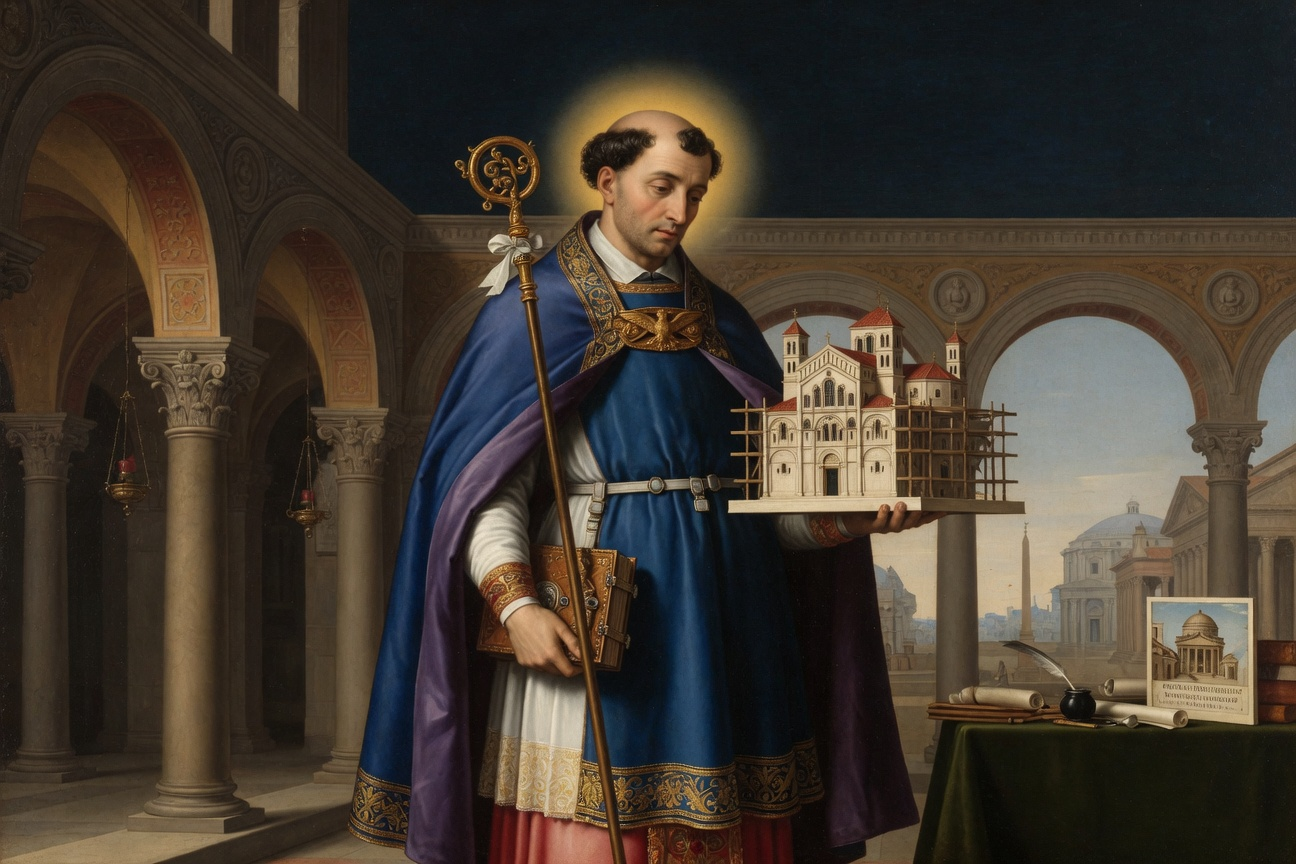
A high dignitary at the court of Charlemagne and a student of Alcuin, Angilbert became Abbot of Saint-Riquier, where he led a life of austerity following a brilliant diplomatic career. He rebuilt the abbey with exceptional magnificence and established perpetual prayer there. He died in 814, shortly after the emperor, leaving behind the image of a great builder and a prudent advisor.
Guided reading
8 reading sections
SAINT ANGILBERT, ABBOT OF SAINT-RIQUIER
Youth and training at court
Angilbert, from the high Frankish nobility, was raised in the palace of Pepin the Short alongside Charlemagne and received instruction from Alcuin.
Among the Saints who illustrated the century of Charlemagne, the Order of Saint Benedict provided two very famous ones, who powerfully assisted this great monarch with their counsel. The first of these two famous figures is Saint Benedict, Abbot of Aniane, whose life we gave on the 11th of this month; and the second i s Saint Angilbe saint Angilbert Abbot of Saint-Riquier and advisor to Charlemagne. rt, Abbot of Saint-Riquier, whose merit we must now discover.
Nothing precise is known about the place and date of Angilbert's birth: what is probable is that he came into the world around the year 740. He was five years younger than the famous Anglo-Saxon deacon Alcuin and two years older than Charlemagne. He belonged to the high Frankish nobility, and the best proof of this assertion is that he was raised in the palace of Pepin the Short. It is known that this honor was sought after by the most powerful leudes, who hoped in this way to secure the future of their children and more easily open to them the career of honors.
Pepin the Short, as well as his two children, Charles and Carloman, cherished Angilbert tenderly and considered him: the first, as his own son, and the other two, as their beloved brother.
The young Angilbert distinguished himself by the sharpness of his mind, the amenity of his character, the superiority of his liberal education, the breadth of his knowledge, and a set of natural qualities that awakened sympathy for him everywhere. People took pleasure in admiring in his person the noble proportions of his body and the beauty of a countenance in which the radiance of virtue was reflected.
The advice of the princes, that of his parents and his friends, determined Angilbert to take the clerical tonsure; but he did not leave the palace. When Charlemagne succeeded Pepin the Short (768), he continued to honor with his intimacy the worthy heir of a family that had been allied with his own and that had rendered considerable services to his ancestors.
Angilbert took lessons from Alcuin, who calls him his pupil, and was part of the famous Palatine Academy under the name of Homer Homère Abbot of Saint-Riquier and advisor to Charlemagne. .
High offices and priesthood
Having become a close advisor to Charlemagne, he held the positions of archchaplain and secretary of state before embracing the priesthood.
King Charles so highly valued the consummate prudence of his favorite that he always took him along on his frequent travels, admitted him to all his councils, and invested him with the high offices of archchaplain and silentiary. This latter title was undoubtedly equivalent to that of a secretary of state, whose delicate negotiations often imply the obligation of silence.
As for the apocrisiarius or archchaplain, who was also called the primicerius of the chaplains, he was charged with the direction of ecclesiastical affairs; he was a kind of minister of worship. Hincmar informs us that this function was filled more by deacons and priests than by bishops.
We see no difficulty in recognizing Angilbert as one of Charlemagne's secretaries. This prince, in one of his letters, calls him his confidant, and we shall see that he entrusted him with various important missions.
Angilbert, inspired by his vocation as well as by the king's advice, embraced the priesthood, and then saw an even more brilliant future open up before his merits.
Retirement and monastic life at Centula
After a worldly period, Angilbert retired to the monastery of Centula where he became a monk, then succeeded Abbot Symphorian.
It is in 790 that Angilbert's retirement to Centula is generall y fixed Centule Monastery of which Gervin was the abbot and builder. ; but this date must obviously be pushed back, and here is why: Charlemagne, in 789, an undisputed date, issued a capitulary that forbade bishops, abbots, and abbesses from keeping pairs of dogs, falcons, sparrowhawks, and jugglers. Now, Alcuin, in a letter to Adalard that all critics date to 790, expresses himself in these terms: "I fear that Angilbert may be angry about the letter that forbids spectacles... I wrote to you formerly on this subject with the keenest desire for the salvation of my dear son, hoping to gain through your intercession what I could not obtain by myself." And later, when Alcuin learns that Angilbert has corrected his fault, he writes to Adalard: "It was truly an astonishing thing to me that a mind so wise did not understand that he was doing a reprehensible thing, opposed to his dignity, and which could not be excused in any way."
He went to prostrate himself at the feet of the abbot, in the middle of the chapter, and there, bathed in tears, humbly requested the monastic habit. Despite the joy that the religious felt at such a conversion, they did not deviate from the wise prescriptions of the rule, and it was only after the time required for probation that the postulant was admitted into the ranks of the monks, whose virtues he soon equaled and often surpassed. The harshest austerities held no terror for the weakness of his constitution; it was not the splendor of finery, the softness of a plush bed, the abundance of food, the delicacy of wines, or the prolongation of sleep that were his delights; it was the tears he shed over the memory of the past, the prayers he exhaled night and day, the readings that excited the compunction of his soul, the holy rigors he exercised against himself, and the daily sacrifice that his contrite and humbled spirit offered to God. Thus, grace soon descended into this soul avid for suffering and procured for him the ineffable consolation of peace.
When Abbot Symphorian had fallen asleep in the sleep of the just, the religious, by a unanimous choice, designated Angilbert as his successor. According to the custom of royal abbeys, this election was submitted to the king, who hastened to approve it, expressing great joy. The new abbot, followed by a numerous procession, was presented to him after his ordination. Charlemagne promised him generosity and protection, and encouraged him to persevere in the career of perfection and devotion.
Diplomatic missions to Rome
The abbot carried out three major missions to Rome to popes Adrian and Leo III, dealing with crucial theological and political issues.
The king knew how to use Angilbert's talents for the benefit of the Church and the State. His biographer tells us nothing about this, but we know from other sources that the abbot of Saint-Riquier carried out three important missions to Rome.
Felix, bishop of Urgel, was condemned by the Council of Regensburg in 792 regarding the errors he professed concerning the mystery of the Incarnation. Angilbert was tasked with le ading the r pape Adrien Pope who approved the mission of Hildegrin in Saxony. epentant prelate to Pope Adrian, who abjured, in the hands of the Sovereign Pontiff, the heresy he would later embrace again.
Charlemagne and various bishops of Gaul, misled by a poor translation of the acts of the Council of Nicaea, drafted a memorandum addressed to the Pope immediately after the Council of Frankfurt (794), intended to clarify the belief of the Church of Gaul regarding the veneration of images. This is the writing known as the Libri Carolini, the authorship of which has remained somewhat contested. Angilbert, recommended by a letter from Alcuin, went to carry this document, as well as the acts of the Council of Frankfurt, to Pope Adrian. We have his reply to Charlemagne where he speaks in these terms of the abbot of Saint-Riquier: "We have graciously received Abbot Angilbert, minister of your chapel, this dear confidant who was raised with you in the palace, almost from his childhood, and who has been admitted to all your councils. In consideration of you, we have shown him much friendship, listening to him favorably, and revealing to him as to yourself the plans we are forming for the exaltation of the holy Roman Church and for that of your royal power."
The third journey of Angilbert had another motive. Leo III, immedia Léon III Pope who presented the relics of Hippolytus to Charlemagne. tely after his election, sent legates to Charlemagne to bring him the keys of the Confession of Saint Peter and the standard of the city of Rome, a double symbol that confirmed his rights as protector of the Church and patrician of the Romans. At the same time, he asked the king to send him some lords of his court to receive, in his name, the oath of fidelity and submission of the Roman people. Charlemagne, in a letter he addressed to his confidant, charged him, while accomplishing this mission, to transmit his advice to the new Pontiff.
Angilbert was at the same time charged with delivering to the Holy See a large part of the treasures that Herric, Duke of Friuli, had brought back from Pannonia after his victory over the Avars. Leo used this rich tribute to decorate the churches of Rome and the Lateran Palace. One can still see today, in this latter monument, a mosaic that he had executed on this occasion.
It was probably while returning from this trip that Angilbert carried a letter from Alcuin to Paulinus, Patriarch of Aquileia, with whom he was on affectionate terms. Another of his friends, Theodulf, Bishop of Orléans, went to the court during this absence of Angilbert, and, because of this disappointment, condemned his muse to silence.
The Builder of Saint-Riquier
Thanks to royal munificence, he rebuilt the abbey of Saint-Riquier according to a symbolic triangular plan and gathered numerous relics there.
Neither his diplomatic duties nor his frequent residences at court could distract Angilbert from the interest he took in his abbey. He knew how to take advantage of Charlemagne's favorable disposition to rebuild the monastery of Saint-Riquier. — "If you enable me," he said to the king, "to realize my projects and to make discipline and regularity flourish, all the good that I shall be able to do will be credited to you, and it is to you that most of the rewards should fall." — It was probably around 796 that, thanks to the prince's munificence, Angilbert transformed the old wooden structures into a marvel of art and splendor. The most skillful workmen were invited to work with wood and stone, glass and marble. Charlemagne sent numerous wagons to Rome to bring back marble columns, and at the same time he dispatched legates to various lands, and even to the Orient, to obtain relics.
Angilbert left us a writing in which he recounts the use he made of the royal generosities. This is a document too precious, from the point of view of art and monumental liturgy, for us not to borrow some details from it.
The general plan, engraved in some works, offers us a large triangular cloister, with a courtyard watered by the Scardon river; to the north, the main church, dedicated to the Savior and to Saint Riquier; to the south, the church of the Virgin and the holy Apostles; to the east, the small church dedicated to Saint Benedict and to all the holy abbots. The whole denotes an imitation of Roman architecture and knowledge of the works of Vitruvius. But the Christian thought reveals itself in this triangular form, in this number 3 which appears in the churches, the oratories, the ciboria, the ambos, etc. It is a tribute paid to the mystery of the Holy Trinity, as Angilbert himself teaches us.
The two altars of the Savior and of Saint Riquier, decorated with bas-reliefs, were sheltered under a ciborium supported by rich columns brought from Italy. It is perhaps at the moment of their erection, or else when the columns that were to support the dome of the eastern tower were raised, that the following event reported by Hariulfe occurred. A column that they were trying to set up slipped from the hands of the workmen and was broken into two pieces. Sadness and discouragement had seized the monks; but Angilbert, resorting to his accustomed expedients, reduced himself to abstinence, and, clothed in a hair shirt, spent the whole night in prayer. During this time, an angel shining with light descended into the church, and, by passing his hand over the broken sections of the column, restored its integrity and all its primitive beauty. When the workmen arrived the next morning, they were very surprised to find the monolith, not only intact, but set on its base, for which they gave thanks to the omnipotence of God.
Some writers have been mistaken in mentioning a fourth church, dedicated to the holy Archangels. These were simple oratories, each provided with a single altar, consecrated to Saint Michael, to Saint Raphael, and to Saint Gabriel. They were located at the top of the three towers that gave entrance to the monastery, according to a custom that seems to come from the Orient and alludes to the missions that the angels accomplish while crossing the air, as well as to the tutelary guard with which they are invested.
It should be noted that the chapel of Saint Michael was in the western tower. In later periods, it is always equally on this side that we see the cult of the holy Archangel established, because he is the conductor of souls and the western forecourt was consecrated to burials.
Liturgical and Intellectual Influence
He established the perpetual prayer (laus perennis) and enriched the library with precious manuscripts, including a Gospel book in gold letters.
It was in 798, though at various times of the year, that the dedication of the three churches and the consecration of the thirty altars took place. The main ceremony brought together on January 1st, in the church of the Savior, twelve consecrating bishops, under the presidency of Maginard, Archbishop of Rouen.
Angilbert, who has been rightly nicknamed the second founder of Saint-Riquier, had not only thought of the material splendor of the abbey, which perhaps had no equal in the 9th century. As the relics of the Saints were considered the most precious treasure of churches, he had sent emissaries to solicit them in all parts of Christendom, and especially in Rome, Constantinople, Jerusalem, Italy, Germany, Gaul, and Burgundy. Thanks to the intervention of Charlemagne, Popes Adrian and Leo III, archbishops, bishops, and abbots had responded to this call. It would be too long to enumerate here all the relics that Angilbert obtained by this means.
The liturgical riches of the three churches were valued at fifteen thousand pounds, that is to say, more than eight million of our current currency.
Angilbert enriched the monastery's library with more than two hundred volumes. One of the most precious manuscripts was the Gospel book, w ritten in go évangéliaire Precious manuscript written in gold letters. ld letters on purple vellum, given to Angilbert by Charlemagne around 793, and which is today in the municipal library of Abbeville.
Angilbert ins tituted t Abbeville Site of the subsequent translation of the relics. he perpetual prayer, the laus perennis, in the church of Centule. Three groups of religious sang the divine office there together, in imitation of the eternal praises that the three angelic hierarchies cause to resound in the heavens. One hundred monks and thirty-three children gathered in front of the altar of the Savior; the same number in the middle of the church, the same number in the eastern part. After the canonical hours, a third of each choir would withdraw and return later to replace another outgoing third. One of the goals of this perpetual psalmody was the salvation of the king and the prosperity of his reign and his family. Prayers were offered for the same intention and for that of the Pope, at the two conventual masses celebrated in the morning and at noon, as well as at the thirty daily low masses.
End of life and imperial coronation
Angilbert attended the coronation of Charlemagne in 800 and died shortly after the emperor in 814, leaving behind a reputation for holiness.
There remain only a few facts to mention in the life of Angilbert. He is said to have contributed to obtaining the canonization of Saint Salvius, Bishop of Angoulême, who was murdered near Valenciennes on June 26, 798. He is said to have joined his wishes for this to those of Charlemagne, when Pope Leo went to the court of Paderborn in 799.
What is more certain is that Charlemagne, that same year, went to celebrate the Easter holidays at Saint-Riquier. Alcuin was there at the time, and he was requested by his former pupil to annotate and embellish a legend of Saint Riquier, written, it was said, in too simple a style. The famous Abbot of Tours having appeared astonished by the brevity of this legend, he was told that they indeed possessed another longer one, but that they did not wish to touch it, because its unrefined style made it more understandable for the people. This fact, by itself, would suffice to demonstrate the existence of a rustic language which was nothing other than a patois of the Latin language.
The following year (800), Angilbert followed Charlemagne to Rome and attended , on Christm couronnement Emperor of the Franks and uncle of Saint Folquin. as Day, that coronation which he had perhaps helped to prepare. It was on the very day of this ceremony that he obtained from the Pope, in favor of his abbey, a privilege, also solicited by Bishop Jesse who was in Rome. The monastery of Saint-Riquier became exempt from the ordinary, as did the town of Centule and the neighboring lands.
Angilbert was one of the four abbots who, in 814, signed the testament of Charlemagne.
He was to survive this monarch by only twenty-two days; for he died on February 13, 814. According to the wish he had expressed, he was buried in front of the portal of the church of Saint-Sauveur, where his tombstone was to be trodden under the feet of passersby.
Cult, miracles, and posterity
Although not officially canonized until the 18th century, his body was found incorrupt and his relics have been the object of constant veneration.
The sculptures of the church of Saint-Riquier have multiplied the image of Saint Angilbert. One sees him, at the portal, kneeling before the Eternal Father; and further on, holding the crozier and a book; at a buttress of the tower, kneeling in the costume of a prince before Abbot Symphorian, who receives his monastic vows. Under the arches, groups represent the mission that Charlemagne gave him for the Holy See; the reception given to him by the Pope, assisted by a cardinal; the healing that a lame man obtained through his intercession.
He rested in this place for the space of twenty-eight years, after which he was found without corruption, and transported to a more honorable place. Other translations of this precious deposit have also taken place, in which God has always shown, through some extraordinary event, how pleasing to Him was the blessed soul that had animated this body.
He was never canonized, and the religious did not celebrate his feast day before Abbot d'Aligre, in the 18th century. One of the chapels of the church of Saint-Riquier is currently dedicated to Saint Angilbert.
## CULT OF SAINT ANGILBERT.
We do not dare to undertake to give here the account of the miracles that God has performed through the merits of Saint Angilbert, both during his life and after his death, because their number is too great; it will suffice for us to say that the author of his Life has composed three books, to which we refer the reader; one will be edified to see all the wonders that God has willed to work through the intercession of this great Saint, and how divine Providence has taken pleasure in giving proofs of the truth of all these miraculous operations.
Information provided by M. Fricourt, parish priest of Saint-Riquier:
I. The monastery. — Founded by Saint Riquier himself, rebuilt with the greatest magnificence by Saint Angilbert, it subsisted until 1790, after having been destroyed and rebuilt several times. In 1790, sold by the nation, a large part of the buildings was destroyed. Purchased in 1822 by M. Pudé, priest, who founded an ecclesiastical institution there, it became, upon the suppression of Saint-Acheul, the minor seminary of the diocese of Amiens, which is still there; the destroyed buildings were reconstructed on the old plans: the monastery is therefore what it was before the revolution. As for the abbey church, reserved during the sale of the conventual house, it serves for the worship of the parish. It is a magnificent edifice of vast proportions, superior to more than fifty cathedrals of France. 13th, 14th, 15th centuries.
II. The relics. — Saint Riquier was first buried in his solitude in the forest of Crécy, then brought back six months later by Abbot Odiade, his successor, into the church of the monastery that he had built. Removed from the second sepulcher, where they had been deposited by Angilbert around 800, his remains were placed in a reliquary, and preserved with care. We still possess his glorious head and the whole body, with the exception of a few parcels given at various times.
As for Saint Angilbert, first buried at the door of the church he had built, transported, twenty-eight years later, to the entrance of the choir, he rested there until around 1670. Then, Abbot d'Aligre having had him exhumed, he placed his sacred remains in a reliquary. We still possess them; it is difficult to see if the body is whole, because the bones, which have probably passed through fire, are in pieces.
These relics were preserved, in 1790, by the parish priest.
III. — The cult. — The cult of Saint Angilbert does not appear to have been very widespread, although in the 12th century a large number of miracles occurred at his tomb.
We have borrowed this life from the Hagiography of the diocese of Amiens, by the Abbé Corblet, while abbreviating it considerably. One must read, in this learned critic, the refutation of everything that has been written until now with little foundation regarding the marriage of the monk Angilbert with a daughter of Charlemagne, his government in Pontbien, the taking of the veil by Bertha, his alleged wife, etc.; vol. II, p. 102 and following. — One will find in the Patrologia Latina of M. Migne, vol. CX, the few writings of Saint Angilbert.
Annexes & related entities
Structured data for exploration: events, miracles, quotes, places, attributes, patronages, and important entities cited in the text.
Key Events
- Education at the palace of Pepin the Short
- Student of Alcuin and member of the Palatine Academy
- Appointed archchaplain and silentiary to Charlemagne
- Entry into the monastery of Centula (Saint-Riquier) and monastic profession
- Election as abbot of Saint-Riquier after Symphorien
- Diplomatic missions to Rome to Popes Adrian and Leo III
- Monumental reconstruction of the Abbey of Saint-Riquier (c. 796)
- Signing of Charlemagne's will in 814
Miracles
- Miraculous restoration of a marble column broken by an angel
- Incorruptibility of the body observed twenty-eight years after his death
- Healing of a lame man through his intercession
Quotes
-
Quidquid amat Dominus, cum toto corde relegit, Pauperibus largus, debilibus medicus.
Epitaph of Saint Angilbert