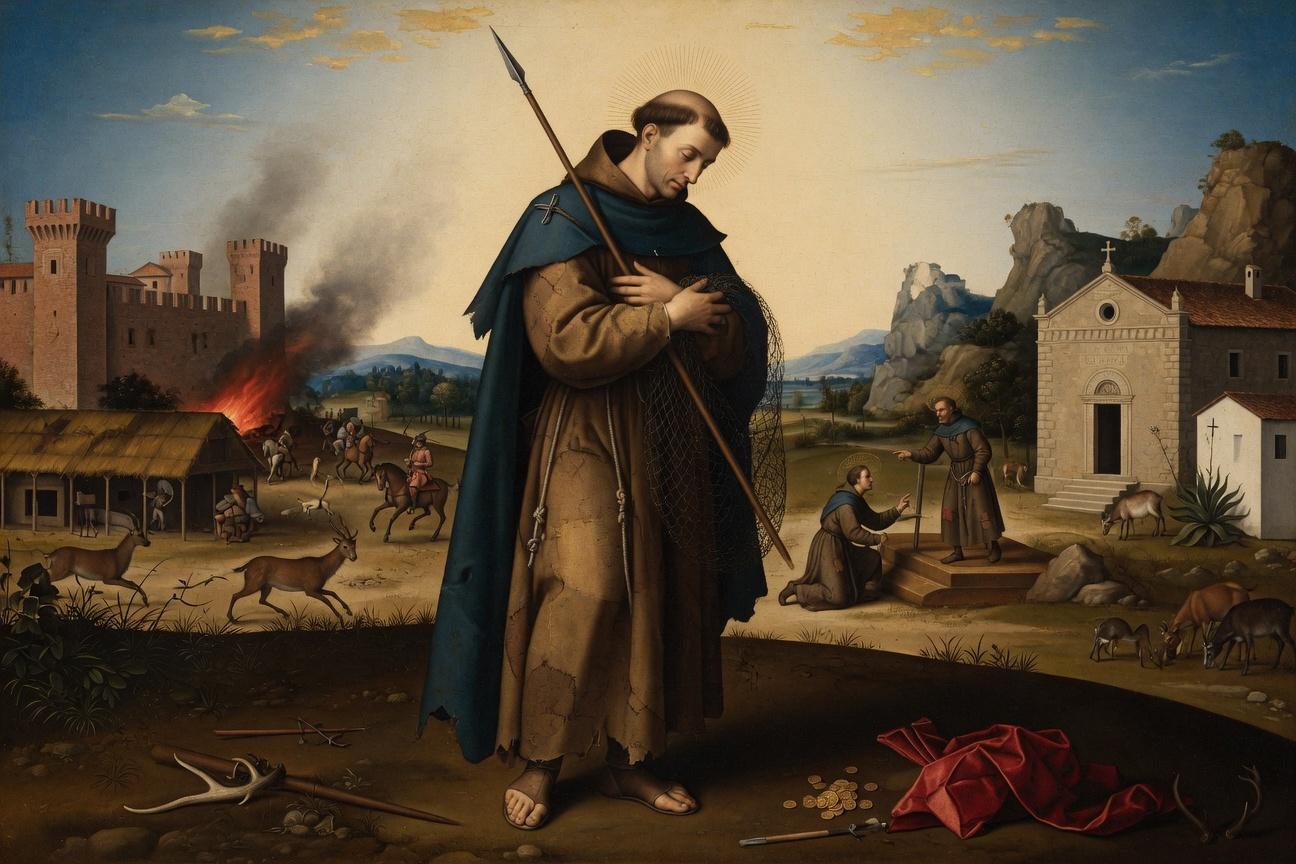
A nobleman of Piacenza in the 14th century, Conrad embraced poverty after causing an accidental fire and saving an innocent man from unjust condemnation. He retired to Sicily as a Franciscan hermit, living for forty years in extreme austerity. He died in 1351, renowned for his miracles and gift of prophecy.
Guided reading
6 reading sections
SAINT CONRAD OF PIACENZA, CONFESSOR
The hunting accident
Conrad, a nobleman of Piacenza with a passion for hunting, unintentionally causes a devastating fire while attempting to flush out game.
God is admirable in His Saints; but when He leads them by paths impenetrable to the eyes of the world, one cannot tire of praising His wisdom and His mercy. The blessed Conrad hardly thought Le bienheureux Conrad A nobleman from Piacenza who became a Franciscan hermit in Sicily. of embracing the path of Christian perfection through the practice of the evangelical counsels, when he found himself as if forced into it by an occasion that God brought about. It was a lord who lived peacefully in his house with his wife and family in the city of Piace nza. He had no oth ville de Plaisance City where the saint founded a house and exercised his ministry. er occupation than the exercise of hunting: one day, the game having retreated into brambles in the middle of the fields, he ordered his servants to set fire to them to flush it out; but a gust of wind having arisen, it pushed the flame further than he intended, to the great damage of the surrounding wheat and even other places in the province, which were all ravaged by the fire.
Justice and conversion
After letting an innocent man be condemned in his place, Conrad publicly confesses his fault, sells his possessions to compensate the victims, and embraces the religious life.
Conrad, surprised by such a distressing accident, entered the city quietly with his men, without showing that he was the cause of this conflagration; a poor man from the countryside was seized and taken prisoner, because he was suspected of being the author of it. He was presented before the criminal judge who, having interrogated him and finding him always in the negative, had him put to the question in order to extract stronger evidence to condemn him. This unfortunate man, lacking courage and constancy, and fearing torments more than the loss of life and honor, confessed to the act of which he was nevertheless innocent, and was immediately condemned to death. He was therefore led to the gallows, and everyone ran to see it. This rumor having spread throughout the city, Conrad was warned of the execution that was about to take place in the person of this innocent man, for a crime of which he himself was the author. Then, pressed by the law of justice and charity which was not entirely extinguished in his heart, he publicly declared the innocence of this poor man, explained how the accident had happened, and offered to repair the damage that had followed: thus the truth was known, the innocent man delivered, and Conrad obliged to make amends.
To achieve this, he sold all his goods, both movable and immovable, reduced himself to the utmost poverty, and compensated his neighbors for all the losses he had caused them. Then, his wife, who had consented to the sale of her dowry for this reparation, took the veil in a monastery in the city of Piacenza, and he retired to a distant land, where he took the habit of Saint Francis, which is called that of penance; then he went to Rome to visit the Holy Places. From there he went to Sicily an d se Noto City in Sicily where the saint lived as a hermit and where he is buried. ttled near Noto, where he remained for forty years as if in so litude, partly in the h hôpital de Saint-Martin Conrad's place of retreat near Noto. ospital of Saint Martin, and partly on a neighboring mountain, to perform a true and serious penance there. His most ordinary occupation was prayer and the mortification of his body, to which he spared no kind of austerity; the bare earth served as his bed, and a stone as a pillow; bread and herbs
Asceticism and solitude
Retired in Sicily near Noto, Conrad led a life of extreme austerities, prayer, and struggle against temptations for forty years.
LIVES OF THE SAINTS. — VOLUME II. 38 raw vegetables made up the entire variety of his meals; it could be said that he nourished himself more with his tears than with bread: the bread he used was, moreover, so coarse that it flattered his senses no more than if it had been ash. All this, nevertheless, did not prevent the demon from often stirring up in him furious temptations of the flesh and of gluttony; but he overcame them all by increasing his austerities and by prolonging the time of his prayers. He thus triumphed over himself to such a point that, when his friends made him a gift of some vegetables, he would only touch them when they had acquired an unpleasant taste. One day, when he felt urged to eat more than usual, he stripped himself naked and rolled for so long among thorns that blood flowed from every part of his body: this is how he repressed his desires.
Death and glorification
Conrad died in 1351 in a miraculous light; his body became the subject of disputes between Noto and Avola before being placed in a silver reliquary.
God rewarded this great virtue with the gift of prophecy and the grace of miracles, which made him admired and respected, not only by the people, but also by prelates and the most illustrious persons; but we pass these wonders over in silence to come to his precious death. Having had a revelation that it was near, he received the last sacraments, and, after having declared to his confessor that he wished to be buried in the church of Saint Nicholas, and having predicted to him that the inhabitants of Noto and those of Avola would have great disputes over his body, he threw himself at the feet of a crucifix. In this state, being surrounded by an admirable light, he rendered his soul to God, in the year 1351, in the presence of his confessor, who was for some time without knowing if he was dead, because his body remained still on its knees, as if it had been alive. As soon as he had passed away, the bells of the two cities of which we have spoken rang of their own accord to warn the people of the death of the servant of God; and, after several contentions between the inhabitants of one and the other, his body was carried to the church of Saint Nicholas, in Noto. Since then, it has been raised from the earth and placed in a silver reliquary, where the Saint has shone until today through several miracles and great favors granted to the f aithfu Léon X Pope who authorized the office of Saint Ozanne. l. This is why the sovereign pontiff Leo X permitted hi s memory Paul III Pope who approved the Somascan Order in 1540. to be honored in this city: which Paul III extended to Piacenza, to all of Sicily, and Urbain VIII Pope who beatified Josaphat. to other places. Finally, Pope Urban VIII permitted, by a brief of September 13, 1625, all the religious of the Order of Saint Francis to insert him into their calendar.
Representations and devotions
The saint is depicted with attributes of a hunter or surrounded by birds, and he is invoked specifically for the healing of hernias.
Here are the various ways in which Saint Conrad of Piacenza has been represented:
1° In most of his images, deer and other game animals are seen escaping near him in front of a breaking fire;
2° Saint Conrad is given, as an indication of his profession as a hunter, a hunting spear or half-pike;
3° Nets also indicate his passion for hunting;
4° Birds flutter around him. It is said that while traveling to the Bishop of Syracuse to live as a hermit, évêque de Syracuse Birthplace of the saint. he was greeted by a cloud of these charming little creatures that seemed to rejoice at his arrival.
Saint Conrad of Piacenza is the principal patron of Noto, where his memory is still held in great veneration. He is invoked there particularly against hernias, because, both living and dead, he healed several; his feast day is regarded as surely bringing about almost countless healings of this infirmity.
Sources and authors
Mention of the works of Canon Campi and Father Cahier concerning the life and traditions linked to Saint Conrad.
An author of his life, from the beginning of the 18th cent ury, Canon Cam chanoine Campi Author of an 18th-century biography of Saint Conrad. pi, of Piacenza, wrote many edifying and curious things about Saint Conrad. We might perhaps be thanked for providing an excerpt from a poem where various popular patronages are associated with that of Conrad, the great hunter, the charitable hospitalier, and the fervent hermit; but this would lead us too far: see, in the absence of the original work, Father Cahier, Caractérist iques, vol. Père Cahier Jesuit and archaeologist, author of the Caractéristiques des Saints. II, p. 411.
Annexes & related entities
Structured data for exploration: events, miracles, quotes, places, attributes, patronages, and important entities cited in the text.
Key Events
- Involuntarily caused a fire during a hunting trip
- Turns himself in to save an innocent man sentenced to death
- Sells all his possessions to pay for damages
- Takes the habit of Saint Francis (penitence) after his wife enters the convent
- Pilgrimage to Rome followed by retirement in Sicily near Noto
- Forty years of eremitic life and penance
- Died in prayer before a crucifix in 1351
Miracles
- Bells ringing by themselves at his death
- Body remaining on its knees after death
- Cloud of birds welcoming him in Syracuse
- Numerous healings of hernias
Quotes
-
The Lord guided the just in right paths, and showed him the kingdom of God.
Wis. 10:10 (Introit)