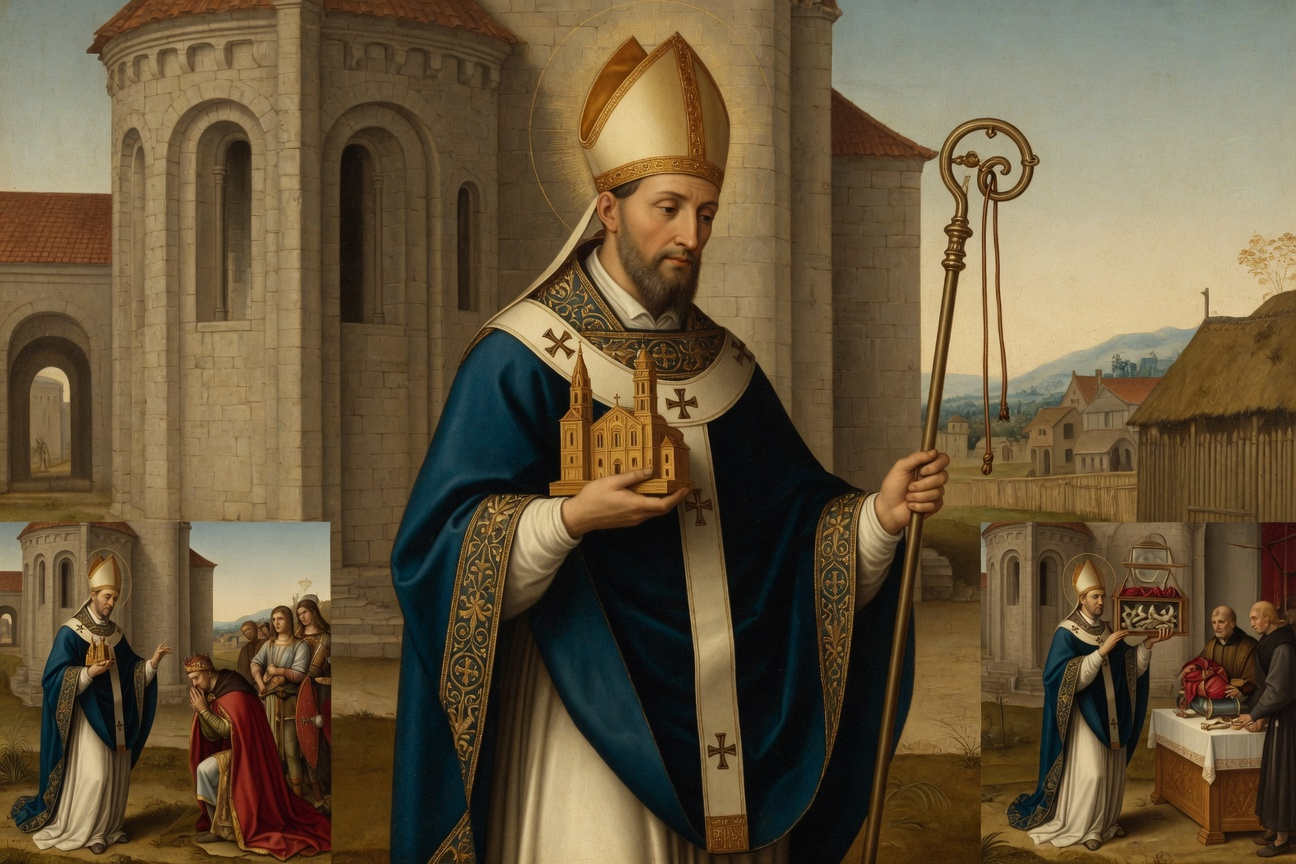
Bishop of Tournai in the 5th century, Eleutherius fought against paganism and heresies. He is famous for baptizing eleven thousand people after resurrecting the governor's daughter and for his courageous remonstrances to King Clovis. He died following an assault by heretics in 531.
Guided reading
9 reading sections
S. ELEUTHERIUS, BISHOP OF TOURNAI AND MARTYR
Origins and episcopal election
Eleutherius was born in Tournai in the 5th century into a noble and Christian family; he was elected bishop in 486, fulfilling a prophecy of his friend Saint Medard.
"Who am I that I should go to teach the children of Israel? The Lord answered him: I will be with thee." Exod., III, 11.
Eleutherius, or Lehire, according to the ancient name, was born in Tour Tournai City associated with the Diocese of Noyon. nai in 454 or 456. Serenus, his father, and Blanda, his mother, were of noble origin and enjoyed great wealth. Serenus counted among his ancestors Hirenée, who was one of the first inhabitants of Tournai to embrace Christianity at the voice of Saint Piat, and who gave the land upon which the church of Notre-Dame was later built.
Eleutherius had received from God such a happy nature that he made as much progress in letters as in piety. He was raised with Saint Medard, later bi shop of Noyo saint Médard Bishop of Noyon and friend of Eleutherius. n, who predicted to him that he would one day be bishop of Tournai. The prediction was verified in 486, when Eleutherius, aged about thirty, was elected to succeed Bishop Theodore.
Exile in Blandain and pastoral zeal
Faced with pagan violence and the disorders of the Frankish kings, Eleutherius took refuge in Blandain, from where he fought heresies concerning the Incarnation.
Even before the death of Theodore, the violence of the pagans had forced the principal Christians of Tournai to take refu ge in Bl Blandain Site of the invention of the relics of Saint Eleutherius and the burial place of Thecla. andain, a village located one league from Tournai, where the parents of Eleutherius had properties.
The people of Tournai had greatly degenerated since the death of their apostle Saint Piat. Their faith was extinguishing day by day, whether through commerce and the violence of the pagans, or through the disorders of the Frankish kings, who were still idolaters and who made their residence in Tournai. Such was the state of the church in this city when Saint Eleutherius was made its bishop. The first years of his episcopate were for him a time of troubles and harsh trials. His flock found itself mixed, on one hand with the Franks, masters of the country and still pagan, and on the other with various heretics who spread among the people doctrines contrary to the dog Incarnation Central mystery of Bérullian theology. ma of the Incarnation of Jesus Christ. This was for Eleutherius a reason to redouble his pastoral vigilance and his labors. He tore a great number of Franks away from the superstitions of paganism, and defended by word of mouth and in writing the mystery of the Incarnation against the heretics.
His zeal to win souls for Jesus Christ led him more than once to penetrate secretly into Tournai, where he preached the Gospel to abandoned families and to men who had recognized the vanity of idols. Such were his ordinary occupations, when a singular event, but one which God made serve for the salvation of a great number, came to reopen to him, as well as to the other exiles, the gates of his native city. Here are the terms in which the authors report it:
The resurrection of the governor's daughter
After resurrecting the daughter of the governor of Tournai, Eleutherius baptizes 11,000 pagans and makes a triumphant return to his episcopal city.
The daughter of the governor of Tournai, a pagan like her father, had conceived a secret affection for the young and virtuous Eleutherius before he had been banished with his family. She had never communicated this feeling to anyone; but one day she traveled to Blandain to confess it to Saint Eleutherius himself. The Spirit of God warned His servant of this danger, which he was unaware of and to which he was about to be exposed. As soon as this pagan girl was in his presence, he said to her: "Unhappy one, have you not heard that Satan dared to tempt the Lord, and that the latter replied to him: 'Begone; do you dare to tempt your Lord and your God?' Following the example of my Savior and in the name of the holy and indivisible Trinity, I command you to withdraw and to return to this place no more." Upon hearing these words, the young girl fell as if struck by lightning and expired on the spot. The governor, desperate at such an unforeseen death, but recognizing the power of the God of Eleutherius, promised to become a Christian if he would restore his daughter to life. The bishop consented to pray for her and humbly asked Jesus Christ that it might please Him to perform this miracle for the conversion of so many unhappy idolaters. After several days spent in fasting and prayer, he went to the place where the corpse had been buried and ordered the stone to be lifted; then he called the young girl three times, commanding her to rise in the name of Jesus Christ, who rose from the dead. At that very instant, she came out of the tomb before the eyes of a multitude of spectators and asked to receive baptism. Despite such a striking prodigy, the father still resisted, no doubt out of fear of the other pagans: this was the usual motive for such resistance to grace. A sudden contagion then broke out among them and caused terrible ravages. In their blindness, the idolaters attributed this punishment from heaven to the artifices of Saint Eleutherius, whom they treated as a magician; and having held council among themselves, they resolved to put him to death. When night came, an armed troop went to seize the bishop and brought him before the governor, who ordered him to be beaten with rods and then thrown into prison. But the angel of God came to visit him there, caused his chains to fall, and opening the door before him, led him back to Blandain. The admirable patience and prayers of the holy confessor of the faith finally appeased the Lord and drew His mercies upon this people, who had been rebellious for so long. Suddenly changed by an effect of grace, the governor went himself to find Saint Eleutherius and begged him to return to Tournai. The Saint welcomed this request with joy, and re-entering the city, he took possession of it in the name of Jesus Christ and regenerated it almost immediately through the baptism of eleven thousand pagans. This beautiful day was consecrated by a solemn feast, which is still celebr Clovis King of the Franks, mentioned to date the existence of the church. ated every year (December 26, 496).
The conversion of Clovis coincided with this event.
Shortly after, a new miracle further increased the joy and occasioned new conversions: this was the healing of the blind man Mantilius, performed on Christmas Day.
Journeys to Rome and return of the relics
The bishop made three journeys to Rome and brought back the relics of Saint Stephen and Saint Mary of Egypt, which were welcomed with miracles.
The conversion of Clovis in 496, having made the times calmer, Eleutherius took advantage of it to re-establish the episcopal see in Tournai, which had been fixed for some years in the village of Blandain. He made the journey to Rome three times to clarify the proper means to remedy the ills of his church. The last time he returned from there, he brought back the relics of Saint Stephen, the first martyr, and of Saint Mary of Egypt.
The return of the Saint to the midst of his flock excited the liveliest joy everywhere. The clergy and the people, having left the city by the Nervienne gate, had gone to meet him, and the procession was already descending the hill of the Sacred Mount, today the Mount Saint-André, when, from the top of this eminence, the venerable bishop appeared, holding high in his hands the precious relics he was carrying. Two circles of light formed at the same instant around him before the eyes of the people, who shouted with admiration; then all set off toward the basilica of Notre-Dame, singing hymns and canticles. On the road, a large number of the sick or crippled were healed, and a mute, well known to the inhabitants, recovered the use of speech.
Confrontation and pardon of Clovis
Eleutherius challenges Clovis regarding his sins; after a night of prayer, an angel brings a document confirming the divine pardon granted to the king.
Clovis distinguished himself by the success of his arms and by the protection he granted to religion; but he stained his memory with acts of perfidy and violence. The legend of Saint Eleutherius offers us a public protest on the part of the clergy against the barbaric means by which the victor of Tolbiac sought to extend and consolidate his dominion. Clovis came one day to Tournai; barely arrived, he went to the church to thank God for his victories. Eleutherius was waiting for him on the threshold: "Lord King," he said to him, "I know why you come to me." Astonished by these words, Clovis protested that he had nothing particular to say to the bishop. "Do not speak thus, O King," replied Saint Eleutherius, "you have sinned and you do not dare to confess it." Then the victor was moved, his eyes filled with tears, he confessed that he felt guilty and begged the pious bishop to celebrate Mass for him and to implore from heaven the pardon for his crimes. Eleutherius began to pray and remained there all night, watering the ground with his tears. The next day, while he was celebrating Mass, and at the moment he was preparing to receive the holy host, a brilliant light spread through the church, and an angel appeared to him: "Eleutherius," he said to him, "servant of God, your prayers are answered"; and at the same time he handed him a document on which was traced the pardon granted for the royal faults which it is not permitted to divulge. Absolved by divine clemency, Clovis gave thanks to God and to the holy bishop, and made considerable gifts to the church of Tournai. The courageous remonstrances of Eleutherius, the public repentance of the prince, the angel bringing from heaven the pardon for political crimes, are at the very least, if one wishes to contest the certainty of these facts, an admirable painting of the popular sentiments of that era.
Defense of the faith and martyrdom
In 520, he convened a synod against the heretics; the latter violently assaulted him upon leaving the church, leading to his death in 531.
To extirpate the last roots of the heretical doctrines that were devastating his diocese, Eleutherius convened a synod around the year 520, in which he appears to have delivered a discourse on the mystery of the Incarnation. His zeal in maintaining the deposit of faith in its purity cost him his life. One day, upon leaving the church, he was set upon by a band of heretics who threw themselves at him and overwhelmed him with blows. The Saint survived his wounds for only a few days; his death occurred in 531, on February 20, the day on which the Church honors his memory.
Translation and protection of the remains
His relics, initially at Blandain, were transferred to Tournai in the 9th century and protected during the Wars of Religion and the Revolution.
The illustrious friend of Eleutherius, Saint Medard, Bishop of Noyon, had hastened to come to Tournai at the news of the violence that had been committed against him. After shedding abundant tears over his lifeless body, he set about rendering him the honors of burial. "He himself celebrated the sacred mysteries, to thank God that He had deigned to admit Saint Eleutherius into the abode of glory." The ceremonies completed, the body was transported to the church of Blandain, where it remained until the end of the ninth century. At that time, a pious lady, who lived in the place called Roubaix, had a revelation, in which Saint Eleutherius commanded her to go on his behalf to Heidilon, Bishop of Tournai and Noyon, to tell him to raise his body from the earth and transport it to Tournai. This holy woman fulfilled the mission entrusted to her, and the bishop, with his clergy, hastened to accomplish this will of heaven which was manifested to him.
In 1247 these relics were placed in a new reliquary, the same one that the ca thedral still p nouvelle châsse 13th-century goldsmith work containing the saint's remains. ossesses today. This reliquary, a work of goldsmithing of the greatest delicacy, has been falsely attributed to Saint Eligius, silversmith to Dagobert.
During the Wars of Religion of the 16th century, the Chapter of Tournai preserved the relics of Saint Eleutherius from profanation by sending them to Douai (1566). Threatened again during the French Revolution, they were sheltered in a private house in Tournai; they remained there until 1801, the time at which Mgr Hirn made their solemn translation to the cathedral.
Saint Eucher of Orléans
The text then recounts the life of Eucher, a monk at Jumièges who became bishop of Orléans in 717 after an angelic announcement to his mother.
« It is in retreat that the soul is tempered like steel in contact with water: it is there that God speaks to our hearts. » Orel., II, 14.
Orléans, one of the most beautiful and richest cities of France, and which, in the time of our first kings, was the capital of a kingdom, served as the cradle for the b lessed Eucher Bishop of Orléans exiled by Charles Martel. Eucher, illustrious by the nobility of his parents; it later had the honor of having him as pastor and bishop. His mother had a revelation of this while she was carrying him in her womb. Having one day returned from church, where she spent entire days in prayer, as she was taking some rest at home, she perceived, near her bed, a venerable man, dressed in white, and whose eyes were all radiant with light; he said to her: « God be with you, O beloved of the Lord! you carry in your womb a son whom God has chosen from all eternity to be bishop of this city ». The virtuous mother, recognizing by these circumstances that he who spoke to her was an angel, begged him to bless the little creature she enclosed in her womb: which he did. She immediately gave notice of this vision to her husband, and both awaited with joy the moment of this happy birth. Eucher was born in 687. His parents, to have him baptized, waited until he could answer for himself, and to honor his vocation announced by an angel, they wanted this sacrament to be administered to him by some holy bishop. They therefore went to present him to the blessed Ansbert, bishop of Autun, who baptized him, was at the same time his godfather, and gave him confirmation (692).
From the age of seven (694), Eucher studied letters. He made great progress there, and even left behind those who were twice his age. He became skilled in the understanding of the Scriptures, the sacred canons, and the writings of the Fathers. It is believed that he entered the clergy under Bishop Léodeber, and that he distinguished himself in some subordinate position in the church of Orléans. But, as the divine truths of Scripture were the continuous subject of his meditations, he weighed the words where Saint Paul says that the goods of the world are but a figure that passes, and that they are foolish before God who love them; he renounced the world, and resolved to live on earth as if he were no longer of it: he retired to the abbey of Jumièges, in the diocese of Rouen (714). He worked with such fervor for his perfection, and attained such eminent holiness that one of his uncles, named Suavaric, bishop of Orléans, having died, he was desired by all the clergy and all the people of the city to succeed him. They therefore sent deputies to Prince Charles Martel, who then governed the kingd om of France i Charles-Martel Mayor of the palace, possible ancestor of the saint. n the capacity of mayor of the palace. They asked for the religious Eucher as bishop; they obtained him to the great contentment of the whole city, but not of the Saint, who burst into tears at this news, foreseeing very well the perils to which this supreme dignity would expose him, and suspecting that it would be for him more of a burden than a true honor (717).
Exile and conflict with Charles Martel
Eucher opposes the seizure of Church property by Charles Martel; he is exiled to Cologne and ends his days at the Abbey of Saint-Trond.
His first cares, as soon as he saw himself raised to the episcopal throne, were to visit the churches of his diocese, to watch over his clergy, and to distribute the bread of the word of God to his people; he did so with such unction, grace, and love that everyone felt honored to be able to render him some service and to show him their obedience. Thus, the report of his holiness spread through all the provinces of France, so that Prince Charles held him in the highest esteem; but this did not prevent envy and slander from disturbing his peace, on the occasion we are about to relate.
The Saracens of Africa, having crossed the sea and made themselves masters of a part of Spain, descended into France with four hundred thousand combatants. Already Guyenne, Touraine, and Poitou had been devastated, and these barbarians were on the verge of forcing the city of Tours and ruining there the famous church of Saint-Martin, which was, at that time, one of the most frequented and richest in all of Christendom. Charles, prince of the Franks, attacked this numerous troop of infidels on the plain of Saint-Martin le Bel, between Amboise and Bléré, in Touraine; others say near the city of Poitiers, at Vouglé. This great hero caused the Saracens to lose more than three hundred and sixty thousand men, having lost, on his side, only fifteen hundred Christians: which earned him the surname of Martel, for having beaten and, as it were, hammered these hordes of Barbarians. This enterprise and several others that this prince had on his hands to defend the churches led him to believe that he could use some ecclesiastical goods and the revenues of the clergy to reward the nobility who had followed him to war. He seized them violently. Some bishops could not suffer this procedure, among others Saint Eucher, bishop of Orléans, who complained, not of the prince's action, which public necessity seemed to authorize, but rather of the extortions that the commissioners committed in the levying of these taxes. This was a pretext for complaints against this blessed prelate: his enemies accused him of being a restless, seditious man, an enemy of the good of the State, who did nothing but criticize those who had the handling of affairs. To better sting Prince Charles to the quick, they painted Eucher as a man hostile to his family (they said, no doubt, to his dynasty), and who favored the party of Raganfrid, mayor of the palace of Chilperic. And as it is the custom of princes to be too credulous of such reports, Charles, passing through Orléans on his return from his victory (733), ordered the bishop to follow him to Paris, from where he sent him, with all his relatives, into exile in the city of Cologne, in Germany. By an admirable conduct of divine Providence, he was received there with such eagerness by the clergy and the people that he seemed to be in the midst of his own diocese and his own possessions. The prince was informed of this, had him go to the Liège region, and ordered Duke Robert to keep him near his person and to watch over his actions, for fear that he might incite some sedition. God, who had made Joseph find favor before Pharaoh, caused Duke Robert, who was not ignorant of the merits of the holy Prelate, to hold him in such great veneration that he named him his almoner, to distribute his liberality to the poor. Eucher, nevertheless, hardly used this power; but he asked as his only favor of Robert to be able to retire, with the religious, to the church of Saint-Trond: which was granted to h im. Then th Saint-Trond Place of final retreat and burial of Saint Eucherius. e holy bishop, forgetting all the things of this world, occupied himself only with praying and thanking God for having delivered him from the burden of a diocese that He had previously given him, and for doing him the honor of suffering for justice. He spent six years in this place building up the monastery, so that the religious, by his example and animated by the fervor they saw in him, despised the things of the earth and had no more thoughts or desires than for heaven.
Finally, it pleased the Almighty to crown the merits of His faithful servant with a happy death: God made him feel its approach through an illness, which, detaching his soul little by little from this mortal body, led it into the glory that will never end. This was on February 20, the year of Our Lord 738.
His body was deposited in the church of the same abbey, where God has honored his memory with numerous miracles. One notes among other wonders that candles placed at his sepulcher burned for a long time without being consumed, and that the oil of the lamps multiplied significantly and even healed several sick people. The blind recovered the use of their sight there, the lame the power to walk straight, and the possessed received relief from their miseries.
Saint Eucher has been represented: 1st, leaving for exile; 2nd, near a tomb from which a viper emerges and whose lid bears the arms of France, or else before a lit pyre in the middle of which appears a crowned personage. These are two ways of saying that the damnation of Charles Martel, who had unjustly disposed of the goods of the Church, was revealed to Eucher. But it is permissible not to attach great value to this old legend.
The Roman Martyrology commemorates Saint Eucher on February 20. One can see the authors who treat of him in the Remarks of Baronius, on this same day. Charles de la Saussaye, in the Particular Annals of the Church of Orléans, reports that a notable bone of an arm of this holy Bishop was sent there solemnly from the Abbey of Saint-Trond, in the year 1605.
Annexes & related entities
Structured data for exploration: events, miracles, quotes, places, attributes, patronages, and important entities cited in the text.
Key Events
- Born in Tournai in 454 or 456
- Election to the bishopric of Tournai in 486
- Temporary exile in Blandain following pagan persecutions
- Resurrection of the daughter of the governor of Tournai
- Baptism of eleven thousand pagans on December 26, 496
- Restoration of the episcopal see in Tournai after the conversion of Clovis
- Journeys to Rome and bringing back relics of Saint Stephen
- Meeting and remonstrances with King Clovis
- Assaulted by heretics upon leaving the church
Miracles
- Resurrection of the daughter of the governor of Tournai
- Healing of the blind man Mantilius
- Apparition of an angel bringing forgiveness to Clovis during Mass
- Multiple healings during the transport of the relics of Saint Stephen
- Circle of light around his head at the Sacred Mount
Quotes
-
Lord King, I know why you come to me... you have sinned and you do not dare to confess it.
Dialogue with Clovis