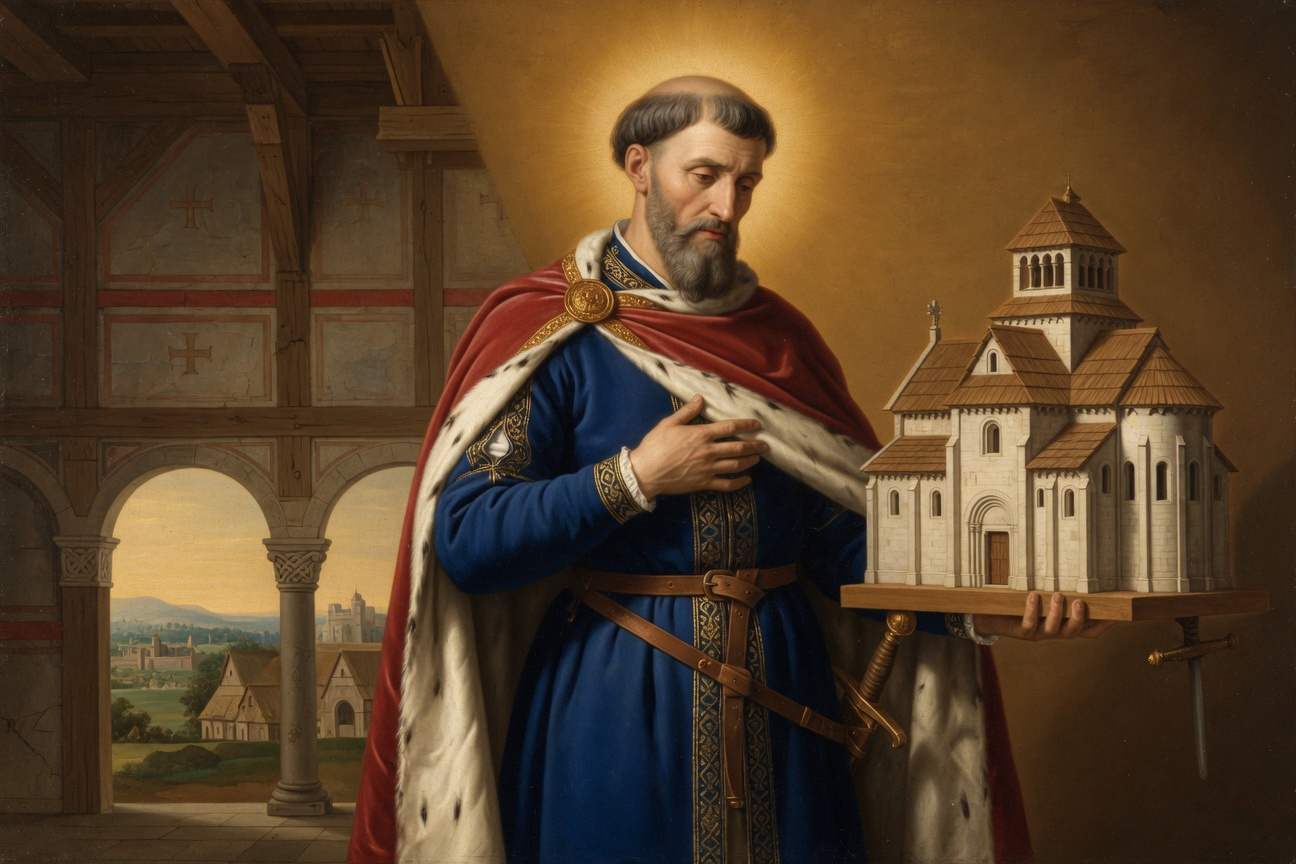
Duke of Brabant and Mayor of the Palace in the 7th century, Pepin of Landen was the wise and virtuous advisor to kings Clotaire II, Dagobert I, and Sigebert II. A protector of the weak and defender of justice, he founded with his wife Saint Itta a family of saints. He died in 640, leaving the image of an upright administrator and a father of the fatherland.
Guided reading
5 reading sections
SAINT PEPIN, DUKE OF BRABANT
Ascension and political virtues
Son of Carloman and Emegarde, Pepin became Mayor of the Palace under several Merovingian kings, exercising his power with a justice balanced between the sovereign and the people.
This holy du Ce saint duc Mayor of the palace and brother-in-law of Modoald. ke was the son of Prince Carloman and Princess Emegarde. He was Mayor of the Palace under Clotaire II, Dagobert I, and Sigebert II, kings of France, and exercised this great office, which was little different from royal authority, with rare prudence. Nothing could be added to his loyalty to his king, nor to his love for the people. He embraced, with invincible constancy, the just interests of both, without allowing that, to favor the people, one should wrong the rights of the king; nor that, under the pretext of the rights of the king, one should oppress and overwhelm the people, because he preferred the will of God to that of men, and knew that He forbids favoring the powerful to the prejudice of the weak. Thus, he rendered to the people what justice required to be rendered to them, and to Caesar what legitimately belonged to Caesar. There is no better proof of this than his desire to have as an associate in his conduct Sa int Arnulf, Bishop of Metz; saint Arnoul, évêque de Metz A virtuous figure at the court of Dagobert. he did nothing without his counsel, knowing his eminent virtue and his great capacity in the government of the State; and, after the death of Saint Arnulf, he took as a colleague in the administration of affairs another great saint, Cunibert, Archbishop of Cologne. One can sufficiently judge with what ardor he embraced just things, since he chose such excellent and incorruptible men to be the directors of his councils and the faithful witnesses of his actions.
The mentorship of Dagobert I
Charged with the education of the young Dagobert in Austrasia, Pepin instilled in him the fear of God and ensured the stability of the kingdom against rival factions.
King Clotaire II was not content with placing the highest office of his State in the hands of this excellent prince by making him mayor of the palace: he also honored him with his full confidence and gave him all the power that a great minister could hope for. Having resolved to associate his son Dagobert King of the Franks petitioned by Sulpicius to annul a tax. Dagobert with a portion of his power and to share the States with him by putting him in possession of the kingdom of Austrasia durin royaume d'Austrasie Merovingian kingdom of which Dagobert II was the sovereign. g his own lifetime, he chose, from among all the great men of his court, this admirable man to entrust entirely with the guidance of this young prince, who was to act only according to this counselor (622). Pepin discharged this duty so worthily that he forgot nothing that could imprint upon Dagobert's mind the fear of God and the love of justice: he often placed before his eyes this beautiful word of the Gospel: "The throne of a king who renders justice to the poor shall never be shaken." Thus, it was through his prudence that Dagobert governed so well and so happily, not only Austrasia, but also all the States that his father left him upon his death. His brother Caribert, and several great men having disputed them with him, this faction was soon dissipated by the valor of Pepin, who was no less generous in war than he was just and wise in peace; and Dagobert, after having maintained the right that belonged to him, won the hearts of all his subjects in such a way through his liberality, his justice, his gentleness, and all the other qualities worthy of a great king, that he equaled and even surpassed the reputation of the most illustrious of his predecessors; his reign would have been one of the most beautiful, had he always followed the advice of such a holy and skillful master.
Moral conflicts and regency
Despite Dagobert's moral excesses, Pepin maintained his integrity, escaped a plot, and eventually governed Austrasia in the name of the young Sigebert II.
But, as nothing is more difficult than to keep one's spirit pure amidst the corruption of the age, and one's body chaste amidst the pleasures that accompany prosperity and sovereign power, this king plunged into voluptuousness, and he had recourse to unjust means to satisfy his foolish and disorderly expenses. Pepin's heart was pierced with pain, he reproved him severely, and reproached him for his ingratitude toward God; this prince at first received Pepin's advice so poorly that he even thought of having him put to death, being urged to do so by some nobles of his court who hated the Saint and envied his virtue. But God, who is the protector of the just, delivered Pepin from this peril. The king finally understood the justice of his remonstrances and had more veneration than ever for the merit and virtue of such a great minister; and, to give him an unequivocal proof of this, he placed his son Sigebert in his hands, whom he sent to reign in Austrasia under his guidance (633). Thus, Sigebert being king in name, and Pepin governing the kingdom in effect, Austrasia found itself delivered from the great incursions of the Barbarians that it had previously suffered. He repressed them, confined them to their own lands; and, after the death of King Dagobert, he would have put Sigebert in possession of all his States, had his father not obliged him, during his lifetime, to be content with Austrasia and to leave the kingdom of France to Clovis, his younger son.
Death and historical legacy
Pepin died in 640 in Landen; the text specifies his genealogical distinction from Pepin of Herstal and Pepin the Short, highlighting his role as an ancestor of the Carolingian dynasty.
This holy duke died on February 21 of the year 640, in his castle of Landen, in Brabant; the affliction that all of Austrasia felt was so extraordinary that it mourned him no less than one of its best kings: for his life was entirely holy, his reputation spotless, his wisdom and conduct admirable; and one could name him, with truth, the protector of the laws, the support of the weak, the enemy of division, the ornament of the court, the example for the great, the guide of kings, and the father of the fatherland. His body, which was first laid to rest in the place where he died, was later transferred to the monastery of Nivelles. Furthermore, one must be careful not to confuse him with two other Pepins, whose names are famous in our histories: the first was Pepin of Herstal, also Mayor of the Palace and father of Charles Martel; the second, Pepin the Short, son of the same Charles Martel, and the first of our kings of the second saint Pépin Mayor of the palace and brother-in-law of Modoald. race: for Saint Pepin, of whom we speak, is older than both, and was the grandfather of Pepin of Herstal, through his d sainte Begghe Daughter of Pepin and ancestor of the Carolingian dynasty. aughter, Saint Begga, who, having married Ansegisel, son of Saint Arnulf, gave him this son for the good of France and the support of this great and illustrious monarchy.
A lineage of saints
Pepin's family is presented as a hearth of holiness, including his wife Itte, founder of Nivelles, and his daughters Gertrude and Begga.
It remains for us to note that the house of Saint Pepin was but a company of Saints: for his wife, named Itte, or Ideburge, sister of Saint Modoald, Archbishop of Trier, after having lived holily in marriage, following the example of her husband, occupied herself, when she was a widow, only with practicing all kinds of good works; and she finally received, from the hands of Saint Amand, the sacred veil of a nun in the famous monastery of Nivelles, which she herself had built: she spent the rest of her days there in such great perfection that she offered to all the nuns who dwelt there a rare example of virtue. The eldest of their daughters, the great and illustrious Saint Gertr ude, abbess of sainte Gertrude Niece of Modoald, honored at Nivelles. this same monastery, was so eminent in holiness that she may be considered one of the most beautiful lights of religion; and her sister, Saint Begga, has the honor of being the blessed stem from which the second lineage of the kings of France emerged.
Annexes & related entities
Structured data for exploration: events, miracles, quotes, places, attributes, patronages, and important entities cited in the text.
Key Events
- Mayor of the palace under Chlothar II, Dagobert I, and Sigebert II
- Advisor to Dagobert I in Austrasia from 622
- Reprimands King Dagobert for his morals and escapes death
- Governed Austrasia under the name Sigebert III from 633
- Died at the castle of Landen in 640
Quotes
-
The throne of a king who renders justice to the poor will never be shaken
Gospel (cited by Pepin to Dagobert)