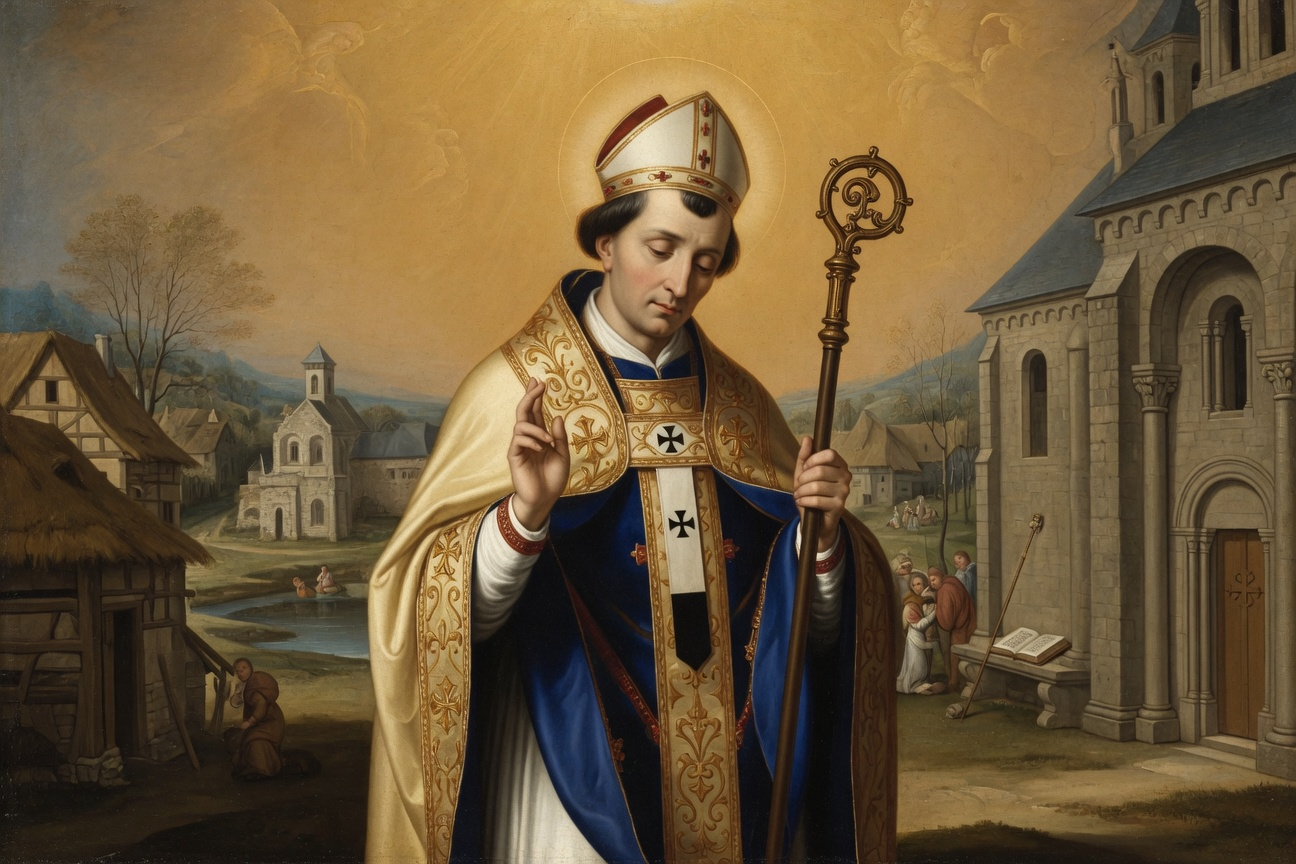
Saint Emebert
Ablebert
Bishop of Cambrai
Son of Count Witger and Saint Amelberga, Saint Emebert (or Ablebert) became Bishop of Cambrai in the 7th century, succeeding Vindician. Known for his humility and devotion, he died of illness in Ham during a retreat in his native land. His relics were later transferred to Maubeuge.
Guided reading
4 reading sections
SAINT EMEBERT, BISHOP OF CAMBRAI (668).
Origins and illustrious family
Emebert was born in Ham into a noble and pious family, the son of Count Witger and Saint Amelberga, surrounded by four sisters who are also recognized as saints.
Saint Emebert Saint Émébert Bishop of Cambrai in the 7th century. , also named Ablebert, was born in the town of Ham, ville de Ham Traditional birthplace of the saint. to parents as distinguished by their piety as by their nobility; his father was Count Witger, and comte Witger Father of Saint Reinelde, referred to as blessed. his mother w as Saint Amelber sainte Amelberge Mother of Saint Emebert. ga. He also had four Saints as sisters, who are: Sain t Reineille, Sai sainte Reineille Sister of Saint Émébert. nt Pharailde, Sain sainte Pharailde Sister of Saint Emebert. t Ermentrude, and S sainte Ermentrude Sister of Saint Emebert. aint Gudula.
An exemplary youth
The young man distinguished himself by his piety, his humility, and his obedience, constantly progressing in the spiritual life and devotion.
After the years of his childhood, which he spent in the fear of God, he was a young man remarkable for the beauty of his countenance, for the graces of his speech, for the gentleness of his soul, for his humility, his obedience, his devotion, and the integrity of his morals, ascending every day from virtue to virtue and progressing in submission to God.
Elevation to the See of Cambrai
After leading a life of solitude and prayer, Emebert succeeded Bishop Vindician to the episcopal see of Cambrai.
Loving solitude, he avoided the company of worldly men, and made himself pleasing to God through the compunction of his heart, through prayers, vigils, fasts, and tears. However, Vindician, Bishop of Cambrai, preaching Vindicien, évêque de Cambrai Bishop of Cambrai and Arras who oversaw the translation of relics. pleasingly to God, rendered his soul to his Creator, adorned with the fruits of his good works. After his departure from this world, Emebert, by the disposition of God, was raised to his see. He was, in this dignity, like a lamp placed on a lampstand, and lived up to the holiness of his birth.
End of life and posterity
He died of illness in Ham during a pastoral visit. His body was later transferred to Maubeuge, where searches were conducted in 1637 to recover his remains.
As he was visiting his diocese, spreading the seed of the divine Word for the greater good of souls, and wishing to devote himself more freely to contemplation, he retired for some time to his native land; it was there that God, wishing at last to reward him, sent him a slight fever which broke down the strength of his body. The hour of the call having thus come, he ended his career in the town of bourg de Ham Traditional birthplace of the saint. Ham, where he was buried. He was later transferred to Maube Maubeuge Monastery founded by Saint Aldegonde. uge and placed in the church of the Mother of God and Saint Aldego sainte Aldegonde Daughter of Walbert and Bertille. nde, virgin. Notable searches were made in 1637 to recover his body.
*Proper of Cambrai.*
Annexes & related entities
Structured data for exploration: events, miracles, quotes, places, attributes, patronages, and important entities cited in the text.
Key Events
- Born in Ham
- Election to the episcopal see of Cambrai after the death of Vindicien
- Pastoral visit of the diocese
- Contemplative retreat in his native land
- Died following a mild fever in Ham
- Translation of his relics to Maubeuge
- Search for his body in 1637