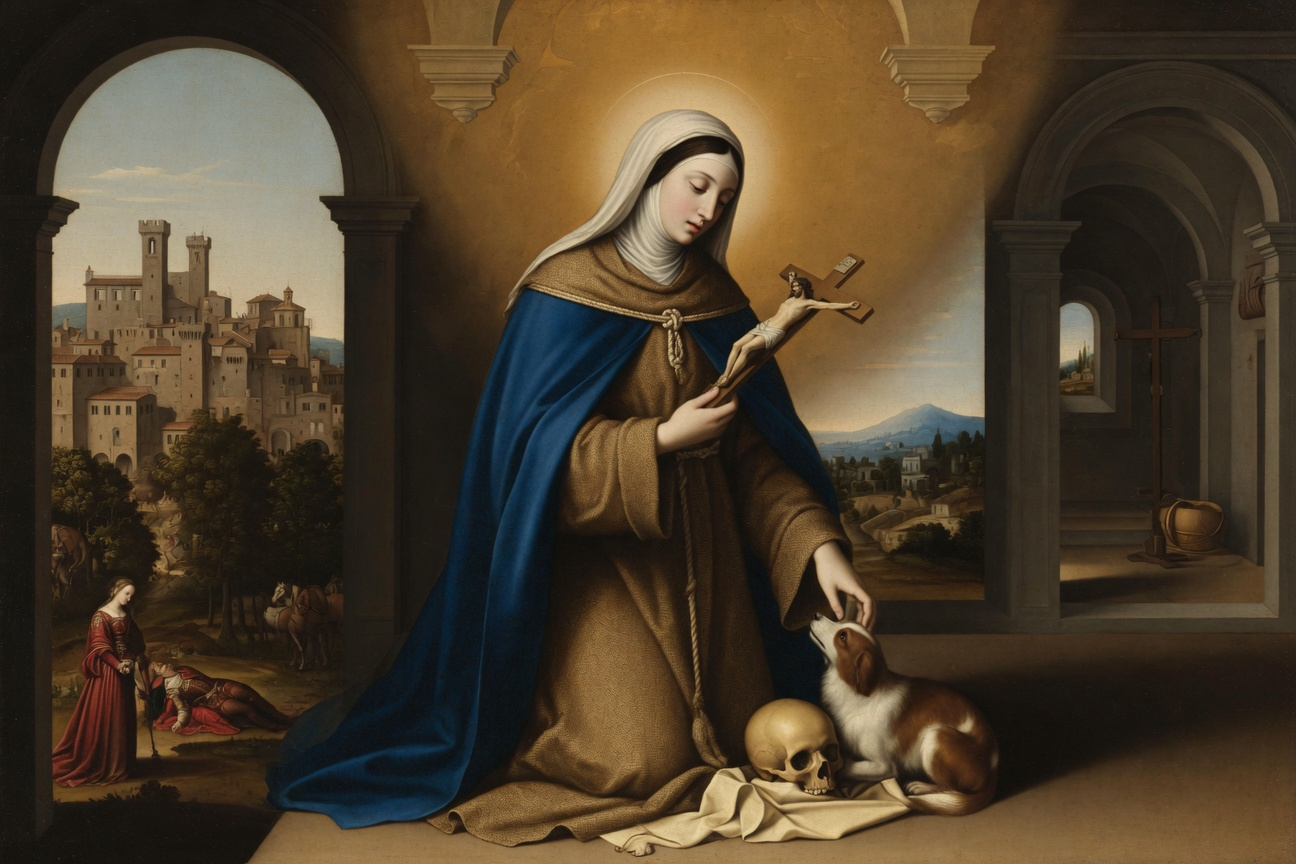
Born in Tuscany, Margaret initially led a life of luxury and sin in Montepulciano. The brutal death of her lover triggered her radical conversion; she joined the Third Order of Saint Francis in Cortona. There, she led a life of extreme austerities, charity toward the poor, and mystical visions until her death in 1297.
Guided reading
9 reading sections
SAINT MARGARET OF CORTONA
Youth and worldly life
Born in Laviano in the 13th century, Margaret led a life of luxury and pleasure in Montepulciano after the early loss of her mother.
Blessed Margaret of Cortona, s o calle Cortone Location of the novitiate where Lawrence trained his most famous disciples. d from the place of her burial, was born in the village of Laviano, in the diocese of Chiusi, in Tuscany, around the middle of the 13th century. Poorly endowed with the goods of fortune, she lost her mother early on, and her father, by remarrying, unfortunately provided her with the pretext to believe that she was free to conduct herself as she pleased. The traps of beauty, of an age without experience, and of abandonment made her accept the attentions of the world as an intoxicating triumph.
She remained for nine years unit ed to a wealt Montepulciano Birthplace of the saint in Tuscany. hy man from Montepulciano, who provided her abundantly with the means to satisfy her penchant for luxury and pleasure. She had a son by him, who later entered the Order Ordre des Frères Mineurs Religious order welcomed by Engelbert in Cologne. of Friars Minor. However, in the midst of her sinful life, she had a singular compassion for the poor. She would have fits of devotion where she would say at the sight of certain places: "How good it would be to pray here! How charming this place is, to lead a penitent and solitary life!" Back in her room, more than once she lamented her miserable state. And when the inhabitants greeted her, she would blame them, saying that, knowing her criminal life, they should not even speak to her. One day when her companions reproached her for her finery, saying: "What will become of you, vain Margaret?" she replied to them: "A time will come when you will call me Saint, when I will truly be one, and you will come to visit me with a pilgrim's staff."
Conversion through death
The discovery of her lover's decomposed body, guided by her dog, triggers a spiritual shock and an immediate desire for penance.
In the year 1277, her seducer was killed in circumstances that historians do not specify; but this death restored the life of the soul to Margaret.
A small dog that she loved very much, having followed this lord, returned to the house after a few days of absence. Upon arriving, it began to make several cries; and, taking its mistress by her dress, it pulled her as if to lead her to some place. Margaret, astonished by this, allowed herself to be led to a woodpile that was nearby; she was terrified when she found hidden there the body of her lover, lying dead and already full of worms that were gnawing at him. This sad spectacle made such an impression on her mind that, with grace effectively soliciting her heart, she felt horror at having abandoned herself to a creature that was nothing but corruption, and resolved to change her life completely and to do penance for her crimes. With this thought, she went to throw herself at her father's feet, like another prodigal child, and asking his forgiveness, with torrents of tears, for her past disorders, she begged him to receive her into his home, so that she could expiate, for the rest of her days, the irregularities of her bad life. However indignant this good father was at his daughter's scandalous conduct, he could not help but embrace her with tenderness, and receive her into his house, where she began seriously to do penance.
Family trials and calling
Driven out by her father under the influence of her stepmother, she is guided by an inner voice toward the Franciscans of Cortona.
Margaret was so touched by her sins, and the fervor of her contrition was so great, that she did not cease to weep and to heave sighs toward heaven to draw upon herself the mercy of her God. She sometimes addressed the Saints of paradise, and asked them, with strange agitations, what was the state of her soul, and if, after so many crimes, Jesus Christ would receive her into His grace. At other times, putting a rope around her neck, she went to the church, where, in the midst of the solemnity of the divine mysteries, she asked pardon before all the people for the scandal she had given. This conduct greatly displeased her stepmother; and she did so much with her husband that he drove the holy penitent from his house, as a madwoman and a fool. This was a terrible trial for her; for, on one hand, the demon suggested to her to return to her former debaucheries, where she would have everything she could desire, whereas in this state of penance, everyone, and even her father, abandoned her; moreover, she saw herself as beautiful, well-formed, still young, and in a state to enjoy the pleasures of life for a long time. As she was
agitated by this temptation, she heard, in the midst of her heart, a voice that told her to go to the city of Cortona , to the convent ville de Cortone Location of the novitiate where Lawrence trained his most famous disciples. of the religious of Saint Francis, where she would learn what she should do for the expiation of her sins.
Entry into religious life
After three years of probation, she was admitted into the Third Order of Penance with the Friars Minor of Cortona.
The faithful penitent, obeying this voice from heaven, went immediately to the place that had been marked out for her; and there, throwing herself at the feet of a confessor, she declared to him the miserable state of her life and the great mercies that God had exercised upon her; she then ur gently requested the habit du Tiers Ordre Religious order welcomed by Engelbert in Cologne. habit of the Third Order, which is called the Order of Penance; the religious at first refused her out of prudence, to test her vocation, and for fear of profaning their holy Order by the reception of a person who had led such a scandalous life; but, at the end of three years, she merited this grace by her perseverance, and finally saw the fulfillment of her pious desires.
A life of austerities
She practiced extreme mortifications, inflicting physical suffering upon herself to expiate her past faults and unite herself with Christ.
Divine love, which had taken the place of profane love, set the heart of the blessed Margaret ablaze; all her life she had as much aversion for all earthly things as she had previously had ardor for tasting their delights. All her eagerness was to make herself pleasing to Jesus Christ through the practice of virtues. Her pleasure was to afflict her body with new mortifications. She had such horror of her beauty, which had served to ruin her, that she would strike her face with a stone, or rub it with crushed sandstone in order to make herself disfigured. She slept on the hard ground and had only a stone or a piece of wood for a bolster. She spent entire nights in vigils, in prayers, and in the contemplation of heavenly truths. Her tears, which were sometimes of blood, became so frequent that her eyes seemed to be coming out of their sockets; she sighed, she sobbed incessantly; one would have said at any moment that she was about to expire from pain. She struck herself and gave herself the discipline so often and for so long with knotted ropes and other instruments of penance that her flesh, previously treated with such delicacy, had become black and livid; and she was delighted to see in this state a body that had served her to offend her divine Savior so many times. She accustomed herself little by little to abstinence, so that a piece of bread and a little water sufficed for her sustenance; rarely did she add a few nuts or boiled herbs. The blessed penitent weakened her body so much through these austerities that she no longer felt any disordered movement of sensuality, nor even the slightest evil desire.
Charity and Demonic Struggles
She founded an infirmary for the poor while enduring violent temptations and attacks from the devil.
She loved nothing on earth but the poor; the fruit of her labor and the alms given to her were for them; she transformed a house into an infirmary where she cared for the sick.
However, although she had thus triumphed over her domestic enemy, which is concupiscence, the enemy from without, which is the devil, did not cease to attack her to try to shake her constancy; for, borrowing a foreign figure, he appeared to her one day, and, feigning a desire to console her, he said to her: "Why, Margaret, do you keep yourself thus enclosed in a cell? Why do you kill yourself with indiscreet penances? Is it not enough, for your salvation, that you practice what the other penitents of the Order do?" But, far from letting herself fall into laxity through these artifices, the Saint invented new austerities every day; and, as Jesus Christ had made her understand that temptations were to take the place of the martyrdom she ardently desired, she was always prepared to fight them. The devil employed other stratagems to make her abandon her penance: sometimes he showed himself to her in horrible figures, other times he presented himself in agreeable forms, in order to make her fall into sin; and, finally, he always told her that she would not persevere, that grace would fail her in the course of her mortifications, and that God would abandon her. But the same God, whose eyes are constantly fixed upon the just, and whose ears are always attentive to their prayers, consoled and strengthened his faithful servant with these loving words: "Do not fear, my daughter, I am with you in affliction; I will deliver you so that you may be glorified. Follow faithfully the advice of your director, and by the help of my graces, you will triumph over all your enemies."
Mysticism and intercession
Favored with visions of Christ and Saint Clare, she intercedes particularly for the souls in Purgatory.
Humility had taken such deep roots in her heart that she could not bear for anyone to have the slightest consideration for her; therefore, having noticed that people were beginning to have some esteem for her virtue, in order to destroy these favorable sentiments, she would go out into the middle of the street and cry out to the inhabitants of Cortona: "What are you thinking, my friends, to keep a detestable creature like me within the walls of your city; do you not know what a shameful life I have led?" Another time, she had herself dragged with a rope around her neck through the city of Montepulciano, and another woman cried out after her: "Here is that Margaret who has lost so many souls; here is that sinner who has profaned your city." Had her confessors not restrained her zeal, she would have committed many other extravagances, if one must call these acts of virtue that pass for madness in the eyes of men, but which, in the eyes of God, are effects of a sublime wisdom, animated by divine love. Thus, God rewarded them with signal favors; for, to highlight the merits of the blessed penitent, He made her so formidable to the spirits of hell that they were forced to cry out, through the mouths of the possessed, that they could not even bear the air where Margaret breathed. We say nothing of the visits of her guardian angel, the admirable revelations, and the extraordinary visions she had incessantly in her prayers and meditations, where Our Lord Jesus Christ spoke to her with a familiarity that is inconceivable. He revealed many secrets to her in this regard. One day, the eve of the feast of Sain t Clare, she sainte Claire Saint who appeared in a vision to Margaret. heard Him say to her: "Blessed be all the pains I have suffered for your soul; blessed be the Incarnation and all my labors. Today the number of the good is small in comparison to that of the wicked; but even if I had only one true child in the whole universe, I would still bless for his sake the pains I have endured." As her devotion was particularly for the Passion of the same divine Savior, she received much consolation in meditating upon it; but these consolations were followed by such a great desire to suffer in order to share in the sufferings of her God that she felt a kind of envy for the people she saw in affliction. She approached the sacraments of penance and the Eucharist every day, after having been invited by Jesus Christ Himself, and she tasted sweetnesses there that cannot be expressed. These sweetnesses, however, were diminished in proportion to her conversations and outpourings with creatures. We pass over in silence the gift of prophecy, the grace of miracles, the virtue of delivering the possessed, and of healing various diseases, with which she was favored during the twenty-three years of her penance.
This frequent meditation on the Passion of the Savior and His other mysteries inspired in Margaret an immense charity for the salvation of souls, whether in this world or in the next. The example of her holy and penitent life, joined to the efficacy of her prayers and her continual austerities, converted a great number of people, who sometimes came from distant lands to testify their gratitude or to recommend themselves to her prayers. The souls in Purgatory themselves, by divine permission, entered into thi s mysterious corre âmes du purgatoire State of post-mortem purification central to commemoration. spondence with her to solicit her pious suffrages. As she was praying one day for two craftsmen who had appeared to her and informed her that they had been killed by thieves without being able to confess, but nevertheless having regret for their faults, the Savior answered her: "Tell the Friars Minor to remember the souls of the departed; they are in such a great multitude that the mind of man can hardly imagine it, and yet they are little helped by their friends." Margaret learned by revelation that her mother had been delivered from Purgatory after ten years; that her father had been drawn from it likewise, but after having endured much greater pains there. One day when she was praying for her deceased servant, the guardian angel said to her: "She will remain in Purgatory for a month, but will suffer light pains there, because of the fits of anger she fell into out of zeal; after which she will be transported among the cherubim." The Savior said to her again on a day of the Purification of the Blessed Virgin: "The three deceased for whom you prayed this morning, according to the opinion of their judges, are by no means damned; but they suffer such extreme torments that, if they were not visited by the good angels, they would believe themselves damned, because they find themselves very close to those who truly are. Just as among religious there are distinct cells, it is the same for the pains of Purgatory: some are purified in thick darkness, others in rapid torrents, others in ice, others in devouring fires, etc."
Passing and ecclesial recognition
She died in 1297; her body remains incorrupt in Cortona. She was canonized by Benedict XIII in 1728.
This admirable servant of Jesus Christ, persevering in this manner in the exercise of harsh mortification, knew, through a celestial light, that the hour of her death was near, and that she would be assisted, in that precious moment, by all the souls who had been delivered, through her prayers, from the flames of purgatory. Thus, the blessed Margaret, overwhelmed by the excess of her austerities and consumed by the ardors of holy love, after having received the divine Sacraments, and entirely transported and transformed in God, rendered her soul on February 22, 1297. Her body, which exhaled a sweet odor, was buried in the church of the Friars Minor of Cortona, where so many miracles occurred at her tomb that no fewer than ten dead were resurrected. This is why Pope Leo X, based on information already gathered by the Cardinal of the Orsini, legate in Italy under Clement V, granted the inhabitants of Cortona the right to celebrate the feast of this blessed penitent on the same day she had died; and Urban VIII, in the year 1624, issued the decree of her beatification and gave the entire Order of Saint Francis permission to celebrate her office Benoît XIII Pope who established the Institute as a religious Order in 1725. . Finally, Benedict XIII canonized her in 1728. Her body has been preserved until the present without any corruption; it is in Cortona, in the church of the nuns of Saint Francis, which has left the name of Saint Basil to take that of Saint Margaret.
Posterity and historiography
Description of iconographic attributes (dog, skull) and mention of historical biographers such as Juncta of Bevegnati.
Saint Margaret of Cortona has been depicted 1° following her dog that guides her to the corpse of her lover; 2° holding a cross in her hand, to recall either her penance or the favors she received from heaven while meditating on the Passion; 3° contemplating, frightened, a skull; 4° receiving a visit from her guardian angel; 5° on her knees, seeing Jesus Christ in heaven; 6° rising from the ground during an ecstasy; 7° with a sword against her chest, to express the sorrows of Calvary, with which, at her request, she was tested. A
I. T. V, f° 46, collection of the Cabinet des Estampes, in Paris.
To the left of the engraving is seen a seated dog holding a skull in its mouth.
The memory of the blessed Margaret of Cortona is celebrated in Italy. Ferrarins did not forget to include her in the Catalogue of Saints who are not found in the Roman Martyrology. Artus du Moustier also mentions her in the martyrology of the religious of Saint Francis. Her life, composed by the Rev. Fr. Junc ta of Bevegnati, her co R. P. Juncta de Bévague Confessor and biographer of the saint. nfessor, and approved by the Inquisition of Tuscany, is reported by the learned Bellandus, in the third volume of February. The Rev. Fr. Wadding also speaks of our Saint in the second volume of the Annals of the Friars Minor.
Annexes & related entities
Structured data for exploration: events, miracles, quotes, places, attributes, patronages, and important entities cited in the text.
Key Events
- Born in Laviano in the mid-13th century
- Nine years of disorderly life in Montepulciano
- Discovery of her murdered lover's body in 1277
- Return to her father's house followed by expulsion by her stepmother
- Entered the Third Order of Saint Francis in Cortona after three years of probation
- Foundation of an infirmary for the poor
- Canonization by Benedict XIII in 1728
Miracles
- Body remained incorrupt, exhaling a sweet fragrance
- Ten dead resurrected at her tomb
- Deliverance of the possessed
- Gift of prophecy and visions of the souls in purgatory
Quotes
-
A time will come when you will call me Saint, when I truly am one, and you will come to visit me with a pilgrim's staff.
Source text -
Blessed be all the pains I have suffered for your soul.
Word of Christ reported by the Saint