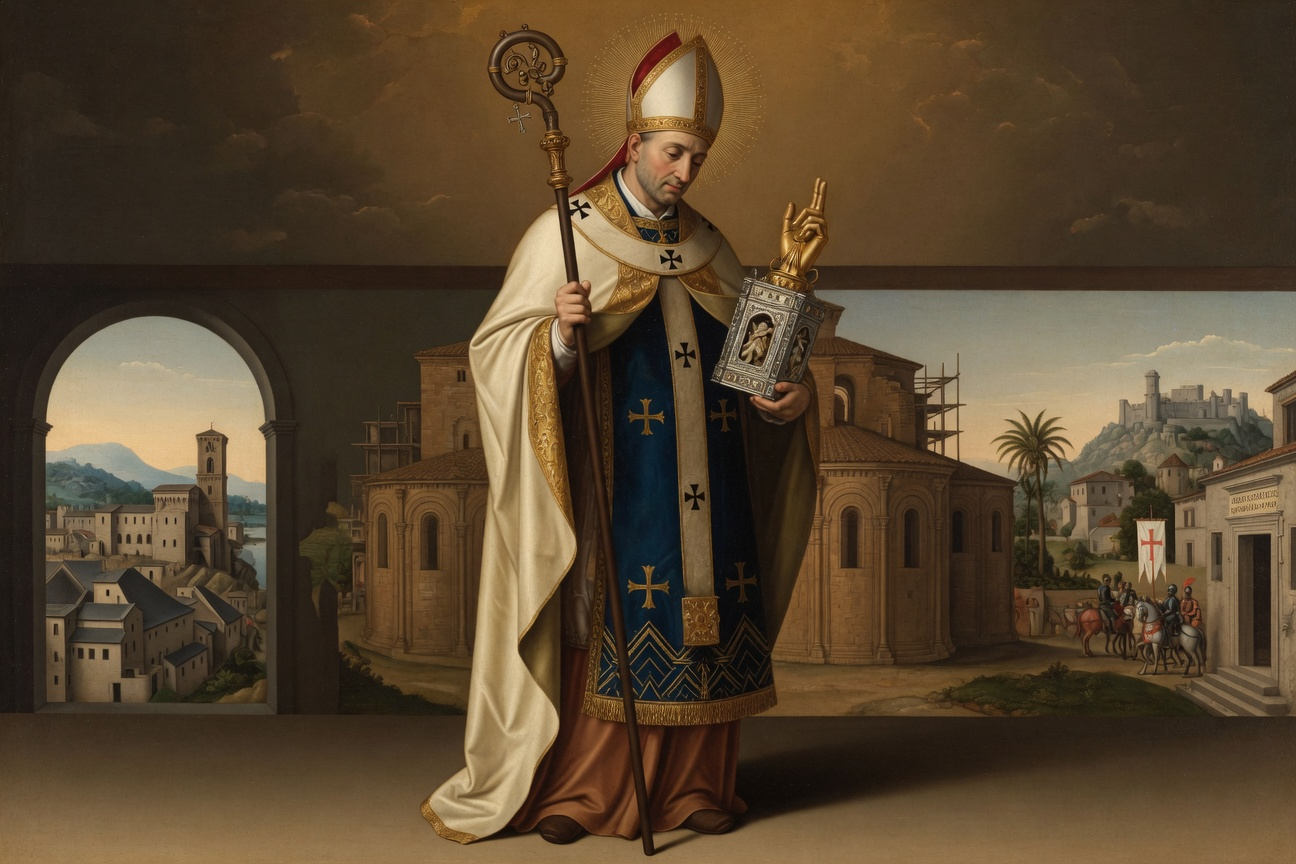
Born in Besançon, Gerland joined his Norman parents in Sicily to restore Christianity after the Arab occupation. Appointed Bishop of Agrigento in 1088, he rebuilt the cathedral and was distinguished by his charity toward the poor and his apostolic zeal. He died in 1100 after assisting Pope Urban II.
Guided reading
6 reading sections
SAINT GERLAND, BISHOP OF GIRGENTI
Origins and call to Sicily
Gerland, born in Besançon in the 11th century, joined his Norman relatives Robert Guiscard and Roger in Sicily to assist in the restoration of the Catholic faith following the Arab occupation.
Gerland Gerland Bishop of Agrigento of Burgundian origin, who played a role in the rechristianization of Sicily. belonged by his family to the nation of the Allobroges. He was born in Besançon at the beginning of the 11th century, to parents distinguished by their fortune and piety. While he was living peacefully under the paternal roof, two Norman princes to whom he was united by ties of blood, Robert Guiscard and Roger Count of Sicily who expelled the Saracens. Roger, were embarking on a distant and perilous expedition: it was nothing less than to free Sicily from the yoke of the Arabs, who had made themselves masters of it in 828. This enterprise succeeded; little by little the two young conquerors had gained ground, and, by the year 1086, the Catholic faith began to flourish again in this unfortunate land. It was then that Robert and Roger called our Saint to them; he could be of great use to them, whether because of his eminent virtues or his talents. Gerland had a noble heart, broad views, an admirable integrity of morals, and a speech that was easy and strong. He had, moreover, just been honored with the priesthood, a circumstance that could only enlarge the circle of his influence and his action. Immediately after his arrival in Sicily, Count Robert attached him to the cathedral of Catania in the capacity of chaplain; a little later, he was primicerius of the chapter; finally, upon the invitation made to him by the chief pastor, he left this new post to become grand cantor of the cathedral of Melit. Our Saint did not remain long in this city; the dreadful dissolution that reigned there inspired in him such a deep disgust for the world that he hastened to return to Burgundy, with the resolution to live in solitude. God, who had particular designs for his servant, did not permit him to execute his plan. Recalled to Sicily by Count Roger, who urged him strongly, he felt he must overcome his reluctance and set out to sea again.
Episcopate in Agrigento
Consecrated Bishop of Agrigento in 1088, he rebuilt the cathedral in a secure location and stabilized the legal boundaries of his diocese with the support of Count Roger.
The Sovereign Pontiff then had to provide a bishop for the church of Agrigento; Gerlan Gerland Bishop of Agrigento of Burgundian origin, who played a role in the rechristianization of Sicily. d was consecrated and sent immediately to this part of the Lord's vineyard. This occurred at the end of the year 1088. One can easily imagine what there was to do in a diocese where barbaric oppressors, who were at the same time the sworn enemies of Christ, had resided for nearly three hundred years. The first care of the new bishop was to restore the ancient cathedral, which Libertinus, one of his predecessors, had built, and of which only ruins remained. But as Sicily was not yet entirely delivered from the presence of the Saracens, Gerland took the precaution of moving this church to the highest part of the city, next to a fortified castle, so that it would henceforth be sheltered from their devastations. This important work, as well as the construction of the episcopal palace, occupied him for no less than six years. Persuaded that he could only work effectively for the spiritual good of his diocese after having removed all material obstacles, Saint Gerland expressed to Roger, at about the same time, the desir e to Roger Count of Sicily who expelled the Saracens. know with certainty the limits of his jurisdiction. The Count, feeling himself how important it was to prevent conflicts in the new district he was organizing in his capacity as legate, hastened to respond to his wish and had a diploma issued to him in due form.
Nothing more was needed to reassure our Saint; however, a few years later, the Pope wrote to him again on this subject. His letter, dated the 6th of the Ides of October 1099, is less an act of pontifical authority than a confidence and a testimony of esteem addressed to the Bishop of Agrigento.
Pastoral Virtues and Charity
The saint distinguished himself by his zeal for the conversion of the Saracens and Jews, as well as by his total devotion to orphans and widows.
Amidst all the cares brought upon him by the temporal administration of his diocese, our Saint practiced the zeal and charity of the Good Shepherd. Not content with announcing the word of God to those who had the right to receive it from him, he sought out the Saracens and Jews everywhere, brought them to private discussions, and baptized them himself once he had converted them. His successes, whether in pastoral instructions or in conferences with the infidels, were truly marvelous. Persuaded that the bishop, "placed like a sentinel on the walls of Jerusalem," needs to have eyes everywhere, he exercised a continual vigilance over his flock. Gerland also knew that the Apostle recommends the bishop to be "the model of others in conversation, in the manner of acting with one's neighbor, in chastity and in faith"; he had meditated on this advice and practiced it to the letter. But what seemed to be closest to his heart above all else was the duty of charity; one could say that he lavished alms rather than merely giving them, and that his title of bishop was in some way eclipsed by the touching title of foster father to orphans and widows.
Death and prophecy
After a journey to Rome to see Urban II, Gerland died in 1099 after prophesying his own end while passing through Calabria.
It was in the midst of these works and in the practice of all these virtues that our Saint died. He had been governing the church of Agrigento for eleven years when he was called to Rome, apparently due to the illn ess of Ur Urbain II Pope who preached the First Crusade. ban II. After witnessing the final moments of this great Pope, for whom he had a filial veneration, he hastened to return to Sicily. While passing through Bal nearia, t Balnearia Town in Calabria where Gerland stopped before his death. oday Bagnara, a city in Calabria, he wished to visit the bishop of that diocese, named Dragon. This prelate welcomed him with honor; he even initially conceived the hope of keeping him for a few days; but our Saint was eager to see his flock again: he set off again almost immediately, and said, upon leaving, to the bishop of Balnearia, to please pray for the soul of Gerland, when he would learn of his death. This word was a prophecy; on February 25 of the following year, Saint Gerland was to receive in heaven the reward promised to the faithful servant. A sweet odor, which spread immediately throughout the episcopal palace, testified that his death had been precious in the eyes of God; the funeral honors that the bishops and priests of Sicily came in crowds to pay him were, in a way, the first fruits of the cult that the Church later granted him. His body was placed in the choir of the cathedral of Agrigento, and, a few years later, this cathedral was placed under the patronage of Saint Gerland.
Cult and reliquaries
Venerated in Sicily and Besançon, his relics are the subject of solemn translations and persistent popular devotions.
Gerland is mentioned as a Saint, under the dual title of bishop and confessor, in several martyrologies. We shall cite in particular those of Cajetan (Lives of the Sicilian Saints. Palermo, 1657) and of Melanna. The miracles that were performed at his tomb increased the devotion of the faithful towards him. A chapel was dedicated to him in the very church he had built, and, each year, two days were specially consecrated to honoring his memory: the first, February 25, which is that of his blessed death; on that day, his arm, enclosed in a silver reliquary, and his pastoral staff were exposed; the other, March 20: it commemorated the solemn translation of his relics, which took place in the latter half of the 14th century. Even today, fragments of the body of Saint Gerland are venerated in Palermo, and the Sicilians have not ceased to give him marks of their trust and love.
In France, the Besançon Breviary provides his office under the semi-double rite. His name is found in the litanies of the diocese of Besançon.
Life of Saint Caesarius
The text also recounts the life of Caesarius, an imperial physician and brother of Gregory of Nazianzus, who renounced the world after surviving an earthquake.
Saint Caesari Saint Césaire Physician, brother of Gregory of Nazianzus. us, brother of Saint Gregory of Nazia saint Grégoire de Nazianze Doctor of the Church who delivered the eulogy for Leontius. nzus and Saint Gorgonia, born around the year 320, went to study at the famous school of Alexandria, and applied himself with success to eloquence, philosophy, and especially medicine, for which he had a remarkable taste and aptitude. Still very young, he already eclipsed the most famous physicians of his century. Before returning to his homeland, he wished to spend some time in Constantinople, in order to perfect himself more and more in the profession he had chosen. His merit and his fine qualities won him public esteem and consideration, to the point that the Emperor Constantius offered him, if he would settle in the capital, an illustrious alliance, as well as the dignity of senator, and the title of his chief physician; but the desire to return to his country, joined to the entreaties of his brother Gregory, who had come to meet him as far as Constantinople, made him refuse these magnificent offers. He therefore returned to Nazianzus, and dedicated the first fruits of his art to the relief of his compatriots. Subsequently, he formed the plan of returning to Constantinople, but Saint Gregory, his father, Saint Nonna, his mother, and his brother, tried to dissuade him, for fear that the air of the court might be prejudicial to his salvation. Caesarius did not believe their apprehensions were well-founded, and went to the capital, where he acquired the most brilliant reputation in a short time. Jul Julien l'Apostat Roman emperor and persecutor of Christians. ian the Apostate, who esteemed him singularly, made him his chief physician, and always excepted him in the edicts he issued against the Christians. He would have liked to win over to his cause a man of such rare merit, and tear him away from Christianity; but Caesarius was unshakable in his attachment to the faith, and he generously repelled the attempts at apostasy and the seductive caresses of the emperor. However, the Christians of Nazianzus murmured to see the son of their bishop in a court full of idols and in the retinue of an apostate emperor. The father had so much sorrow from this that life seemed unbearable to him. As for the mother, everything was carefully hidden from her, for fear that she would be overwhelmed by it. Gregory wrote a touching letter to his brother to urge him to return: following this letter, he left the court, where he did not reappear until under Jovian and Valens, who both honored him with their confidence. The latter made him treasurer of his domain, then intendant of Bithynia. Saint Gregory, his brother, and Saint Basil, his friend, often wrote to him to urge him to leave the world, so as to live only for God. Caesarius received these advices very well, but he was in no hurry to put them into execution. Providence used, to break the bonds that held him in the world, the earthquake that occurred in 368 in Nicaea where he resided, and from which he escaped only by a kind of miracle, having been buried under ruins, from which he was pulled out slightly wounded. Saint Gregory and Saint Basil took advantage of this occasion to renew their entreaties. The latter wrote him a very pressing letter, in which he told him that he is obliged, more than any other, to give himself entirely to God, since He had just withdrawn him from death. Caesarius finally yielded, and prepared to receive the sacrament of regeneration, which he had not yet received, although he had already earned the glorious title of confessor of the faith. He wrote to his brother that he was going to leave the service of the king of the earth to serve only the king of heaven; but the Lord was satisfied with his pious resolution and did not give him time to execute it, having called him to Himself at the beginning of the year 369.
Saint Gregory delivered his funeral oration, and in the detail he gives of his virtues, he remarked that in the midst of honors he always regarded the advantage of being a Christian as the first of dignities and the most glorious of all titles. He also dwells on his disinterestedness and his generosity. Not only did he relieve the poor, but he showed himself liberal toward everyone. The goodness of his heart and his obliging manners made friends of all those who knew him. He practiced his profession without any view of gain, even with regard to the rich. He was the father of the poor, and besides the free care he devoted to them in their illnesses, he also distributed to them the greater part of his income, and instituted them as his heirs some time before his death.
Dictionnaire hagiographique de Migne et Rohrbacher.
Annexes & related entities
Structured data for exploration: events, miracles, quotes, places, attributes, patronages, and important entities cited in the text.
Key Events
- Born in Besançon at the beginning of the 11th century
- Arrival in Sicily to assist Robert Guiscard and Roger against the Arabs
- Appointed chaplain in Catania, then grand cantor in Melito
- Consecrated as Bishop of Agrigento in 1088
- Reconstruction of the cathedral and episcopal palace of Agrigento
- Assisted Pope Urban II during his final moments in Rome
- Died in Agrigento after 11 years of episcopate
Miracles
- Sweet scent spreading through the episcopal palace at his death
- Prophecy of his own death made to Bishop Dragon
- Miracles performed at his tomb
Quotes
-
Ut moriens viveret, vixit ut moriturus.
Epitaph cited as an epigraph