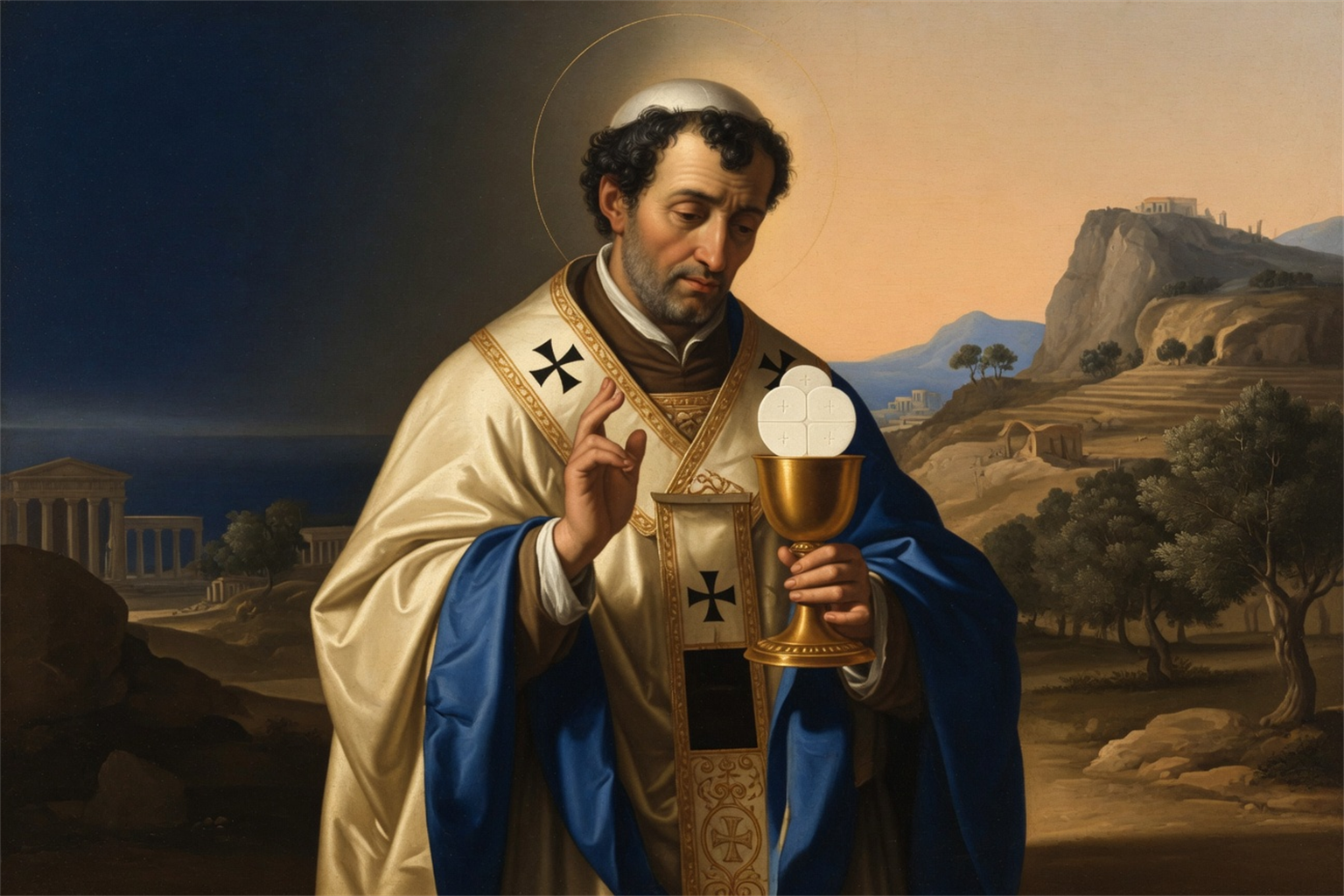
Of Greek origin and an anchorite on Mount Carmel, Telesphorus became pope in the 2nd century under Emperor Hadrian. He is famous for codifying the Lenten fast, instituting the Midnight Mass at Christmas, and introducing the Gloria into the liturgy. He died a martyr after vigorously fighting the early heresies alongside Saint Justin.
Guided reading
4 reading sections
SAINT TELESPHORUS, POPE AND MARTYR
Origins and election
Greek by birth and a former anchorite of Mount Carmel, Telesphorus settled in Rome and succeeded Pope Sixtus I during the reign of Emperor Hadrian.
"Beloved brothers, we have confidence that you keep the faith of the Apostles intact." Epistle of Sai nt Telesphorus t saint Télesphore Eighth pope of the Catholic Church, of Greek origin and a martyr. o the bishops of the cathedral. (Patrol. graeca, vol. V, col. 1061-1084.)
Saint Telesphoru Saint Télesphore Eighth pope of the Catholic Church, of Greek origin and a martyr. s was Greek by nation and an anchorite. It is a tradition, in the Carmelite order, that the place where he practiced the solitary life, before undertaking the preaching of the Gospel, wa s Mount Car mont Carmel Place of retreat for the hermits for whom the rule was written. mel, famous for the sojourn of the holy prophets Elijah and Elisha. Having come to Rome to work for the establishment of the Christian religion, he gave such visible marks of a consummate wisdom and holiness that, after the martyrdom of Saint Sixtus, the first of that name, he was put in his place and created Sovereign Pontiff, under the empir Adrien Abbot sent to England to restore monastic discipline. e of Hadrian.
Regulations and Liturgy
The holy pope codified the Lenten fast, instituted the midnight Mass for Christmas, and introduced the singing of the Gloria into the liturgy.
Among several fine regulations he made for the advancement of the Church, one of the principal ones was that of the forty-day fast before Easter, which we call Lent. It is not that he was the first author of this observance; for Saint Ignatius, martyr, who lived before him, makes mention of it in his Epistle to the Philippians; and it is the common sentiment of the Fathers of the Church that it is of apostolic tradition: many even speak of it as a thing of divine institution, in that Our Lord taught it to us by His example. But what this holy Pope did was to establish by decree what was kept only by the authority of tradition, and to reawaken the fervor of Christians who were beginning to slacken in this holy practice: one may see on this subject a very curious treatise concerning fasts, which Father Thomassin, so well known for his insight into ecclesiastical antiquity, gave to the public. It is also said that our Saint ordered that at the solemnity of Christmas, Mass would be celebrated in the middle of the night, whereas at other times, it was celebrated only at the hour of Terce, that is to say, around nine o'clock in the morning: which must be understood of the solemn Mass, and of what was most ordinarily done in the churches. He is also attributed with the command to sing the hymn of the angels: *Gloria in excelsis*, etc., before the action of the sacrifice. All these ordinances are reported in the * Liber pontificalis Liber pontificalis Primary historical source cited for this biography. *.
Defense of the Faith
Assisted by Saint Justin, Telesphorus vigorously combated the doctrines of Valentinus, Marcion, and Apelles, which threatened the unity of the Church.
During the time of this blessed pontiff, there arose three very pernicious heretics, namely: Valentinus, Marcion, and Apelles, whose impious and sacrilegious dogmas are recorded by Saint Epiphanius and by other ecclesiastical authors who have written on heresies. This apostolic man did not fail to combat them with all the vigor that could be expected from a head of the Church as learned and as pious as he was, and he was aided in this combat by the great Saint Justin, a Christian ph saint Justin Saint to whom the virtues of Misselin are compared. ilosopher, who also later presented to the emperors two excellent apologies to justify our holy religion against the crimes that the pagans imputed to it, driven as they were by their own malice and by the diabolical doctrine and corrupt morals of these heretics who passed themselves off as Christians. Finally, Saint Telesphorus, after having governed the Church for eleven years, three months, and twenty-two days, was crowned with a most glorious martyrdom, as Saint Irenaeus expressly states. He had performed ordinations three times in the month of December, and created twelve priests, eight deacons, and thirteen bishops. His body w as buri Vatican Burial place of Saint Gelasius. ed at the Vatican, near that of the Prince of the Apostles, and his memory is celebrated in the Church on the very day of his martyrdom, according to the order of the breviary reformed by Clement VIII.
Martyrdom and cult
After an eleven-year pontificate, he died a martyr and was buried at the Vatican. His traditional iconography recalls his institution of the three Christmas masses.
Saint Telesphorus is depicted with a chalice surmounted by three hosts, to recall that he instituted the practice of saying three masses on Christmas Day. The Roman Martyrology mentions him on this day, after the vigil of the Epiphany, as do those of Bible and Umari, and generally all the authors who have written the lives of the sovereign Phaidons. Zegon of Paul, sub-prior of the Carmelites of Cologne, composed the life of our Saint with notes, and Rolandus dates it to January 5th.
Annexes & related entities
Structured data for exploration: events, miracles, quotes, places, attributes, patronages, and important entities cited in the text.
Key Events
- Solitary life as an anchorite on Mount Carmel
- Arrival in Rome for the establishment of the Christian religion
- Election as Sovereign Pontiff after the martyrdom of Saint Sixtus I
- Regulation of the Lenten fast
- Institution of the Midnight Mass at Christmas and the singing of the Gloria in excelsis
- Struggle against the heretics Valentinus, Marcion, and Apelles
- Martyrdom after a pontificate of 11 years, 3 months, and 22 days
Quotes
-
Beloved brothers, we have confidence that you keep the faith of the Apostles intact.
Epistle of Saint Telesphorus to the bishops