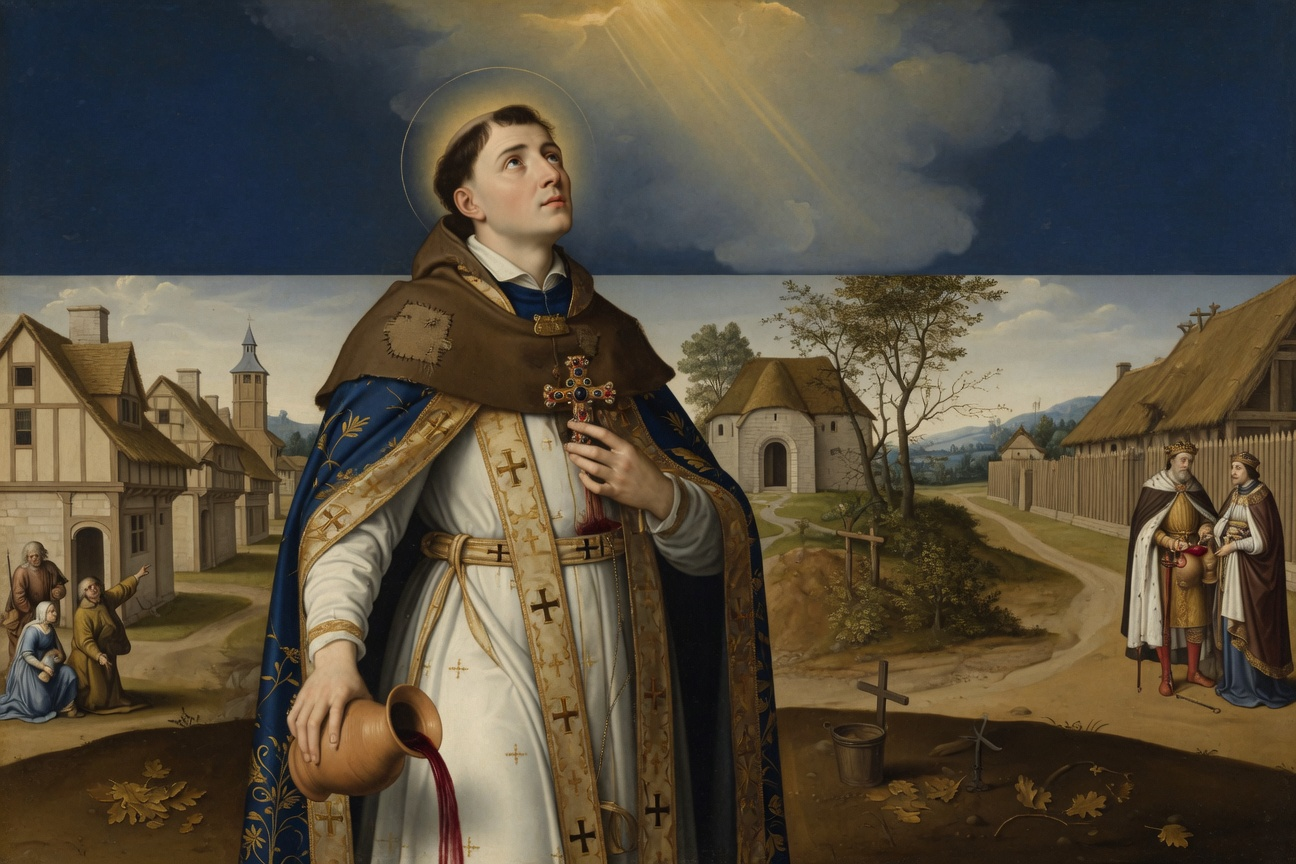
A 6th-century priest from Troyes, Victor retired as a hermit near Plancy. Renowned for his charity and miracles, notably the transformation of water into wine for a king, he experienced celestial visions. His cult was promoted by Saint Bernard of Clairvaux, who composed his office.
Guided reading
6 reading sections
SAINT VICTOR OF PLANCY, PRIEST AND HERMIT
Origins and childhood
Born in Troyes in Champagne in the 6th century, Victor manifested his holiness even before his birth and distinguished himself by his early charity.
6th century. Like Saint Victor, let us put a curb on our tongue and our temper; let us sleep little, let us pray much. Saint Bernard, Ser m. Vic Victor 6th-century priest and hermit in the diocese of Troyes. tor, whose beautiful name accords very well with his triumphs, has the advantage of having had a great Saint who worked to make him known; this is the pi ous Saint Ber saint Bernard Abbot of Clairvaux and spiritual master of Raoul. nard, from whom we have two panegyrics pronounced in his praise. He was born i Troyes Episcopal see of Manasses. n Troyes, in Champagne. While he was still in his mother's womb, a man possessed by a demon cried out publicly: "Victor, the saint of God, why do you torment us before your birth?" From his childhood, his actions were accompanied by a great maturity of spirit, and he was so charitable towards the poor that he often distributed to them the best part of what was given to him for his food and his upkeep.
Eremitic life and royal miracle
After his ordination, he retired as a hermit near Arcis where he received a visit from the king and changed water into wine.
As soon as he reached the age prescribed by the Canons to receive Holy Orders, he was ordained a deacon, and then a priest. He first devoted himself to preaching; but, wishing to renounce the world entirely, he abandoned his parents and retired to the ter ritor Arcis Principal site of the saint's ministry and martyrdom. y of Arcis, near a village called Saturniac, in the same diocese of Troyes. There, he built himself a hermitage, in which he began a life so holy that he spent his days and nights in prayer, fasting, and penance. His reputation, spreading throughout France, reached the ears of the king, who resolved to go and find him in his solitude, to have the consolation of seeing such a holy man. Victor, warned of his visit, came to meet him, and, after both had greeted each other with a kiss of peace, they entered the hermitage, where the Saint asked the prince to take some refreshment; but as he found only a little water, he had recourse to God, and kneeling down: "Lord," he said, "whose power is infinite, bless this vessel, and fill it with your heavenly dew, so that, as our fathers were satiated with manna in the desert, we may be filled with the gift of your blessing"; then he made the sign of the cross over the vessel, which was at the same time filled with excellent wine; the king drank of it with his escort, who could not cease to admire the goodness of the Almighty.
Miracles and celestial visions
The saint performs healings, delivers a possessed man, and is granted visions of celestial glory and the cross.
The entire life of Saint Victor was a continuous series of miraculous actions, which Saint Bernard reported succinctly in the first sermon he gave for his feast day. One day, when he had sent laborers to sow wheat in a field, one of them hid two bushels to steal them; immediately he was possessed by the demon with such fury that smoke mixed with flames came out of his throat, to show that, through his sin, his body and soul had become like a hell. The Saint, seeing him come toward him, had compassion on him, and, making the sign of the cross over him, delivered him. This poor man, recognizing that this misfortune had happened to him because of his theft, confessed his fault with tears and made restitution.
Historians of his life report that God granted him an extraordinary favor. He had once held at the baptismal font the young lord of Cupidini, today Queudes (Marne), four and a half leagues from Plancy. For a long time, Queudes Place of the saint's death. the noble gentleman had pressed Victor to honor his ancient castle with his presence: the holy priest finally yielded to his repeated requests. It was a Sunday: Victor was heading toward the neighboring church to attend the divine office. Suddenly he stopped: the heavens had just opened before him; he was enjoying the beatific vision and he heard something of those angelic harmonies, such as the ear of man has not heard since the apostle Saint Paul. It is undoubtedly in memory of this marvelous event that the church of Queudes chose him as its patron and that he is held in the greatest veneration there.
Another time, during his prayer, which he usually performed at night, he saw the heavens opened, and, in the middle, a beautiful golden cross, enriched with several precious stones brighter than the stars of the firmament. As he contemplated this wonder, he heard a voice that said to him: "The diamonds that you see are the souls of the Saints who, for the love of their Lord, have washed their robes in the blood of the Lamb." From that time on, his soul was so far removed from the earth and enraptured in heaven that he renounced all kinds of communication and commerce with the world, in order to attach himself solely to his sovereign good.
Death and eulogy of Saint Bernard
Victor died on February 25; Saint Bernard of Clairvaux delivered his panegyric, emphasizing his continued intercession.
After having continued the rest of his days in a perfect recollection of his senses, he finally rendered his soul into the hands of his Creator, on February 25, in the 6th or 7th century, and, to use the terms of Saint Bernard: "It was then that Saint Victor ascended victorious into heaven, to receive, from the hand of his Lord, the crown of victory. Placed in heaven, he now contemplates God openly. He swims in an ocean of delights; but he is still occupied with us. The land of the saints that he inhabits is not a land of forgetfulness. Heaven does not cool hearts; it makes them, on the contrary, both more tender and more compassionate; it communicates a new activity to their affections. The angels, although they see the heavenly Father unceasingly, nonetheless fly to our aid. How then could we be forgotten by those who have been like us, and who have passed through the miseries under the weight of which we groan? No, no, I know that the just await that I receive the reward. Victor is not like the cupbearer of Pharaoh, who thought no more of Joseph when he had left prison. He has not taken the crown of glory to close his bowels to our ills..."
Translation of relics and devotion
His remains were transferred from Saturniac to Montieramey, then Arcis, becoming the object of popular fervor and miracles of liberation.
## RELICS AND TRADITIONS.
He was buried at Saturniae, today the Saint-Vitre chapel, which is a corruption of the word Victor: a church was built there over his tomb. In 837, his body was transferred to the monastery of Montier monastère de Montieramey Monastery to which the saint's relics were transferred in 837. amey, in the diocese of Troyes, then in 1791 to Arcis-sur-Aube. His relics are found, today in 1872, in the village church of Montieramey. His tomb has been celebrated for several miracles. It is said, among other things, that a prisoner having secured his seal, heavily laden with irons, and having approached the Saint's sepulcher, his chains broke in an instant and he found himself at liberty.
Such was the confidence of the people in Saint Victor that they would commend themselves to him for the slightest indispositions. They would go to drink water from the river near his hermitage, and often the sick would return healed. People wanted Saint Victor to be the protector of every family: thus, they took care to give his name to one of their children. There is not a farm, a wood, situated in the vicinity of the hermitage, and even a street in Plancy, that is not under his protection. The statue from his chapel has been given a place of honor in the parish church, and to satisfy the devotion of all even more completely, a notable relic (the right arm of the Saint, bras droit du Saint Distinguished relic exposed annually for veneration. detached from the rest of the body) is exposed each year to the veneration of the faithful.
Toponymic studies and historical sources
Analysis of associated place names (Saint-Vitre, Villeneuve-Saint-Vistre) and a survey of ancient hagiographic sources.
We had asked M. de Juhainville, archivist of the Aube department, whether the Vitrys that exist in France, and particularly Vitry-le-Français, might owe their name to saints by the name of Victor.
This scholar replied: "The Gallo-Roman form of the name of the many Vitrys that exist in France is Victoriacum, that is to say, the property of Victor or Victorius. Vitré and Vitrey are variants of Vitry. There is no reason to assume that these Roman landowners named Victor or Victorius are identical to the saint venerated in the Aube."
It did not seem doubtful to us, however, that Saturniae, where the hermitage of Saint Victor was located and which later took the name of Saint-Vitre, and the commune of Villeneu ve-Sa Vitre 6th-century priest and hermit in the diocese of Troyes. int-Vistre, owed this name to the alteration of the word Victor. This filiation seemed all the more apparent to us as our saint is vulgarly called Vitre and formerly Victre. We referred the matter to M. Latore, a professor at the Grand Seminary of Troyes, who had the kindness to send us the following information on February 12, 1872:
"1st Saturniacus is a destroyed village, if this village is not Saint-Saturnin (Marne).
"2nd Villeneuve-Saint-Vistre (Marne, eleven kilometers from Sézanne) has precisely Saint Victor as its patron.
"3rd The Saint-Vitre or Victor, of whom Baillet and Higne speak, and whom they place three leagues from Arcis, is a small chapel called the Penance of Saint-Victre, one kilometer from Plancy-sur-Aube and three leagues from Arcis. One must not confuse the chapel of Saint-Vitre with the village of Villeneuve-Saint-Vistre, which is quite far from it, as you can verify by taking a glance at the General Staff map.
"4th You know the reason why some moderns have given Saint Victor the surname of Plancy: it is because the chapel or Penance of Saint-Victre is located one kilometer from the territory of Plancy, towards the village of Saint-Saturnin.
"5th One still finds the head of Saint Victor in the church of Montieramey. The abbey is completely destroyed: there are, moreover, fragments of his relics at Chervey, at Pruguy, at Neuville, etc.
Saint Bernard composed a proper office for Saint Victor, at the request of Abbot Guy and the other religious of Saint Bernard Abbot of Clairvaux and spiritual master of Raoul. Montieramey, as he himself says in the conciliatory epistle add ressed t abbé Guy Abbot of Montieramey for whom Saint Bernard composed the office of Saint Victor. o the same abbot. The Roman Martyrology, along with that of Umard and the additions of Molanus, commemorates him on this day. His life, written by a very ancient anonymous author, is found in Bollandus Bollandus Monumental hagiographic collection by the Bollandists. ; and the heart of the Guerrois reports it in French in his Ecclesiastical History."
Annexes & related entities
Structured data for exploration: events, miracles, quotes, places, attributes, patronages, and important entities cited in the text.
Key Events
- Birth in Troyes announced by a possessed person
- Ordination as deacon then priest
- Eremitic retreat in the territory of Arcis (Saturniac)
- Royal visit and the miracle of the wine
- Vision of the open heavens and a golden cross
- Translation of relics to the monastery of Montieramey in 837
Miracles
- Changing water into wine for the king and his escort
- Deliverance of a possessed plowman after a theft of wheat
- Vision of the golden cross and angelic harmonies
- Healings through water from the river near his hermitage
- Miraculous liberation of a prisoner near his tomb
Quotes
-
Lord, whose power is infinite, bless this vessel, and fill it with your heavenly dew
Prayer of Saint Victor reported in the text -
Victor is not like the cupbearer of Pharaoh, who thought no more of Joseph once he was out of prison.
Saint Bernard, Sermon