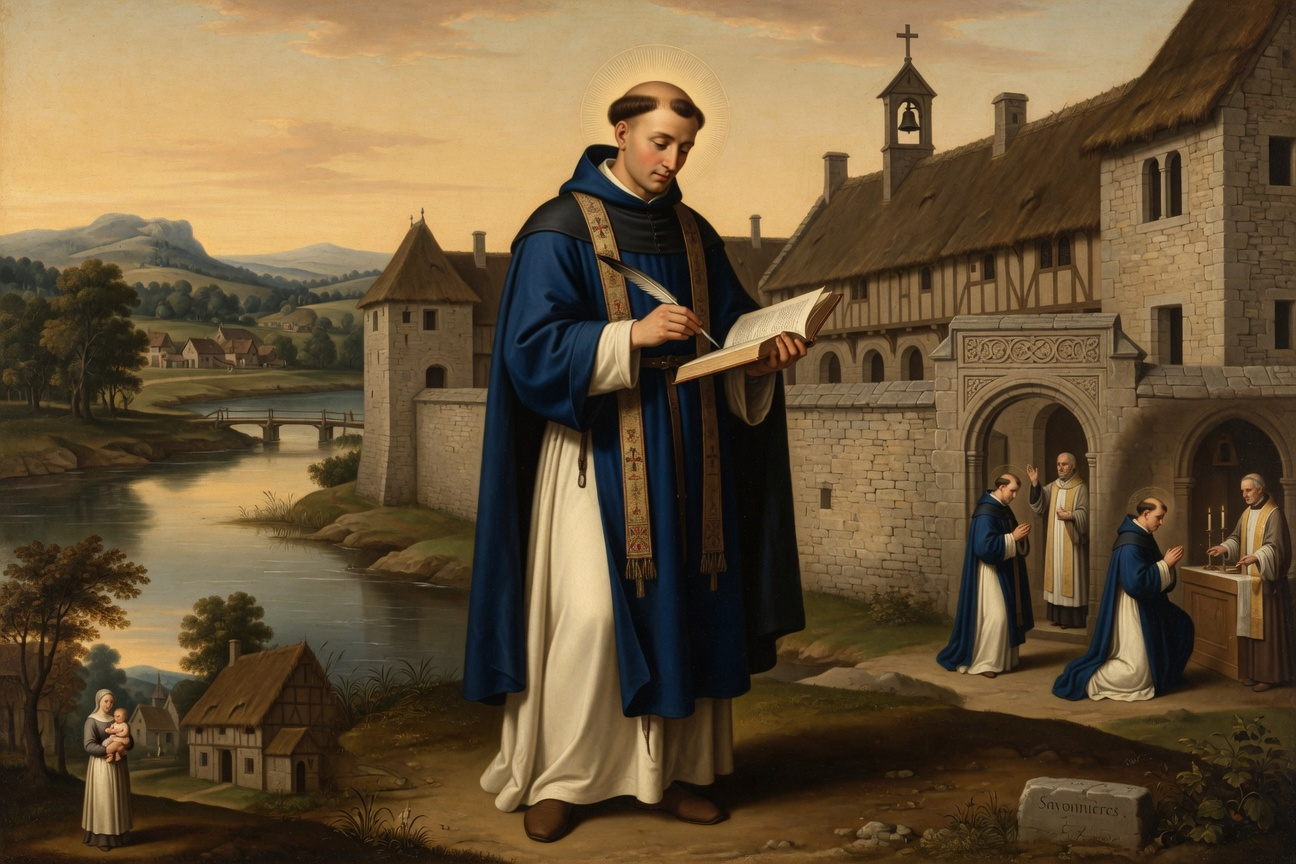
Abbot of the monastery of Saint-Calais in the 7th century, Siviard succeeded his own father as head of the community. Known for his humility, scholarship, and piety, he is the author of a life of Saint Calais. He died in 687 during the reign of Theuderic III.
Guided reading
6 reading sections
SAINT SIVIARD, ABBOT OF SAINT-CALAIS
Origins and formation
Siviard was born in Maine into a noble and pious family, distinguishing himself from his youth by his humility and his balance between secular studies and divine wisdom.
His last word to his religious was: Perseverans.
Saint S iviard was bo Saint Siviard Abbot of the monastery of Saint-Calais and hagiographer. rn in the l and of Maine, pays du Maine Region where Almire settled as a hermit and later as an abbot. in the first half of the 8th century, to parents equally illustrious for the nobility of their race and the brilliance of their virtue. His father, who was a great-nephew of Saint Bertrand, Bishop of Le Mans, w as name Sigiram Father of Siviard and his predecessor as abbot. d Sigiram, an d hi Adda Mother of Saint Siviard. s mother Adda. From his youth, he gave great signs of the holiness to which God had destined him; for far from spending his time in the amusements ordinary to that age, he employed it in prayer, retreat, and study; and, however young he was, one saw in all his actions only the maturity of an old man. He knew from then on how to combine the spirit of devotion with the application required by human letters, so that he was filled with the lights of divine wisdom, at the same time that he learned the human sciences. It is noted, however, that, enlightened as he was, he never followed his own thoughts until after having them approved by the most skillful masters he could consult: he showed, by this submission, the low opinion he had of himself, and how eminent his humility must have been, since he established it on such a solid foundation.
Entry into religious life
Rejecting the vanities of the world, he joined the monastery founded by Saint Calais on the Anisole to dedicate himself entirely to the service of Christ.
All the fine knowledge of this young man served only to convince him more strongly of the vanity of earthly things, and of the sweetness tasted by those who dedicate themselves entirely to the service of Jesus Christ. He resolved to follow the counsel of the Gospel to the letter, and to embrace the religious state in the monastery that S aint Calais saint Calais Founder of the monastery of Anisole. had founded the previous century, on the Anisole river, in rivière d’Anisole Site of the foundation of Saint Calais's main monastery. the land of Maine: preferring to live hidden in a cloister, to please God alone, rather than to be exposed to the storms in which persons of high station often suffer shipwreck.
Monastic life and priesthood
Having become a priest, he became a model of fervor, charity towards the sick, and ascetic discipline for his brothers.
As soon as he saw himself clothed in the holy habit of religion, he redoubled his fervor, and he made such great progress in virtue that the religious, who looked upon him as a model of perfection, chose him to be ordained a priest, so that he might serve them all as a spiritual father. Indeed, an extreme gentleness, joined to a profound humility, made him lovable to God and to men. He was always of an even temper, composed in all his actions, edifying in his conversation, zealous for the observance of the rule, and prompt to render service to everyone; he sympathized with the sufferings of his brothers, and tried to console those he knew to be in sadness; he was assiduous in prayer, and performed it with such fervor that he sometimes shed torrents of tears; he visited the sick and encouraged them so much to patience that they remained entirely consoled by his pious conversations; his abstinence was almost continuous; he often spent the nights in prayer; he was so restrained in everything he said that he never offended anyone with his words. His care to keep his chastity inviolable was so great that it can be compared to that of the angels. Finally, to use the terms of his historian, all the virtues, like so many precious stones, seemed to be united in him to make his holiness shine forth.
Government and end of life
He succeeded his father Sigiram as abbot, leading the community with wisdom before dying in 687, assisted in a vision by the apostles Peter and Paul.
Whatever effort the blessed Siviard made to remain hidden from the eyes of men, the great graces with which God had anticipated him, and the talents that made him capable of governing others, could not remain undiscovered; this is why, after the death of Saint Sigiram, his saint Sigiram Father of Siviard and his predecessor as abbot. father, who was abbot of this same monastery, where he had retired after the death of his wife, and where he had lived so holily that his memory has since been marked in the Martyrologies of several churches in France on December 4th, the religious cast their eyes upon our Saint to give him the leadership of this house. History teaches us nothing particular about what he did during this superiorship; but it tells us in general that he discharged it very worthily, by nourishing the souls of his brothers with entirely heavenly food, and by embellishing the monastery with the splendor of a very exact observance. It was in the exercise of these holy functions that he happily completed the course of his life, at a very advanced age. At his death, one of the brothers saw his holy soul, all shining with light, between the princes of the Apostles Saint Peter and Saint Paul, who were leading it to heaven.
He passed away on March 1st, in the 8th year o Thierry III King of the Franks who made donations to Saint Condedus. f the reign of Theuderic III, son of Clovis II, and in the year of Our Lord 687.
Burial and posterity
Interred at Savonnières, his relics were later transferred to Sens to protect them from the Norman invasions.
The body of Saint Siviard was buried at th e monastery of Savonnièr monastère de Savonnières Monastery founded by Siviard and the site of his first burial. es which he had founded, in the place where a chapel bearing his name could be seen long afterwards, at the southern extremity of Saint-Georges-de-Couée. As for his relics, they were transported t o Se Sens Archiepiscopal see occupied by Saint Aldric. ns at the time of the Norman invasion.
Work and sources
Siviard left a biography of Saint Calais, considered a major historical monument of Maine, and appears in the principal martyrologies.
Saint Siviard distinguished himself by his taste for letters; he left a life of Saint Calai vie de saint Calais Hagiographical work written by Siviard. s, a remarkable monument among all the legends written in the 6th century, and one of the most beautiful pages in the history of Maine.
The Roman Martyrology and those of several churches and monasteries make mention of Saint Siviard on this day. His life was written by a religious of Saint-Calais, who had been an eyewitness to his virtues. Su rius r Surius Hagiographer and compiler of saints' lives. eported it in his second volume of the Lives of the Saints; and the continuators of Hollandus in the 1st of the month of March.
Annexes & related entities
Structured data for exploration: events, miracles, quotes, places, attributes, patronages, and important entities cited in the text.
Key Events
- Born in the Maine region
- Entered the monastery founded by Saint Calais on the Anisole
- Priestly ordination
- Election as abbot following his father Sigiram
- Writing of the life of Saint Calais
- Foundation of the monastery of Savonnières
- Died in the 8th year of the reign of Theuderic III
Miracles
- Vision of his soul being led to heaven by the apostles Peter and Paul at his death
Quotes
-
Persevering
Last words to his monks