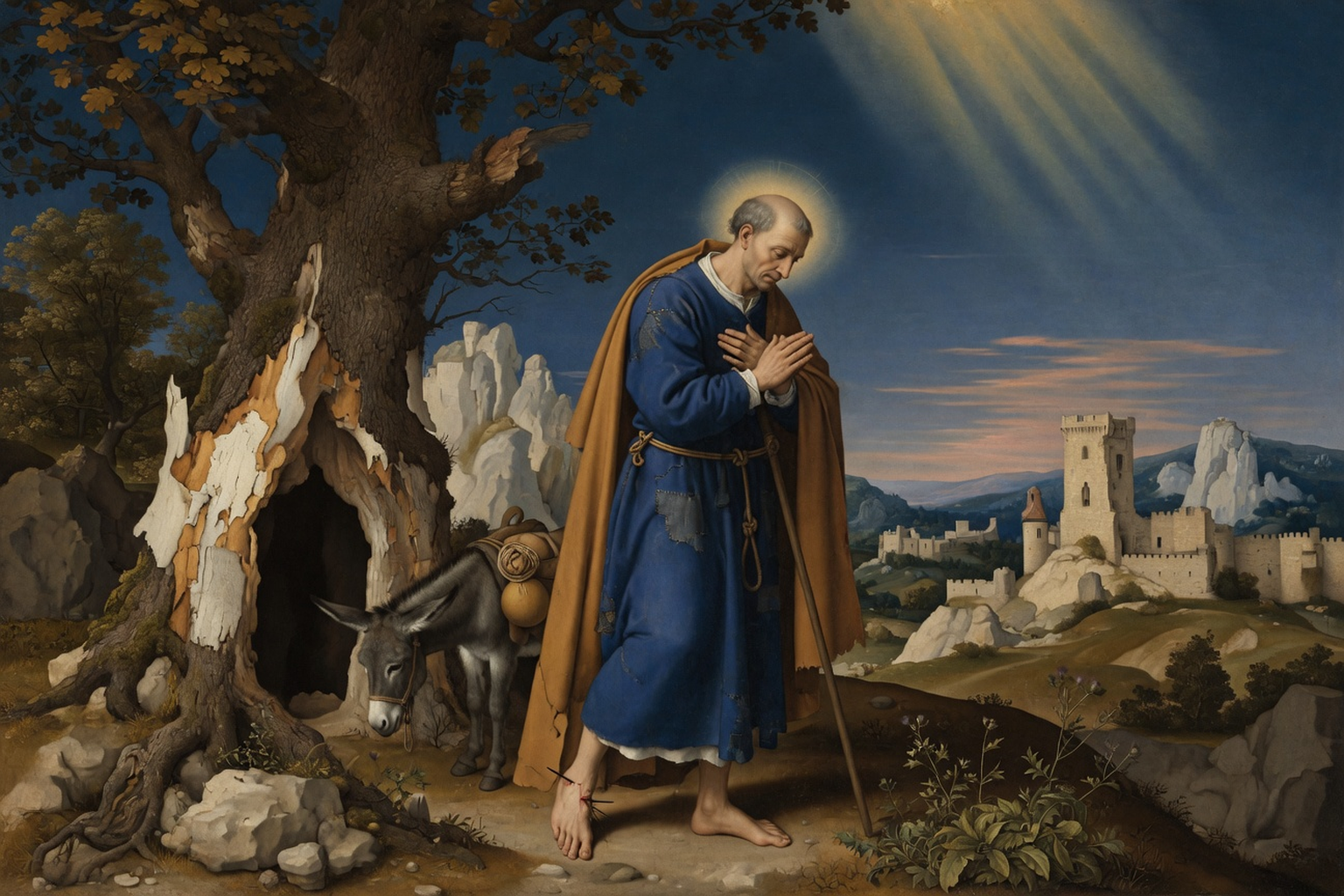
A former knight of Limburg in the 12th century, Gerlac converted after the sudden death of his wife. After seven years of penance in Jerusalem, he lived as a hermit in the hollow of an oak tree in Houtem, practicing extreme mortifications. His sanctity was confirmed by miracles and a vision of Saint Hildegard.
Guided reading
9 reading sections
SAINT GERLAC, PENITENT
Context and military youth
Gerlac, a nobleman of Limburg in the 12th century, leads a life of a soldier and disorder under the authority of Goswin II.
Died circa 1170. — Pope: Alexander III. — Emperor of Germany: Frederick I (Barbarossa).
Quam bonum est correptum manifestare poenitentiam. How salutary it is that the tried man should bear witness to repentance and do penance! Beoli., xx, 4.
It is so rare and so difficult to change one's ways when vice has strengthened with age, that we may consider this story as one of those signal wonders of grace which are so extraordinary that they surprise everyone when they occur. The blessed Gerlac was a gentleman from th e land of Valkenberg Le bienheureux Gerlac 12th-century hermit and penitent, former soldier. or Valkemburg, which we call Fauq uemont, in Valkenberg Place of origin of Saint Gerlac in Limburg. Limburg; he followed the profession of arms during his youth. Goswin II, known in history for his brutal valor, was then lord of Heynsberg and Fauquemont. Gerlac accompanied him on some of his expeditions, which were usually nothing more than brigandage. A soldier in this army, he soon gave himself over to all pleasures and threw himself into all manner of disorder. But God, who, in the impenetrable order of predestination, had chosen him to be an admirable example of penance, touched his heart so deeply in the midst of his pleasures that he changed his life entirely, and lived in the manner we are about to see.
Conversion and penance in Jerusalem
Struck by the death of his wife during a tournament in Juliers, he converted and went to serve the poor at the hospital in Jerusalem for seven years.
Gerlac, who was a master of the camp of a cavalry regiment, passionately loved tournaments. One day, he had planned with other gentlemen to amuse himself in the city of Juliers; but, as he was clad in his armor, lance in hand and ready to joust, news was brought to him of the death of his wife. It was a thunderbolt; he was so struck by it that, divine grace making him realize at the same moment the inconstancy and vanity of earthly things, he laid down his arms, dismounted from his horse, and, in the presence of the entire assembly, which was composed of an innumerable multitude of people, he made a sacrifice of them to God and protested that he was abandoning them forever, in order to follow Jesus Christ perfectly. Then he mounted a donkey, following the example of our divine Savior, and returned to his house. After settling all his domestic affairs, he donned a hair shirt on his bare skin, took an iron corset, and set out on his way, barefoot, to visit places of piety and devotion. He went to Rome to receive absolution for his sins. He made his general confession at the feet of Pope Eugene III, who imposed upon him as his penance to g o and serve the pape Eugène III Pope who transferred the relics of Saint Vannes in 1147. poor at the hospital in Jerusalem for seven years.
The holy penitent accep ted this satisfactio hôpital de Jérusalem Holy city where the Cross was lost and subsequently recovered. n with a glad heart and discharged it with very profound humility. But, seeing that the officers of the hospital, who had recognized from his face and bearing that he was a man of quality, did not wish to assign him to the lowliest ministries, he begged them insistently not to spare him, and judging himself unworthy to serve the members of Jesus Christ, he asked for and obtained, by dint of prayers, that he be given the care of the swine and other livestock. Going through the fields, he one day wounded his foot so severely that he suffered great pain from it; the Saint, remembering that, in his childhood, he had kicked his mother with that same foot, gave thanks to God for chastising that part of the body which, in the past, had served to offend Him; he had an ulcer in the same spot for the rest of his life.
Return and eremitic life
Upon returning to Europe, he established himself in a hollow oak near his home, living in extreme austerity and following the rule of Saint Norbert.
Once his seven years of penance had elapsed, he returned to Rome and ad dressed h Adrien IV Pope whose death in 1159 triggered the schism. imself to Adrian IV (who had succeeded Eugene in 1154), to beg him to prescribe a rule that he might keep for the rest of his life. The Pope proposed several religious orders to him; but the penitent having pointed out that he had vowed never to eat meat or drink wine, to observe a perpetual fast, to wear a hair shirt constantly, and to perform other mortifications, the Pope advised him to return to his home, to lead a private life there, and to give all his goods to the poor and to the churches; which he confirmed by a bull that was still preserved in the time of Father Giry, in the monastery of Gerlac, inhabited by nuns of the Premonstratensian order. The zealous servant of God was no sooner back at his home, around 1156, than he had the hollow of an old oak tree that was near his house filled with pebbles, and, having had a mat spread over it to serve as his bed, he withdrew into it dressed in his hair shirt and his iron corset, with a white habit, in the manner of the religious of Saint Norbert. He used all his income to assist the poor and to receive pilgrims, contenting himself, for his nourishment, with barley bread mixed with ashes, and for his drink, with a little water from a nearby fountain, which has ever since retained the name of Saint Gerlac's fountain, and whose waters have served to perform several miracles. All his time was spent in contemplation, in prayers, and in other works of piety. He rose every night at the first cockcrow, and, however bad the weather and the road might be, he went barefoot to the city of Maastricht, which was a long leag Maëstricht Final destination of the pilgrimage of Evermar. ue from his hermitage, to be present at Matins in the church of Saint Servatius; on Saturdays, he never failed to go on a pilgrimage to the famous chapel of Our Lady, built by Saint Charlemagne, at Aachen, from which he was thre e g Aix Imperial residence where Lioba was summoned by the queen. ood leagues away.
Persecutions and Episcopal Protection
Accused of hypocrisy by the monks of Mersen, he is exonerated by the Bishop of Liège, who has penitential cells built for him.
A life so holy and so conformable to that of the ancient Fathers of the desert, who lived in dens and caverns, was nevertheless not exempt from the persecutions of envy and slander; the religious of the monastery of Mersen, unable to bear that the angelic life of the Blessed Gerlac should condemn the licentious life they led, accused him to the Bishop of Liège, and gave him to understand that the holy Solitary was a hypocrite who hoarded money instead of giving it to the poor; the prelate, believing this report too lightly, traveled to the place, had Gerlac's oak tree cut down, and ordered that all the stones be pulled from the cave where the monks had said he was hiding his money. He was very surprised to find there only instruments of rigorous penance; therefore, to repair the honor of the Saint, he ordered that from these same stones two cells be made: one for the blessed penitent (it was so low that he could only be in it lying down or on his knees), and the other for a chapel for his use. In order to shelter him from the persecution of his envious detractors, the bishop placed him under the guidance of the Abbot of Bolduc, to administer the divine sacraments to him. We pass over in silence many other trials that he suffered, as much from men as from the demon.
Mystical visions and passing
Saint Hildegard testifies to his holiness through a heavenly vision. Gerlac dies in 1170 after receiving the sacraments from Saint Gervase.
But if our Saint was on one hand persecuted by the envious, he was on the other consoled and honored by that admirable prophetess of the New Testament, Saint Hildegard, sainte Hildegarde Benedictine virgin and abbess, mystic, and Doctor of the Church. whom God often favored with heavenly visions. Now, this faithful spouse of Jesus Christ, in one of the apparitions that were ordinary for her, saw, one day when she was transported in spirit to heaven, a choir of blessed confessors, and in their midst an empty throne, but of admirable beauty; as she contemplated this wonder with the desire to know for whom this throne was prepared, she learned that it was for the hermit Gerlac, who every day went to visit the relics of Saint Gervase, in Maastricht. This vision having made known to her the merit of the blessed Penitent, she wished to contract a spiritual society with him, and, to give him a greater mark of her esteem, she sent him the crown that the Bishop of Mainz had placed on her head, when giving her the veil of virginity; she kept it, in the time of P. Giry, in the monastery of Saint Gerlac, of which we have already spoken. God himself made known by miracles the virtue of our admirable Penitent. On a Passion Sunday, the priest who ordinarily went to say Mass in his chapel, having also brought him water from the fountain to quench his thirst, it was found to be changed three times into very good wine. This wonder, which happened some time before his death, was followed by another even greater at the hour of his blessed passing; for the priest not having come soon enough to administer the holy Viaticum to him, a venerable old man, whom everyone believes to have been Saint Gervase himself, appeared to him in his cell, clothed in p riestly garme saint Gervais Brother and successor of Saint Ternat to the see of Besançon. nts of marvelous radiance and gave him the last sacraments; the holy Hermit then rendered his soul to God, on the eve of the Epiphany, in the year of Our Lord 1170. He had been doing penance in the same place for fourteen years, without ever leaving off his hair shirt or his iron corset, with which he was also buried in the same chapel. Some time later, his body rose from the earth of its own accord, and remained thus more exposed to the devotion of the faithful.
Evolution of the cult and the monastery
The site of his penance became a monastery of the Premonstratensian Order, whose cult was revived in the 16th century by the Bishop of Roermond.
The religious of the monastery of Heinsberg established a branch chapel in this holy place. Such was the origin of the monastery and the village of Gerlac. Molanus attests that in his time the relics of the Saint were still famous for the miracles performed there. The illustrious Bishop of Roermond, Doctor H enri de Cuyckius, Henri de Cuyckius Bishop of Roermond who restored the cult of Gerlac. confirmed this testimony and contributed much to reviving the cult of Saint Gerlac. In 1599, he performed the solemn blessing of the famous fountain of Saint Gerlac, which had long since disappeared and had just been rediscovered; its waters then restored health to many men and animals.
"The monastery of Saint Gerlac formerly belonged to the diocese of Liège; it was united to that of Roermond upon the erection of this see in 1559. In its primitive foundation, around 1201, it was a double monastery, like that of Heinsberg, for men and women of the Order of Saint Norbert; later it was transformed into a provostship of canonesses depending for spiritual direction on the abbey of Heylissem, and whose provost was chosen from among the members of that community.
"The old monastery was rebuilt with luxury through the care of the provost François Van Cauwenberg of Tienen, licentiate in theology from the University of Louvain, who died in 1718; under the reign of Joseph II, the nuns were expelled from their convent and retired to Roermond."
Relics and popular devotions
The church of Houtem-Saint-Gerlac preserves his relics. His fountain is a place of pilgrimage renowned for the healing of livestock.
The church and the monastery escaped devastation. Sold by the French government, they became the property of a private individual who adapted the convent buildings for his own use, and who ceded the church to his parish, subject to certain conditions that the fabric council accepted, because this church was incomparably more beautiful, larger, and more central than the old parish temple. It has only one nave, wide and very high; inside, all around, the life of Saint Gerlac is represented in fresco paintings. The parish itself, placed under the patronage of this Saint, today bears the name of Houtem-Saint-Gerlac.
It is in this church that the relics of the Saint are preserved; namely: the skull, encased in a silver reliquary; a small relic which appears to be a rib, encased in a smaller silver reliquary; a considerable quantity of large bones, kept in a wooden shrine, crafted in the form of a fierte. This shrine is placed in the middle of the church, at the head of a wooden statue representing the Saint in life-size, and lying on a very simple monument three to four feet high. If the authenticity of the first two relics is incontestable, the same is perhaps not true of those contained in the shrine in question. For, when in 1841 the last two nuns who were still in Roermond since the time of the suppression of their convent returned the relics of their patron to the church of Houtem, a solemn translation took place on this occasion for which a report was drawn up in due form; but no document was found capable of verifying that the bones contained in the shrine belonged, in part or in whole, to the true relics of the Saint. Moreover, these bones are not mentioned in the printed works or in the rare written notes kept at Houtem, where there is mention of the relics that were formerly in the monastery church.
The fountain of Saint Gerlac, of which we have already spoken, is located in one of the meadows of the farm situated near the buildings of the old monastery. This fountain is surrounded and covered by cut stone masonry and provided with two buckets attached to a chain for drawing water. A considerable number of pilgrims are accustomed to going to this fountain to drink its water, of which they take supplies as a preventative against epizootics.
On January 5 and June 1, there are annually two solemn feasts in honor of Saint Gerlac; on Tuesday of each week a mass is celebrated for the same intention. These annual feasts and even the weekly mass usually attract a large number of pilgrims, especially when diseases prevail among the livestock.
The Proper of Roermond, which Cuyckius had printed in Cologne in 1604, contains hymns, lessons, and a prayer proper for the feast of the Saint; because of the solemnity of the Epiphany, it was transferred to the Monday before Pentecost; in the diocese of Liège, it is celebrated on June 1.
Iconographic representations
The saint is traditionally depicted with a donkey, in a hollow tree, or wearing an iron corselet.
Saint Gerlac is represented: 1° in search of a hermitage, mounted on a donkey! There was a long way from the humble mount to the palfrey of tournaments: it is still mounted on a donkey that, having become old, he went on a pilgrimage to Aachen; 2° lodged in the hollow of an old tree; 3° with his foot pierced by a thorn. He is then in the costume of a pilgrim or a shepherd; 4° clad in an iron corselet which recalls his former profession as a man-at-arms and serves him as an instrument of penance; 5° a spring flows near him: it is the one which, still today, is called the Saint-Gerlac fountain; 7° receiving the Viaticum from the hands of Saint Gervais, whose tomb he had been faithful to visit every day, barefoot.
Notice on Saint Syncletica
A brief biography of Saint Syncletica of Alexandria, a model of female religious life in the 4th century.
--** SAINT SYNCLETICA ( SAINTE SYNGLÉTIQUE Saint of Alexandria mentioned at the end of the text. 4th century).**
Saint Athanasius wrote the life of Saint Syncletica so that, as he said, women might find in her a model to follow, just as men had one in Saint Anthony. Syncletica was the mother of nuns, just as Saint Anthony had been the father of monks. She was born in Alexandria to a noble and wealthy family. She lacked nothing of what usually attaches one to the world: family, riches, beauty, seductions of all kinds; but all these things together could not withstand the irresistible force of the divine vocation that drew her. She broke with them all and went to hide in a sepulcher. She lived there until the age of eighty-four, constantly visited by a multitude of persons of her sex, whom her instructions and examples formed in religious life and virtue. The last years of her life were filled with very acute illnesses and sufferings which she endured with admirable patience.
Let us say, for the consolation and edification of persons of the sex so often visited by cruel illnesses, that our Saint was, in her extreme old age, attacked at once by a malignant fever, an abscess, and a cancer! All this lasted four years. She feared only one thing: that the doctors might diminish the intensity of her pains. She barely allowed them to cut or remove the parts of her body that were dead. The cancer had taken away her power of speech. Three days before her death, she made it understood that her soul was about to be delivered from the prison of the body. When the hour came, she appeared surrounded by a dazzling light, and surrendered her soul into the hands of God the Creator. The life of Saint Syncletica by Saint Athanasius, which had long been lost, was rediscovered at the Escorial.
The Greeks celebrate her feast day on January 4.
Annexes & related entities
Structured data for exploration: events, miracles, quotes, places, attributes, patronages, and important entities cited in the text.
Key Events
- Military career under Goswin II
- Conversion following the death of his wife during a tournament in Jülich
- Pilgrimage to Rome and confession to Pope Eugene III
- Service to the poor and swineherd in Jerusalem for seven years
- Return to Rome to Pope Adrian IV in 1154
- Hermit life in the hollow of an oak tree in Houtem starting in 1156
- Persecution by the monks of Mersen and visit from the Bishop of Liège
- Vision of Saint Hildegard regarding him
- Reception of the last sacraments through an apparition of Saint Gervase
Miracles
- Fountain water turned into wine three times
- Apparition of Saint Gervasius to give him the Viaticum
- Body emerged from the ground by itself after burial
- Miraculous healings through the water of his fountain
Quotes
-
Quam bonum est correptum manifestare poenitentiam.
Ecclesiasticus, 20:4