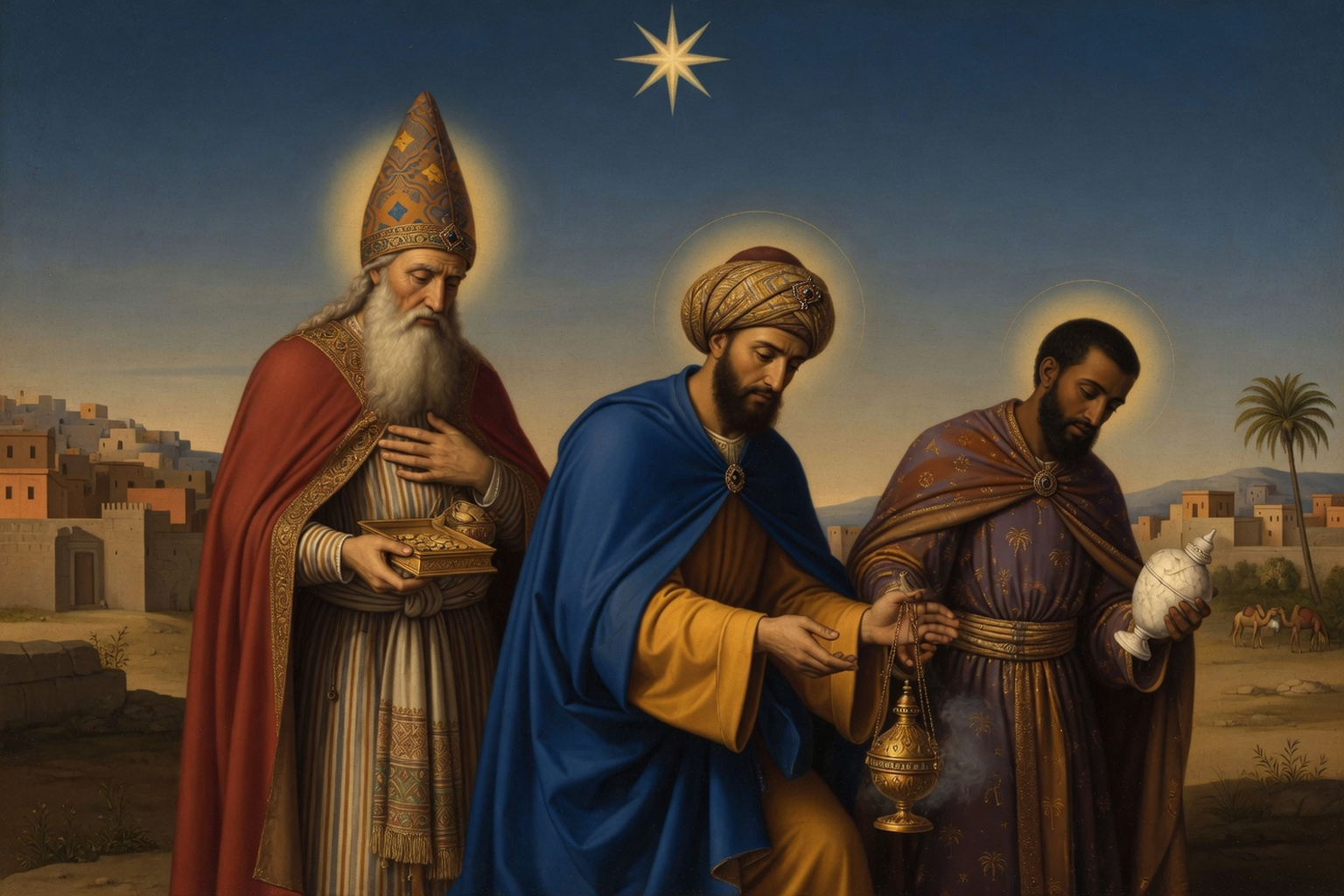
Wise men from the East guided by a star, the Magi Melchior, Gaspar, and Balthazar came to adore the Child Jesus in Bethlehem, offering Him gold, frankincense, and myrrh. After avoiding Herod's trap, they returned to their country where they were later baptized by Saint Thomas. Having become bishops, they died as martyrs and their relics rest today in Cologne Cathedral.
Guided reading
8 reading sections
THE EPIPHANY OF OUR LORD
OR THE ADORATION OF THE KINGS
Theology of the manifestation
The text explains that the coming of the Magi symbolizes the manifestation of God not only to the Jews, but also to the Gentiles, unifying humanity in a single worship.
If God grants me the grace to go to heaven, I rejoice from this day forward to be admitted into the society of the Saints, of whom legend tells so many wonderful things; above all, I will go in search of the three Magi to tell them how much I love and admire them. A. Stols.
It was fitting that the Son of God, who had clothed Himself in human flesh to save all men, should make Himself known to everyone, and that He should manifest Himself not only to the Jewish people, who were enlightened by the law and the prophets, but also to the Gentile people, who lived in ignorance and infidelity, so that those who were previously so different in religion might be happily reunited in the knowledge and worship of one and the same divinity. It was also very appropriate that the child Jesus should give signs of His sovereign power, and show that the weaknesses of that age did not prevent Him from being that strong and powerful God who executes all that He pleases and to whom no one can resist. That is why, being today lying in a manger and on a little hay, He calls to Himself heaven and earth, angels and men, the learned and the ignorant, the rich and the poor, kings and shepherds, and obliges them to render Him the homage they owe Him, as their sovereign Monarch. All the holy Scriptures preach to us the greatness of this mystery; the Psalms of David and the Prophecy of Isaiah offer us the image and description of it, rather than the prediction and the promise. As the birth of this amiable Savior was announced to the Jews and the shepherds by the ministry of an angel, sent from heaven, so it was discovered to the Gentiles and the kings by the appearance of an extraordinary star, which God formed expressly for this purpose. And indeed, since kings are the stars of the world, it was reasonable that these kings of the Orient should have a star destined to lead them, and that they themselves should be instructed of the coming of the new king by the mute word of a celestial torch.
Identity and origin of the Magi
The Magi are described as scholars from the East, identified by tradition as the kings Gaspar, Balthazar, and Melchior, representing the three branches of humanity.
These illustrious men are called Magi in the holy Gospels, not because they were enchanters or magicians, according to one meaning of the word Magi, but because they were very learned in natural things and endowed with extraordinary wisdom; this was the name that the Persians and most of the peoples of the East gave to their doctors, just as the Hebrews called them Scribes; the Egyptians, Prophets; the Greeks, Philosophers; and the Latins, Sages. The Church also gives them the title of Kings, as we have already named them: which is founded on these words of Psalm 72: "The kings of Tarshish and of the isles shall bring presents; the kings of Sheba and Seba shall offer gifts. Yea, all kings shall fall down before him: all nations shall serve him." The oldest paintings of our mystery agree with this sentiment, representing the Magi crowned and with all the marks of royal dignity. Indeed, it is the common belief of all the faithful, the beginning of which cannot be marked, and which, consequently, could only have come down to us through the tradition of the first centuries. We even have testimonies of this in the most famous Fathers of the Church, such as Tertullian, Saint Cyprian, Saint Hilary, Saint Basil, Saint John Chrysostom, Saint Isidore, the Venerable Bede, Theophylact, and several others. It was the custom of that time, in the regions of the East, to raise to royalty those persons most commendable for their erudition and wisdom, or, if the kingdoms were hereditary, to train their young princes early in the natural sciences and the exercises of the mind that could make them deserve the name of Sages. This is what Plato noted when discussing the education of the children of the kings of Persia, where he adds that astronomy, above all, has always been esteemed a science worthy of sovereigns. If Saint Matthew does not call these Magi kings, it is to teach us that, in the presence of Jesus Christ, no one should attribute to himself the august and majestic title of king, and that the most powerful monarchs are but his humble vassals and his unworthy servants.
One may also believe that these Magi were priests, following the ancient custom of several peoples reported by the same Plato when speaking of royal functions: they made their kings priests, or conferred upon the priests the power and dignity of kings, so that, undoubtedly, their kings, approaching the altars continually to offer sacrifices and occupy themselves with divine things, would more easily take on the manners and inclinations of the divinity, and that they would also be more respected by their subjects. But, whether these Magi were properly kings and priests or not, it is certain that they were persons of great merit and very high consideration, and it has always been believed that there were three of them, not counting their retinue, namely: Gaspar, Balthazar, and Melchior. They thus represented, at the Savior's crib, the three branches of human Gaspar One of the three Magi, often representing the descendants of Ham. it y: Melchi Balthazar One of the three Magi, representing the descendants of Japheth. or, the desc Melchior One of the three Magi, representing the descendants of Shem. endants of Shem; Gaspar, those of Ham; Balthazar, those of Japheth. Having therefore observed, through their astronomy, that a new star appeared, much brighter than ordinary stars, they judged immediately and believed undoubtedly that it was the star of Jacob of which the prophet Balaam, whose predictions were known to them, had once spoken, and which was to announce an admirable king born for the salvation of the peoples. Moreover, the Creator of the stars, who enlightened them interiorly and spoke to them in the depths of their hearts, effectively excited them to follow this new guide, and to seek the one he wished to show them. Thus, without further consulting human reasoning or the principles of their astronomical science, they said to one another: "This is, without doubt, the sign of that great king whom we await; let us go seek him and offer him gifts." And, abandoning their States and their goods to the care of divine Providence, they took the road to Judea, where they knew, by their traditions, that this King desired by all nations would be born.
It is not known precisely where they came from, because the Evangelist was content to say that they came from the East, that is to say, from a country that was oriental with regard to Jerusalem and Bethlehem, or from that part of the world which is called absolutely the East, which includes a great number of provinces and kingdoms. The most probable opinion is that they came from Arabia Felix, which was inhabited by the children that Abraham had by Keturah, his second wife, namely: Jokshan, who was the father of Sheba, and Midian, who was the father of Ephah. This is what the King-Prophet seems to testify when he says "that Our Lord would be adored by the kings of the Arabs and of Sheba, and that gold of Arabia would be given to him"; and the prophet Isaiah, when he says "that they would come from Midian and Ephah on camels to recognize him." The gifts that the Magi offered him greatly favor this opinion: indeed, it is mainly in Arabia that gold, frankincense, and myrrh are born.
The Journey and the Stopover in Jerusalem
Guided by a star, the Magi arrive in Jerusalem where they meet Herod the Great, whose anxiety hides a murderous design against the newborn.
It is not known exactly how long their journey lasted. The tradition of the Church teaches us that they arrived in Jerusalem on January 6th. If the length and difficulty of the roads caused them much fatigue, they were infinitely consoled by the sight of the marvelous torch that shone before them and showed them their route, and by the hope of soon enjoying the presence of this incomparable King whom the stars themselves announced to the world; moreover, the Holy Spirit did not fail to spread into their souls His divine sweetnesses, which seemed all the more perceptible to them as they were not accustomed to these supernatural impressions.
Arrived in the capital of Judea, the Magi asked, not if the King of the Jews was born, but in what place he was; "for," they said, "we have seen his star in the East, and we have come to adore him." This language deeply troubled Herod, surnamed the Great or the Asca lonite; the family of the Herods, which h Hérode, surnommé le Grand ou l'Ascalonite King of Judea who ordered the Massacre of the Innocents. ad taken the throne of Judea from the legitimate family of the Maccabees, constantly feared being dispossessed of it. The Ascalonite, moreover, was of a suspicious and cruel character; he had put to death Mariamne, his wife, whom he had once loved madly; Alexander and Aristobulus, whom he had had by this first princess; another of his sons, Antipater, whom he had had by Doris, his first wife, and many eminent persons who aroused his suspicions.
As soon, therefore, as he heard of a newly born King of the Jews, he resolved to stop at no crime to get rid of him. But, to better hide his bloodthirsty designs, he pretended to attach no importance to the prophecies of which the Magi spoke; he granted them and their retinue the faculty to continue their journey, while recommending the greatest secrecy to them. And, as if he were ready to help them by all means in their projects, he gathered, under the pretext of providing them with the information they requested, the chief among the priests and the most considerable doctors of the city, in order to learn from them where the Christ they awaited for their king was to be born. They answered him that, according to their traditions, founded on a prophecy of Micah, it was to be in Bethlehem of Judah. Then he took the Magi aside, asked them very precisely the time at which th is star of which Bethléem de Juda Place of the birth and anointing of David. they spoke had appeared to them, and sending them to Bethlehem, he said to them: "Go, take exact information about this Child, and when you have found him, do not fail to give me notice, so that I may also go and adore him." Nothing was further from his thoughts, but he wanted to know the place of the Savior's birth, to have him slaughtered as soon as possible, as the subsequent massacre of the Innocents proved.
The Adoration and the Gifts
The Magi find the Child in Bethlehem and offer Him gold, frankincense, and myrrh, symbolizing His royalty, His divinity, and His passible humanity.
The Magi, having received these instructions, departed at that very hour from Jerusalem, little edified by the conduct of the Jews who neglected to seek among themselves Him whom strangers had come to adore from the most distant lands. And behold, the star they had seen in the East preceded them until, moving ever forward, it stopped above the place where the Child was. At the sight of the star, they were transported with great joy; they entered and found a child of thirteen days, wrapped in poor swaddling clothes and lying on a handful of hay. It is true that there are authors who hold that the Holy Family, that is to say, Mary and Joseph with their divine child, had by then retired to a more comfortable house in the city of Bethlehem, and they base this on these words from the Gospel of Saint Matthew: "And, entering the house, they found the Child." But the common sentiment of the holy Fathers is that it was in the very stable where the Savior was born that He was found by the Magi; the words of Saint Matthew are not contrary to this opinion, since the word house, in Holy Scripture, signifies any kind of dwelling. Be that as it may, such wretched surroundings were not enough to deter them; penetrating, by the light of faith, the infinite greatness of Him who appeared only as a child, they recognized Him as true God and sovereign Monarch of the universe. They prostrated themselves before Him to the ground, they adored Him with profound respect, and opening their treasures, they offered Him as gifts gold, myrrh, and frankincense: gold to honor His royalty, frankincense to pay homage to His divinity, myrrh to bear witness to His passible and mortal life. "But, O Magi! what are you doing?" cries Saint Bernard. "O sages of the world! what are you thinking? You adore a child hanging at his mother's breast, lodged in a vile hut and wrapped in poor swaddling clothes. What then! do you believe that this child is God? God is in the immensity of heaven as in the temple of His glory, and this child is reduced to the narrow dwelling of a stable, a manger, and the bosom of a mother. Do you believe, once again, that He is a king? Where then is His royal palace? Where is the throne of His empire? Where is the circle of His courtiers? Perhaps the stable is His palace; the manger, His throne; Mary and Joseph, His courtiers. How is it that such wise persons have so blinded themselves and renounced common sense to such a degree as to adore, as God, a child whose age and retinue seemed to have nothing but what was contemptible and infinitely removed from divinity? It is undoubtedly the Holy Spirit who blinded them and inspired in them this folly according to the world, to make them wise according to God." We could add, to these beautiful sentiments of Saint Bernard, other very elevated and pious thoughts on the same subject; but books of meditation are filled with them; let us content ourselves with this reflection. Although this poor place, over which the star stopped, and where the Magi found Jesus, does not appear to be the palace of a king nor the temple of a God, it is nevertheless both; and indeed there is no palace in the world so superb nor temple so magnificent. It is a palace consecrated by the presence and the dwelling of Jesus. It is a temple where Jesus, who is the first and sovereign Priest, offers to His eternal Father the sacrifice of His humiliations, of His self-emptying, and even of His sufferings, by shedding His blood there in the Circumcision. It is a holy house that we may call the paradise of the earth, since God is there in the splendor and glory of His majesty; that the eternal Word, delight of the blessed, rests there as truly as in heaven; that the holy soul of the Savior enjoys there the intuitive vision of the divine essence, with the same perfection as at the moment of His resurrection and His ascension, and that in the succession of all the centuries; finally, that all the powers of heaven descend there in crowds to adore, in the infirmity of the flesh, Him whom they have adored since the creation of the world in the strength of the divinity.
After the Magi had rendered their homage to this sovereign Lord and had enjoyed for some time the admirable conversation of Mary and Joseph, they were warned, by revelation, not to pass back through Jerusalem, not to return to Herod, but to take another road to reach their own country. They therefore took leave of the Son, the Mother, and the holy foster-father, shedding many tears and protesting to them that they would never abandon this faith which they had just professed. They left their hearts and their souls in that stable and that manger where they had found such a great treasure, and departed quietly and as secretly as they could, without making themselves known in the places through which they passed, for fear that notice might be given to Herod.
Apostolic Life and Martyrdom
Upon returning to the East, they were baptized by the Apostle Saint Thomas, became bishops, and eventually received the crown of martyrdom.
The religious Cyril, in the life of Saint Theodosius, Abbot, says that they avoided the main roads and places most frequented by travelers, and that they went by remote paths and retired, at night, into caverns they found in the midst of the solitude. Led by the same hand that had brought them, they finally arrived in their own country, where they preached to their peoples what they had seen and heard of the wonders of the Word of God incarnate for the salvation of men. Leaving then their kingdoms, their pleasures, and their riches, to better conform to the state of poverty and abjection they had recognized in the Savior of the world, they began to profess Christian humility. They continued with great constancy, striving moreover to make the light with which they had been enlightened penetrate into souls blinded by the darkness of idolatry, and to inflame the hearts of those who listened to them with the divine fire that devoured their bowels. They were still living when, after the death, resurrection, and ascension of Our Lord, the Apostle Saint Thomas came to their country; he taught them all that had happened since their departure from Judea, during the course of the Savior's life and after his death, instructed them in all the mysteries of our holy religion, baptized them, confirmed them, made them priests, and consecrated them bishops; they then had more freedom to publish the faith of Jesus Christ on all sides and to exercise apostolic functions in these eastern regions.
Finally, they acquired for themselves, by their zeal and generosity, the crown of martyrdom, offering themselves as a sacrifice of a more pleasing odor than the gold, frankincense, and myrrh they had formerly presented in Bethlehem. This is what the tradition of the Church provides us as most certain regarding the Magi, although the calendar of Cologne reports their death differently; according to this martyrology, these holy personages, being already priests and bishops, all three met together, in the year 54 of Our Lord, in the city of Servan, after numerous evangelical labors, and there celebrated the feast of Christmas together; then Melchior died on the first day of January, aged one hundred and sixteen years; Balthazar, on the sixth, in the one hundred and twelfth year of his age; and immediately after, Gaspar, aged one hundred and nine y Gaspar One of the three Magi, often representing the descendants of Ham. ears. When the second was dead and they wished to bury him in the sepulcher of the first, the body of the latter withdrew of its own accord to give him the right side; and when the third was brought there, both withdrew also to give him the middle. These things, nevertheless, are uncertain, for there is no ancient author who makes mention of them. What is more certain is that their holy relics were first transported from Persia to Constantinople by the zeal and piety of the Empress Saint Helena, and that they were deposited there with magnificence in the august basilica of Hagia Sophia. Since then, they were brought to Milan, in the time of the Emperor Emmanuel, by the Bishop Saint Eustorgius, and they remained, according to the calculation of Peter Galesinius, for the space of 670 years, in the church called Eustorgian, where it was the custom to celebrate the holy mysteries on the feast of the Epiphany, in the middle of the night and with the same ceremonies as at the feast of the Nativity of Our Lord. Finally, in the year 1162, when the Emperor Frederick Barbarossa took and sacked the city of Milan, these precious remains of the bodies of the holy Magi were transported to Cologne in Germany, Cologne en Allemagne Archiepiscopal see and burial place of the saint. where they are kept to this day with extreme veneration.
Translation of the relics
Their remains traveled from Persia to Constantinople, then Milan, before being transferred to Cologne by Frederick Barbarossa in 1162.
In 1794, at the moment when the French armies were approaching the city, the cathedral treasury was carried to the right bank of the Rhine; the chapter emigrated to Arnsberg, in Westphalia, and placed the shrine in a safe place there. From Arnsberg, this treasure was carried to various places, and finally to Frankfurt am Main. It was there that the canons decided to sell the shrine to provide themselves with the means of existence. The rumor of this spoliation, already partially executed, reached the ears of an inhabitant of Frankfurt, who, alarmed at this news, sought to avert the dire fate that threatened this precious monument.
Mr. Molinari (this is the name of this zealous friend of the arts) went to the French President in Frankfurt, and obtained from the First Consul the permission to have the ancient reliquary o l'antique reliquaire de Cologne Goldsmith monument containing the remains of the three kings in Cologne. f Cologne returned to its former place. It was on January 4, 1804, that the shrine entered the city and was deposited in the chapter hall, where it remained until it had been suitably repaired. The transport had notably damaged the monument: some of the statues were broken, twisted, or detached and lost; a large number of stones had been stolen; the decorations of the lids were almost entirely missing. A goldsmith named Guillaume Pollock, assisted by his two sons, worked for several years on this restoration, and succeeded in putting the shrine in approximately the state in which one sees it today.
On December 23, 1807, the shrine was publicly exhibited in the chapter hall, and on January 8, 1808, it was blessed and re-established in the marble chapel that had been assigned for this purpose in the 17th century. However, a new disaster was to befall this monument.
A wretch, tempted by greed, had the idea of seizing this treasure, and in the night of October 18 to 19, 1810, he carried off several gold and silver ornaments and a large number of precious stones. Thanks to the activity of the police, the thief and the stolen objects were soon discovered; the most precious items were returned to the cathedral chapter, and on June 6, 1822, the shrine, entirely restored for the second time, was reinstated in the sanctuary dedicated to it.
Iconography and devotion
The text details the artistic representations of the Magi and mentions their patronage for wood sawyers and against epilepsy.
It is easy to recognize the Magi in the various representations that the arts have given of their adoration, whatever the varieties of costume with which they are adorned, and the multiplicity of accessories with which they are accompanied.
Artists have rarely failed to place, in the sky spread out like a tent above their heads, the guiding star. The meaning of this star is as clear as can be when, within this celestial body, painters have placed a swaddled child who seems, from the height of the firmament, to invite the first fruits of the Gentiles to his cradle. Their heads are sometimes covered with the Phrygian cap that Greco-Roman art attributed to the Assyrian and Median races that remained outside of ancient civilization; sometimes it is surrounded by the oriental turban; and sometimes, finally, it wears the crown that recalls their dignity as kings. Behind them, a train of camels is placed. Finally, one of these monarchs often takes on the Negro type to signify that all human races were called in their persons to the knowledge of the Gospel.
A Greek Menologion, from the 9th century, shows them being presented by an angel to King Jesus. The Campo Santo of Pisa possesses a famous fresco of the adoration of the Magi made in the 15th century by Benozzo Gozzoli. — Ciampini published a mosaic from Ravenna, from the 6th century, where four angels surround the throne of the Virgin holding the child Jesus presented for their adoration. The same subject appears in several mosaics and several bas-reliefs of the catacomb tombs.
The Magi, as is known, are especially honored in Cologne. Their cult is also held in honor in Lima, the capital of Peru. They are invoked against epilepsy. Finally, wood sawyers in Mechelen and card makers in all countries have adopted them as patrons.
Liturgy and traditions
Analysis of the feast of the Epiphany, its historical origins, its names (Theophany), and popular customs such as the king cake.
The feast of the Epiphany has always been very famous in the Christian Church; so much so that even emperors did not dare to fail to attend the holy mysteries and ecclesiastical ceremonies on that day. Julian the Apostate, although he was a very wicked and impious prince, nevertheless wished, while in France, to cover his apostasy by attending, on the day of this feast, the solemnity that was being held in the Church. The Emperor Valens, although he was infected with Arianism and abhorred the holiness of our mysteries, fearing to pass for a man entirely devoid of religion, did not have the boldness to absent himself from it. As for the very religious Emperor Theodosius, he honored this feast to the point of ordering, by an express law, the cessation of all legal proceedings, seven days before and seven days after. According to a custom that was preserved at the court of France until 1378 and beyond, the most Christian king, coming to the offering on this day, presented gold, frankincense, and myrrh as a tribute to Our Lord.
The Church does not only honor in this feast the manifestation of Jesus Christ to the Magi, but it also celebrates the memory of two other manifestations of the Savior. The first took place at his baptism, when the Holy Spirit descended visibly upon him in the form of a dove, and a voice from heaven was heard saying: "This is my beloved Son, in whom I am well pleased." The second took place at the wedding at Cana, where Jesus Christ performed his first miracle by changing water into wine: by this miracle the Savior manifested his divinity, and gave in advance the omen that he would one day convert wine into his precious blood: which he did at the last supper, and which he does every day in the celebration of the holy sacrifice of the Mass.
To complete the picture of this feast, we borrow the following excerpts from Dom Guéranger's Liturgical Year:
"The fea st of the Epi Dom Guéranger Abbot of Solesmes, author of an influential memoir on the mystery. phany is the continuation of the mystery of Christmas; but it presents itself on the Christian cycle with a grandeur that is its own. Its name, which means manifestation, sufficiently indicates that it is used to honor the appearance of a God among men.
"This day, in fact, was consecrated for several centuries to celebrating the birth of the Savior, and when, around the year 376, the decrees of the Holy See obliged all Churches to celebrate henceforth, with Rome, the mystery of the Nativity on December 25, January 6 was not entirely disinherited of its ancient glory. The name of Epiphany remained with it, along with the glorious memory of the baptism of Jesus Christ, whose anniversary tradition fixes on this day.
"The Greek Church gives this feast the venerable and mysterious name of Theophany, so famous in antiquity, to signify a divine apparition. We find this name in Eusebius, in Saint Gregory of Nazianzus, in Saint Isidore of Pelusium; it is the proper title of the feast in the liturgical books of the Melkite Church.
"The Orientals also call this solemnity the holy lights, because of the baptism that was formerly conferred on this day, in memory of the baptism of Jesus Christ in the Jordan. It is known that baptism is called, in the Fathers, illumination, and those who have received it, the illuminated.
"Finally, we familiarly call this feast, in France, the Feast of the Kings, in remembrance of the Magi whose arrival in Bethlehem is particularly solemnized today.
"The Epiphany shares, with the feasts of Christmas, Easter, the Ascension, and Pentecost, the honor of being qualified as a most holy day, in the Canon of the Mass, and it is ranked among the cardinal feasts, that is to say, among the solemnities upon which the economy of the Christian Year rests. A series of six Sundays borrows its name from it, just as other Sunday successions are presented under the title of Sundays after Easter, Sundays after Pentecost.
"Following the convention made in 1801 between Pius VII and the consuls of the French Republic, the legate Caprara proceeded to a reduction of feasts, and the piety of the faithful saw, with regret, a large number of them suppressed. There were solemnities that were not suppressed, but whose celebration was moved to the following Sunday. The Epiphany is among those that underwent this fate; and whenever January 6 is not a Sunday, our Churches see the pomp that accompanies such a great day throughout the Catholic universe delayed until the following Sunday.
The piety of the faithful, in the Middle Ages, presented to the priest, so that he might bless them on the feast of the Epiphany, gold, frankincense, and myrrh, and these touching signs of their devotion to the Son of Mary were kept in honor of the three Kings, as a pledge of blessing for homes and families. This custom is still preserved in some dioceses of Germany, and it only disappeared from the Roman Ritual in the edition of Paul V, who believed it necessary to suppress several blessings that the piety of the faithful no longer requested except rarely.
"Another custom has survived longer, also inspired by the naive piety of the ages of faith. To honor the royalty of the Magi who came from the East to the Child of Bethlehem, a king was chosen by lot, in each family, for this feast of the Epiphany. In a feast animated by pure joy, and which recalled that of the wedding in Galilee, a cake was broken, and one of the pieces served to designate the guest to whom this royalty of a moment had fallen. Two portions of the cake were set aside to be offered to the child Jesus and to Mary, in the person of the poor, who also rejoiced on this day in the triumph of the humble and poor King. The joys of the family were once again mingled with those of religion; the bonds of nature, of friendship, of neighborhood were tightened around this table of the Kings, and if human weakness could sometimes appear in the abandonment of a feast, the Christian idea was not far away and watched in the depths of hearts.
"Happy still today are the families in whose midst the feast of the Kings is celebrated with a Christian thought!"
Ext. from Dom Guéranger's Liturgical Year.
Annexes & related entities
Structured data for exploration: events, miracles, quotes, places, attributes, patronages, and important entities cited in the text.
Key Events
- Observation of an extraordinary star in the East
- Journey to Judea and arrival in Jerusalem
- Adoration of the Child Jesus in Bethlehem and offering of gifts
- Return to the East by another way to avoid Herod
- Baptism and consecration as bishops by Saint Thomas
- Martyrdom for the Christian faith
Miracles
- Guidance by a miraculous star
- Spontaneous movement of the bodies in the sepulcher to make room for one another
Quotes
-
We have seen his star in the East, and have come to worship him.
Gospel according to Saint Matthew