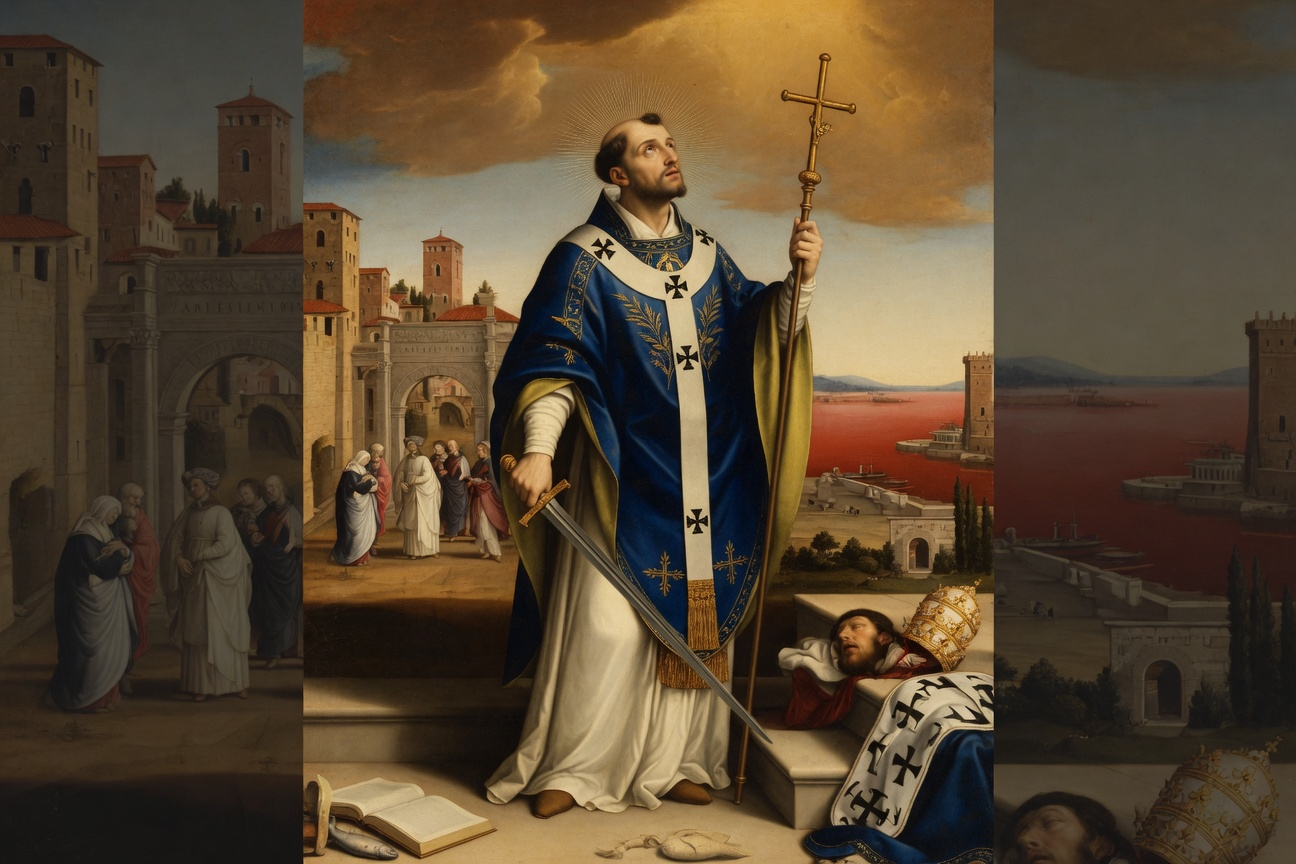
A native of Tuscany, Lucius I succeeded Saint Cornelius as pope in 252. After experiencing exile under Emperor Gallus, he returned to Rome where he continued his pastoral and charitable ministry during a period of plague. He was finally martyred by beheading in 254 under Emperor Valerian.
Guided reading
5 reading sections
SAINT LUCIUS I, POPE AND MARTYR
Origins and beginning of the pontificate
A native of Lucca in Tuscany, Lucius succeeded Cornelius and exercised his pontificate between 252 and 254 during the reigns of Gallus and Valerian.
Lucius Lucius 22nd pope of the Catholic Church and martyr. was Tuscan by origin; he was born in Lucca and his father was Licinus... He sat from the consulship of Gallus and Volusianus (252) until that of Valerian III and Gallienus II (254). After having been exiled for the faith, God permitted him to return to his church. He prescribed by a decree that two priests and three deacons would accompany the bishop everywhere, to constitute a kind of ecclesiastical court around his person. He was beheaded on March 3, 254, by order of Valerian. While going to the place of execution, he entrusted the government of the church to Stephen, his archdeacon. In two ordinations, in the month of December, he laid hands on four priests, four deacons, and three bishops, destined for various churches. He was buried in the cemetery of Callixtus on the Appian Way. After him, the episcopal see remained vacant for thirty-five days.
It is in these terms that the Liber Pontificalis, or chronicle of the Popes, summarizes the acts of the pontificate of Saint Lucius: let us enter into some details.
Lucius had already accompanied Pope Saint Cornelius, his predecessor, into exile. His promotion to the pontifical throne only designated him more specifically for the proscription of the Caesar Gallus, whose policy regarding Christians struck the shepherds by preference, in order to better reach the flock. Saint Lucius I was therefore exiled as Saint Cornelius had been, and received, at the place of his banishment, let ters from Sai saint Cyprien Bishop of Africa who opposed Stephen on the question of baptism. nt Cyprian, bishop of Carthage, who congratulated him on his glorious confession. The place of his second exile has remained unknown to us. It is known that the time of his first banishm ent was spent Civitá-Vecchia Site of the first exile of Lucius. at Civitá-Vecchia.
The scourge of the plague and Christian heroism
While the plague ravaged the Empire, Christians distinguished themselves by their charity toward the sick, despite pagan slanders accusing them of spreading the evil.
The plague was then knocking at the gates of the Empire. Decius the Younger, who had just put Saint Cornelius to death, was one of its first victims in Rome. But it was in Africa above all that the scourge raged with horrible intensity. The courage of the faithful wavered for a moment in the face of this new kind of peril. Saint Cyprian then addressed his magnificent book on Mortality to his clergy and his people to lift their dejected spirits.
The contrast between the conduct of the faithful and that of the idolaters during the duration of the scourge was one of the most striking proofs of the divinity of Christianity. Christians were everywhere that help was needed: they cared for the plague-stricken without distinction of family or creed.
Far from opening their eyes and at least blessing this heroism, the official Roman world took advantage of the occasion to spread a new slander. If
SAINT LUCIUS I, POPE AND MARTYR.
the Christians showed themselves everywhere, it was said, it was to spread the plague: under the pretext of helping the population, they were poisoning it. One of the most ardent of these infamous denouncers was, in Africa, Demetrianus, a fellow student and school rival of Saint Cyprian. The latter, who called him a barker, proudly replied to his insults and branded the greedy cowardice of the pagans in the face of the scourge. The pamphlets of Demetrianus have perished forever: the victorious epistle that Cyprian wrote to him in refutation will remain as an eternal monument to the degradation of the pagans of the 3rd century, true monsters with human faces, who took advantage of a public calamity to enrich themselves and become intoxicated with lust or wine over the corpses of the victims.
What was happening in Carthage was taking place likewise in Asia, in Greece, in Italy, and in the Gauls. It was at this time that Saint Regi na was martyred in Burgundy. saint Grégoire de Néocésarée Fervent disciple of Origen and author of his panegyric. It was during this plague that Saint Gregory of Neocaesarea conquered and justified his glorious surname of Thaumaturge. He traveled through all the houses invaded by the scourge. Everywhere he appeared, he invoked the name of Jesus Christ and the plague fled.
Return from exile and correspondence of Saint Cyprian
After an exile in Civitavecchia, Lucius returns to Rome to the acclamations of the people and receives a congratulatory letter from Saint Cyprian of Carthage.
Despite the plague, despite the invasions of the Numidians in the South and the Scythians in the North, Gallus, who then reigned over the world, had but one preoccupation: to annihilate the Christians. This dream, cherished by so many others before and after him, was not as easy to realize as he imagined. He perished miserably in a battle he was forced to fight against one of his rebel captains. Valerian succeeded him.
In the interval, the sovereign of the catacombs, the exiled pontiff, Saint Lucius, took advantage of these political revolutions to return to his episcopal city to the acclama tions of the Saint Cyprien Bishop of Africa who opposed Stephen on the question of baptism. faithful people.
Saint Cyprian, informed of this happy event, wrote him a letter of congratulation, in agreement with the other bishops of Africa. Here is a fragment of this letter: "Some time ago, beloved brother, we wrote to congratulate you on the double honor for which the divine mercy reserved you by calling you to lead the Church, and to illustrate it at the same time by your glorious confession. Today I address my congratulations to you again, to you, to your companions, to all of Christendom. Blessed be the Lord who has brought you back from exile. The shepherd is returned to his flock, the pilot to the helm, the leader to his people. It seems, therefore, that your banishment was arranged by Providence, not so that the Church should remain widowed of its bishop, but so that the bishop should return to his Church greater and more honored. If the days of trial were shortened for you, the authority of your episcopate has only increased. Pontiff, in ascending to the altar of our God, you will no longer need words to confirm the faith of the people; your past is eloquent enough... And would to God, beloved brother, that it were given to me, at this moment, to mingle with the pious crowd that acclaims your return! What joy among all the brothers! What an immense gathering of all the faithful of Rome to receive you and embrace you! All eyes are fixed on you. All hearts flying in your path, such is the spectacle that I contemplate in spirit, and which makes me think of the ineffable joys of which the second coming of Jesus Christ will be the signal. Just as John the precursor announced the coming of Christ, so the Pontiff confessor who returns to us today appears to us as the precursor of the sovereign Judge. — My colleagues, as well as the Christian communities of our provinces, charge me to transmit to you through this epistle their sentiments of joy and faithful attachment. In our sacrifices and our prayers, we do not cease to give thanks to God the Father and to Jesus Christ his Son, Our Lord, asking him to preserve you and to further increase the glory that you have acquired by this first confession of his holy name. Perhaps God has only recalled you to Rome to give your future martyrdom a more brilliant theater..."
The martyrdom of Saint Lucius
Denounced by pagan priests and refusing to sacrifice to idols, Lucius was beheaded on March 4, 254, after entrusting the Church to his archdeacon Stephen.
The prediction of Saint Cyprian was soon to be verified. — Sa int Lucius I, in Saint Lucius Ier 22nd pope of the Catholic Church and martyr. the presence of the disasters caused by the plague, multiplied the efforts of his charity and sent aid to all the Christian communities of the world. Such brilliant zeal could not go unnoticed. The people of Rome were gradually becoming accustomed to turning their hopes toward the vicars of Jesus Christ as toward their true leaders. These tendencies were bound to excite pagan jealousy. The priests of Jupiter Capitolinus, the idolatrous senators, the official majority, the satellites of power, in a word, organized a veritable riot against Saint Lucius. Dragged before the tribunals and summoned to sacrifice to the gods of the Empire, the Pope responded with a generous refusal. Immediately, the bribed populace, which filled the praetorium, burst into insults and vociferations. They rushed upon the venerable Pontiff; they dragged him away while heaping outrages upon him. Lucius allowed himself to be led like a docile lamb, and after having undergone numerous tortures, he had his head severed by the executioner's sword on March 4 of the year 254.
Posterity, relics, and cult in Denmark
His relics were transferred by Paschal I in 822, then rediscovered in 1599. He also became a major patron saint in Denmark.
We have remaining from Saint Lucius I a few decrees that Gratian collected. They are found in Volume I of the councils, and all of them, like Saint Cyprian, who particularly loved the Holy See and wrote to Pope Stephen, are worthy of veneration and respect.
Pope Paschal I raised his body from the earth, along with those of Saint Urban, pope, Saint Cecilia, Saint Valerian, Saint Tiburtius, and Saint Maximus: he transported them from the cemetery into the city in the year 822, and placed them under the altar of Saint Cecilia where they remained buried for nearly eight centuries, until, in 1599, they were rediscovered under the pontificate of Clement VIII, through the care of Cardinal Sfondrati, titular of Saint Cecilia. They were exposed, from October 20, to public veneration for an entire month, then enclosed in new reliquaries, and solemnly replaced on the feast day of Saint Cecilia, November 22.
Saint Lucius is honored as a patron in Copenhagen, Roskilde, and Zealand in Denmark.
The first translation o f Saint Danemark Mission territory for evangelization. Lucius by Pope Paschal I coincides precisely with the departure of the first mission which, under the leadership of Saint Ansgar of Corbie, went to evangelize Denmark. Several churches in this kingdom have had Saint Lucius as their patron. The reason for this is surely that the Pope must have given relics of his holy predecessor to the missionaries of the North. Moreover, it is certain that the church of Roskilde once possessed the head of Saint Lucius, given by Pope Gregory VII. But the temple with the great towers and splendid naves has long been empty; no more tombs, no more relics, no more chants, no more faithful. The cold of death is what has replaced the worship of the living God and his saints.
— Saint Lucius, pray for Denmark!
One of his relics is kept at the Carmel of Amiens.
Various Church histories and History of the Catholic Church in Denmark, by Abbé G. J. Karup.
Annexes & related entities
Structured data for exploration: events, miracles, quotes, places, attributes, patronages, and important entities cited in the text.
Key Events
- Election to the pontificate in 252
- Exile to Civitavecchia under Emperor Gallus
- Return from exile to Rome under Valerian
- Decree on the accompaniment of the bishop by priests and deacons
- Martyrdom by beheading on March 4, 254
Quotes
-
The shepherd is returned to his flock, the pilot to the helm, the leader to his people.
Letter of Saint Cyprian