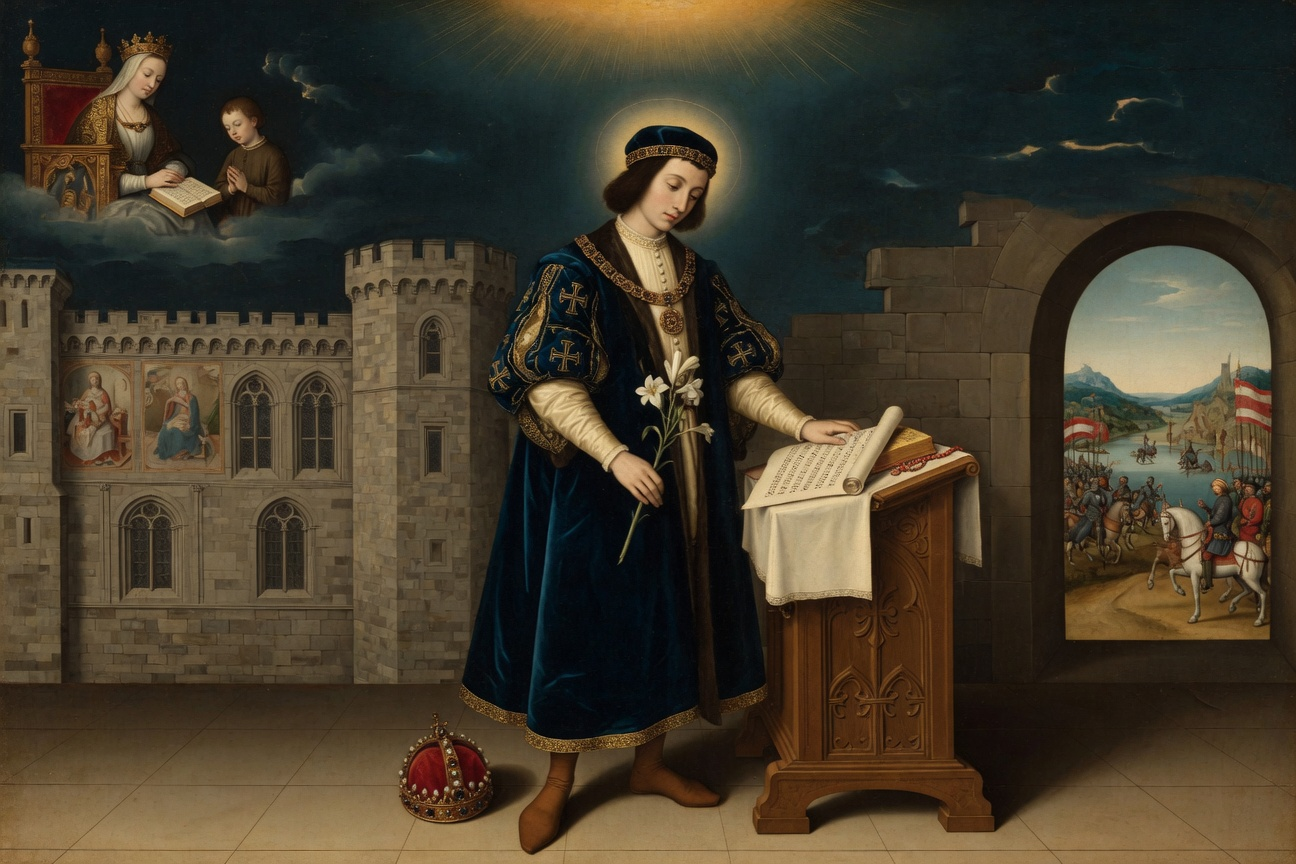
Son of the King of Poland, Saint Casimir distinguished himself by an austere piety and heroic chastity at court. He refused the throne of Hungary out of respect for justice and preferred to die at twenty-five rather than break his vow of virginity. His body was found intact 120 years after his death.
Guided reading
7 reading sections
SAINT CASIMIR, DUKE OF LITHUANIA
Origins and royal family
Presentation of Saint Casimir, son of the King of Poland and Lithuania, raised in rigorous piety within a large and influential family.
Chastity is the virtue that represents here below the glorious state of immortality.
S. Dern., *Ep. xxiii, to Henry, Archbishop of Sens.*
Although virginity is a very delicate flower, and is not ordinarily found in the courts of princes, where corruption slips in very easily, it is nevertheless not so rare there that one cannot notice several examples of it in the history of the Saints. We have already seen two that have excited our admiration, in the sacred persons of Saint Cunigunde, Empress, and her very chaste spouse Saint Henry; here is a third in the person of Saint Casimir.
This prince was th e second son saint Casimir Polish prince, son of Casimir IV, known for his chastity and piety. of Casimir III, King of Poland and Grand Duke of Lithuania, and of Elizabeth o f Austria Lithuanie Grand Duchy of which Casimir was the prince. , daughter of Emperor Albert, whom Martin Chromer, Bishop of Ermeland in Prussia, calls a very holy and very religious princess. This pious mother took wonderful care to have him instructed and raised in the love and fear of God, along with her other children, who were twelve in number: six boys on one side, and on the other six girls, who were married into the houses of Bavaria, Saxony, and Brandenburg. The eldest of the sons was elected King of Hungary and Bohemia, after Matthias Corvinus: three others were successively Kings of Poland, and the last was Cardinal-Archbishop of Gniezno and Bishop of Krakow.
An ascetic youth
The prince distinguished himself by his contempt for worldly pleasures, practicing severe mortifications and intense devotion despite his rank.
As for our Saint, he made great progress in letters and virtue under the good tutors the queen provided him; from his earliest years, he despised the pleasures, amusements, and delicacies that other children seek with passion, in order to devote himself entirely to the exercises of the spiritual life. He was the sworn enemy not only of vice, but also of the slightest liberty and even the shadow of sin. He studied with such ardor and achieved such happy success that he was admired by everyone. He joined piety to his studies, for his themes, poems, and speeches revolved only around sacred subjects. He macerated his body, still tender and delicate, through fasting and the frequent use of the discipline; beneath his rich garments, he usually wore a hair shirt and a cilice. Often he spent entire nights on the hard ground or at the doors of churches, where he prayed at length with his face against the earth. He lived in extreme austerity amidst the honors due to his birth and station: although he was the son, brother, and uncle of the kings of Poland, one can say of him what Panigarola, Bishop of Asti, said of the great Saint Charles Borromeo, Cardinal and Archbishop of Milan: that he was like a poor dog in his master's house, eating only a little bread, drinking only a little water, and sleeping only on a little straw.
He often exhorted the king, his father, to govern his subjects according to the rule of justice. If it happened sometimes that he strayed from it, he did not fail to warn him gently, always remaining within the bounds of the respect that a son owes to his father. The king listened to him willingly; and since, besides the uprightness of his heart, he noticed in him a great depth of judgment and a penetration of mind beyond his years, he followed his advice with pleasure in the government of his States.
The refusal of the throne of Hungary
Sent to conquer Hungary at thirteen, Casimir withdraws out of respect for the Pope and a refusal of an unjust war, preferring penance to power.
Some Hungarians, dissatisfied wit h Matth Mathias King of Hungary who received the saint's relics. ias, their king, wished to raise our Saint to his throne in 1471; they sent a deputation for this purpose to the King of Poland, his father. The young Casimir, who had not yet completed his thirteenth year, would have liked to refuse the crown offered to him; but out of compliance with his father, he set out at the head of an army to support the right of his election. Having arrived at the borders of Hungary, he learned that Matthias had just gathered sixteen thousand men to go and meet the Poles and that he had regained the hearts of his subjects. He also learned tha t Pope Sixtus Pape Sixte IV Pope who authorized the reform of the Couëts. IV had declared himself for the dethroned king and had sent an embassy to his father to make him abandon his enterprise. All these circumstances combined gave a secret joy to the young prince. He asked his father for permission to retrace his steps; which was only granted to him with great difficulty; but in order not to increase the sorrow that his father felt at having seen his designs fail, he first avoided appearing in his presence; thus, instead of going straight to Krakow, he retired to the castle of Dobzki, which is a league away, and spent three months there in the practices of austere penance. Having subsequently recognized the injustice of the expedition he had been forced to undertake against the King of Hungary, he constantly refused to yield to a second invitation made to him by the Hungarians, and this despite the solicitations and repeated orders of his father.
The vow of virginity
Casimir preserves absolute chastity, even refusing the marriage recommended by his doctors to treat his illness, preferring death to sin.
He was so devout to the Passion of Our Lord and to the holy sacrifice of the altar, that often, when he heard of the pains and torments that Jesus Christ suffered for us in the Garden of Olives and on Mount Calvary, or when he attended Holy Mass, he would fall into ecstasy and rapture.
His purity and chastity were, from his childhood, entirely virginal and angelic; they appeared so admirably in all his actions that they made those who, in conversing with him, looked upon him, chaste and continent; thus he took great care to keep them inviolable throughout his life: being ill with languor, he preferred death (which the philosopher calls the most terrible of all things in the world) to health and life, rejecting with heroic constancy the advice of the doctors, who strove to persuade him to lose his virginity to prolong his years and to marry in order to be able to reign after the King, his father. For, although in the Polish nation, which is no less jealous of its liberty than it is proud and generous, kings ascended the throne by election, and succession did not take place in this kingdom, nevertheless, if the King's son rendered himself worthy, by his virtues and his fine actions, to bear his father's scepter, the Orders of the kingdom usually elected him, as was seen for Ladislas IV and for Casimir V, who succeeded their father Sigismund.
The Hymn to the Virgin
Description of his deep devotion to Mary and the Latin hymn 'Omni die' which he composed and with which he was buried.
Those who consider the conduct of our prince, the honor and glory of the royal house of Jagiellon, which governed the kingdom of Poland for nearly two whole centuries, will no longer be astonished that, in the midst of the sweetness and delights of the court, he led such a holy and chaste life, given the tender devotion he bore to Our Lady, Virgin of virgins and Mother of God. He composed, in her honor, a long prayer in Latin, which he recited every day, and with which he wished to be buried; for, when in the year 1604, his tomb was opened in the church of Vilna, his body w as fo Vilna City where Josaphat completed his apprenticeship and entered religious life. und fresh and whole, and the hymn between his hands. It is as follows:
"Each day, O my soul, pay your homage to Mary, solemnize her feasts and celebrate her brilliant virtues;
"Contemplate and admire her elevation; proclaim her happiness both as Mother and as Virgin;
"Honor her so that she may deliver you from the weight of your sins; invoke her so as not to be dragged away by the torrent of passions;
"I know it, no one can honor Mary worthily; yet he is foolish who remains silent about her praises;
"All men must exalt and love her especially, and we must never cease to venerate and pray to her;
"O Mary, the honor and glory of all women, you whom God has raised above all creatures;
"O merciful Virgin, grant the vows of those who do not cease to praise you;
"Purify the guilty, and make them worthy of all heavenly goods;
"Hail, O holy Virgin, you through whom the gates of heaven have been opened to the wretched, you whom the wiles of the ancient serpent have never seduced;
"You, the restorer, the consoler of despairing souls, preserve us from the evils that will fall upon the wicked;
"Ask for me that I may enjoy eternal peace, and that I may not have the misfortune of being a prey to the flames of the lake of fire;
"Ask that I may be chaste and modest, gentle, good, sober, pious, prudent, upright and an enemy of falsehood;
"Obtain for me meekness and the love of concord and purity; make me firm and constant in the path of good."
Charity and passing
Nicknamed the 'Father of the poor', he died at twenty-five years of age in 1483 after having transformed his court into a place of prayer.
Saint Casimir is particularly praised for having been extremely averse to slander, very modest and restrained in his speech. He never spoke, even with his closest associates, of the faults of his neighbor, nor of the imperfections of others, but only of the affairs of his conscience, of the contempt and vanity of the world, of the misery of this perishable life, of the horror of vice and sin, of the beauty of virtue, and of the happy and holy state of grace. His palace was a nursery where all the plants of virtue grew, a flowerbed where all the flowers of devotion blossomed, and like a temple where nothing was done but to pray to God. Indeed, prayer was practiced there as perfectly as in the most austere and reformed monasteries and religious houses. All his servants were, by his example, so full of goodness that, when they were at the court of the King of Poland, or at that of Ladislas, King of Hungary, his elder brother, one recognized those who were of his household more by the exercise of extraordinary virtue than by his colors and liveries. He was full of attachment to the Catholic religion, and his zeal led him to employ all the means at his disposal to extirpate the schism of the Russians. He had so much love and charity for all the poor, the widows, and the orphans of his lands that he acquired, through this virtue, the beautiful nickname of 'Father and defender of the poor and the unfortunate'.
The holy duke having led a life so pure, so virtuous, and s o innocent, Le saint duc Polish prince, son of Casimir IV, known for his chastity and piety. God granted him the grace of revealing to him the day and the hour of his departure from this world. This was around March 4, 1483, and in the twenty-fifth year of his age, after he had received, with great fervor and devotion, the holy Viaticum, in the presence of several priests and religious whom he cherished and honored extremely.
The angels came to seek his virginal soul to lead it to heaven; which a contemporary panegyrist expressed in these verses:
Procul planctus : date cantus Et lilie tomulo : Casti floros et odores Uno erunt cumulo.
En coitlens angelicus Ab alto exercitus, Ad hoc funus, graium munus Prosequendum excitus
Anfer planctus, audi cantus, Vide quantos tomulo Spargunt flores, dant odores Vero suo modulo.
No tears, but songs, and lilies; for this tomb there must be a chaste flower, a virginal perfume;
For behold, the holy troop of celestial spirits descends from the heights of heaven, coming to assist at the funeral of a brother, as if at a feast.
Once again, cease your weeping, lend an ear to the harmonies from above: see how many flowers and perfumes the Angels scatter upon the tomb of him who resembles them!
Cult, miracles, and posterity
Account of posthumous miracles, the incorruptibility of his body, and his influence on the Polish and European royal lineage.
His body was carried with truly royal funeral pomp to the cathedral church of Vilna, the capit Vilna City where Josaphat completed his apprenticeship and entered religious life. al city of his duchy of Lithuania, where he received the honors of burial.
One may see, in a chapel of Saint-Germain-des-Prés, in Paris, the portrait of Saint Casimir, drawn from life. This chapel was built by Casimir, King of Poland, and the last prince of the House of Vasa, who, after abdicating the crown, retired to Paris, where he died as Abbot of Saint-Germain-des-Prés in 1668.
The crown placed at his feet signifies that he renounced his claims to the throne of Hungary when he saw King Matthias supported by the Pope. The lily he carries in his hand is an indication of the inviolable chastity he maintained until death. Sometimes a writing is placed beside him, because he wished to be buried with the prose
Omni die, die Maria mea laudes anima.
often called the hymn of Saint Casim Omni die, die Maria mea laudes anima Latin hymn in honor of the Virgin Mary attributed to the saint. ir.
[APPENDIX: CULT OF SAINT CASIMIR.]
Some time after his death, the Grand Duke of Muscovy entered Lithuania with a powerful army, which threw all these people into disorder and confusion; but, having recourse to heaven, they made a vow at the tomb of their holy duke, and, a few days later, a small troop of Lithuanians cut the Muscovite army to pieces; this was not done without a miracle, for the Saint appeared in the air, fighting for his subjects against these schismatics.
Several people afflicted with various illnesses obtained a perfect cure at his sepulcher: a young girl named Ursula, who had died in Vilna, having been carried by her parents to the tomb of this prince, recovered her life there before a large assembly, and she lived for several more years.
These miracles, and others like them, caused Pope Leo X to declare him Blessed, at the request of Sigismund I, King of Poland, h is brother; pape Léon X Pope who authorized the office of Saint Ozanne. and, since then, Pope Paul V has commanded that his memory be celebrated throughout the Church and that his feast be kept with a semi-double office. His aid is implored to overcome temptations against chastity, to be preserved or delivered from the scourge of the plague, and to repress the cruelty of the Turks. He is the patron of Poland.
One hundred and twenty years after his death, his body was found without corruption. The rich fabrics in which he had been wrapped were also found intact, despite the excessive humidity of the vault where he had been buried; a magnificent marble chapel has been built to house his relics.
Zacharie Ferrier of Vicenza, Bishop of Guardia and Papal Nuncio in Poland, wrote his life and Zacharie Ferrier de Vicence Bishop and nuncio who wrote the life of the saint. composed his office with the authority of the Holy See, and it is from there that we have extracted this account. But we do not wish to omit that the last two kings of Poland, Ladislas and Casimir, who married one after the other the Princess Marie-Louise de Gonzaga, of the House of Mantua, were great-nephews of this great Saint, being sons of Sigismund III, King of Poland and Sweden, whose mother was Catherine Jagiellon, Queen of Sweden and daughter of Sigismund I, King of Poland, brother of Saint Casimir. And to make a more particular remark on the house of this blessed prince, our most Christian king, Louis XIV, was also one of his great-nephews, for Ladislas Jagiellon, King of Hungary and Bohemia, elder brother of Saint Casimir, married Anne of Foix, of the House of Candale, from whom he had Jagiellon, Queen of Hungary and Bohemia, wife of Emperor Ferdinand I, from whom several children were born, and, among others, Anne of Austria, Grand Duchess of Tuscany, mother of Queen Marie de' Medici, wife of King Henry the Great and mother of King Louis XIII, who had from Queen Anne of Austria King Louis the Great.
Annexes & related entities
Structured data for exploration: events, miracles, quotes, places, attributes, patronages, and important entities cited in the text.
Key Events
- Pious education by Queen Elizabeth of Austria
- Military expedition to Hungary at the age of 13 (1471)
- Three-month retreat at Dobzki Castle
- Refusal of a second invitation to the throne of Hungary
- Chose death over breaking his vow of virginity on the advice of physicians
- Discovery of the incorrupt body in 1604
Miracles
- Apparition in the air to assist the Lithuanians against the Muscovites
- Resurrection of a young girl named Ursula at his tomb
- Incorruptibility of the body and clothing despite humidity
Quotes
-
Omni die, die Maria mea laudes anima
Hymn attributed to Saint Casimir