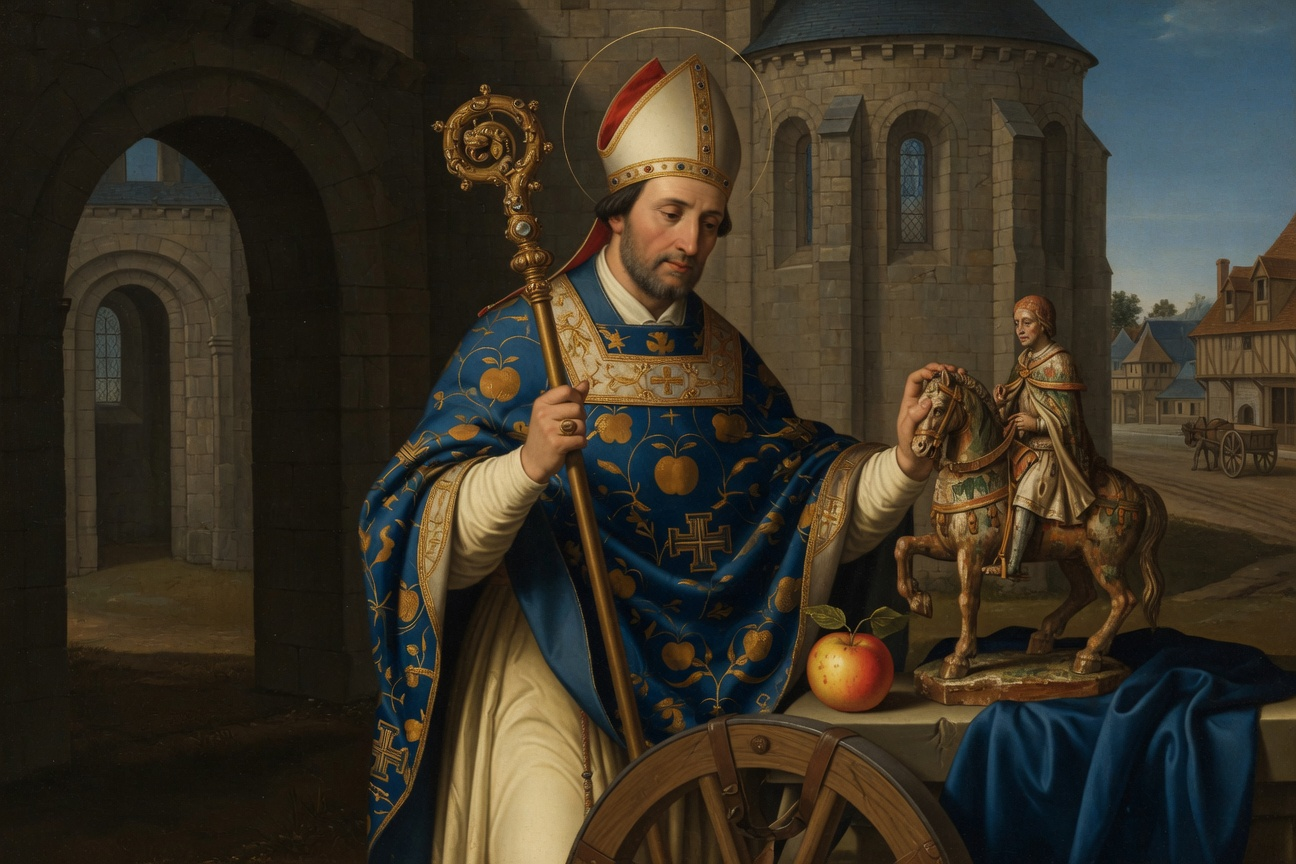
Bishop of Avranches in the 6th and 7th centuries, Leonard (Leodowald) transitioned from a violent youth to a life of holiness following a conversion symbolized by a ripening apple. Successor to Saint Sever, he spread the cult of Saint Martin in Normandy. He is traditionally invoked by carters for his strength and protection on the roads.
Guided reading
5 reading sections
SAINT LEONARD OR LEODOWALD, BISHOP OF AVRANCHES, INVOKED BY CARTERS (630).
Origins and geographical context
Presentation of the village of Saint-Léonard near Avranches, the saint's birthplace, and an evocation of the site's supposed ancient origins.
At the western extremity of the large parish of Vains, in the canton of Avranches (Manche), on a mound overlooking the coast of Brittany and the shores of the Ocean, lies a village, a medieval villa, with its church, its ancient priory, and its monumental tower, from the heights of which unfolds, before the spectator's eyes, one of the vastest and most beautiful horizons!... This village, this ancient borough that one can see from afar, is Saint -Léonard, the Saint-Léonard Bishop of Avranches in the 6th and 7th centuries, of Frankish origin. place consecrated to Saint Léodowald.
The ancient and primitive history of this village, before its Christian name, is completely unknown. However, a modern historian believed he saw there the location of the capital of the Veneti, who fought so energetically against Caesar during the conquest of Gaul.
But we leave the solution of this problem to other collections: the village that concerns us deriv es its modern name of Sa saint évêque d'Avranches Bishop of Avranches in the 6th and 7th centuries, of Frankish origin. int-Léonard from a holy bishop of Avranches of the 6th century. This Saint was born there around 540 and was its most glorious child. It is said that his Merovingian castle once stood on the mound where, later, the temple that we still see today was erected to him.
Tumultuous youth and conversion
Account of the violent youth of Léodowald and his miraculous conversion illustrated by the legend of the apple.
From his birth to his episcopate, we have nothing written, nothing that can withstand severe criticism; but tradition comes to fill the gaps of history, and poetry to supplement authentic documents.
The young Léodowald, accordi ng to the Léodowald Bishop of Avranches in the 6th and 7th centuries, of Frankish origin. oral testimony of our fathers and the old men who still tell the tale, belonged to a rich and pious family, but his youth did not respond to their wise instructions. Born with a lively and impetuous character, and gifted with Herculean strength and a majestic stature, he fell into all the excesses to which the youth of that time too often abandoned themselves. The abuse of his strength and power soon made him the scourge of the region, and people trembled at the approach of this man who, as his name indicates, resembled quite closely a lion emerged from its wild forests.
His mother, his pious mother, nevertheless ceased not to call him back to a more moderate and Christian life; but the time fixed by Providence to touch and convert this young heart, which the ardor of the passions carried away, had not yet arrived. However, in the midst of his excesses, good still surfaced, and several times one could recognize in them the element of a good heart and the principle of a good action. Thus, it was a pleasure to recount that many times he had been seen bringing aid to the carters of the surroundings, and pulling, by the strength of his arm, their wagons mired in the hollows of the road or the sands of the banks. Meanwhile, his pious mother prayed always, and like another Monica, waited, full of hope, for his sincere return to God. A child who had cost so many tears and prayers could not perish, and this tender mother soon saw the happy moment arrive for which she sighed: it was the striking conversion of her dear son. How did it come about? History cannot tell us; but this inner feeling, or rather this divine grace which touched the heart of the lord Léodowald and brought him back to the spiritual life he had lost, is delightfully expressed by a charming popular legend: it is the legend of the Apple, which the old men of Léosard still recou légende de la Pomme Popular narrative explaining the conversion of Leodowald through the observation of a ripening fruit. nt to whoever wishes to hear them:
"Pensive and solitary, Léodowald was one day descending the verdant hillsides of his domains, and under the shade of the orchards, was turning over in his mind the pressing solicitations of his mother and the acts of his past life. Suddenly, an apple tree branch laden with fruit drew him from his reveries. He stopped to pick one, whose vermilion color and charming shape had struck him. But scarcely had he brought it to his mouth than the apple, acidic and still too green, soon disgusted him. He threw it away immediately, and almost in anger, placed it on the forked branches of the tree. Some time later, passing by the same place again, he found the apple where he had left it. This time it appeared even more ravishing to him; its green and purplish color had taken on that of gold, and he stopped to taste it again. He found it delicious, and its taste, formerly so bitter, had become most agreeable. This simple adventure, this happy encounter, then inspired in him the most salutary reflections: Everything changes, he said to himself, everything improves, everything perfects itself; shall I be the only one not to change, shall I always be the green fruit that is rejected or the sterile tree that produces nothing?... No, he cried out, it shall not be so... At that very instant God touched his heart, and Léodowald was converted. The light had been made in his soul, he was ashamed of his past, and the proud lord had found himself small before God. But in his humiliation, it was humility that triumphed, and this man, struck down by the passions, straightened himself up like a tree laid low by the storm, and the more he had leaned toward the earth, the more his soul, having regained its momentum, rose back toward the heavens."
Accession to the Episcopate
Election of Leodowald as Bishop of Avranches in 578, succeeding Saint Sever, marking the rise of a Frankish leude to this position.
His conversion was sincere, and knowledge went hand in hand with holiness, for in 578, Saint Seve saint Sever Companion of Saint Clair and martyr. r having resigned from his episcopal duties to retire into the forest which has since borne his name, the clergy and the people elected Leodowald to succeed the holy bishop who had become a monk. It was certainly necessary that eminent qualities be recognized in him, since, as the first of the Frankish leudes of his diocese, he was chosen as pontiff, and this in preference to the Gallo-Romans who were still found in great numbers in Neustria, and who, by their knowledge and their virtues, had until then been at the head of the bishoprics and abbeys.
Devotion and foundations
Pastoral action centered on the cult of Saint Martin of Tours, including the acquisition of relics and the foundation of churches.
The episcopate of Saint Leonard did not go unnoticed, and the father of French history, Gregory of Tours, in his second book of the miracles of Saint Martin, devotes the entire 36th chapter to recalling the trust of our holy bishop in the illustrious apostle of the Gauls. Saint Leonard had indeed long nurtured in his heart a great devotion to Saint Martin, whom he recognized, no doubt, as one of the first apostles of his diocese, evangelized by one of those missionaries whom the holy bishop of Tours drew from Marmoutiers and sent, at the peril of their lives, to work for the conversion of the peoples. This profound veneration for this holy pontiff gave rise, in the bishop of Avranches, to the desire to possess his relics. He therefore sent, for this purpose, one of his priests, who made the pilgrimage to Tours to obtain what he so ardently wished for. Having visited the tomb of Saint Martin in the distinguished basilica that his successors had raised for him, and having obtained what he had come to ask for, the envoy of Saint Leonard hastened to return, as quickly as possible, t o the city of the cité des Abricates Episcopal see and center of the saint's activity. Abricates. When the inhabitants of Avranches learned of his arrival, each of them hastened to go along his path, and among the crowd that surrounded him was a poor paralytic who, carried in the arms of his friends, came piously to commend himself to Saint Martin, kissing with confidence the veil that covered the reliquary. Immediately, the Latin text tells us, he felt healed, and standing upright, he returned to his house himself. At the place where this miracle had occurred, Saint Leonard had a temple built to Saint Martin, which he himself solemnly dedicated. This blessed land, where Saint Leonard had just raised a temple, was located at the edge of a suburb of Avranches, at the place where, in 1845, a vase was discovered containing five hundred silver coins, minted before the Roman domination. The erection of this church, which no longer exists, contributed powerfully to spreading the cult of Saint Martin in the Avranches region, so much so that it could be said: Saint Martin and Saint Mary share Normandy. Around the new church of Avranches, which from then on became a center of devotion, other temples were seen to rise, which, in imitation of their elder sister, also placed themselves under the patronage of Saint Martin. In the 16th centur y, Robert Cena Robert Cenalis 16th-century historian and Bishop of Avranches. lis counted 31 of them in the diocese, and he does not hesitate to trace most of them back to Saint Leodowald, and to attribute to them all, as their reason for being, the mother and primitive church of Saint-Martin des Champs.
Passing and popular cult
Death of the saint around 630 and development of an important pilgrimage, notably for the protection of travelers and carters.
History is silent on the remainder of Saint Leonard's episcopate. After having grown white under the pastoral burden, he fell asleep in the Lord at the age of ninety, around 630.
Saint Leonard has always been regarded as a saint. The faithful hastened to raise a temple to him at the place of his birth, and it is believed that his remains were transported to this venerable church.
What leads us to think so is that within the enclosure of this church is concentrated all the devotion, and, so to speak, all the cult rendered to Saint Leodowald. It is there, under its ancient vaults, that a pilgrimage was formed which contributed not a little to spreading, even from afar, the profound veneration with which his name was surrounded. Since time immemorial, on the steps of his altar, knelt a crowd of pilgrims, travelers or drivers of carts, who came to claim his protection against the dangers of the road or nocturnal surprises.
Today, when means of communication are so easy and so safe, such a devotion is less understood; but if one goes back to the Middle Ages, if one travels what remains of the old roads of Lower Normandy, one will no longer be surprised that there was a need to invoke a saint, a special protector of the pilgrim, the traveler, the carter.
Men of our generation have still been able to question the old people who, with such happiness, recount the memories of the past: those of the next generation will no longer be able to. The author of these lines still remembers some of their stories, where the old people retold the tutelary protection of Saint Leonard, and the dramatic incidents of the miraculous deliverance of some unfortunate driver.
The priory of Saint-Leonard still exists in the commune of Vains, as well as its beautiful Romanesque church, which has become private property. It is in the center of a charming village whose inhabitants still venerate the statue of their patron, richly decorated and very well maintained. Mgr Bravard visited it recently and en couraged th Mgr Bravard Bishop of Coutances and Avranches in the 19th century. is devotion.
M. Fabié Pigeon, chaplain of the Lycée de Coutances. — March 15, 1872.
Annexes & related entities
Structured data for exploration: events, miracles, quotes, places, attributes, patronages, and important entities cited in the text.
Key Events
- Born around 540 in Vains
- Dissipated and violent youth
- Miraculous conversion through the apple episode
- Election to the episcopate of Avranches in 578, succeeding Saint Sever
- Construction of a church dedicated to Saint Martin in Avranches
- Died at the age of 90
Miracles
- Healing of a paralytic during the procession of Saint Martin's relics
- Legend of the sour apple that became delicious, symbolizing his conversion
Quotes
-
Everything changes, everything improves, everything is perfected; shall I be the only one not to change?
Oral tradition (Legend of the Apple)