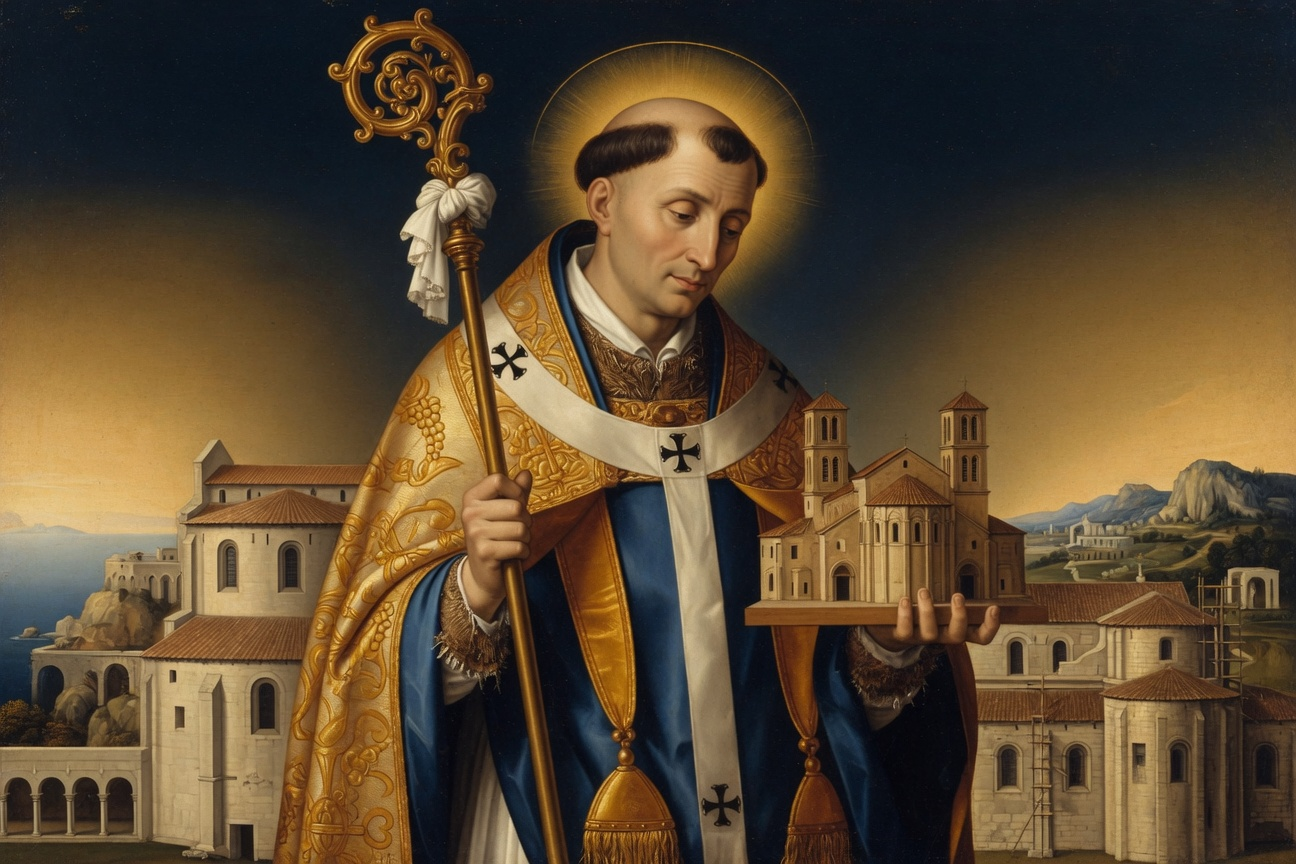
Saint Virgilius of Arles
ABBOT OF SAINT-SYMPHORIEN AND METROPOLITAN BISHOP OF ARLES
Religious of Lérins, Abbot of Saint-Symphorien and Metropolitan Bishop of Arles
Born in Aquitaine around 530, Virgilius was a monk at Lérins and then abbot at Autun before becoming Archbishop of Arles. As Vicar of Pope Gregory the Great for the Gauls, he played a key role in the evangelization of England by consecrating Saint Augustine of Canterbury. He is famous for his charity, his religious constructions, and several miracles of resurrection.
Guided reading
8 reading sections
SAINT VIRGILIUS, RELIGIOUS OF LÉRINS,
ABBOT OF SAINT-SYMPHORIEN AND METROPOLITAN BISHOP OF ARLES
Youth and formation at Lérins
Born around 530 in Aquitaine into a Gallo-Roman family, Virgile received a Christian education before joining the monastery of Lérins to embrace the religious life.
Around the year 530, a child of blessing named Virgile was born in Aquit aine. H Virgile Metropolitan of Arles who consecrated Augustine. is parents, wealthy Gallo-Romans whose virtue and piety equaled their opulence and nobility, gave him the most brilliant, yet also the most Christian, education. Their care was not lost: they had the consolation of seeing the happiest qualities of mind and heart develop in their son from his earliest childhood. Growing in wisdom as in age, Virgile, after having been an admirable child, became the most accomplished young man, and all the hopes he had inspired were surpassed by reality. At that time of life when passions boil, when everything is seduction and danger, he preserved, says the biographer, in all its freshness the angelic virtue that his name expressed. In him, the amiable candor of innocence was united with that precocious maturity, with that gentle gravity that comes from restraint, modesty, continual vigilance, the practice of all virtues, and serious habits. Eager for study and never ceasing to cultivate his remarkable intelligence, he soon distinguished himself by the breadth of his knowledge and the superiority of his talents. The reading of the Holy Scriptures was especially dear to him: every day he gathered there the celestial food destined for the nourishment of his soul. Accustomed by his sublime meditations and his conversations with God to live in a higher sphere, he had a pious and noble disdain for all the material things of this world, valued only invisible goods, and treated his body, although always innocent, as the natural enemy of evangelical perfection, constantly compressing it under the weight of austerities, in order to prevent or immediately stop any revolt of the flesh against the spirit. To this love of study, of prayer, and of the beautiful virtue that ennobles, enlarges, and in a way spiritualizes the lowest part of our being, the holy young man added a magnanimous and generous heart, a strong soul, an amiable mansuetude, a calm, a tranquility, and a patience that could withstand any test. Who would be surprised by this? Is not piety useful for everything? So many beautiful qualities, so many virtues seemed further enhanced by the charms of his person: he had a remarkably beautiful face, an always amiable and attentive air, affable manners, a noble and serene brow where one could see the elevation of his thoughts along with the peace of his conscience; and from his graceful lips, where a benevolent smile often blossomed, fell a word that was always sweet and caressing.
With all these external advantages, with talents, birth, and fortune, Virgile could have shone in the world. But his great soul aspired to rise higher: he wanted to be perfect, and he knew that to rise to the perfection of which the evangelical counsels are the goal, the Christian must renounce everything and break all the bonds that can chain him to the earth. That is why he ran immediately to shelter his young virtue, alarmed by the dangers of the century, in a pious asylum. The famous monastery of Lérins opened its doors to him. Happy to live with brothers in this ho ly community, the n monastère de Lérins Place of monastic formation for Virgilius. ovice showed admirable charity to all and soon attracted general affection. Scrupulously exact in observing the ancient rule in its primitive rigor, he soon became the model for all the religious. Finally free from all earthly preoccupation, he seemed to have conversation only with heaven.
Abbot of Saint-Symphorien d'Autun
Virgile is called to lead the abbey of Saint-Symphorien d'Autun, where he distinguishes himself by his pastoral vigilance and performs his first miracle by healing a young man.
After having been formed in all religious virtues within those famous cloisters that have seen so many illustrious figures, Virgile was called to the government of the abbey of Saint- abbaye de Saint-Symphorien d'Autun Abbey that housed the relics of Ardaing. Symphorien d'Autun: a holy and famous school as well, where, as at Lérins, under the influence of the rule of the Eastern monks, science and virtue flourished, a happy mother of great men and great saints who were likewise the light of the clergy, the glory of the Church. The new abbot soon justified the high opinion held of his merit and always showed that he was at least equal to that reputation for talent and holiness which had caused him to be placed at the head of such an important institution. Never did a pastor guard his flock with more active solicitude, lead it with more skill, or love it with a more tender affection. Like a father, or rather like a mother always anxious, he watched by day, he watched by night: and while the religious, his children, tasted the sweetness of sleep, he never failed to walk through the monastery, making the most exact visit everywhere. Once, in one of these circumstances, the demon tried to frighten him by appearing to him in a horrible form. The holy abbot made a sign of the cross, and the infernal phantom disappeared. One of the young men raised in the house also saw the frightful specter and was so terrified that the fright gave him a burning fever. Virgile went to him, reassured him with paternal kindness, and said a prayer. That was enough: the young sick man rose immediately, perfectly healed.
Elevation to the Episcopate of Arles
On the recommendation of Saint Syagrius of Autun, Virgilius is elected Archbishop of Arles by the clergy and the people, despite his initial resistance.
However, Licerius, Archbishop of Arles Arles Ecclesiastical metropolis of the province to which Constantine belonged. , died. Now, it was of extreme importance that this see, the first in Gaul at that time, should be occupied by a pontiff of eminent merit. Saint Sy agrius, Bishop of Autun, und Saint Syagre, évêque d'Autun Bishop of Autun who oversaw the education of Aunarius. erstood this better than anyone. This illustrious prelate, whose zeal, as enlightened as it was vast and active, was constantly preoccupied with the salvation of souls, the good of the Church, and the glory of God, therefore turned all his attention to this great matter, and believed he should use his powerful influence to procure a worthy pastor for the metropolis of Arles. Having been able to know perfectly all the merit of the Abbot of Saint-Symphorien, he proposed him. No one seemed to him more capable of rising to the height of the sublime functions of the episcopate. And besides, Virgilius had a very great reputation, especially in the southern provinces: his nomination would therefore infallibly be welcomed there with general assent. Syagrius, a just judge of men and things, had not been mistaken. The clergy and the people, accepting with eagerness the proposal of the Bishop of Autun, asked with a unanimous voice for the illustrious religious. He indeed tried to oppose a lively resistance to a choice against which there was only one objection, that of his humility; but he was obliged to yield to wishes and a call no less obstinate than his resistance itself. Vanquished by this sort of moral violence, torn against his will, like Saint Germanus, from the pious calm of his dear abbey, acclaimed with an irresistible enthusiasm that no longer left him his freedom, he finally consented to receive episcopal consecration, and gave himself entirely to his people, as he had given himself entirely to his religious (380). The monastery of Saint-Symphorien, honored as it was by the glory of providing bishops to the principal churches of Gaul, must have been very sensitive to this new and great loss, although no doubt they were given a new abbot worthy of its reputation and its importance.
Reforms and monumental foundations
In Arles, he reformed the clergy and had the basilicas of Saint Stephen and Saint Savior and Saint Honoratus built, attaching a monastery to them.
Scarcely had Virgilius taken possession of his diocese when, consumed with zeal for the house of God, he reformed his clergy, gave great wealth to his Church, and built in his episcopal city a basilica in honor of Saint Stephen, the first martyr. Later, he raised another under the title of the Savior and Saint Honoratus, the illustrious founder of Lérins and one of his predecessors on the see of Arles. To this latter church, he annexed a monastery, so that the praises of God might be sung there day and night. He was happy in the midst of this community of brothers, which reminded him of his former family of Saint-Symphorien of Autun and was to provide his diocese with a pious and learned clergy.
Vicar of Pope Gregory the Great
Pope Gregory the Great appoints Virgilius as apostolic vicar in the states of Childebert, addressing instructions to him regarding the baptism of Jews and the fight against simony.
The reputation of Virgilius did not remain confined within the limits of Gaul; it crossed the mountains and reached Rome. Th e great Pope Saint Gregory, Le grand pape saint Grégoire Pope contemporary to Saint Psalmodius. whose judgment was so enlightened and so just, paid the most striking tribute to the merit of the holy archbishop through frequent letters, through the esteem, and through the singular affection with which he honored him, and did not fear to share in some way the authority of the supreme pontificate with him, by naming him his vicar in the sta Childebert King of the Franks, historical founder of the Abbey of Saint-Aubin. tes of Childebert. Here is what the Holy Father wrote to Virgilius shortly after the appointment of this worthy abbot of Saint-Symphorien to the archbishopric of Arles: « Gregory, to Virgilius, Bishop of Arles. — I regret that I have not yet been able to write to Your Fraternity to return the greeting I owe you. But today I shall, in one and the same letter, testify to my brotherly affection and at the same time speak to you of the manner in which one must act with regard to the Jews. Some of them, who are established in your province and who travel to Marseille for the affairs of their commerce, have informed us that several of their coreligionists were receiving baptism more by force than by conviction. Now, such conduct proceeds no doubt from a good intention; it is dictated by love for Our Lord Jesus Christ. But I greatly fear that this zeal, less enlightened than it is ardent, will not obtain the results it promises, and will cause, which God forbid, the loss of the souls it would wish to save. For men who have not been brought by an intimate conviction, but who have been dragged by force to baptism, return to their ancient superstitions and find through their apostasy death where they should have found life. Let Your Fraternity therefore make frequent exhortations to these poor blind men, in order to engage them gently to ask themselves for the sacrament which opens the door of the Church... »
The illustrious Pontiff, responding to a new letter from the holy archbishop, who according to custom had requested the *palli um*, sa pallium Liturgical vestment and symbol of authority requested by Virgil from the Pope. id to him: « What an admirable thing is charity!... How right the great Apostle was to call it the bond of perfection! Indeed, other virtues adorn the soul, but it is charity that attaches them to it. Now, my dearest brother, I know by the testimony of those who come from the Gauls that you are a model of this excellent virtue; and besides, your letters would suffice to provide proof of it.
Thus, I am far from suspecting that in requesting, according to the custom of your predecessors, the *pallium* and the apostolic vicariate, you had as a motive the petty glory of reaching the height of passing dignities and adorning yourself with an exterior ornament. You know very well, — moreover, no one is ignorant of it, — that the faith came from the Roman Church into the Gauls; in addressing yourself to the Holy See, according to ancient custom, you wished to show that it is the source of all favor and all authority. Would a good son not love to have recourse to the bosom of his mother? That is why we grant you very willingly what you ask of us. We would not wish to deprive you of a distinction that you deserve so well, nor to despise the request of our most illustrious son, King Childebert. But also redouble your zeal, so that your solicitude and your vigilance grow in proportion to your dignity; serve as a model to all those who are subject to your authority, and seek, not the temporal advantages attached to honors, but the goods of the eternal homeland. For Your Fraternity is not ignorant of what the Apostle says while groaning: « All seek their own interests, and not those of Jesus Christ ». Then the sovereign Pontiff particularly excites the zeal of Virgilius against two abuses that he stigmatizes with force and indignation: simony and the hasty ordination s of su simonie Buying or selling of spiritual goods, a major struggle of the saint. bjects unworthy or incapable of ecclesiastical functions. His letter ends thus:
« It is therefore necessary that Your Fraternity hasten to recommend to our most illustrious son, King Childebert, to extirpate from his kingdom the disorders that we have just signaled, so that this prince may receive the reward promised to those who love what God loves and who hate what God hates. Finally, we charge you, in the name of God, to exercise according to the ancient usage the functions of vicar of the Holy See in all the states of our most illustrious son, King Childebert, saving however the right of the metropolitans. We send you at the same time the *pallium* which Your Fraternity shall wear in the church to celebrate mass solemnly. No bishop shall be able to leave his diocese except with the permission of Your Holiness. If discussions arise concerning the faith or some other difficult point, let the question be discussed and resolved in a council of twelve bishops. If the matter, after mature examination, is not decided in this assembly, let it be deferred to the tribunal of this Apostolic See. May the almighty God cover you with his protection and grant you the grace to always raise yourself by your virtues to the height of the dignity with which you are invested (395) ».
Nothing escaped the vast solicitude, the prodigious activity of the great Pope; and he recommended everything to the zeal of our Saint, his worthy vicar in the Gauls.
Consecrator of the Apostle of the English
Virgilius supports the mission of Augustine of Canterbury to England and performs his episcopal ordination in Gaul.
It is known that he had sen t the monk August le moine Augustin Leader of the evangelical mission to England and first Archbishop of Canterbury. ine and several other evangelical workers to labor for the conversion of the Anglo-Saxons who had settled on the island of Britain (England). This was his favorite work: thus, he did not fail to recommend the new apostles to the charity of Virgilius with truly paternal care. Here is what he wrote to him on this occasion: "I judge the affection with which you will welcome brothers who must go to find you spontaneously, by that which you show to those whom you have invited more than once. I do not doubt, therefore, that you will receive Augustine and his companions with a gentle kindness that will fill them with consolation. Examine these missionaries at the same time, and if you notice anything reprehensible in them, warn them, correct them, so that they may be more apt to effect the conversion of the peoples. May God have you in his holy keeping, my most reverend brother." Augustine,
VIES DES SAINTS. — TOME III. 41 fortified by the encouragements of Virgilius, departed for England where he effected numerous conversions. But, to be better able to govern the new church he had just formed, the apostle of the English returned to Gaul to receive episcopal ordination (597) from the hands of the holy archbishop of Arles, vicar of Saint Gregory, and went to establish his see at Canterbury. Thus, Saint Virgilius was the consecrator of Augustine, apostle of England; and as he had lived at Lérins, the island of Saints, he is like the connecting link between the island of Saints of the Mediterranean and the island of Saints of the Ocean. How glorious this memory is for the abbey of Saint-Symphorien, but also how sad!
Signs and wonders
The saint performs several notable miracles, including the resurrection of the nephew of the deacon Aurelian, that of a young girl, and the healing of a blind man named Fulgence.
It is also seen through this correspondence what regard the Holy Father had for Virgilius. But Our Lord wished to honor with the gift of miracles the one whom His vicar so justly honored with his esteem and confidence. Here is what old legends recount.
A deacon, named Aurelian, had an orphaned neph ew whom Aurélien Gallo-Roman nobleman and ambassador of Clovis. he served as a father and whom he loved tenderly. Now, this child, playing one Saturday evening with his little companions on the city ramparts, fell, broke his head, and died. The deacon, inconsolable at the loss of this cherished nephew, immediately took the corpse and carried it to the feet of Virgilius. The holy archbishop, who was then attending the office in the new basilica of Saint-Étienne, happy to have been able to consecrate this beautiful edifice to God and thanking Him for the success of this great work, told Aurelian to place the dead child in his room and to have faith. After the office, the desolate deacon, having thrown himself at his knees and holding them embraced, said to him: "Lord, I will not let you go until you have obtained for me the grace I implore." Touched by such great sorrow and yielding to such lively entreaties, the venerable bishop went, followed by all the people who were in the church, to the dead child and addressed an ardent prayer to heaven. Then, taking the child by the hand, he returned him full of life to his uncle. Immediately all the crowd surrounding him burst into transports and cried out: "O God, glory to You!"
During the construction of the superb basilica that the man of God had raised outside the city walls in honor of the Savior and Saint Honoratus, it happened one day that the workers, despite all their efforts, could not erect those magnificent marble columns that one sees today, the legend adds. In vain did they employ all means; in vain did they call to their aid a great number of men in the full vigor of age; always the same resistance, the same impossibility of imparting the slightest movement to the columns. Then they became frightened and ran to warn the archbishop. The latter arrived and, recognizing there an intervention of that wicked spirit, enemy of God and man, who always seeks to do evil and prevent good, he said: "My children, do not give yourselves so much trouble; it would be useless, you would not succeed. To a supernatural resistance, one must oppose a supernatural force as well." Then, falling to his knees, he implored the help of the Almighty and cried out, after having finished his prayer: "Wretched one! How could you have the audacity to oppose the work of God? Flee far from here." Immediately the workers returned to work, and the columns were erected without the slightest difficulty. Another time, as the holy bishop was celebrating Mass, a desolate widow, who had just lost an only daughter, her consolation, her hope, had the coffin containing the remains of the one she mourned carried near him, before the altar, and begged him with her tears, even more than with her words, to be willing to obtain from God the life of her beloved child. Virgilius, whose heart did not hold against this maternal tenderness and sorrow, approached the coffin, prostrated himself humbly, raised his hands toward heaven, and addressing Him who has sovereign goodness as well as sovereign power, he prayed to Him, with all the ardor of his charity, to console a poor mother by returning her only daughter to her. He was heard. Suddenly the deceased opened her eyes: she seemed to be emerging as if from a deep sleep. "Rise," the saint then said to her. She rose, and her mother received her in her arms, watering her with the sweet tears of joy mixed with the bitter tears of sorrow that had not yet dried. "Miracle! Miracle!" cried all the people transported with admiration, while the holy Pontiff, whose humility was alarmed by the homage paid to his credit with God, hastened to escape it by flight. But he was surrounded on all sides, the greater part of his garments were torn from him, and the piety of the faithful, says the biographer, still preserves these shreds preciously as the relics of a great servant of God.
A blind man, who had great confidence in the merits of the servant of God, asked a subdeacon, named Fulgence, to lead him during the night into the vestibule of the basilica of Saint-Ét Fulgence Subdeacon who witnessed the healing of a blind man. ienne. "There," he said, "I will not fail to find the archbishop at the moment he leaves the Matins office, I will implore his assistance, he will intercede for me, and I will be healed." Indeed, when Virgilius retired to take a little rest, the blind man who was waiting for him, attentive and motionless, threw himself at his knees, stopped him in his path, and did not let him go until he had obtained the promise of a prayer. The Saint, touched by such naive confidence and such lively faith, therefore implored divine goodness for this unfortunate man through a fervent supplication, made the sign of the cross on those extinguished eyes that for fifteen years had not seen the light, and immediately they opened. Then, tenderly embracing the poor blind man who was thanking him with transport, the humble prelate recommended that he keep the most inviolable secret about everything that had just happened. But this man was too happy not to betray his benefactor: his joy and gratitude burst forth in spite of himself. Soon the whole city knew and proclaimed the new miracle performed by the holy pontiff.
Death and posthumous glorification
Virgile dies at the beginning of the 6th century after predicting his end; a miracle of resurrection occurs during his funeral before his burial at Saint-Honorat.
We could still report a great number of wonders due to the charity and prayers of the holy archbishop, for the Holy Spirit who dwelt in his soul, adds the historian, denied him no favor. But it is time to speak of the blessed death that crowned a life entirely of labors and virtues. He knew by revelation and predicted the day of his passage to another life; this day was very near. The sad news soon spread and the desolation was general. He, on the contrary, happy to go and reunite with the good master he had always served so well and loved so much, calmly gave all the orders relating to his burial, not forgetting to request that he be buried with the hair shirt he always wore on his flesh like a breast plate cilice Garment of austerity worn by the saint. against the attacks of the impure spirit. Then, when the day of his death arrived, he lay down quietly in bed, as if to take his rest, began the holy office, and went to finish it in heaven. His last words, which were praises of God, mingled on his lips with his last breath. At the same instant, a delicious odor exhaled from the holy body; one believed, says the legend, to breathe the perfumes of all the flowers of spring. Saint Virgile died in the first years of the 6th century. His funeral attracted an immense gathering of people. Everyone wanted to approach the coffin and touch at least the edge of the hangings that adorned the funeral bier. This confidence of the faithful was not in vain: God himself wished to justify it by attesting to the holiness of his servant through a striking wonder. The procession was arriving near the place of burial, and they were about to cover the venerated remains of the holy pontiff to place them in the tomb, when suddenly people were seen running up carrying a corpse. It was that of a young girl who had just died in a neighboring village. The hope of obtaining through the intercession of the great servant of God that life be restored to her quickened their steps. Finally, they arrived breathless, threw themselves on their knees in tears, and begged the clergy to allow the Saint's coffin to touch the body of the deceased. They yielded to their urgent pleas. At the given signal, the whole multitude also fell to their knees, praying, silent, motionless, in expectation of what was to happen. Soon the Kyrie eleison was intoned: a thousand voices repeated it, and at the seventh time, the young girl rose full of life. Immediately a shiver of religious terror ran through and made the immense assembly shudder. At first, all remained mute with stupor, admiration, and respect. But a feeling that dominated all others did not take long to emerge: joy burst forth and replaced the sadness of the funeral. The mournful and plaintive chants were succeeded by hymns of gladness, and the funeral ceremony turned into a triumphal march. Those who had brought the resurrected young girl hastened to strip her of the shrouds of death to adorn her with festive clothes; and there she was, walking, drunk with happiness, in the midst of the pressed ranks of this innumerable crowd, and crying out, in the transports of her gratitude: "O blessed bishop! O good and holy pastor! How much I owe you! How powerful your merits are! Yes, you have well shown by restoring my life to me that you yourself live the eternal life."
Meanwhile, the procession had entered that superb basilica of Saint-Honorat that the illustrious archbishop had had built outside the city and chosen as the place of his burial. The funeral ceremony was completed there with great solemnity, and the holy body was deposited in this tomb which, the biographer says, so many miracles have since made so famous. Thus, the church of Arles soon celebrated each year, on October 10, the feast of the holy prelate. The monastery of Lérins, where Virgile had spent his youth and learned virtue, did not remain behind and consecrated March 5 to annually honor a memory so holy and so dear.
We have borrowed this legend from the work of M. Dinot: Saint Symphorien d'Autun.
Annexes & related entities
Structured data for exploration: events, miracles, quotes, places, attributes, patronages, and important entities cited in the text.
Key Events
- Born in Aquitaine around 530
- Entered the monastery of Lérins
- Abbot of Saint-Symphorien in Autun
- Appointment to the Archbishopric of Arles
- Appointed Vicar of the Holy See by Gregory the Great
- Consecration of Augustine, apostle of England in 597
- Construction of the basilicas of Saint-Étienne and Saint-Honorat
Miracles
- Healing of a young man frightened by a demon at Saint-Symphorien
- Resurrection of Deacon Aurelian's nephew
- Miraculous placement of marble columns hindered by the demon
- Resurrection of a widow's only daughter during Mass
- Healing of a fifteen-year-old blind man
- Resurrection of a young girl during her own funeral procession
Quotes
-
What an admirable thing is charity!... How right the great Apostle was to call it the bond of perfection!
Letter of Saint Gregory the Great