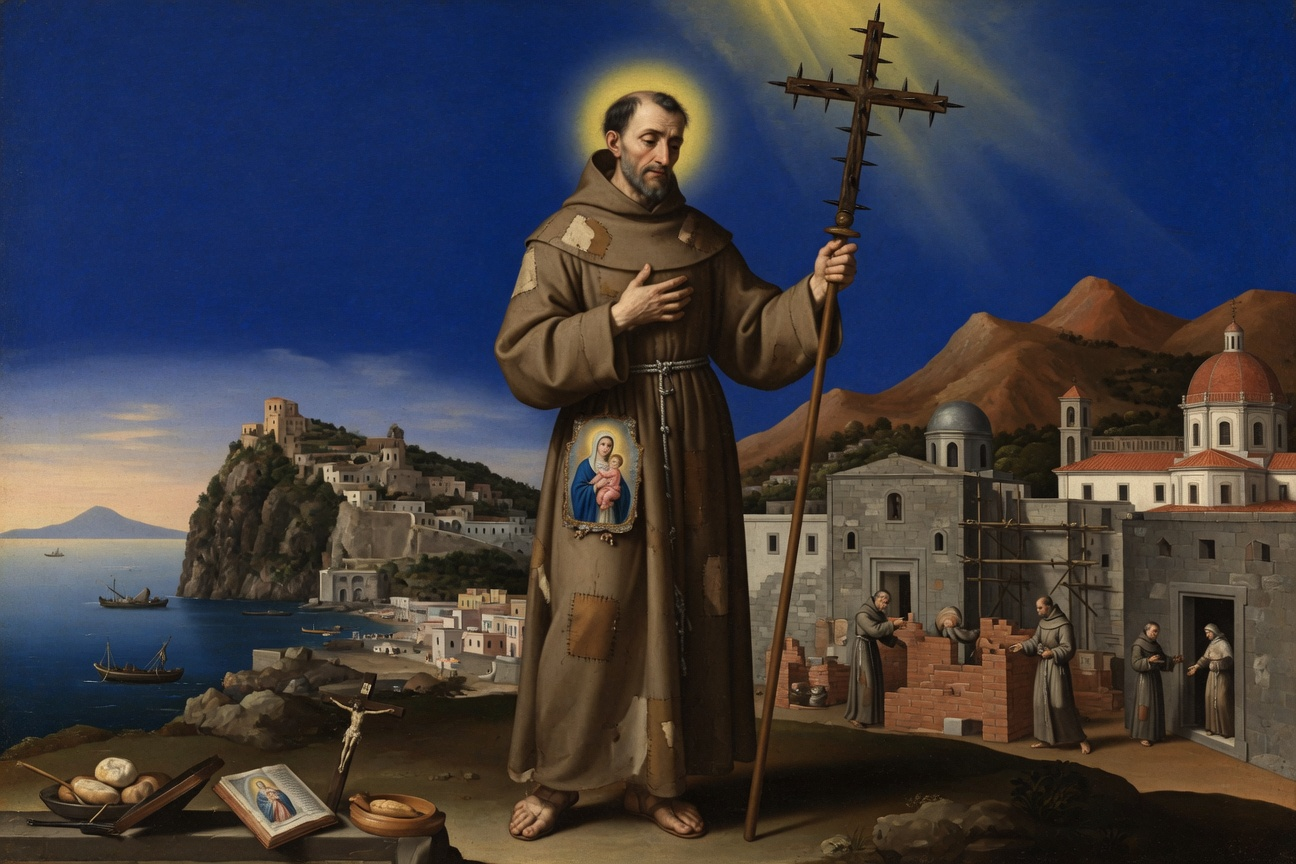
Born in Ischia in 1654, John Joseph of the Cross was a pillar of the Alcantarine reform in Italy. Known for his heroic humility and extreme mortifications, notably the wearing of a spiked cross, he was graced with numerous mystical gifts such as bilocation and ecstasies. He died in Naples in 1734 after a life dedicated to the poor and to spiritual direction.
Guided reading
10 reading sections
SAINT JOHN JOSEPH OF THE CROSS
Youth and Vocation
Born in Ischia in 1654 under the name Charles-Cajetan, he manifested an austere piety very early on before joining the Reformed Franciscans in Naples.
The word of the cross is foolishness to those who are perishing; but to those who are being saved, it is the power of God. I Cor., I, 18.
He alone is a perfect Christian who is crucified to the world and to whom the world is crucified, and who glories in nothing else but the cross of Our Lord Jesus Christ. At our entry into life, we are marked with the sign of the cross, and we die pressing the cross to our lips; the cross is engraved on our tomb to bear witness to our faith and our hope. "If anyone wishes to be my disciple," said Our Lord, "let him take up his cross and follow me"; that is to say that, of all the things of the earth, one must take, in order to follow Jesus Christ well, only pains and tribulations; our hearts must be, like our divine Savior, attached to the cross and raised from the earth; they must be for this world as if they were dead. Among the Saints who have most shone with this love, with this folly of the cross, we cannot forget Saint John-Joseph of the Cross, whose name alone invites us to love the cross.
He was born on the day of the feast of the Assumption in the year of Our Lord 1654, in the city of Ischia, on the island of the same name which is part of the kingdom of Naples, to respectable parents, Joseph Calosirto and Laure Garguilo, and received, that same day, at the sacred fonts of baptism, the names of Charles-Cajetan. Distinguished by his piety above his brothers, a t least five of Charles-Cajétan Franciscan Alcantarine saint renowned for his extreme asceticism and mystical gifts. whom dedicated themselves to the service of God, he let the seeds of the virtues that sanctified his life in the religious state appear early on: we mean humility, gentleness, obedience, and an incomparable modesty; he also manifested a wonderful inclination for silence, retreat, and prayer. Thus, from his childhood, he chose a room in the most secluded part of the paternal house; he set up a small altar there in honor of the Blessed Virgin, on whose great feast he had had the happiness of being born, and with whom he maintained a tender and entirely filial devotion all his life. He spent all his time in study and exercises of piety; he manifested no less early his love for the cross, sleeping on a narrow and hard bed, and fasting on certain days of the week; to this premature mortification of the flesh he joined a great zeal to stifle every feeling of pride, constantly wearing very common clothes, despite his birth, his position, and the remonstrances and reproaches made to him about it. The horror of sin equaled in him the love of virtue, so that his heart, from the first dawn of reason, knew how to withdraw, like a delicate plant, from the very shadow of sin, and found itself entirely penetrated with zeal for the glory of God. Thus, he was not content to flee with the greatest care the company of young people of his age, for fear of staining his innocence there; he also sought every opportunity to inspire in others the hatred and fear of sin, the slightest appearance of which awakened his indignation and drew complaints from him. Laziness, frivolity, vanity, and lying, in the least important things, were in his eyes faults worthy of severe reprimand. When his efforts to destroy sin drew persecutions upon him from others, far from losing patience, he saw in them only a new opportunity to practice virtue. One day, having out of charity tried to stop a quarrel, he received a slap on the face in the middle of the street: immediately he fell to his knees and began to pray for the one who had struck him. His tenderness for the poor exceeded everything that can be said: he reserved for them the best portion of his meals and gave to Our Lord, in their person, the money he received for his small pleasures.
The holiness of his early years earned him the grace of being called to a holy state: feeling inwardly urged to leave the world, he took great care to seek counsel from the Father of lights; for this, he multiplied his prayers and his mortifications; he was heard: God inspired in him the desire to enter the Order of Saint Francis of Assisi, reformed by Saint Peter of Alcantara. He was admitted to the novitiate in the house of Naples. He manifested so much ardor that the superiors judged it appropriate to clothe him in the holy habit before the expiration of the required time. When he was still in his sixteenth year, on the day of the feast of Saint J ohn th Naples Place of the saint's death. e Baptist, in the year of our redeemer 1671, he took the name of John-Joseph of the Cross. He nevertheless prolonged the exercises of his novitiate and continued above all to practice, for three years, an extraordinary mortification. At the age of nineteen, his superiors
Foundation of Piedimonte
At 19, he directed the construction of the monastery of Piedimonte di Afile, where he established a strict rule and experienced his first ecstasies.
sent him to direct the erection of a convent at Pied imonte di Afile (th Piedimonte di Afile Site of the foundation of a convent by the saint at the foot of the Apennines. e monastery of Afila) at the foot of the Apennines. Not content with giving his monastery a simple and poor exterior and narrow dimensions in proportion, our Saint took care that the rule was rigorously observed. He demanded the greatest silence, the deepest recollection, and an exact submission to orders and recommendations. He did not believe that the two and a half hours devoted to mental prayer were sufficient; he wanted the divine office to be recited with more attention and solemnity. Nothing could stop him in the rapid construction of this house; he did not hesitate to engage in the lowest and most arduous tasks, carrying bricks and mortar on his own shoulders to the workers. His zeal did not go unrewarded: it was on this occasion that he experienced for the first time those ecstasies and raptures with which he was subsequently so singularly favored. One day, after having searched for him in vain throughout the monastery, he was finally found in the chapel, lost in ecstasy, and so elevated from the ground that his head touched the ceiling.
Ministry and Eremitic Life
Having become a priest, he founded a wooded hermitage to imitate the Desert Fathers and assumed the duties of novice master and guardian.
Out of obedience, he consented to receive the order of the priesthood and was charged with hearing confessions; it was there that he displayed his theological knowledge and his experience in the spiritual life, which he had acquired like Saint Bonaventure, Saint Thomas Aquinas, and Saint Teresa, by studying the crucifix, the most useful of all books. In order that his soul might, without being distracted by foreign objects, have its gaze constantly fixed on the cross, and draw from it each day new treasures of grace through new austerities and continual prayers, he resolved to make for himself, in a wood adjoining his monastery, a kind of solitude, in the manner of the ancient Desert Fathers. God blessed this holy enterprise by making it produce the most abundant fruits, and won him the hearts of those who were far as well as those who were near; a delicious fountain was discovered in the woods, whose waters healed the sick; near this fountain, he raised a small church, and all around, at certain distances, five small hermitages, where, together with his companions, he renewed the austere and entirely heavenly life of the ancient anchorites; so that no earthly care might come to disturb it, the monastery provided them each day with the food they needed. But the superiors, who knew what a rich treasure they possessed in the person of our Saint, chose him as novice master as soon as he had reached his twenty-fourth year. In this new post, far from allowing himself the slightest dispensation, he was always the first to set the example of a scrupulous observance of all the rules, of assiduity in the choir, of fidelity to silence, to prayer, and to recollection: he took care to instill in the hearts of those under his guidance an ardent love for Our Lord Jesus Christ, a great desire to imitate Him in everything, and, moreover, a special veneration and a tender attachment for the Blessed Virgin, his mother. He was a zealous monitor, but full of sweetness, without violence as without caprice, vigilant without being fussy or annoying; discreet, kind, and of an always even temper, he sought out and discovered faults only to remedy them with tender charity; he led others to virtue much more by his examples than by reprimands, which are often out of season. He conducted himself in this way especially when he was invested with the office of guardian at Piedimonte: he took care to make others appreciate his prescriptions by showing himself the first to observe them, imitating the captain who encourages his soldiers by braving the dangers himself and overcoming the obstacles, or the bird which, to teach its young to take flight and soar into the air, measures the distance first and stimulates their inexperienced flight. He soon won the hearts of all the religious who, under his guidance, advanced with great strides toward perfection. However, his humility groaned under such a heavy burden; having obtained, after two years, the rest to which he aspired, he turned his zeal toward the direction of souls, the assistance and relief of the dying and the unfortunate, and the conversion of sinners. He did not enjoy this holy liberty for long. He had the sorrow of seeing himself reinstated in the office of guardian by the Provincial Chapter of 1684; and, far from making this cross light for him, it pleased Our Lord to envelop his soul in darkness, dryness, and desolation; he looked upon himself as being on the edge of the abyss, incapable of preventing others from falling into it. But the good Savior, who seemed to abandon him for an instant only so that he might turn toward Him with more strength, like a child about to perish throwing himself into his mother's arms, brought calm back to his mind through a very consoling vision.
It seemed to our Saint that he saw the soul of a brother, who had died a short time before, who calmed his alarms by giving him the sweet assurance that all the religious of Saint Peter of Alcantara, who had come to Naples, or who had made their profession there, had led such a holy life that not a single one had been lost. This gave him courage and emboldened him to embrace the duties that his office imposed upon him, and God deigned to glorify him more than once through miracles. Supernatural aid came to relieve the needs and deprivations to which the monastery found itself reduced; so much so that, in a time of famine, all the bread having been distributed to the poor, so that there was none left at all for the community, at that very moment an unknown person brought and deposited, at the door of the monastery, exactly as many loaves as there were members in the community. This marvelous fact was repeated on two occasions of the same kind; furthermore, one saw more than once the bread multiply miraculously and the wine that had become sour return to its natural state, and the same herbs which, one day, had been gathered to be given to the poor, grew back during the night and in greater abundance.
Government and reforms of the Order
He plays a crucial role in maintaining the Italian branch of the Alcantarines and becomes Provincial before retiring to Naples.
When he was once again relieved of his duties as guardian, it was only to take up the position of master of novices, which he occupied for four consecutive years, and which he exercised partly in Naples and partly in Piedimonte. At that time, he was called to his birthplace, Ischia, to receive his mother's last breath; at the sight of him, all her vital powers rallied around their expiring flame, which from then on burned joyfully in the lamp until the end. She could not bear for him to deprive her for a moment of his dear company, unable to satiate her maternal eyes, until death had extinguished them, with contemplating the fruit of her womb, and not ceasing for an instant to commend herself to his prayers. She died full of hope and calm, in the presence of this beloved son. The latter, enclosing the feelings of his grief within his heart, accompanied her mortal remains to the church and offered the sacrifice of propitiation for the rest of her soul. Who could have a just idea of what was happening within him then? How the waves of his grief pierced through the holy thoughts that occupied his soul and his brow! How he saw in spirit the suppliant soul of his mother rejoicing at every prayer that came from the mouth of her son! How he saw her face shine with greater radiance as her temporal pain was remitted by the blood of the Lamb of God! With what happiness, at the end of the sacrifice, he saw this grateful soul ascend to the abode of eternal bliss, and there immediately exercise her influence, praying in her turn for her beloved son! This is how he behaved in this great circumstance; he needed no less courage when dryness and perpetual desolation returned to torment his soul. The demon mixed another bitterness into this cup of tribulations; our Saint feared that he was not procuring the glory of God through the austerities he practiced himself, or recommended to those under his direction, and feared that they were the effect of a deceptive illusion. A vision consoled him again in this trial: a novice, who had died, appeared to him surrounded by heavenly glory and assured him in formal terms that it was solely to his direction that he owed this glory: which finally restored calm to his soul. The Provincial Chapter of 1690 charged him with the office of definitor, without removing the charge he already held; the difficulties attached to these two functions required the union of the virtues of the active life with those of the contemplative life: our Saint overcame them all in a manner as admirable as it was happy; he had the occasion to show that he was the firmest support of his Order. The religious of Saint Peter of Alcantara of Spain, having had some disputes with those of Italy, obtained from the Holy See to be separated from them: those of Italy thus found themselves abandoned; in a congregation held in 1702, the cardinals and bishops were all disposed to order its suppression; John of the Cross made them change their sentiment, so that, the day after the feast of the apostle Saint Thomas, a decree was published by virtue of which the Order was established in Italy, in the form of a province. A Chapter entrusted its government, or rather imposed it upon our Saint, who, through incredible difficulties and obstacles, established it in a firm and solid manner. The more he avoided dignities, the more his Order imposed them upon him; he finally obtained from the Pope a brief that exempted him from all charges and that even took away his active and passive voice in the Chapter. In the course of the year 1722, another Brief granted the monastery of Saint Lucy in Naples to the religious of Saint John of Alcantara; and it is there that our Saint retired, to no longer appear in the broad daylight that he fled with such care, and where monastère de Sainte-Luce, à Naples Monastery in Naples where the saint retired and died. he remained to edify his brothers for the rest of his life and to raise the edifice of his virtues, of which we are now going to trace a faint sketch.
Virtues and Charity
The text details his profound faith, his unwavering hope, and his heroic charity toward the sick and the poor.
He bowed with complete submission before the truths of the faith, without raising with a rash or profane hand the veil of that sanctuary. One day, when he saw someone murmuring against Providence, he exclaimed vividly, placing his hand on his forehead: "What can a bone three fingers wide understand of the impenetrable designs of God?" From this virtue of faith flowed, as from their source, a great zeal to instruct the ignorant in the mysteries of religion, the strength, the fervor, and the prodigious clarity with which he explained the sublime dogmas of the Trinity and the Incarnation, and even of predestination and grace; the gift he possessed of calming apprehensions and appeasing doubts relating to the faith, and finally that continual exercise of the presence of God, which he practiced without discontinuation and which he never ceased to recommend by saying: "He who always walks in the presence of God will never commit sins, but will preserve his innocence and become a great Saint."
From this also came that interior recollection which neither relations with the world nor the exercise of various duties that brought him into contact with others could disturb; from this came the habit of referring to God all his thoughts, all his words, and all his actions; a blind submission and an entire conformity to the will of God amidst the countless crosses with which he was visited, and finally that warmth of sentiment which escaped in these terms: "To die for Jesus! Can I be worthy to shed my blood for him! Oh! With what ardor I desire to shed my blood to bear witness to the holy faith!" He maintained a serene and joyful face in the midst of the most horrible pains; he blessed God for all his evils. Among the numerous illnesses he had to endure, there was one that lasted twenty-three days, during which he was obliged to remain with his head resting on pillows and his arms extended without movement. But not a word of murmuring or complaint escaped his lips; he answered with joy and patience all those who came to visit him: which caused him to be called "the Job of modern times, a man exempt from human frailties." What sustained him thus was the hope he had in God. He was accustomed to saying to his companions, when they became discouraged at the sight of the persecutions they had to endure: "Let us hope in God, and we shall certainly be consoled"; and to the unfortunate who flocked to him: "God is a tender father who loves and helps all his children"; or else: "Do not doubt it; hope in God, He will provide for your needs." Knowing that God destined him for an eternal kingdom, he did not doubt that He would provide the necessary means to arrive there; everything that passes seemed contemptible to him compared to what lasts eternally. "What is this earth," he said, "if not mud, a piece of dust, a pure nothingness! Paradise, heaven: God is everything. Do not attach yourselves to the goods of this world, fix your affections on high; think of this happiness that will last eternally, while the shadow of this world will vanish."
Although his hope, in view of the merits of the holy Passion of Our Lord, was boundless, he nevertheless thought with dread of the gravity of sins and the formidable severity of the judgments of God; he had the keenest regret for the slightest faults, he ceaselessly deplored his lack of correspondence to divine grace, he proclaimed himself a sinner everywhere, and recommended himself to the prayers of others.
God rewarded the confidence of His servant with several miracles; here is one that happened eight years before his death: in the month of February, a Neapolitan merchant waited for him until evening at the gate of his garden, and, at the moment he was returning, he approached him, imploring him to pray for his wife who was then in great danger, being seized with a violent desire for peaches which it was impossible to obtain at that time of the year. The Saint ordered him to remain in peace and to be consoled, telling him that the next morning the Lord, Saint Peter of Alcantara, and Saint Paschal would satisfy his desire. Noticing then, at the moment he was climbing the steps, some chestnut branches, he turned to his companion and said to him: "Brother Michael, take three of these branches and plant them; if you do so, the Lord, Saint Peter of Alcantara, and Saint Paschal will have regard for the needs of this poor woman." The lay brother exclaimed, quite amazed: "What, my father, can chestnut branches bear peaches?" "Leave everything," replied the Saint, "in the hands of Providence and Saint Peter of Alcantara." The brother obeyed and planted the chestnut branches in a flower pot outside the Saint's window, and behold, in the morning they were found covered with green leaves, and each of these branches bore a superb peach. The merchant's wife ate them and thus escaped death.
The love of God burned so ardently in his heart that it broke out even in his features, where it spread a supernatural and celestial light, and gave his discourses a particular unction. "If there were neither heaven nor hell," he said, "I would, nevertheless, want to love God always." Or else: "Let us love Our Lord, let us love Him really and in truth; for the love of God is a great treasure. Happy is he who loves God!"
He made every effort to kindle in the hearts of others the fire that devoured his own. Loving God thus, whom he did not see, could he fail to have the bowels of a father for his neighbor whom he did see? All his life he made it a duty to feed the poor; and, when he had been chosen as superior, he forbade sending away a single beggar from the monastery gate without giving him alms. In a time of famine, he consecrated to the relief of the unfortunate his own portion and that of his community, resting on Providence for the care of providing for the needs of his house; being only a simple monk, he strongly recommended this act of charity to his superiors. He obtained for the poor and for the merchants, who often resorted to him for this purpose, the payment of things that were owed to them. But it was especially toward the sick that his charity knew no bounds; he visited not only those of the monastery but also those outside, during the most rigorous seasons. He even went so far as to pray to God to transfer the sufferings of others onto himself, and his prayer was answered. Thus, Father Michael, later Archbishop of Cosenza, suffering greatly from two ulcers on his legs, where a painful incision had become necessary, recommended himself to the prayers of our Saint, who prayed to God generously to transport this affliction onto himself: immediately the limbs of the sick man were delivered from his infirmity, and those of the Saint were infected with two horrible ulcers that caused him frightful pains. Just as God makes His sun shine on the wicked as well as on the good, so our Saint did not exclude even his enemies from the benefits of his boundless charity. He did everything in his power to procure an advantageous position for a man who had insulted him; and, as he was warned that this man was his enemy, he replied that he consequently had a graver obligation to render him service. His charity redoubled in ardor when it was a question of works of spiritual mercy to be accomplished. As in his old age he was advised to spare himself, by reason of his infirmities: "I have no infirmity," he replied, "that prevents me from working; but, even so, should I not sacrifice my life for the same end for which Our Lord Jesus Christ was crucified?" Thus God used him to bring about a great number of conversions. The same spirit of charity, which made him take upon himself the illnesses of others, also led him to take charge of their spiritual pains. A servant of a prince had lived for five years far from the Sacraments and was plunging without restraint into every kind of disorder: finally conquered by the remorse of his conscience, he made a general confession to our Saint, who, in consideration of the sincerity of his sentiments and touched by compassion for his weakness, imposed on him only a light penance, taking it upon himself to accomplish the rest of the penalty due to his sins.
Mortifications and Asceticism
He practiced extreme penances, including wearing spiked crosses, hair shirts, and total abstinence from liquids for thirty years.
In addition to these general virtues, he possessed to a high degree those proper to the religious state, especially a prompt and unlimited obedience to all the orders of his superiors, however painful or difficult they might be. One day, when he had to make a very long journey, he set off with joy, although his limbs were afflicted with severe ulcers; arriving at a town that was on his route, the local doctor strongly urged him not to go any further, for the reason that his wounds were inflamed and the weather was excessively cold; and, seeing that his love for obedience prevented the Saint from yielding to his reasons, he proposed that he write to his superior; but the Saint refused invincibly, though politely, and continued his journey without any delay. A short distance away, having slipped on the ice, he fell and cruelly tore his diseased limbs, to the point that he could hardly stand; however, with truly heroic courage and perseverance, he continued his task and accomplished it. This obedience that he practiced himself, he took great care to demand from others, when his quality as superior made it a duty: for he regarded this virtue as essential to a religious. Thus, when he discovered, by a supernatural light, some secret transgression of this precept on the part of one of the novices, he immediately punished that fault with severity, by stripping the culprit of the holy habit. His love for poverty was no less remarkable. A most common chair and table; a bed composed of two narrow boards, with two sheepskins and a poor wool blanket, a stool to support his ulcerated legs, then his Breviary: this was all the furniture of his cell. Although the Order allowed each of the religious to have two pairs of habits, he had no others, however, during the forty-six years he was part of it, than the one he was clothed in at the novitiate. However, it was in the care he took to watch over the guarding of his chastity that he appeared most admirable. His continual mortifications, his extreme modesty, and the perpetual vigilance he exercised over all his senses preserved him from the slightest breath of corruption: never, during the sixty years he lived, was he seen to look a person of the other sex in the face; all his words and all his actions recommended purity and inspired love for it: in the streets, he politely returned the greetings he received from all those he met, but without raising his eyes from the ground, and he never conversed with persons of a different sex without necessity or without observing the greatest reserve. When he went to a convent of nuns, he always took a companion with him; and all the time he spent there, he made so little use of his eyes that it would have been impossible for him to say anything about what was there, even objects that might have been pointed out to his attention. With the members of his Order, he did not believe he should depart from this singular modesty of conduct: conversing with them from a distance, and always keeping his eyes lowered toward the ground. To accustom the novices to this restraint of the senses, he forbade them to raise their eyes, even to examine holy images. His love for this virtue was always so constant and so delicate that, on his deathbed, when one of his brothers lifted the blanket from his legs to dress the wounds with which they were afflicted, the Saint, dying as he was, made an effort to pull it back. In reward for this virginal purity which he preserved without stain since his baptism, as his confessor later attested, God willed that his body, despite his age, his infirmities, and the wounds from which he was never free, should give off a sweet and delicious odor, which was felt by all those who approached him. This virtue, so solidly rooted in our Saint, was not separated from its unique and true foundation: humility. He took pleasure in performing the domestic tasks of the monastery, and, when his task was finished, he showed himself eager to perform that of others. This same virtue led him to cleverly hide his extraordinary mortifications. Having lived, for a very long time, only on a little bread and fruit, he liked to repeat that he was greedy for fruit, and that he was satisfying his sensuality. This is also what made him flee all positions and all honors, at least as much as his vow of obedience could allow. When he traveled through Italy as provincial, he did not want to make himself known at the inns where he stayed, for fear that he might become the object of some distinction. One can attribute to the same cause the reluctance he always had to return to visit his native land; the repugnance he had to being in the company of the great, when their spiritual interests did not require it; the refusal to accept the invitations that the Viceroy of Naples and his wife addressed to him to come to the palace; the habit he had of calling himself the greatest sinner in the world, an ungrateful man who responded to the benefits of God only with criminal ingratitude, a worm on the surface of the earth; the custom he had of frequently kissing the hands of priests; his reluctance to declare his opinion in councils; the care he took to refrain from speaking of his birth and his friends, to thank God for enlightening those who despised him, to never be scandalized by the sins of others, however great they might be, and finally to never show the slightest resentment for the insults or outrages he received. He studied to hide and dissimulate the gift of miracles and prophecy with which God had favored him to such a high degree, attributing the miracles he performed to the faith of those in whose favor they were performed, or else to the intercession of the Saints. Often he ordered those he restored to health to take some medicine, so that the healing could be attributed to a purely natural remedy. As for his prophecies, which are numerous, he affected to judge according to analogy and experience. Thus, during the terrible earthquake that took place on Saint Andrew's Day (1732), as the nuns of several convents did not dare to go to their dormitories, he reassured them, telling them that after only a few tremors, it would cease without causing the slightest damage to the city or its inhabitants. Someone having asked him what reason he had for expressing himself in such a positive manner: "I am sure," he replied, "that it will happen this way, because that tremblement de terre qui eut lieu le jour de saint André (1732) Seismic event predicted by the saint. is how it happened previously." The event justified his prediction, and, the day before the earthquake, he had warned his companions in this way: "My brothers, if an earthquake were to happen, where would we find a safe refuge?" No one answering: "It is in the refectory," he added, "because it is placed further up the mountain." Let us now speak of his extraordinary mortifications. To the numerous penances and austerities prescribed by the rules of his Order, he added as many as an ingenious self-denial can imagine. He watched in a very particular way over the guarding of his senses; even in his youth, he did not allow himself to raise his eyes to the ceiling of his cell, and when he had been raised to the priesthood, he made it a rule not to look anyone in the face. He mortified his ears by refusing them the pleasure of hearing music; he would not even have wanted to smell a flower. Keeping silence as long as possible, he spoke only in a low voice. He went bareheaded in all seasons; and, under his clothes, which were coarse and heavy, he wore various hair shirts and various chains, which he took care to vary to always awaken the feeling of pain. In addition, he gave himself harsh disciplines; and when at the age of forty his superiors forced him to wear sandals, he put between them and his feet a quantity of small nails; but the most frightful instrument of penance that he invented against himself was a cross about a foot long, equipped with sharp points, which he attached so strongly to his shoulders that a wound formed there which never closed again. He also wore another cross of the same kind, but smaller, attached to his chest. He shortened his sleep to a degree that is truly prodigious; and the little he took, he took only sitting on the ground, or with his body hunched on his bed, too small for him to lie down on, and his head often resting against a piece of wood that protruded from the wall. His abstinence was no less extraordinary. For the last thirty years of his life, he entirely overcame the most insatiable of all needs, thirst, by abstaining not only from wine and water, but even from any kind of liquid. One day when his confessor asked him how he had managed to master such an imperious need of nature, he replied that it had cost him terrible battles; that, however, the reflection he made on the sufferings to which men voluntarily devote themselves for motives that are not worth it, had made him persevere in his design. Surely, all this would seem incredible to us, if we did not remember that Saint Jean-Joseph of the Cross had taken upon himself the instrument of the holy Passion of Our Lord Jesus, and that he was miraculously supported under its weight. If we are not endowed with such great courage, we are all at least capable of suffering much more than is asked of us to gain heaven.
Mystical Gifts and Prophecies
Subject to bilocations, ecstasies, and visions, he also possessed the gift of prophecy and the reading of hearts.
Ecstatic raptures and heavenly visions were something habitual for our Saint. In this state, he was dead to everything happening around him: seeing, hearing, and feeling nothing, he remained motionless like a marble statue; and, upon waking, his face shone like a burning coal. In a state so analogous to that of the Blessed, he participated from time to time in their glory. Thus, while he was in prayer, his head often appeared surrounded by a circle of light; and, while he was saying Mass, his face radiated a supernatural brilliance. He was said to have declared, in a moment of transport, that the Blessed Virgin had appeared to him and that she had spoken to him. On Christmas night and on other occasions as well, the infant Jesus would descend into his arms and remain there for several hours at a time. His frequent raptures, in which he no longer touched the ground but remained suspended in the air, were perfectly well known; several people who attended his Mass were witnesses to it; the same thing also happened in a very extraordinary way during the course of a procession.
God did not refuse him that singular prerogative with which He has sometimes favored His Saints, of being present in several places at once, or of moving with the promptness of celestial spirits from one place to another. It is reported that, at a moment when he had remained gravely ill in his cell, a lady sent for him to come and hear her confession at the church. "You see," he said to the messenger, "in what state I am: I cannot move." But when the servant went to report this answer to his mistress, who, during his absence, had conversed with the Saint, she refused to believe his words until she had acquired the certainty that the Saint was really in the position he said. Francisco Viveros, who was a servant to a certain duchess, came to beg the Saint to accompany him to his mistress, who wished to see him, and, finding him entirely incapable of moving, he hastened to go and share this circumstance with the duchess, at the side of whose bed he found the Saint occupied in consoling her.
There is nothing above the astonishment with which he was then seized, and he expressed it in a very vivid manner; but the Saint said to him with an air not at all embarrassed: "How simple you are; I passed right by you, and you did not see me!" Likewise, Mrs. Artemisia, mother of the Marchioness of Rugiano, seeing herself seized with the horrible pains to which she was subject, and having no means of calling the Saint to her aid, let slip this plaintive exclamation: "O Father John-Joseph, you are far from me in my distress, and I have no one to do me the service of bringing you here." She was still speaking when he suddenly appeared and said to her with the air of kindness that was habitual to him: "It is nothing, it is nothing!" then he blessed her, healed her, and disappeared instantly.
The secrets of hearts had nothing hidden for him. Thus, he shared with a brother of his Order the knowledge he had of the desire he secretly harbored to go to infidel lands to suffer martyrdom there. Another time, having been introduced to a lady whom he had never seen before: "Ah! here is," he said, "this lady who has so much to suffer from the bad conduct of her husband!" Then, addressing her, he said: "Why do you give him the occasion for it?" and he began to reproach her for her faults on this point.
Now, we will add a few traits relating to the knowledge he had of distant and future events. He predicted the recovery of a lady who had been abandoned by the doctors, and who, in fact, returned to health. A nun who was gravely ill was recommended to his prayers: "Do not fear," he said, "she will be fine"; and it happened so. On the contrary, he predicted the death of several people who were not suspected to be so close to passing away. Having been called to assist a nun who was expiring, he noticed beside her bed a young person who was her niece: "You have called me here," he said, "to assist at the death of the aunt whose life must still be prolonged, while it is the niece who is on the edge of eternity." Shortly after, in fact, the nun recovered perfect health, and the young person was carried off suddenly by a stroke of apoplexy.
But a very striking example of his prophetic veracity is what happened to three young men to whom he predicted their various destinies, in his own house in Ischia, in 1694. Their names were Gabriel, Anthony, and Sabato; all three manifested the desire to enter the Order of Saint Peter of Alcantara. When the first of the three opened his design to him, our Saint exclaimed with compassion: "Alas! my son, a religious Order is not your vocation: you have the look of the gallows." When the second consulted him, he said to him: "Be on your guard, my son, for you are threatened with a great peril." Then the third, who was only a simple peasant, having heard in part what had already passed, answered the questions that the Saint asked him relative to what he desired, by telling him that "his parents being dead, and finding nothing better, he desired to join his destiny to that of the two others, who proposed to become monks." — "Sabato," said the Saint, "pray to the Blessed Virgin with fervor, do your duty often, and God will assist you." Following this advice, the honest peasant became a lay brother among the Discalced Franciscans, and was often in contact with our Saint. He led a holy life, endured with truly Christian courage the horrible sufferings of his last illness, and died with the reputation of a great servant of God. But, before his death, he had the occasion to be a witness to the fulfillment of the two other predictions of our Saint; for, passing one day in the vicinity of Pozzuoli, he was shown a place on the surrounding mountains where Anthony had been killed and reduced to ashes by a bolt of lightning, when he had come into the vicinity to get married and settle down. By a truly strange coincidence, he met, around the same time, in the vicinity of the island of Ischia, the third whose destiny the Saint had predicted, Gabriel Martin, armed and equipped like a brigand. He learned from his own mouth that having committed a murder, he had been condemned to be executed, but that he had escaped from prison in a moment of insurrection, when all the prisons had been opened, and that now he was wandering as a fugitive, in a continual apprehension of being pursued for another homicide of which he was guilty.
Miracles and dominion over nature
The saint performed numerous healings and manifested a sovereign dominion over the elements and evil spirits.
It remains to speak of the miracles of our Saint, the number of which is incalculable. First, he had a sovereign dominion over evil spirits, whom he cast out of several people. The part of the monastery of Santa Lucia del Monte, called the Novitiate, was infested at night by these wicked spirits; but our Saint dislodged them for good by blessing the apartment. A strange thing: after his death they tried to return, but they were repelled by the simple invocation of his name. The elements themselves obeyed him: the rain would cease to fall at his command when it fell hard enough to force him to seek shelter. Another time, while traveling with a companion under incessant rain, their clothes were found to be dry when they arrived at their destination, as if they had had sunshine throughout the journey. All of nature was subject to him and served his desires. The air brought back on its wings his staff which he had left behind, and the plants, as we have seen, grew supernaturally to support the aims of his charity. Sometimes he performed miracles by a simple prayer; often by making the sign of the cross, or by using relics or holy images, or the oil from the lamps that burned before them.
No fewer healings are cited as being performed by contact with things that belonged to him, or by contact with his own person. A cloak used by him delivered an individual from a furious madness that was judged incurable; the manner in which this healing occurred is truly extraordinary. The mother of this sick man holding his cloak spread out before him, he jumped from a very high window into the street, and, when one expected to find him dead and all mutilated, he was picked up full of life and returned to his right mind; he remained in this state until the moment of his death. With a piece of the Saint's habit, Casimir Avellon cured his wife, in London, of a spasmodic affection of the shoulders, against which all remedies had hitherto been tried in vain. A gentleman was delivered from an acute pain in his head by the simple contact of his person; he strengthened the limbs of a three-year-old child, and restored sight to a young man who had become blind, by simply touching them with his hands.
Death and glorification
He died on March 5, 1734, in Naples after an agony marked by prodigious signs linked to a relic of Saint Cajetan.
It was thus, in the practice of all virtues, and favored with all privileged graces, that our Saint spent the days of his pilgrimage, glorifying God, giving alms, and doing good, until the moment when it pleased the Lord to put an end to his earthly career, not without having made known to him in advance the time and circumstances of his death. The year it happened, his nephew having written to him from Vienna that he would return home in the month of May, he replied that he would no longer find him alive then. Only a week before his departure, while talking with his brother Francis, he said to him: "Until now, I have asked you for nothing yet, do me the charity of praying to the Almighty for me next Friday; do you hear? Next Friday, remember it, do not forget." It was the very day of his death. Two days before his final mortal attack, he said to Vincent Laine, upon approaching him: "We shall not see each other again on earth." Now, on the last day of February, after having heard Mass and received Communion with extraordinary fervor, he retired to his room to address to the crowd that was pressing around him his last paternal warnings. He continued without interruption until noon; and, at precisely noon, turning toward the lay brother who was caring for him, he said: "Shortly, a thunderclap will knock me to the ground; you will lift me up, but it will be for the last time." Indeed, two and a half hours after sunset, an apoplectic attack knocked him to the ground; he was alone at that moment; but a lay brother having entered his apartment shortly after, lifted him up and placed him on his bed. While he was rendering him this service, the Saint said to him gently: "I entrust this image of the Blessed Virgin to you"; then, with a face full of joy and serenity, he lay down with his eyes fixed on the image of the Mother of God. At first, the nature of his illness was mistaken; it was thought that the excess of fatigue had caused a fainting spell; but, the next day, alarming symptoms appeared, the progress of which resisted all remedies. The Theatine Fathers, by whom he was tenderly loved, having learned of the accident that had befallen him, came to visit him, bringing with them their renowned relic, the staff of Saint Cajetan. When they touched his head with it, a remarkable event occurred, which we shall report by cit ing the very saint Cajétan Saint whose relic (staff) manifested signs during the agony of John Joseph. words of Father Michael, by whom the relic in question was applied to the head of the sick man: "By virtue," he said, "of the reciprocal love that existed between Father John-Joseph of the Cross and me, and also of my deep respect and my particular obligations toward him, no sooner had I learned that he had been struck by an apoplectic attack and that there were fears for his life, than I brought him the staff of Saint Cajetan. As I touched his head with it, a prodigy occurred that has had no equal, before or since, although the relic has been continuously and is still carried to a great number of the sick." Here is the fact: "When I had entered the cell of the aforementioned servant of God, who was dying, and had placed the aforementioned relic on his head, the staff, at that very instant, made certain jumps and leaps corresponding to a melodious sound that was heard by all those who were present; and, despite all my efforts, I could not prevent it from moving in my hands, to my great astonishment and to my great satisfaction, which were shared by all those who were with me witnesses of such an unheard-of prodigy. At the very moment when this prodigy was being accomplished, one saw the servant of God slowly raise his hand and point his index finger toward heaven. Struck with astonishment at what was happening, and what is more, seeing that the Saint, by the violence of his illness, was beside himself, I was preparing to approach the relic to him a second time, when the staff began to jump like the first time and the melodious sound was heard again; a second time also the servant of God raised his hand and pointed to heaven with his index finger: which made me understand that Saint Cajetan was inviting him to paradise. All this was, to all those who were present and to me, a great subject of consolation and a superabundance of spiritual joy; and the rumor of this great miracle coming to spread suddenly throughout the monastery, one saw arriving near the sick man a crowd of religious and persons of distinction, who joined their voices to beg me to apply the relic to him once more, so that they too might be witnesses of this prodigy. At first I remained undecided, thinking that it would be in some way tempting God; but, yielding finally to their importunity, I lent myself to their desires, saying to myself: Perhaps God wishes to glorify his servant even more. Drawing the relic from its case, while all those who surrounded me examined with pious curiosity what the result would be, I applied the relic to the sick man, on two different occasions, and each time the jumps and sounds of which I have spoken were renewed; each time also, the servant of God raised his hand and pointed to heaven as in the first times; which confirmed me fully in the persuasion that it was an invitation by which Saint Cajetan was calling him to celestial happiness, and to which the Saint was responding with this sign. This is a point worthy of serious attention, when one reflects that the servant of God had been struck by apoplexy and that he was deprived of feeling."
This is what Father Michael teaches us. Although he appeared thus, according to all appearances, devoid of feeling during the five days he survived, one cannot doubt that his soul was entirely given over to ecstasies and deep contemplation; this is, in fact, what his face, his lips, and his gestures indicated, which had the expression of the most tender devotion. His eyes, generally closed, opened frequently to rest on the sweet image of Our Lady, of which he had a painting in front of him; sometimes also he turned them toward his confessor, as if to ask for absolution, just as had been previously agreed between them. One also perceived a tightening of the eyes and an inclination of the head, and he was seen to strike his breast when, for the last time, he received sacramental absolution from the hands of the superior. Likewise, when his dear friend, Innocent Valetta, threw himself on his knees at the edge of his bed and poured out his soul to him, recommending himself secretly, he and his family, to the prayers of the holy man, and conjuring him not to forget them when he would be i n Paradise, the Innocent Valetta Close friend of the saint and witness to a posthumous apparition. servant of God cast upon him a look of ineffable sweetness and benevolence, squeezing his hand tenderly as a sign that he promised to do what he desired of him. It was then that they gave him Extreme Unction, in the presence of his community and also of several personages of distinction, ecclesiastics and laymen, who were all kneeling around the miserable pallet of the expiring Saint. Now, when, following the custom observed among the religious of Saint Peter of Alcantara, the father guardian addressed the community, to declare to all the religious that their dying brother asked, in the name of charity, to be buried in a poor habit, the servant of God made a sign of the head to mark his assent, and touched the garment of the one who was speaking. Then, all those who were present could not help but be deeply affected, seeing that the habit that the humble Saint had just chosen was the poorest there was, having been worn for sixty years, and being so patched that it was no longer possible to perceive its shape.
Finally, the dawn brought back the day, and one saw the rising of that long-desired sun which was to illuminate the passage of our Saint from this valley of tears and this land of sorrows to a better life: it was Friday, March 5, a day which was not yet occupied in the calendar, as if it had been reserved for him on purpose. He had spent the previous night in continual and fervent acts of contrition, resignation, love, and gratitude, as far as one could judge by seeing him frequently strike his breast, raise his hands to heaven, and make the sign of the cross over himself. At an early hour of this last day, addressing a lay brother who was assisting him, as if he were coming out of an ecstasy, he said to him: "I have only a few moments left to live." Then the lay brother ran in all haste to warn the superior who, with the whole community, which was at that moment in the choir, went promptly to the cell of the dying man. They recited the recommendation of the soul while shedding torrents of tears, and our Saint remained so deeply recollected during this solemn moment that, when Brother Bartholomew, seeing that he had twice made efforts to lift himself up, passed his arm under his head, the servant of God waved his hand to warn him to cease, so that his union with God would not be interrupted. The father guardian, noticing that he was in agony, gave him the last sacramental absolution; the Saint inclined his head to receive it and raised it immediately; then he opened his eyes for the last time, appearing to swim in joy and intoxicated with celestial delights, fixed them, at the very moment they closed, with a look of ineffable tenderness, on the image of the Blessed Virgin; and finally, giving his lips the expression of a sweet smile, without any other movement and without any other demonstration, he ceased to breathe.
Thus expired, without effort and without any reluctance even of nature, John-Joseph of the Cross, the mirror of religious life, the father of the poor, the consoler of the afflicted, and the invincible Christian hero. Scarcely had he rendered his soul, than he began to manifest himself to several in a glorious state. At the very hour of his departure for the other life, Diego Pignatelli, Duke of Monte-Lione, who was then walking in his apartment, perceived Father John-Joseph of the Cross, who appeared to him in perfect health (although he had left him sick in Naples a few days before), and all surrounded by a supernatural light. Struck with astonishment at this sight, the Diego Pignatelli, duc de Monte-Lione Neapolitan nobleman who witnessed an apparition of the saint at the moment of his death. duke exclaimed: "What! Father John-Joseph, are you then so suddenly recovered?" To which the Saint replied: "I am well and happy," then he disappeared. The duke then sent to Naples, and learned that he had died at the hour when he had gloriously appeared to him. He manifested himself in a still more remarkable way to Innocent Valetta; for, finding himself asleep at the moment of the passing of our Saint, he felt himself pulled by the arm, and heard himself called aloud by his name. Waking then, seized with a lively fright, he perceived a cloud of glory, and, standing in the middle of this cloud, a religious of the Order of Saint Peter of Alcantara, advanced in age, whose features, however, he could not distinguish because of the multitude of rays of light that were constantly escaping from it and which, by their bright brilliance, dazzled his eyes. The religious who appeared to him thus having asked him if he knew him, he replied that he did not; he then said to him: "I am the soul of Father John-Joseph of the Cross, delivered at this very instant from the bonds of the flesh and on the way to paradise, where I will not cease to pray for you and for your house. If you desire to see my body, you will find it in the infirmary of Saint Lucy of the Mount." At these words, he disappeared with the cloud, leaving the one he had favored with this visit, melting into tears and filled with a holy joy. He dressed himself immediately in all haste and went to Saint Lucy, where he found a numerous crowd, who announced to him the death of the Saint, and whom he struck with astonishment by the account of what he had seen himself. Falling then on the body of the Saint, he expressed his regrets by torrents of tears and returned inconsolable from this loss: this is what he himself attested thirty years later, when it was a question of drafting the process for his beatification. Likewise, three days later, he appeared to Father Buono, a religious of his own community, enjoining him to tell the superior to order the recitation of a *Gloria Patri* before the altar of the Blessed Sacrament, to render thanks to the Most Holy Trinity for the favors he had received from it. A little later, Mrs. Marie-Anne Boulei de Verme was visited by the Saint, from whom, at that moment, she ardently desired to receive spiritual help. Baron Bassano, whom a mortal illness kept in bed, was favored with a similar vision and so well healed that he lived for several more years; and when he died, it was from an illness entirely different from that with which he was then afflicted. Having therefore sent for Father Buono, he told him how the Saint had healed him, recommending that he send for him, and to conduct himself in everything according to his spiritual advice: which he faithfully accomplished.
Cult and official recognition
His body remained flexible and fragrant; numerous posthumous miracles led to his canonization in 1839 by Gregory XVI.
Beyond these facts, which were witnessed by only a few people, there is another more public proof of our Saint's elevation to eternal glory. His body, which, due to the time of his death and the illness that had caused it, should naturally have stiffened almost immediately, retained all its flexibility and presented a very surprising spectacle when, in order to wrap him in the shroud, he was placed in a sitting position. The face was very beautiful and freshly colored, although during his life he had a swarthy complexion; and such a sweet peace breathed from it that the Saint appeared to be merely asleep. Warm and vermilion blood flowed from his wounds, exhaling a sweet odor; many people dipped their handkerchiefs in it and carried them away as relics. When the body was transferred from the church to the sacristy, it seemed less to be carried by the bearers than to be carrying them itself.
The news of the Saint's death had no sooner spread in Naples than crowds flocked to where the body was to see it; and, to prevent any violence, it was deemed appropriate to post guards all around. It was in vain: the people overcame all obstacles, and, in a few moments, there remained no trace of the garment in which he was wrapped; it was seized with avidity as a relic of great price. The bier was torn to pieces as well as the veil that covered it, and three times the body had to be brought back to the sacristy to be decently clothed. People brought crosses and rosaries to touch his sacred person; natives and foreigners, all crowded to kiss his feet.
Even before the body had received the honors of burial, heaven glorified the sacred remains of our Saint with miracles. Brother Michael of San-Pasquale, in trying to resist the curiosity and indiscreet devotion of the crowd, received a wound to the head, having been struck by the point of a halberd. The blood, which flowed abundantly, was stanched by applying a piece of the Saint's habit to it. But the most striking prodigy was the miracle performed in favor of Charles Carafalo. During the funeral he was attending, he recommended himself to the Saint in a moment of fervor, promising him that, if he were cured of the epilepsy from which he had suffered for twenty-five years, he would publish this miracle to the whole world. The ailment left him at that very instant. But the sequel was even more extraordinary; for having, through a culpable ingratitude, neglected to fulfill his commitment, he experienced a relapse after a year: which led him to go and throw himself at the feet of the Saint; he implored his pardon, repaired his fault, and was cured again.
Hyacinths thrown on the Saint's body cured the daughter of Girolamo Politi of a violent inflammation in the eye; and, without mentioning an innumerable multitude of facts of this kind, two small pieces of his clothing cured Anne di Matia and Paschal Christiano: the first, of a violent stitch in the side, which had until then resisted all remedies; and the other, of frightful colics that had not left him for six years and kept him in a continual agony. These favors excited the ardor and piety of the people to such a point that all efforts to shelter the body from indiscreet zeal were useless; and the superiors thought it prudent to accelerate the burial. This is why, despite the resolution previously taken to leave these precious remains exposed for three days to public veneration, the next day, early in the morning, before the crowd could enter the church, the funeral was celebrated, and the body was piously deposited in the tomb. Nothing could paint the disappointment of the people at the moment the church doors opened; the violence to which they resorted is beyond anything that can be said: they rushed in a crowd onto the stone that covered the precious remains of the Saint, kissing it and watering it with their tears. Marguerite di Fraja obtained, on this occasion, the healing of her nephew, who was dying following wounds he had received in a fall; and the same day Vincenza Aldava was cured of a contraction of the knee, which made her incapable of walking, by simply sitting on the chair that had belonged to our Saint, and reciting the Ave Maria in honor of Our Lady.
Likewise, after his burial, countless miracles attested to the virtues and glory of our Saint. Fevers, spasms, attacks of apoplexy and epilepsy, and various diseases deemed incurable were cured with his relics. These prodigies determined Pope Pius VI to inscribe him in the Catalogue of the Blessed on May 15, 1789. Pius VII recognized, on April 27, 1818, the authenticity of two new miracles. Leo XII gave, on September 29, 1824, a decree by which he decided that one could, with full assurance, proceed to his canonization, and Gregory XVI performed the solemn ceremony on May 26, 1839.
His life was written in Italian by Father Diodato, and printed in Naples in 1794. The one we provide is taken from the works of Cardinal Wiseman, vol. xv; from th e Evangelica Grégoire XVI Pope who established the liturgical feast of the blessed. l Demonstrations of M. Migne.
Annexes & related entities
Structured data for exploration: events, miracles, quotes, places, attributes, patronages, and important entities cited in the text.
Key Events
- Born in Ischia on August 15, 1654
- Entered the novitiate of the Reformed Franciscans (Alcantarines) in Naples in 1671
- Directed the construction of the Afila monastery at age 19
- Appointed Master of Novices at age 24
- Elected Provincial of the Order in Italy in 1702
- Retreat at the monastery of Santa Lucia in Naples in 1722
- Died in Naples following a stroke in 1734
Miracles
- Multiplication of bread and wine at the monastery
- Miraculous peach shoots on chestnut branches in February
- Healing of ulcers through the transfer of suffering
- Bilocation to a duchess and to Mme Artémisia
- Leaps and melodious sounds from Saint Cajetan's staff during his agony
Quotes
-
What can a bone three fingers wide understand of the impenetrable designs of God?
Response to a murmur against Providence -
He who always walks in the presence of God will never commit sins.
Spiritual teaching