Saint Thomas Aquinas
AND DOCTOR OF THE CHURCH
Dominican Friar and Doctor of the Church
Born in 1226 into a noble Italian family, Thomas Aquinas joined the Order of Saint Dominic despite the violent opposition of his relatives. Nicknamed the 'Angelic Doctor', he revolutionized theology through his writings, notably the Summa Theologica, and composed the office for Corpus Christi. He died in 1274 at the Abbey of Fossanova, leaving an intellectual body of work that remains the pillar of the Church's teaching.
Guided reading
10 reading sections
SAINT THOMAS AQUINAS, DOMINICAN FRIAR
AND DOCTOR OF THE CHURCH
Origins and early signs
Born into an illustrious Italo-Norman family near Aquino, Thomas manifested a singular piety from childhood and miraculously escaped a lightning strike.
1274. — Pope: Gregory X. — King of Naples: Charles I.
Angel of the school... that is to say, virgin and doctor.
God, who delights in placing flowers near streams and who predestines the cradle of the Saints, caused Sain t Thomas Aquinas to saint Thomas d'Aquin Saint cited as an example of resistance to temptation. be born in an admirable corner of the earth, protected by the last peaks of the Apennines, still named today in the sweet language of these places: the happy countryside, the campagna felice; a happy countryside, indeed, spread out like a rich carpet at the foot of the most famous monast ery in the wor le Mont-Cassin Reference monastery for the Benedictine Rule. ld: Monte Cassino.
The city of Aquino, which this great Saint and great genius has immortalized, is situated in the middle of the happy countryside, in the ancient land of Lavoro, at approximately equal distance from Rome and Naples.
On the point of a rock that juts out into the plain and is named Rose-Sèche, there once stood a castle of the same name: it was there that the powerful family of Aquino lived, lords of Loreto, Belcastro, Sommacle, and other places. This house traced its origin back to the 8th century, to the time of the wars of Charlemagne, when several of its members appeared with distinction. At the end of the 17th century, its last descendants helped the grandson of Louis XIV to found a new monarchy in Spain. In the second half of the 19th century, the glory of this house was upheld by Thomas of Sommacle, one of the favorites of Frederick Barbarossa: this Thomas was the grandfather of the Saint whose life we are sketching. From the marriage of Thomas with Frances of Swabia, own sister of the emperor, was born Landulf, father of our Saint. Landulf had married Theodora, of the illustrious Caraccioli family: she herself descended from the Norman princes who, two hundred years earlier, had come to carve out a kingdom under the beautiful sky of Naples. Princess Theodora was worthy of her origin: in her lived again the pride of her ancestors, their religion, but also an exaggerated sense of authority; history accuses the haughty spirit of this noble woman while respecting her heart and her virtues.
Saint Thomas Aquinas came into the world in 1226, the year that saw Saint Francis of Assisi descend to the tomb and Saint Louis ascend the throne. What names and what a century! It would take a volume to give only the list of the great men and monuments of this era. But is it not enough to name Innocent III and Thomas Aquinas, Saint Louis and Albert the Great, Roger Bacon and Saint Bonaventure, Giotto and Dante, the Summa Theologica and the Divine Comedy, the cathedral of Cologne and the Sainte-Chapelle of Paris, the Imitation of Jesus Christ and the cathedral of Amiens: it was in the 13th century that the universities of Oxford and Paris were founded, t l'Ordre de Saint-Dominique Religious order to which the saint belongs. he Order of Saint Dominic and that of Saint Francis of Assisi, that the establishments of Saint Louis and the great English Charter were given.
But at the center of this century appears Saint Thomas Aquinas, for Saint Thomas was more than a pious cenobite; he dominated his era by the power of the idea, he directed the political movement of his century, not only as a theologian, but as a philosopher.
This is what the rest of this history will prove to us.
The last of the children of Landulf and Theodora of Aquino was called Thomas at the baptismal font, like his grandfather. If it is true that the Saints receive from God the name that qualifies them, the entire future was contained in this word Thomas, which means abyss, depth: for he was an abyss of science and virtue.
The first years of a famous life are rarely known: this is not the case for Thomas Aquinas. His oldest historians have preserved for us numerous details about his early childhood and even about the circumstances that preceded his birth. Unable to say everything, we will limit ourselves to the following two traits:
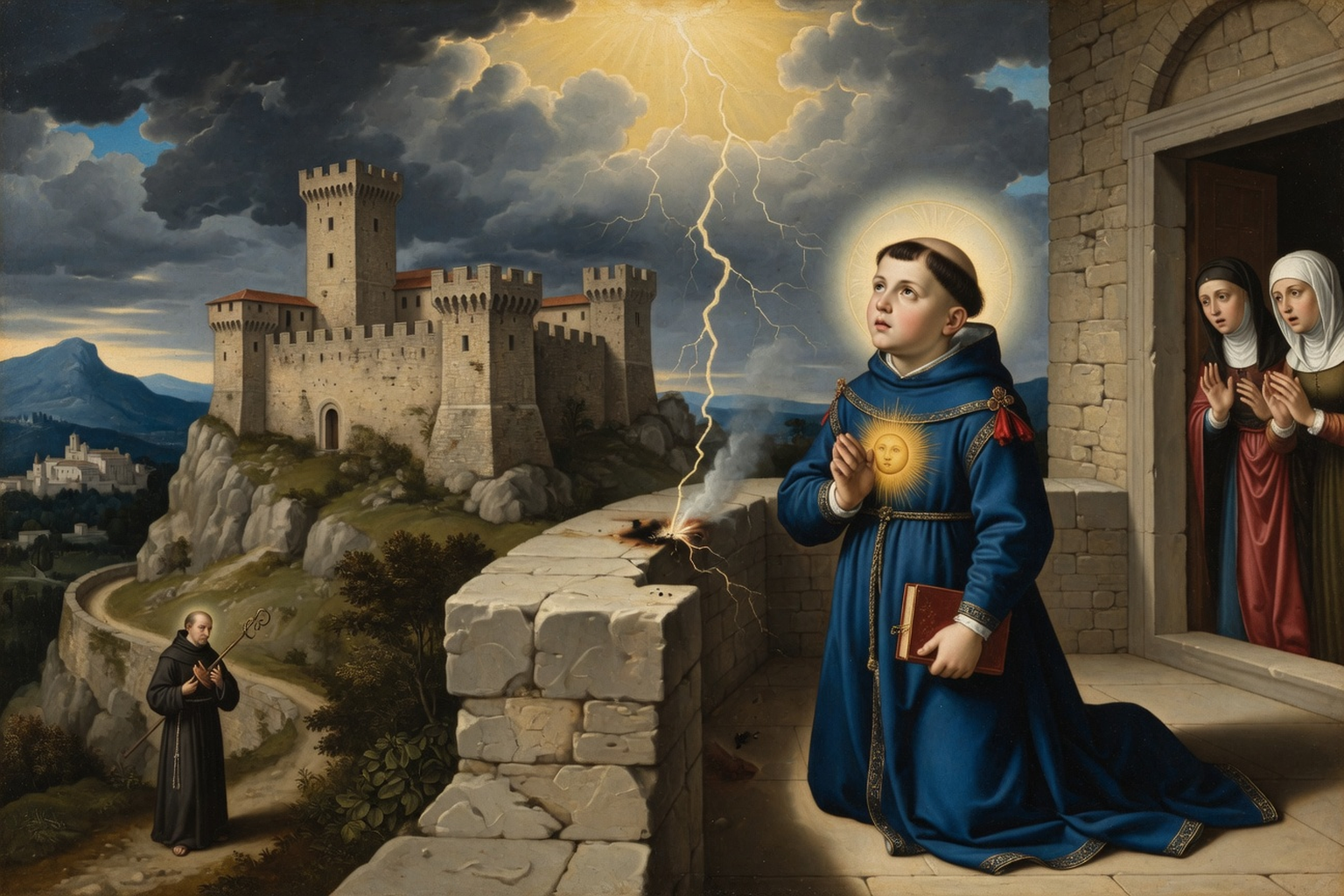
One day lightning struck one of the towers of the castle in which the child was, killed his sister beside him, and spared him: the gaze of heaven watches over his days.
It happened another day that the countess his mother, going to the baths with other ladies, gave orders to the nurse to accompany her with the child. The latter, having seated him in the accustomed place to wait for the hour of the bath, noticed soon after that he was holding tightly in his hand a very small piece of paper, without her being able to understand how he had found it in that place. She tried at first to open the child's hand; but he defended himself with his tears. It was necessary to leave him in possession of this singular treasure, and to bring him back to his dwelling, without him opening his hand for a single instant. This unaccustomed resistance having, however, piqued the curiosity of the countess, she loosened her child's hand, despite his cries and tears. The paper contained nothing other than these words: Ave, Maria, the salutation of the glorious Virgin.
Another trait no less charming: when he cried, the surest way to appease him was to give him a book that he could leaf through.
Education and Dominican Calling
After studies at Monte Cassino and then at the University of Naples, Thomas decides to join the Order of Preachers despite the violent opposition of his family.
The famous abbey of Monte Cassino rises six miles from Roccasecca. A member of the Aquino family, Landolfo Sénébaldo, was its abbot: it was into his hands that Thomas was placed at the age of five. It was noted from then on that at an age when children usually only know how to babble, Thomas knew how to be silent and reflect.
His old biographer shows him interrupting his childish games to gravely discuss the question: what is God, surrounded by little blond heads, attentive and silent, behind which hid more than one head whitened by science, but no less motionless with admiration and astonishment.
These childhood meditations were a worthy prelude to the research that was to fill a whole life: no doctor was to answer this question more satisfactorily: what is God.
Thomas was ten years old: the development of his intelligence determined the Count of Aquino to withdraw him from Monte Cassino to send him to one of those universities then so flourishing in Europe: he chose that of Naples, which Frederick II had just created.
A political motive alone could have dictated this choice Frédéric II Holy Roman Emperor. , for Naples was the most voluptuous city in the universe, and in a few years its university had reached the last stage of depravity.
Between these two times of his studious life, a moment was left to our Saint, which he spent with his own, in the castle of Loreto. Having left at the age of five, he had not yet been able to taste the delights of princely opulence, nor even the joys of family. The unforgotten memory of the kisses with which his mother covered his forehead will one day be the martyrdom of Thomas; but without martyrdom, there is no Saint.
Famine was then ravaging the region: the generous child asked as a favor to be the distributor of his parents' alms: but these alms were far from sufficient for the numerous miseries that every day came to be displayed at the gate of the castle. The young Thomas then entered into a struggle with the steward and began to raid the pantry as cleverly as possible for the benefit of his poor friends. The steward, to save his compromised honor, gave notice to the count, who set out to lie in wait to surprise the child's pious thefts.
One day, therefore, as Thomas was going stealthily through the corridors of the ancient castle of Loreto, carrying in a fold of his cloak the sweet booty of charity, he was suddenly stopped by the unexpected encounter of his much-feared lord and father. The latter, blocking his passage, ordered him to uncover what he was hiding with such care. Disturbed by the count's look and voice, Thomas let the folded flap of his garment fall back: it was found to be full only of flowers, which, to the great astonishment of both, covered the feet of the child and the old man. At the sight of such a justification, Landolfo, moved to tears, embraced his son with transport, and allowed him to follow the inspiration of his charity from then on, as long as there remained a mite or a piece of bread in the old manor of the Sommacle.
Later, the inhabitants of Loreto would vow a cult of love and gratitude to Thomas, would honor themselves by bearing his name, would have a church built for him, and would charge the arts to recount on stone and canvas the actions of their charitable benefactor.
But let us follow the young student to Naples, where charity was to serve as his shield at the same time as his occupation.
Placed under the guidance of a wise tutor, and formed by the lessons of heaven which spoke to his heart, Thomas kept himself pure in the midst of the bad advice of his fellow students, their perverse examples, and the seductions of all kinds that surrounded him. One cannot recommend too much to Christian youth the means he employed to preserve himself from these dangers.
He first made a pact with his eyes, and forbade them to see anything that could have softened his heart. His love for prayer; his devotion to the Blessed Virgin, the practice of works of charity to which he applied his surplus; his application to work, a retired life, such were the other weapons with which he fought the influences of corruption.
The two professors of the University of Naples to whom Thomas attached himself most particularly were Peter of Ireland and Peter Martin. The former, one of the most learned men of his time, held a school of dialectics and philosophy; the latter taught rhetoric and belles-lettres with brilliance.
These masters did not take long to discover the treasures of their disciple's mind, despite the reserve in which he wrapped himself; soon they proposed him as a model to the students gathered around their chair. It was noted from then on that Thomas's reports were clearer and more learned at the same time than the lessons of the professors themselves.
Exiled in the heart of a foreign land, and so to speak lost in the midst of Babylon, Thomas had found brothers in the children of Saint Dominic: the greatest pleasure his tutor could give him was to allow him to visit the good religious and to go pray in their church. The wise tutor saw no danger in these repeated visits: he allowed them, assured that they could only contribute to strengthening his young pupil in the good and to consolidating in him the salutary principles which, later, would serve as a counterweight to the seductions of the world. But he did not take long to notice that the young man entrusted to his care was thinking of burying his future under the shadow of the cloister.
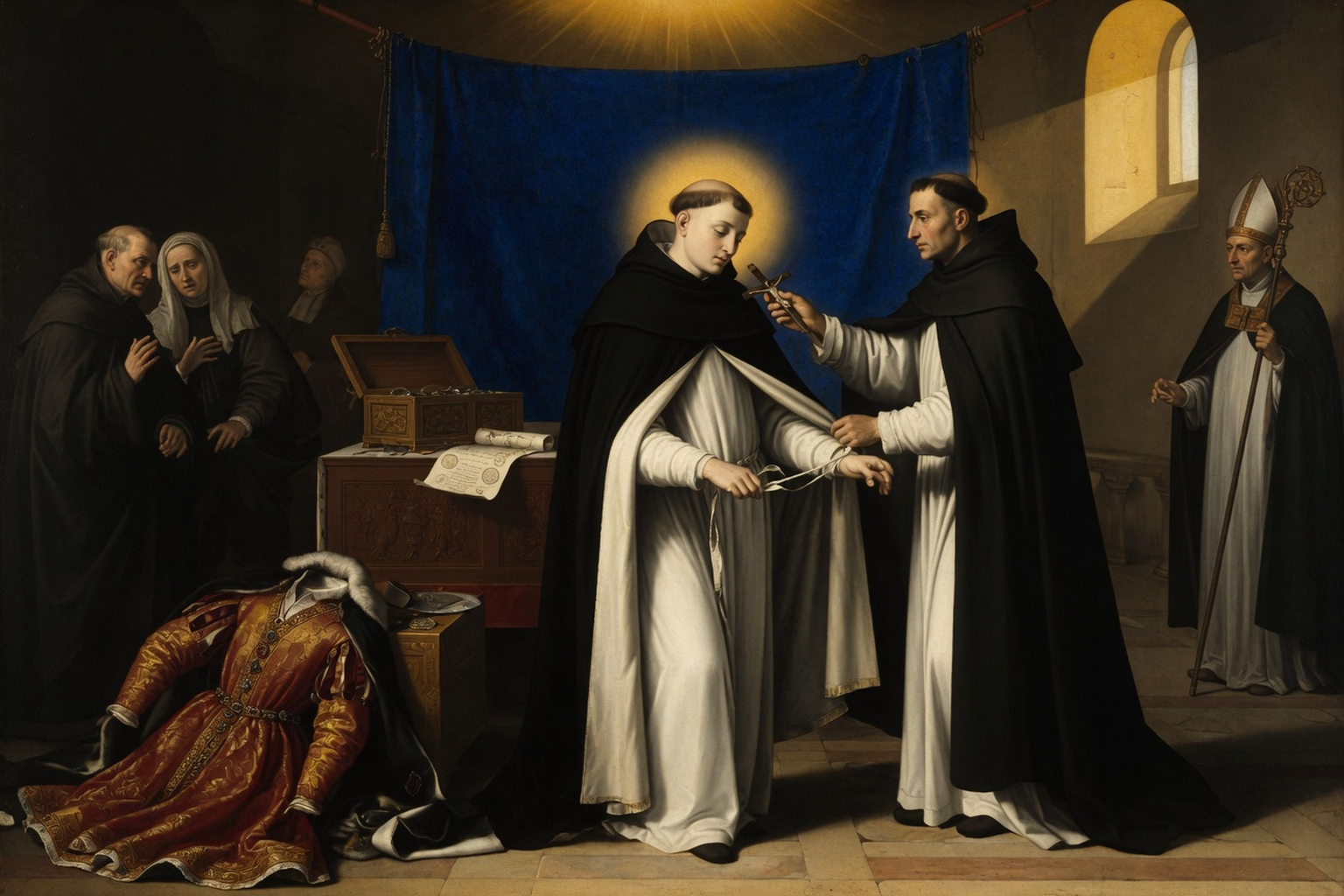
Thomas was then nineteen years old. For a long time he had been seeking the white habit of the Dominicans. As much as these religious had thought it necessary to put his vocation to the test through delays, they used the holy freedom of the children of God when they believed they recognized in this vocation the call from above. In vain did the Count of Aquino, informed by the tutor of what was being plotted, make threats and speak of the intervention of the emperor, his cousin. Heaven had spoken.
One day when Thomas was in prayer in the church, one of the religious saw as if luminous rays coming out of his eyes and illuminating all those present. The day was fixed for the young lord's taking of the habit: the ceremony took place in the presence of the religious and all that Naples counted as most prominent. The world did not fail to disapprove; but the Saints do not hesitate between the world and the Gospel.
Countess of Aquino (for it is thought that the count had died in the interval) learned with as much spite as pain the realization of a project so contrary to her hopes. Without delay, she left for Naples, hoping to bring her son back.
Now, in spiritual warfare, flight is not a shame. As soon as Thomas had learned of his mother's departure for Naples, he left that city and went to continue his novitiate in Rome, in the famous convent of Santa Sabina. But his flight only irritated a mother's despair; she returned to Rome, and, this time, without Thomas having been warned of the noise of this second journey. Surprised in his retreat, Thomas made himself invisible there: he refused to see his mother. What renunciation and what superhuman violence this twenty-year-old young man must have imposed upon himself! If the mother's tears make ours flow, does the thought of the horrible sufferings of nature in the son not make one shudder? Only one thing can explain such inexplicable sacrifices: the power of the grace of God. "He who will not leave his father and mother to follow me," it is said in the Gospel, "is not worthy of me."
Captivity and victory over temptation
Imprisoned by his brothers, he resists an attempt at seduction and receives from angels a girdle of perpetual chastity.
Fearing that the countess, who was very influential at the Pope's court, might eventually succeed in forcing the doors of their residence, the Dominicans resolved to have Thomas leave secretly for Paris; but God, who wished to use him to convert his sisters, permitted him to fall into the hands of his two brothers, Landulf and Raynald, who were serving in the imperial armies and who, warned by their mother, had all the roads by which one could leave the States of the Church guarded.
Forced by fatigue, Thomas had stopped with his companions not far from Aquapendente, between Siena and Lake Bolsena. Suddenly he saw himself surrounded by a detachment of armed men, with fierce looks and brutal speech. The young novice had to surrender without resistance: he contented himself with asking in whose name he was being taken prisoner. The leader of the escort identified himself: it was Raynald of Aquino, Thomas's own brother.
Raynald wanted to tear the religious habit from the novice by force: faced with this outrage, the son of Saint Dominic proudly raised his head and resisted his brother's orders as well as the brutality of the soldiers: "It is an abominable thing," he said to those who were violating him, "to want to take back from God what one has once given to Him." It was therefore dressed in the liveries of poverty and humility that he was led back to the castle of Aquino.
Far from bursting into reproaches, his mother had only tears to shed on the neck of this prodigal of grace. No allusion was initially made to the delicate events that had just taken place. But this calm, these smiles, these eager attentions of the first welcome worried Thomas. He tried to flee again; but the drawbridges of the castle did not lower before him. Then his mother began the attack: she first used tears, prayers, and reasoning: Thomas remained unshakable. "Mother," he said to her, "to love God more, shall I love you less?" When anger stirred the proud descendant of the Normans, he kept silent, and when she wept, he mingled his tears with hers, while trying to make her understand the divine motives that determined his conduct.
These struggles lasted for some time longer, but always with as little success. In her spite, the Countess of Aquino condemned herself to no longer see her son and relegated him to one of the towers of the castle, where no one would have the right to see him except for his two sisters who had accepted the mission of harassing him incessantly, to lead him to change his resolution. Thomas's sisters respected religion, no doubt, but above all they were worldly. The holy young man was not frightened by their speeches: on the contrary, he spoke to them with such calm, serenity, and conviction of the happiness of serving God that their hearts and minds were subjugated. The eldest renounced the world and a brilliant marriage to bury herself in the monastery of Saint Mary of Capua, of which she later became abbess. Admirable Providence of God, which made the captive's trial turn to the sanctification of his family.
But let us not anticipate: the young girls kept the secret of their conversion. Continuing to enter the tower, they sent the young captive the external aids that were so necessary to him: pious and study books, and encouragement from his friends in Naples and Rome.
Meanwhile, Thomas's two brothers, Landulf and Raynald, had just returned to the castle of Roccasecca. They undertook, as a matter of honor, to ruin his generous resolution: the forgetting of religious principles, of which the profession of arms is too often the occasion, pushed them to use weapons unworthy not only of Christian men, but of loyal soldiers.
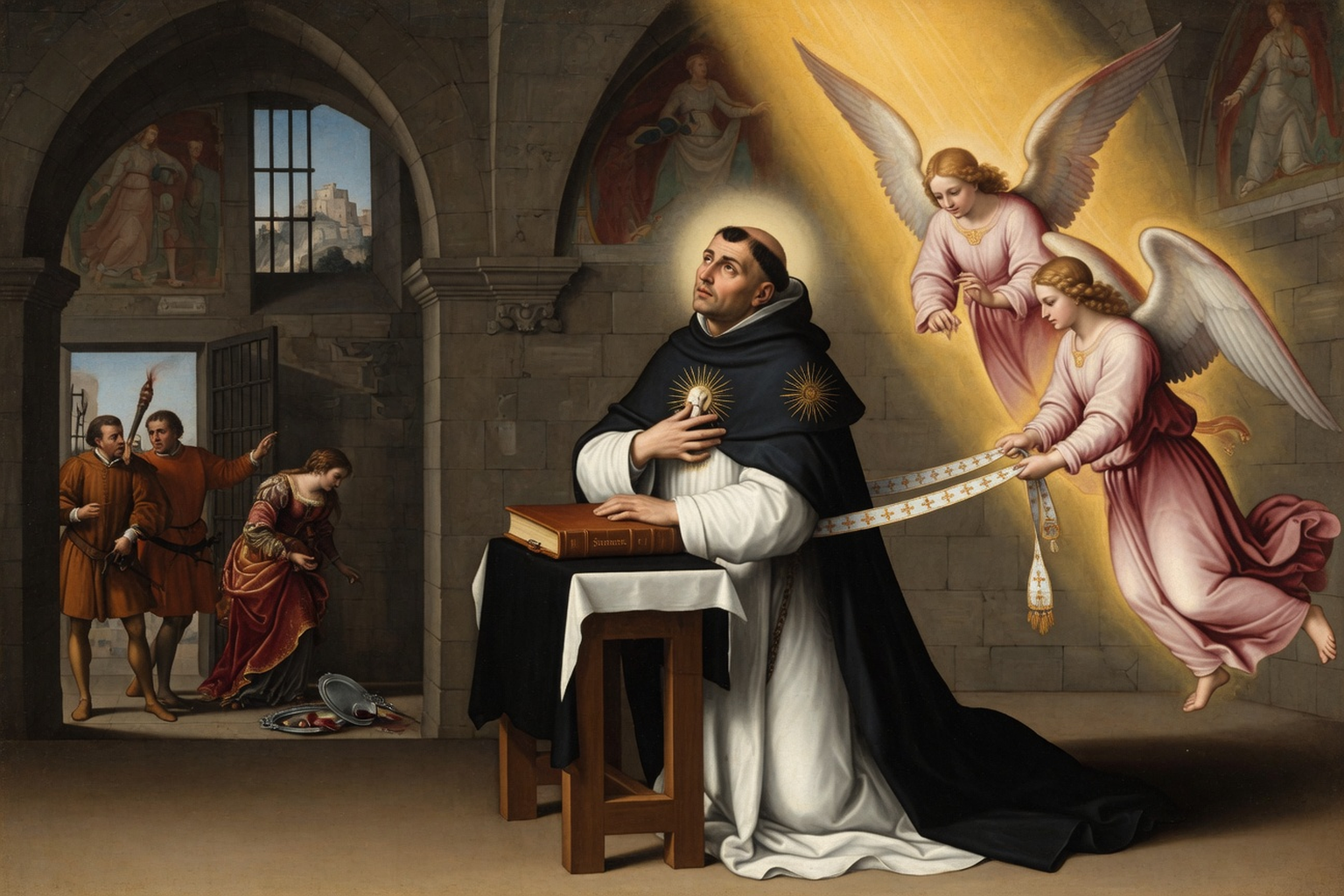
After having exhausted sarcasm, reproaches, and mistreatment, after having torn the habit of Saint Dominic that Thomas was wearing and forced him to resume the liveries of the world, they called to their aid, to deliver the final assault, the demon of impurity. A woman more beautiful than virtuous was introduced into the tower where Thomas was locked up. Unable to flee, he raised a look to heaven, grabbed a firebrand that was fortunately within his reach, and pushed back the unfortunate woman who had made herself the instrument of his brothers' designs. Then, falling to his knees before a cross that he had traced on the wall with the same firebrand, he sent up to God, who alone can make us continent, his hymn of thanksgiving and renewed the vow by which he had already entirely consecrated himself to the Lord.
While he was praying, a sweet sleep lulled his senses. During this sleep, which a pious author compares to that of Adam, the first man in the earthly paradise, he was visited by angels: these blessed spirits congratulated him on his victory and girded his loins with the belt of chastity, saying to him: "We come to you on behalf of God, to confer upon you the gift of perpetual virginity, of which He makes you from this moment the irrevocable gift." Thomas was not armed as a knight of purity without a sharp feeling of pain that made him let out a very sharp cry. The guards ran up, but he sent them away. He never spoke of this virginal ecstasy, of this mysterious and fruitful sleep, until the approach of death: his confessor, Father Renaud, alone received the confidence. Confessing then to the end the mercy of the Lord, he declared that the celestial belt had sheltered him all his life from those humiliating temptations, from those blows of Satan with which the apostle Saint Paul himself was afflicted.
This belt or cord, which became, after the Saint's death, the property of the Dominicans of Vercelli, gave birth to a pious Confraternity known as the Ange ceinture ou cordon Miraculous relic given by the angels to Thomas. lic Militia. The members of this Confraternity wear a cord similar to the one consecrated by the memory of Saint Thomas with the goal of preserving the sacred treasure of chastity or recovering it after having lost it.
Although Saint Thomas had received the gift of continence directly from heaven, it is a marvel to see, say the old hagiographers, what restraint he kept all his life and what care he always took to flee the company of women. A lady having one day asked him the motive for this reserved conduct: "It is because," he replied, "being the son of a woman, I fear them all." Thus Father Renaud, his confessor, was able to declare later that Thomas had died as pure as a five-year-old child.
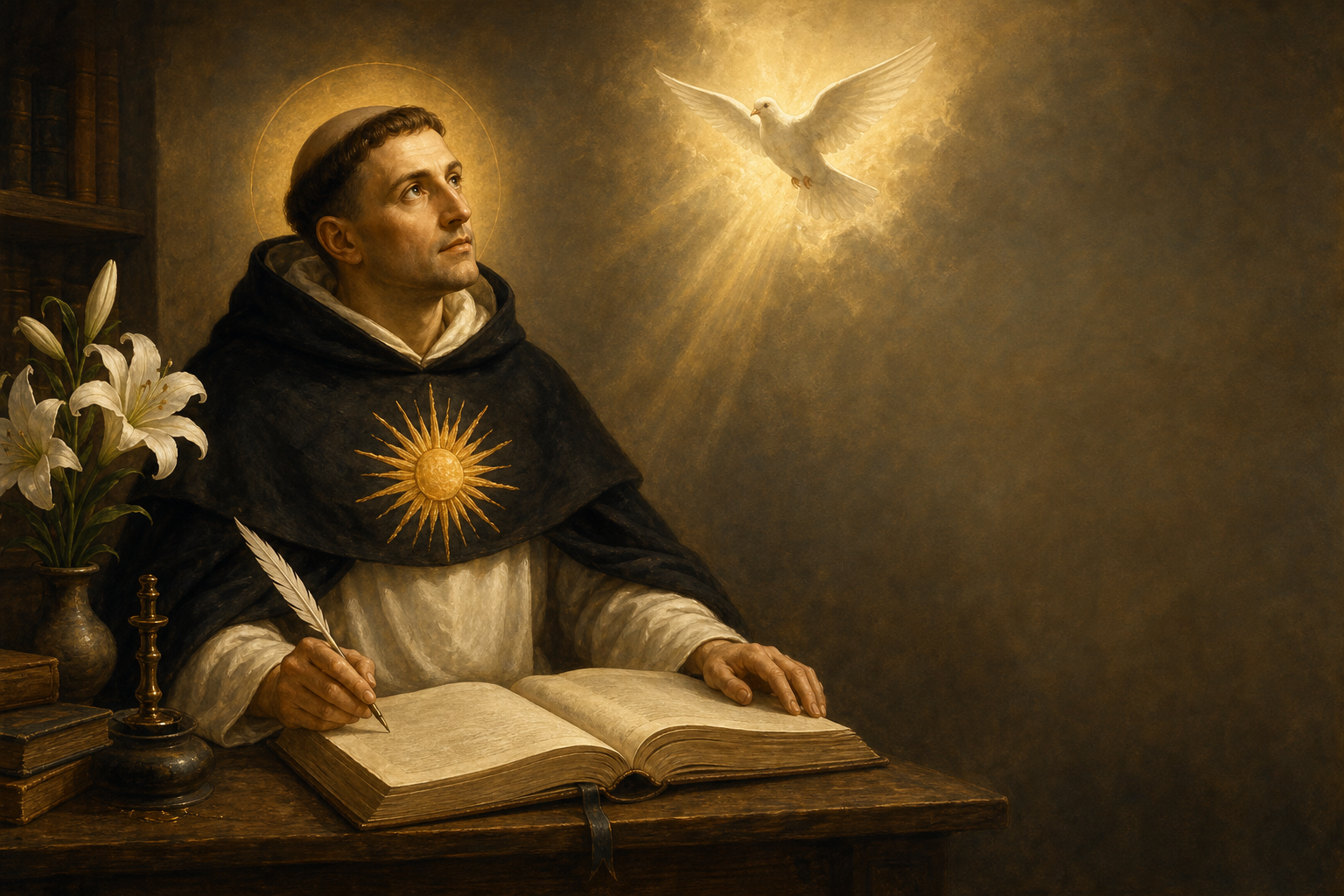
Christian iconography has always placed, in the arms of the angelic doctor, the lilies of purity near a luminous sun which represents the brilliance of genius, brother to the brilliance of chastity. Our fathers were right, for the genius of Saint Thomas Aquinas is a conquest of his chastity. If, as a young student in Naples, he had abandoned himself to homicidal and devastating pleasures, instead of a great doctor, we would soon have had we know not what useless being exhausted in body and spirit, forgotten from the day after a death without honor. Can one imagine Thomas Aquinas... simply married! And instead of the illustrious destiny of the great religious, instead of those immortal writings which are the honor of the Church, instead of the Summa, in a word, a few obscure days of vulgar happiness in an Italian manor!
We do not say it without reason, therefore: the genius of the great Saint Thomas is a conquest of chastity. Alas! How our time needs these examples, and how necessary it is to remind it that the honor of the intelligence is brother to another honor: that of morals and virtue. Stupidity, Saint Thomas himself was to say later, is a sin, because it is the daughter of lust.
The Student of Albert the Great
In Cologne, his humble silence earned him the nickname of the "Dumb Ox," before Albert the Great revealed his prophetic genius to the world.
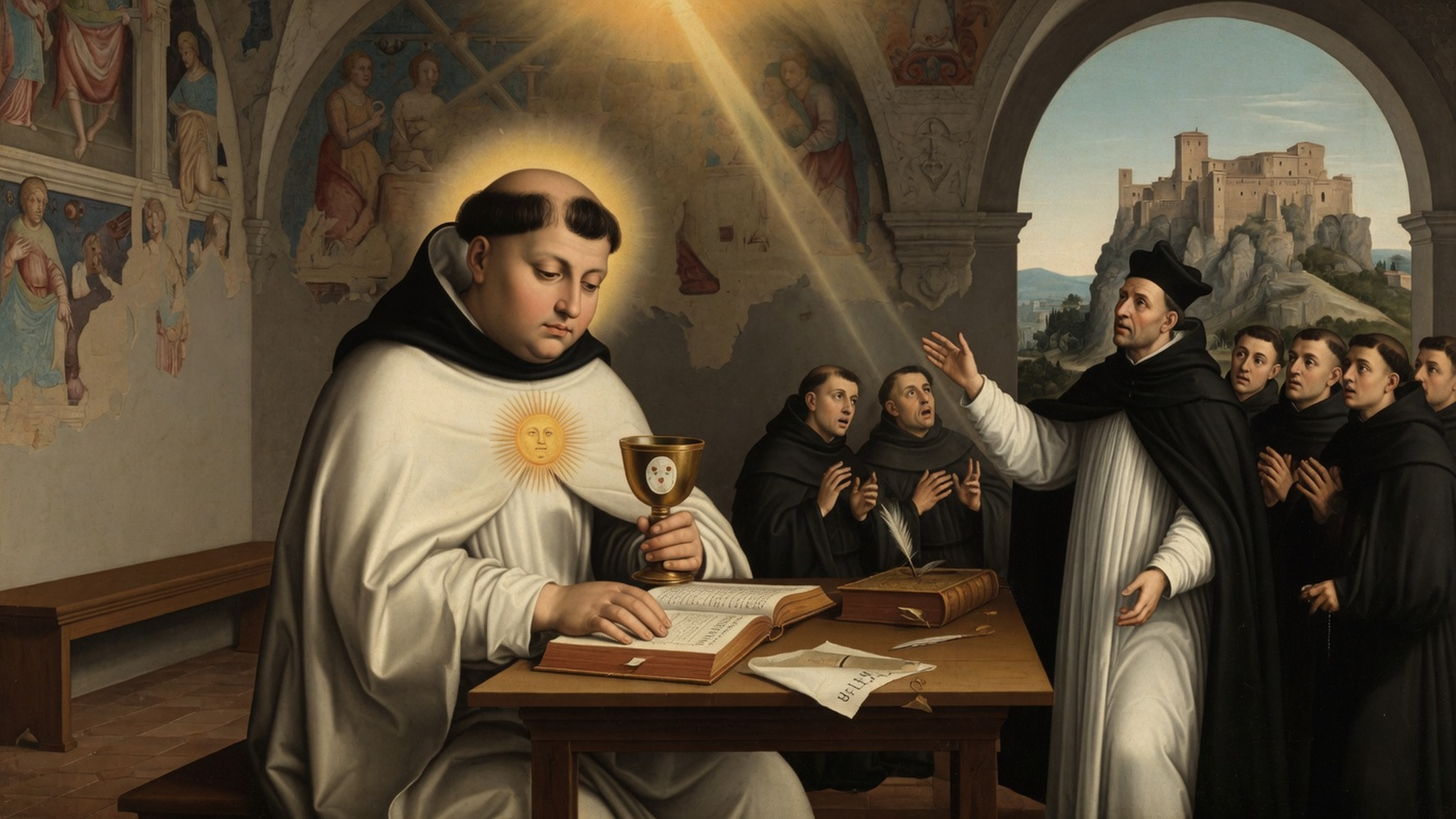
However, Thomas's captivity had lasted for two years, and nothing suggested an end to it. The Dominicans of Naples seized the moment when the Emperor of Germany had just made peace with the Pope to bring the complaints of outraged religion and liberty to his feet. To curry favor with the Sovereign Pontiff, the Emperor appeared very irritated that a religious man had been chained on his lands, and transmitted to the two officers of his army, Landulf and Raynald, the formal order to return Thomas to the Dominican family. They wanted to save appearances at the castle of Aquino. Thomas's two sisters had the Dominicans of Naples asked to come at night to the foot of the tower of Rocca-Secca. At the appointed hour, the prisoner was lowered in a basket by the hands of two weak women who let him slide into the arms of his brothers. Having returned to Naples, Thomas renewed by religious profession the entire and irrevocable sacrifice of his liberty.
At that time, Brother Albert was teaching the ology in the Frère Albert Master of Ambrose in Cologne. convent that the Dominicans had in Cologne: the lessons of this learned master were to be the final step by which Thomas would ascend to the royalty of divine science. He left Italy in the month of October 1244, in the company of John the Teuton, General of the entire Order, and arrived in Cologne at the beginning of the following year. The holy travelers visited the capital of France while passing through. It is reported that upon arriving at the gates of Paris, Saint Thom as st Paris Place of birth, ministry, and death of the saint. opped on a hill from which one could see the great city, with its church spires and abbeys sown on both banks of the Seine, and that, seized with admiration, he seemed absorbed by the contemplation of these wonders. His companion said to him: "Brother Thomas, what would you give to be the king of this capital?" — "I would rather," replied Thomas, "have the treatise of Saint John Chrysostom on Saint Matthew than all this great city." This response shows how difficult it was at that time to obtain even the most famous works, while at the same time indicating the kind of ambition to which the future king of theology had surrendered his soul.
Public esteem and the honorable distinctions of which Thomas had been the object in Naples had alarmed his humility: thus he resolved, once arrived in Cologne, to hide from the eyes of men and to wrap himself in absolute silence.
The students, usually as skillful at distinguishing among themselves a talent that the master's eye does not always perceive as they are at putting a mediocre person in favor back in their place, all found themselves at fault in this circumstance. They did not think they could better characterize the silent fellow student that Italy had sent them than by calling him the great Dumb Ox of the century. It is only known that their professor would shake his head with a smile when by chance he heard the now-accepted epithet come out of their mouths: *Bos magnus, Bos mutus*; great Ox, Dumb Ox.
But if such profound humility was something completely unknown among the students of the Dominican convent, the duties of Christian charity were at least known there. What proves this in an absolutely undoubted manner is that one of Thomas's fellow students, attributing, like all the others, his silence during lessons and the length of his studies to the slowness of his intelligence, thought he should come to his aid. He therefore offered, with as much generosity as confidence, to provide him every day with private explanations on what would have been the subject of the public lesson, given perhaps too rapidly by the learned professor.
But the talent of the taciturn Sicilian had here set a trap for itself. He had not foreseen the peril in which his natural kindness constantly placed him. One day, in fact, seeing his new master tiring himself uselessly to develop an obscure point proposed by Albert, and sinking more and more, by the very efforts he was making, into the dark maze of his reasoning, without hope of return, Thomas felt charitably obliged, says the ancient narrator, to come to his aid; or rather, without reasoning, and by the instinctive movement of his heart, he naturally let himself go to extricate his imprudent fellow student.
Hardly had he approached the difficulty, by clearly stating the question according to the method from which he never deviated, than all obscurity vanished immediately. But it was done; the plan conceived by his humility had just received a mortal blow. The few words he spoke brought into the mind of his fellow student a light so vivid and so sudden that he remained as if dazzled: he only regained his speech to ask Brother Thomas for forgiveness for the lessons he had dared to give him, and to implore him to maintain toward him the role that nature had clearly assigned to him, by becoming his master from then on; to which our Saint consented with the same simplicity he had initially shown in receiving a completely opposite role. In yielding, however, to the desires of a brother, to the impulses of charity, Thomas took one more step toward that external brilliance he fled with such solicitude; if he was not invested by men with the power to teach, he seemed to have received it from God Himself: he was naturally a master and a licentiate. It was in vain that humility took its precautions, by demanding from the disciple a secret it had been far from imposing on the professor. The latter did not consider himself obliged.
Some time later, in fact, Albert proposed to his students the explanation of a very obscure passage taken from a work commonly attributed to Saint Denis the Areopagite, and which concerns the names that should be given to the Supreme Being. The student who had recently become the fair appraiser of Thomas urgently begged the latter to put in writing both the state of the question, which was generally little understood, and the answer he thought should be given to it. This was granted to him again, but still under the seal of secrecy. The question was explained with such force, depth, and clarity that one would have said, according to the remark of a historian, that the very author of the text had used Thomas's pen to develop his thought.
On purpose or otherwise, the writing fell into the hands of Brother Albert; and it was then especially that this truly great man was seized with that divine joy that a superior mind alone can experience at the sight of a genius who must, by eclipsing himself, make the holy cause to which they will both be entirely devoted triumph. He saw clearly the glorious mystery he had only glimpsed until then.
Thus the secret of his humility was rapidly escaping the young student, despite his efforts and his pain. Brother Albert, wanting to justify to the eyes of all the admiration he felt for his student, ordered him to be ready for the next day on a certain number of thorny questions, to which he was to respond in the presence of a large assembly. Thomas's obedience was equal to his humility: he prepared himself, therefore, without using the little time he was given as a pretext, all the more apt, moreover, to use it well, as he was more indifferent to the result of this test.
The next day, he appeared with the assurance of self-denial, with the modesty of true merit, before all the students and all the professors of the Dominican school. He presented his subject with such erudition, accuracy, and lucidity that all those present, despite the greatness of their expectations, remained confounded. The master of the students wanted to make some objections, according to the custom and order of Brother Albert; Thomas took up his arguments again, to conform to the known rules of this sort of scientific fencing. But immediately he posed some general principles of solution, so luminous and easy that they seemed to make any challenge impossible. The debater, reduced to silence on the very object of the question, reproached Thomas for his way of answering; the words he addressed to him would show the spite of defeat, if they did not serve to hide a completely opposite feeling, with the intention of testing the modesty of the respondent. — "Brother Thomas," he said to him, "you seem to forget that you are not here a master who decides, but a student who must resolve the objections proposed to him." — "I have not seen a better way to answer the arguments stated." — "Well!" continued the professor, "apply your principles to what remains for me to object to you!..."
And thereupon he began to raise new difficulties, which seemed destined to crush the mind of such a young student. But each of these difficulties was in turn seized and overturned by the imperturbable dialectic of Thomas. The professor insisted; the student did not let himself be shaken: the thesis had become a true struggle. Other opponents entered the lists; but the victory always remained with Thomas: at the shock of an armed word, his talent had just revealed itself without restraint and without reserve; the entire assembly henceforth shared the admiration of Albert the Great; the latter felt the admiration he had already conceived grow. In the first flashes of this nascent glory, he had embraced with a prophetic glance successes and triumphs that would be those of his Order and of the Church, these two objects of his powerful affections. It was following this thesis, before the respondent and the assembly, that he pronounced these words, which their fulfillment was to make so famous: "We call this one a Dumb Ox; but in truth, his bellowing will rise so high that it will resound throughout the universe."
Thomas was about twenty-two years old at that time. During his stay of a few months in Cologne, he found enough leisure to write his first *Treatise on the Ethics of Aristotle*.
Master at the University of Paris
Thomas becomes a doctor in Paris, distinguishing himself through his teaching, his defense of the mendicant orders, and his friendship with Saint Bonaventure.
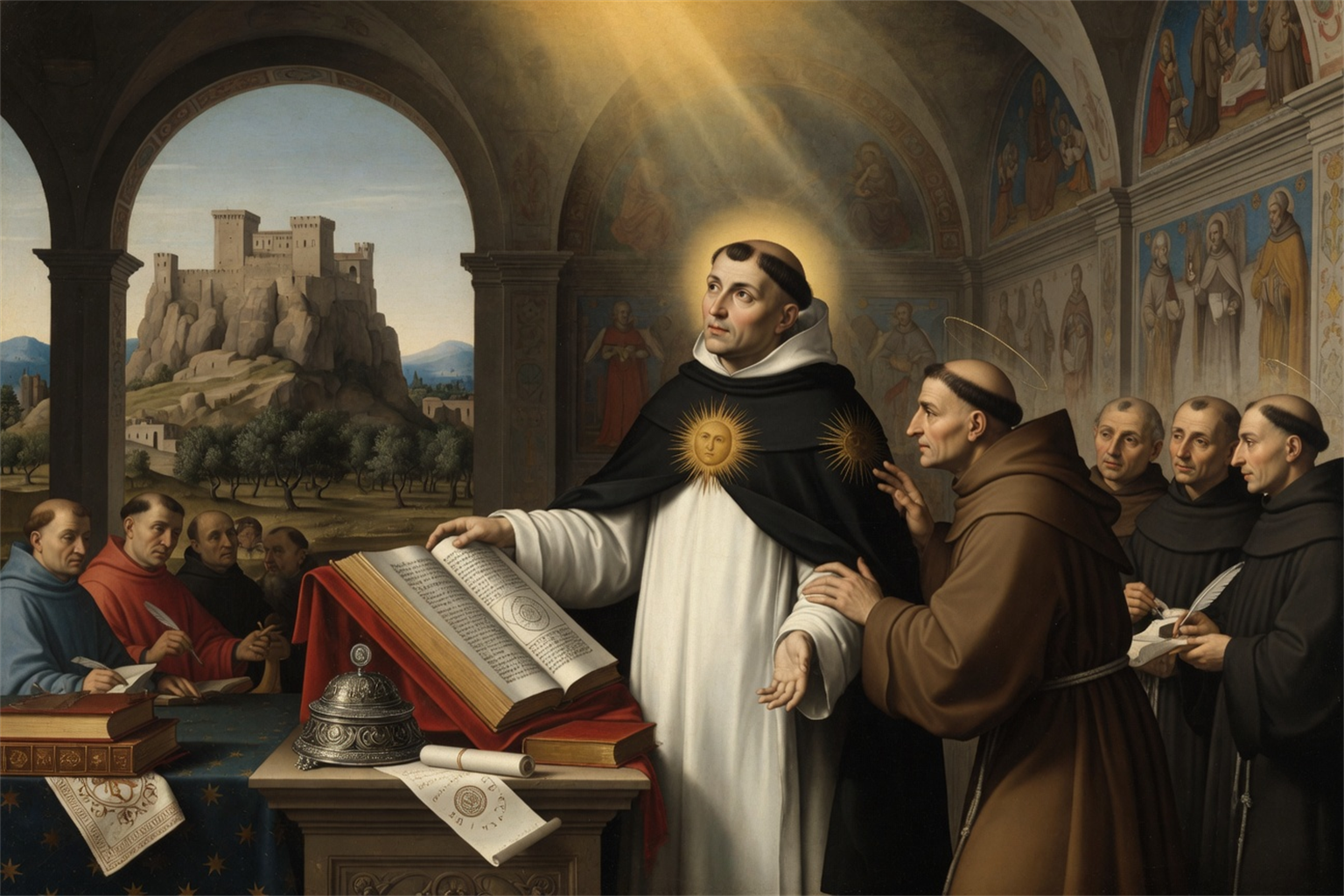
In the month of June 1245, the General Chapter of the Preachers decided that at the end of the academic year, Master Albert would go to Paris to receive the rank of doctor, and that Thomas would follow him there to receive that final refinement which, even at that time, Paris alone seemed able to give to the education of youth. The two pilgrims were received in that house on the Rue Saint-Jacques which Jean de Barastre, chaplain to the King of France and professor at the University, had ceded twenty years earlier to the Dominicans.
The final goal of Thomas's studies remained invariably the same. He would later say that he could not conceive of a religious person applying himself to studies other than those which have God as their object.
He therefore studied as a truly religious man, and this character of religion permeated all knowledge, even secular, which he strove to acquire; he bent them all to his ultimate goal, and made them serve as steps to rise to the knowledge of Him who is Truth by essence.
Despite the nature of his studies and the goal he always proposed to himself in pursuing them, Thomas experienced, in this purely scientific work, what every man who devotes himself to it with perseverance experiences in his turn, what the holy founder of his Order had experienced before him: namely, that science dries up the heart, and that the life of the intellect is after all only half the life of the soul. He therefore had recourse to the means employed by Saint Dominic. The conferences of Cassian never left his work table; and from time to time he would suspend his study, to quench the thirst of his weary soul at these refreshing springs of primitive piety. This pious author, through his simple and touching narrations, would suddenly tear him away from the arid labors of the school, and transport him into the society of the ancient Fathers of the desert: he became, in a way, the witness of their prodigious austerities, their fervent prayers, their meditations prolonged throughout the night, their ecstasies and their raptures: his soul would fly to these holy solitudes, his imagination would repopulate them with their ancient inhabitants; these were the only dreams that a Thomas Aquinas allowed himself. He would have liked to retrace in his life the angelic conversation of the Christian solitaries; he groaned over the present and future necessities of his apostolic vocation; but one always found in his conduct a reflection of his pious readings.
The modesty of his demeanor, the wisdom of his discourse, his unalterable gentleness, the natural beauty of his features, the depth of goodness that breathed in his whole person, communicated something celestial and divine to those who conversed with him.
His mortification reveals to us, in part, the secret of his chastity as well as that of his fervor: by subjecting the flesh to the spirit, it rendered the former more capable of divine communications. It is in souls so independent of appetites, and even of the necessities of the body, that the Holy Spirit delights to reside. The conduct that Thomas kept at meals was that which one has seen shine in the greatest Saints of all centuries: he had as if lost the taste for food; he ate only by a sort of passive obedience; his soul did not mingle with this material action except to elevate it by celestial motives; he almost never knew, after he had left the table, either what had been served or what he had eaten. Regretting the hours that must be given to the care of the body, he usually concentrated within himself through prayer or reflection.
Let us finally recall from this school of Paris a trait that characterizes at once two of the virtues of our Saint. One day when he was reading in the refectory, the table corrector, by mistake, signaled to him to pronounce a word differently than he had done: the reader corrected himself immediately, as if he had actually been mistaken. Upon leaving the meal, several of his brothers having told him that he should not have repeated the error of the one who had corrected him inappropriately, he gave them this answer, truly worthy of Thomas: "It matters little to pronounce a word in one way or another; but it matters infinitely for a religious to practice obedience and humility." Never was the evangelical precept better fulfilled: "Become like little children!"
After three years spent in this silent work of prayer and study, Thomas was sent to teach in Cologne, under Albert the Great, in the capacity of a bachelor (1248). Those who, in our day, still devote themselves to serious studies, will like to hear the advice that Saint Thomas gave to his students on how to study. "You ask me," he wrote to one of them, "what is the true way to succeed in your studies, and to arrive surely at the possession of wisdom? The advice I give you is not to attach yourself first to difficult questions, but to rise as if by degrees; the knowledge that you will be able to acquire of the simplest truths will lead you insensibly to the knowledge of deeper truths. Do not be in a hurry to say what you think, or to show what you have learned; speak little, and never answer with precipitation. Flee useless conversations; one loses both time and the spirit of devotion there. Preserve above all with care the purity of conscience, and never do anything that could soil it or make you less pleasing in the eyes of God. Let your prayer be continual. Love to hide yourself, to give to reading or meditation all the time that you spend in fruitless conversation with creatures. You will be admitted into the secret of the spouse, if you know how to converse heart to heart with him in retreat. Let solitude, however, not make you difficult or annoying; show yourself always gentle and affable, but without becoming too familiar with anyone; for familiarity is usually followed by contempt. Leave to each the care of what concerns him, and do not worry about what is done or said in the world. It matters infinitely for you to flee useless errands or visits. By remembering the life and actions of the saints, walk in their footsteps as much as it is possible for you, and humble yourself if you cannot reach their perfection. Always keep the memory of what you learn that is good, from wherever you learn it. Do not be content to receive superficially what you read or what you hear; but try to penetrate and deepen all its meaning. Never remain in doubt about things that you can know with certainty. Work with a holy avidity to enrich your mind; classify with order in the compartments of your memory all the knowledge that you can acquire; however, do not force the talents that you have received from God, and do not seek to penetrate what will always be above your intelligence.
"If you follow exactly the advice that I give you, do not doubt that you will arrive, according to your desires, at the possession of wisdom. Your life will be filled with flowers and fruits. You will fertilize the vineyard of the Lord, all the time that you carry and drag the yoke of this mortal life."
It is at the time of his professorship in Cologne that his admission to the priesthood takes place. To prepare for the celebration of the holy mysteries, Thomas spent a large part of the night at the feet of the holy Tabernacles. There, he vied in fervor and humility with those pure spirits who are represented to us watching around the sanctuary. After the holy sacrifice, he prolonged in thanksgiving the happiness he had experienced in receiving the Eucharistic bread. Usually, he honored himself by fulfilling the ministry of altar boys, and serving another priest at the altar.
Strange revolutions had taken place in Italy since Thomas had left this first theater of his militant life. Frederick II aspired to universal monarchy: to achieve his goal, the Emperor of Germany made himself the persecutor of the Church, which opposed an insurmountable barrier to the triumph of brute force: this persecutor of the Popes was to end like all those whom every century has seen rise, but while dragging many ruins in his fall. Most of the Italian lords, among whom must be counted the brothers of Saint Thomas Aquinas, had detached themselves from the cause of the excommunicated. Frederick avenged himself for these defections by ravaging Italy: the city of Aquino among others was razed (1250). Upon learning of the temporal misfortunes of his parents, Thomas hoped more for their eternal salvation. Landolfo and Raynald indeed understood the severe lesson that Providence had just given them: their faith, awakened by misfortune, rose to the most generous practice of Christian virtues. The mother of Saint Thomas, Countess Theodora, bowed under the blows that struck her house, and henceforth imitated a holiness that she had once fought. Of the two sisters of Thomas, the eldest vowed her body to work in the cloister, her eyes to tears, and her soul to contemplation. The virtue of the youngest shone in the fulfillment of social duties: she was married to the Count of San-Severino.
Thomas did not delay in returning to the capital of France, the true cradle of his glory (1252). Warned of his departure, the canons of the Chapter of Louvain begged him to honor them with a visit and made him the arbiter of disputes that had arisen between them: a glorious homage rendered to the extreme youth of our Saint, and which recalls that which the English barons rendered to the spirit of justice of his royal friend Louis IX.
The entry of Thomas into Paris was not ignored like the first and even the second time.
The University of Paris had not forgotten the triumphs of its student; it saw him again singularly grown by the public lessons given, during four years, in the new University of Cologne. It welcomed him with that enthusiasm which usually presages brilliant successes, and received him, without making him undergo the customary tests, into the number of its bachelors. It was to clothe him with the ministry of that secondary teaching which he had just exercised on a less vast theater; it permitted him to sit immediately on a chair of theology. It was, however, only at the age of thirty-five that the regulations of the university permitted the teaching of the highest as well as the most difficult of all sciences; but Thomas did not delay in covering with a glorious veil the infringement that had just been made in his favor to the letter, if not the spirit, of the common law. The enclosure of the College of Saint-Jacques could soon no longer suffice for the ever-growing multitude of listeners who pressed around the young Dominican Bachelor; the inferiority of this title had completely disappeared under the superiority of the teaching. Does genius then need a habit or a name? Let one leave it a free field, and suddenly it exercises its ascendancy and its sovereignty!
The ancient doctors themselves, the guides and pastors of the people, became the disciples of a young man of twenty-six years. The most difficult questions arrived at him one after another, from all parts of the Catholic world; but the vivacity of his mind, seconded by the ardor of his charity, multiplied the solutions with the difficulties, the answers with the questions: his treatises spread simultaneously among all Christian nations. The fruitfulness of his word, radiating in all directions with such marvelous abundance, could from then on make him compared to that unique star, whose fertile gaze embellishes and fertilizes at once the entire nature and whose image has become the radiant symbol of his powerful genius!
One then saw renewed what antiquity tells us of some rare and almost superhuman spirits, who seem, indeed, to borrow something from the exclusive attributes of divinity: Thomas dictated at the same time to three or even four secretaries, on matters quite dissimilar, and often all equally thorny. Undoubtedly, the works that came out so rapidly from this poor cell of the Dominican convent, and went, in all directions, to dissipate darkness and doubt, to direct opinion, to strengthen orthodox doctrine, have not reached us in their entirety; but enough remains so that one is obliged, in order to explain their existence, to have recourse to that sort of intellectual phenomenon which gives our young Saint such a glorious resemblance to that frightening genius who was called Origen!
The Dominican Bachelor was far from forgetting that he had been invested with the character and mission of the priesthood. The numerous churches of Paris resounded so often with his word that the faithful, for their part, could easily imagine that Brother Thomas had only one occupation, one ministry, the apostolate. In the society of Christians, Thomas was, in effect, an apostle.
The character and effects of the apostolic eloquence of Thomas Aquinas have hardly been preserved for us except by tradition and history. Of the countless sermons that he delivered in the course of his ministry, we possess only short and skeletal analyses, quite similar to those rapid memories that Bossuet was accustomed to trace, while descending from the pulpit where his genius had just burst forth with such breadth and magnificence. One finds nevertheless in these abbreviated notes of the Angelic Doctor the indelible imprint of his broad thought, the inflexible rigor of his method, an admirable use of Scripture, the unalterable purity of religious teaching, and that war above all that he never ceased to wage against vices, against the depravity of the world: everything leads him to this final goal, the panegyric of a saint, like the meditation of a mystery, like a direct discourse of evangelical morality.
The lessons of Thomas were interrupted by disputes that divided, in 1253, the secular doctors and the regular doctors.
During the Lent of that same year, four students had revolted against the watchmen in the streets of Paris; one of them had been killed, and the others put in prison. Great rumor in the university: it demanded back its students, who were returned to it the very next day; it demanded more still, it wanted those who had treated them so cruelly to be punished. This second reparation having been delayed, the secular doctors suspended their lessons, and pledged by oath to pursue it to the end. The regular doctors, however, continued to open their schools, and did not believe they should adopt for themselves a similar measure. In this they were only imitating the conduct of their predecessors, who had likewise refused to enter into this sort of conspiracy, when, on a quite similar occasion, in 1229, under the minority of the king and the regency of his mother, the doctors abandoned the capital to retire to various cities of the kingdom.
The satisfaction, once obtained, the university doctors made a statute stating that every master, in any faculty whatsoever, would be strictly obliged to close his school, in cases similar to the one that had just happened. Refusal on the part of the religious to swear, as was required of them, the observation of this new rule, and this despite the very particular skill with which the formula was drafted. New decree of the university, which excluded them from its body and deprived them of their chairs.
But there was a power then in the world ready to repress all kinds of oppression and tyranny. The religious, unjustly stripped of their rights, appealed immediately to the Holy See. Innocent IV, and after him Alexander IV, ordered the re-establishment of the independent chairs of the regular doctors, namely those of the Dominicans. Among all these movements by which he was surrounded, Thomas lost nothing of that inner peace, which is the proper sphere of genius as much as of virtue. His name was frequently mixed in these ardent quarrels, without his showing any concern for them. In vain was he insulted even in the public exercise of the apostolic ministry; he kept constantly the calm of innocence and dignity. Interrupted in his preaching, on a Palm Sunday, in the very church of Saint-Jacques, by an emissary of the university, he listened without emotion to the insulting warning that this man had come to bring to the audience, on behalf of his masters, and continued, without answering, the instruction begun.
At the time we have reached, Bonaventure and Thomas often visited each other in the poor cell that each of them, in his convent, had made so famous and powerful. There, in the uninterrupted work of prayer and study, were forged the terrible weapons that would soon serve for the triumph of religion and the confusion of its enemies. The religious of Saint Francis came to visit his Dominican brother one day; and in the naivety of his affection and his humility, he said to him: "What is the book, my brother, where you find the beautiful things that the world admires in your works?" "There is my book!" replied B rother Thom Bonaventure Franciscan saint, contemporary friend of Thomas Aquinas. as, showing his illustrious friend the image of Jesus crucified. Saint Paul would have acknowledged this answer! Bonaventure had understood its full meaning. We know to what point he was advanced in the reading of this great book, what touching and sublime pages he drew from it, to deliver them to the admiration, to the edification of the world.
Another day, it was Thomas who went, accompanied by one of his brothers, to visit his friend Bonaventure. But arrived near the cell of the latter, he perceived him leaning over his solitary table, and currently devoting himself to the work of composition. "Let us," he said in a low voice, "let us leave a saint to write to the glory of a saint!" Bonaventure was then working on that life of Saint Francis where the soul of this great patriarch seems to have passed entirely. Thomas was not unaware of the subject that occupied his friend; and he knew his seraphic soul well enough to anticipate the voice of posterity, in the place it was to assign to the son beside such a father!
After a trip that Thomas was obliged to make to Italy to defend before the Pope and his senate the cause of the mendicant religious attacked by a member of the University of Paris — the famous William of Saint-Amour — he returned to Paris where the doctor's cap awaited him. This is the case to admire the profound humility of the saints. Thomas Aquinas believed himself unworthy to gird the doctoral laurel! and it took nothing less than an order from heaven to dry his tears and put an end to his reluctance. The night that preceded the day fixed for his public act, Thomas saw in a dream an old man, of venerable appearance, with a serene brow, who asked him what was the subject of his sadness. "It is only too just," he replied, "since they are forcing me to take rank among the doctors; of which I am not capable." And the old man said to him: "The very order that you have received, my son, must be your assurance; it destroys your own will, and manifests to you the will of God in that of your superiors. You will take for the text of your thesis these words of the Psalmist: 'You will water the mountains from your sublime heights; the earth will be satisfied with the fruit of your works!'" The next day, new proof of humility, in the presence of all the faculties gathered in one of the halls of the bishopric of Paris: Bonaventure and Thomas, who must undergo the test the same day, vied for the last place. Thomas finally yielded, as the youngest. He developed the magnificent passage of the Prophet, applying it to the divine economy of religion, which he showed as illuminating all souls with the celestial rays of grace and truth. Posterity has made another application of this same text; it has not found another expression to render the influence that the new Doctor was to exercise on the Christian universe, of that torrent of light and life that he was to spread on the highest summits as on the humblest valleys of the world of intelligences. A unanimous acclamation had named him doctor.
This day, October 23, 1257, produced Thomas Aquinas on the vast theater of Christian society, invested with the triple authority of genius, admiration, and virtue. Now, this man who had silenced envy, confounded error, made the cause of the mendicant religious Orders and evangelical devotion triumph, and finally acquired in such a decisive manner the high domination of science and holiness, had barely entered the thirty-first year of his existence!
The Doctrine and the Miracle of the Crucifix
He writes his first Summae and receives the miraculous approval of Christ in person for his writings on the Eucharist.
Invested with the title of Doctor, Thomas hastened to resume the triple teaching of professor, preacher, and writer. It was then that he addressed to Father Renaud, the dearest and most constant of his friends, a treatise on theology in two hundred and fifty-six chapters.
Whatever idea one may have formed of the modesty of our Saint, one will undoubtedly find it hard to believe that he gave such a considerable work the title of Compendium of Theology. This is, however, what he does in his preamble.
In this first year of his doctorate, Thomas also wrote his Apology for the Religious Orders and his Summa contra Gentiles. This latter work, undertaken at the request of Saint Raymond of Pennafort, another child of Saint Dominic, was traced on broad enough foundations to include the simultaneous refutation of Judaism, Manichaeism, and Mahometanism. It was immediately translated into Greek, Hebrew, and Syriac, and the missionaries whom the Orders of Saint Dominic and Saint Francis did not cease to send from then on to foreign nations, to the center of Buddhism and to the depths of the Orient, no longer engaged in these difficult enterprises without taking with them such a precious weapon.
This work, so considerable, was immediately followed by an even more considerable labor on all the Epistles of Saint Paul; it was the portion of the Scriptures that Thomas loved most after the Gospel.
The holy passion of the young Doctor of Paris for the Apostle of the nations merited a miraculous favor. Evoked by the strength of this sentiment, Paul crossed the fatal limits that separate this material world from the sublime abode of souls; he revealed his immortal features to the eyes of his fervent interpreter.
But this interview with the superior spirits was only a first trial for the humility of our Saint, a test for his mortal gaze. After the visit of the Apostle, he was destined to receive that of the Master of the Apostles.
At the time when Saint Thomas Aquinas lived, the question of Eucharistic accidents was being debated in all Christian schools and divided the doctors of the first of all, the University of Paris. It had to be decided whether these accidents had something real or were merely a simple appearance. The real presence of Jesus Christ in the Eucharist was never called into question; it was recognized, proclaimed as a truth as ancient as Christianity: it was only a matter of determining the nature of the accidents that present it to our senses.
Weary of discussions whose end could not be foreseen, all the doctors were of the opinion to rely on this great question solely on the sentiment of Brother Thomas Aquinas, who had then been teaching at the University of Paris for several years, being only thirty-two years old. All his confreres declared that they would hold as truly in conformity with the lights of reason and faith the decision that the young doctor would give, for they had more than once experienced how, more surely than the others, he grasped the true point of the difficulty, and how much more clearly he developed it.
The writings in which each expressed his sentiment having been placed in his hands, Thomas Aquinas recollects himself, rises to a high contemplation, prays according to his custom; then he traces, with as much precision as lucidity, what the spirit of God deigns to inspire in his soul.
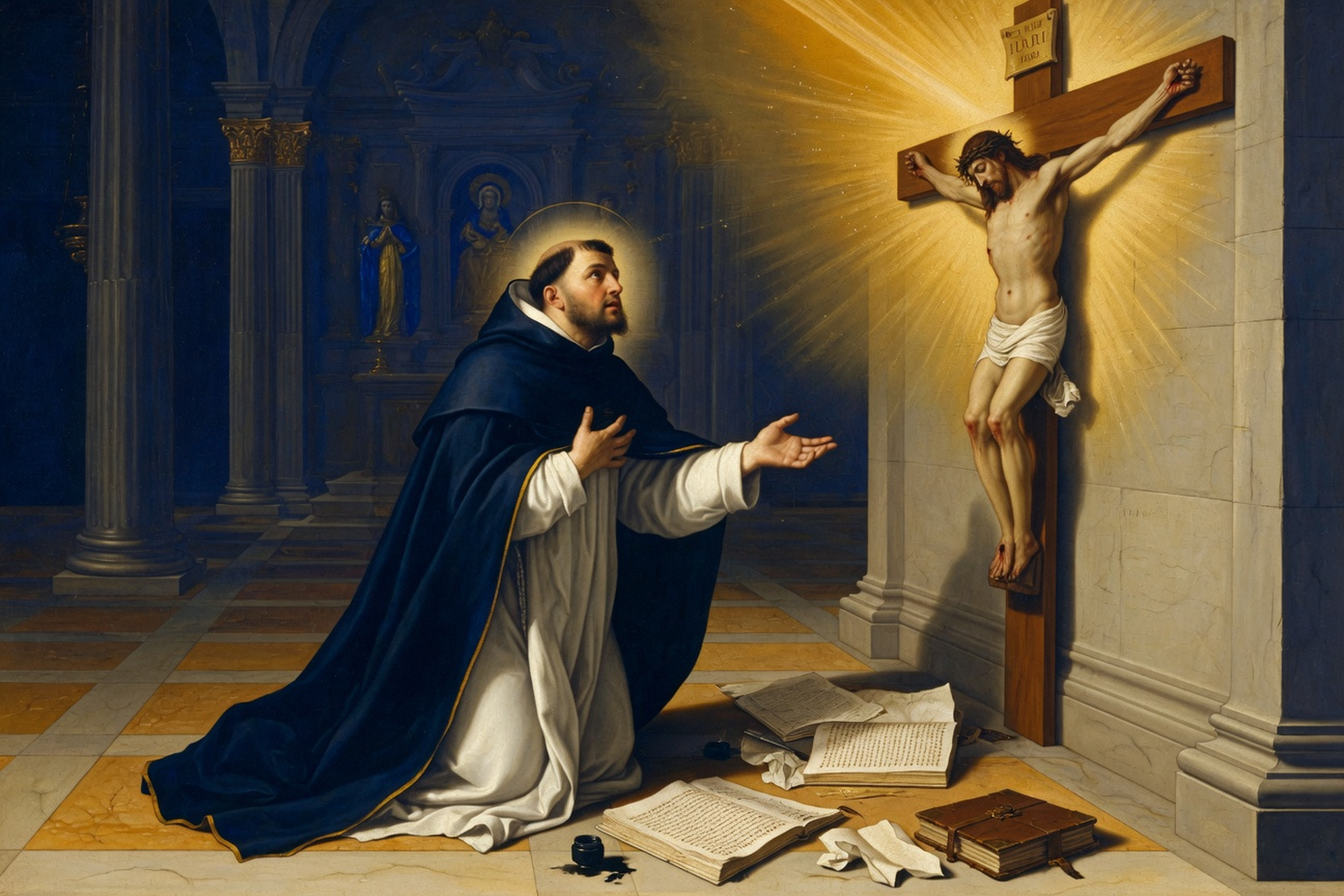
However, he does not wish to bring the fruit of his science and his orison into the presence of the doctors and the schools before consulting the very one of whom he had to speak, whose support he had implored. He comes to the altar, and placing before the tabernacle, as before the Master of masters, what he had written on the controversial subject, he lifts his hands toward the image of Jesus crucified, and prays in this manner:
"Lord Jesus, you who truly reside in this admirable Sacrament, you whose works are incomprehensible wonders, I humbly conjure you, if what I have written about yourself is in conformity with the truth, grant me to teach it and to persuade it on your behalf to my brothers; if, on the contrary, there exists in this writing something that departs from the Catholic faith, put me in the impossibility of producing it before their eyes."
Now, the doctor had been followed by his usual companion and by several other religious of the Order, who saw Jesus Christ appearing to him, and who, standing on the very sheets written by the hand of Thomas, said to him with love: "You have worthily written of me, my son, concerning the Sacrament of my body: Bene scripsisti de me, Thoma," and the orison of the Doctor continuing still, he was seen to rise about a cubit in the air, as if pushed on one side by the ardor of his own prayer, and lifted on the other by the attraction of his God!
The solution of Saint Thomas was in favor of the reality of the accidents or Eucharistic species. According to him, these accidents, these species or appearances, although intimately linked to the substance of the bread and wine that supports them, nevertheless have an existence of their own, and they retain this existence, while the substances of the bread and wine have been converted into those of the body and blood of Our Lord Jesus Christ. Thus, what we see, what we touch in the Eucharist, the quantity, the color, the figure, are real things, and our senses are in no way deceived as one would be forced to admit in the contrary opinion.
The opinion of Saint Thomas was universally adopted; it is not of faith, but the Church has clearly marked the preference it gives it, since in the office of the Blessed Sacrament, of which we shall have to speak, it has a part of what the holy Doctor wrote on this subject recited.
The learned were not the only ones who did justice to the rare merit of Thomas. Saint Louis, King of France, had entire confidence in his lights and asked his advice on the most impo rtant affai Saint Louis King of France whose chaplain was Thomas Hélye. rs of the State. He often invited him to eat at his table, an honor that the Saint accepted as rarely as possible, out of a principle of humility. When, however, he was obliged to accept it, he appeared at court as modest and as recollected as in his convent. Being one day at the king's table, he had one of those distractions peculiar to great men that must be reported here. He was then working to refute the heresy of the Bulgarians, or new Manichaeans, which, for some years, had been renewed in Italy. As his head was full of his subject, and his mind strongly occupied with the deep meditations he had made, he suddenly exclaimed: "That is decisive against the Manichaeans!" His prior, who had accompanied him, having told him to think of where he was, he set about repairing his fault by asking the king for pardon: but this good prince, far from showing any dissatisfaction, ordered one of his secretaries to write down the reasoning that the Saint had just made, for fear that it might escape his memory.
The general chapters held regularly each year by the Friars Preachers did not only have the goal of perpetuating the holiness of their Order: they proposed at the same time the perfection of studies. Thomas attended the one of 1259, held at Valenciennes; Albert the Great, his master, and Peter of Tarentaise, his disciple, were added to him for the drafting of the regulations that were to procure the uniformity of teaching in the Dominican houses. These regulations are still partly observed in our days in the schools of the Order of Saint Dominic.
Upon his return to Paris, Thomas should have suspended the course of his public lessons, according to university laws, which only allowed theology professors three consecutive years of teaching in the same school: but the movement of admiration that had led the doctors of Paris to place Thomas on the theological chair before the required age led them also to prolong a teaching whose honor returned entirely to their body. The charms of his virtue, his affability, and his modesty won hearts even more than his science.
One of his own students, in his public act for the license, dared to rise against the sentiments he had taught, to support propositions he had formally combated. Thomas, who was present, kept silent, however. His other disciples complained about it to him afterward: Thomas renewed to them by word of mouth the lesson of patience and kindness that he had given them by his conduct. But if charity had seemed to require this first sacrifice, truth could not lose its rights either: and our saint had long since learned to confuse his interests with those of truth. The respondent, according to custom, had to appear again the next day in one of the halls of the bishopric, before a more numerous and imposing assembly. Neither the touching example he had received from his master, nor the reflections of the night brought any change to his thesis. The Doctor then thought he should break his silence, to justify in the eyes of all the teaching with which he had nourished the minds of his students. He cited the authorities, discussed them; he laid down the principles, deduced the consequences; he destroyed one by one all the propositions of the young graduate, showing all that they contained of false and dangerous; but all this with such a mixture of sweetness and serenity that his student, suddenly returning to the bounds of duty, effectively corrected of his self-love, showed himself quite happy with a defeat that made him open his eyes to the light. Ill-treated by cold argumentation, by a word without bowels, this young soul could have stiffened in his opinion, sunk without return into the dark paths of error. It has taken less sometimes to give birth to heresies! Tenderly raised by a paternal hand, he returned immediately to the cult, to the love of truth.
Another young man dared to tell him one day that he did not gain from being known, and that his merit was far from equaling his reputation. What would one of our modern philosophers have answered? Here is the answer of the Catholic Doctor: "You are right, my friend; so I would like the world to be undeceived, by seeing me study without respite!"
Pope Urban IV, who knew all the merit of our Saint, called him to Rome in 1261. Thomas was charged there by his general to profess theology, a job he performed with his usual talent. The sovereign Pontiff wanted to raise him several times to ecclesiastical dignities; but the Saint refused them all, and preferred the state of a simple religious to places that ambition would seek less if it were capable of reflecting on the dangers that surround them. All that Urban could obtain from him was that he would not move away from his person. This gave him the opportunity to announce the word of God in all the cities where the Pope was accustomed to reside, such as Rome, Viterbo, Orvieto, Fondi, and Perugia. Preaching in Rome one Good Friday, he spoke in such a touching manner of the love of Jesus Christ for men and the ingratitude of the latter toward the Redeemer, that he made the whole audience shed tears: the sighs and groans of the assembly even forced him to stop several times. The sermon he gave the following Easter day on the glory of Jesus Christ and on the happiness of those who rise with him by grace produced even more wonderful effects. Guillaume de Tocco adds that, as the Saint was leaving the church of Saint Peter after his sermon, a woman was suddenly cured of a hemorrhage by touching the hem of his habit. But the conversion of two distinguished rabbis among the Jews was an even greater prodigy. The Saint, who had met them by chance at the country house of Cardinal Richard, entered into a dispute with them, and proved to them solidly that the Messiah had come; that this Messiah was Jesus Christ, God and man all at once, and that one must consequently submit to the Gospel. It was agreed on both sides that the conference would be resumed the next day. Thomas spent the night at the foot of the altars, and conjured the One who alone can convert hearts to finish the work he had already begun. His prayer was answered. Indeed, the two rabbis came to find him the next morning, not to restart the dispute, but to embrace the Christian religion. Their example was followed by several other Jews.
These difficult conquests, Thomas did not only accomplish them by his living word; after his death, he has not ceased to speak with the same effectiveness!
Spain saw, in the 15th century, another rabbi, whose name is known in the history of science, renounce, by reading the Summa of Saint Thomas on the agreement of the old with the new alliance, his national antipathies, fortified by the studies of his whole life, to embrace the grace of Christianity. Under the inspiration of this genius so devout to the Queen of virgins, the rabbi Paul of Burgos wanted to be named, at his baptism, Paul of Saint Mary. He was successively Bishop of Cartagena and of Burgos, his homeland; he died Patriarch of Aquileia.
In the following century, a zealous disciple of Melanchthon, Theobald Thamer, undertook the reading of the Summa, with the design of combating its doctrine, of ruining its results, and of destroying one of the firmest supports of the Catholic Church. Had he heard the word of his confrere Martin Bucer, the Lutheran apostle of Strasbourg: "Tolle Thomam, et dissipabo Ecclesiam; Get rid of Thomas, and I will make the Church crumble?" But he soon perceives that the work is beyond his strength: he falls crushed under the weight of the genius; he rises a fervent Catholic. A man even more illustrious, raised in the principles of Calvin, but whom doubt torments in the bosom of the reformation, feels pressed to seek the Christian truth in the works of Saint Thomas Aquinas; soon this truth shines in his eyes: he abjures Calvinism, he throws himself with transport into the arms of the Catholic Church; the latter welcomes him with love, and later rewards his talents and his services with the most eminent dignities: this man was Cardinal Jacques Davy Duperron!
It is during this first stay in Rome that he wrote his Literal Commentary on the whole book of Job, and this admirable explanation of the Gospels by the Fathers, which scholars only know under the name of Golden Chain (Catena aurea).
Composition of the Office of Corpus Christi
At the request of Urban IV, he composed the liturgical hymns for the Blessed Sacrament, surpassing the work of Bonaventure through his humility.
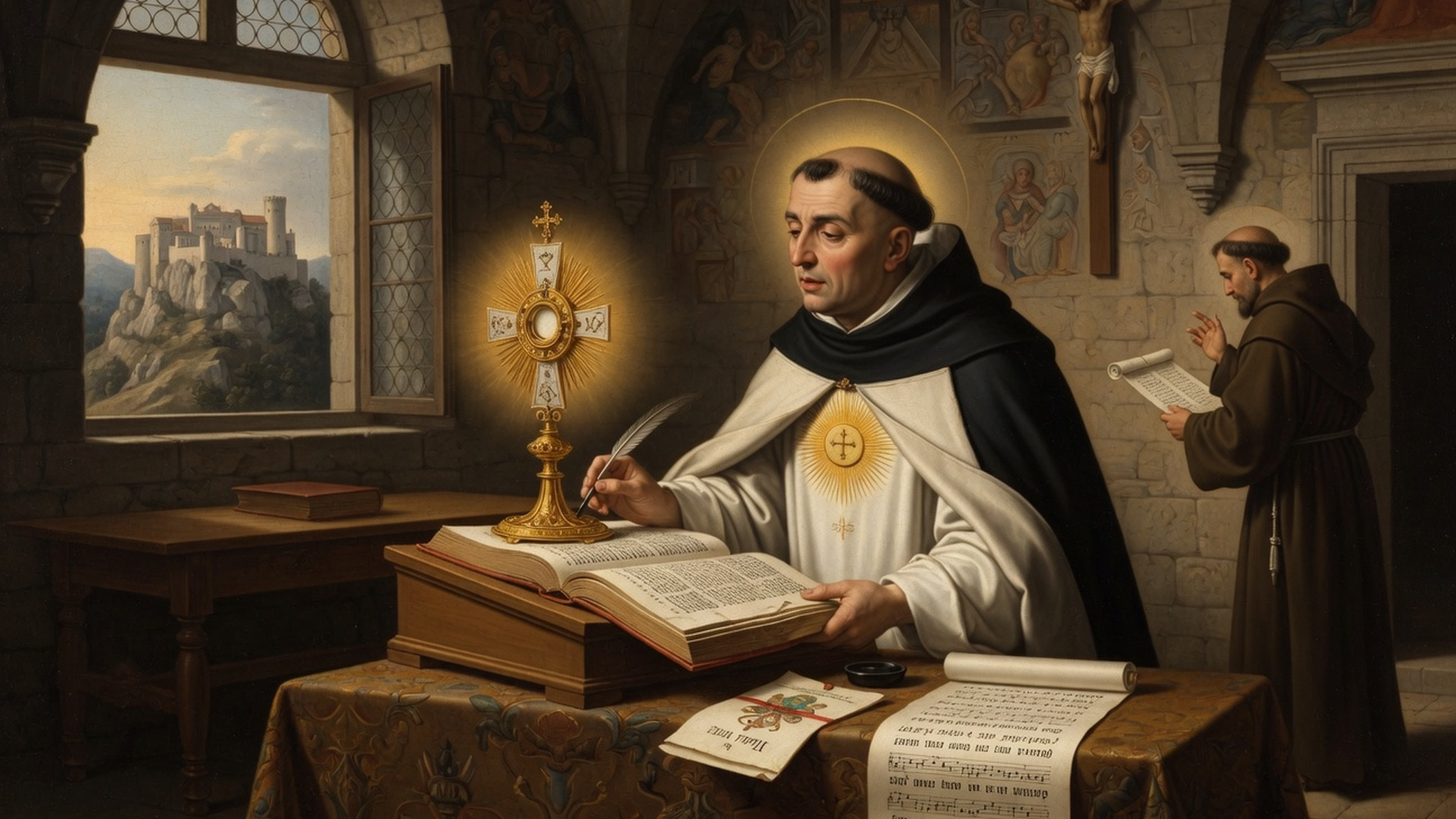
A few years later, that is to say in 1264, Thomas Aquinas was called again by Pope Urban IV, who was th pape Urbain IV Pope who canonized Felix in 1262. en in Orvieto. He went there and took advantage of the first conversations he had with the Holy Father to propose to him the establishment, throughout the Catholic Church, of a special solemnity in honor of the divine Eucharist.
This feast was already being celebrated in several churches. That of Liège had been the first of all. A pious nun, named Juliana, had had a vision on this subject and had communicated it to the archdeacon of Liège, who later became Pope Urban IV, and who approved the project of a feast for the Blessed Sacrament. The office was composed by a religious of the Order to which Juliana belonged, and the feast took place for the first time in the year 1247. From Liège it spread to other regions, and the eagerness of the populations for these pious ceremonies made it desired that they could be celebrated everywhere, and no one wished for it with more ardor than Brother Thomas.
The pious thoughts that the Saint had long nurtured in his heart on this subject were neither less profound nor less ancient in the soul of the Vicar of Jesus Christ. The new wonders that were taking place every day on the holy altars had only served to excite the pious desires of the Sovereign Pontiff. It seemed that God himself had wished to confound the doubts or profanations of impiety, and to second the love and faith of the people through various miraculous interventions of his power. Blood had repeatedly flowed from the consecrated hosts, and various Christian peoples had been witnesses to these wonders.
Pope Urban IV, having decided on the establishment of the feast of the Most Holy Sacrament, wanted the office to be composed by the two greatest geniuses of the century. He therefore summoned to him the angelic Thomas and the seraphic Bonaventure: "Brothers," he said to them, "I wish to establish throughout the Church the greatest and most touching solemnity; I wish to celebrate the Sacrament of love and mercy." Then he developed his plan to the two monks and ordered them to prepare to execute it. The humility of the two Saints was astonished at the choice of the Pontiff; they resisted, but in vain; at a fixed time, they had to submit their work to the one who, better than any other, was capable of judging it.
Thomas and Bonaventure, on the day determined by the Sovereign Pontiff, went to him, modesty on their brows and distrust of themselves in their hearts. "Begin, Brother Thomas," said Urban IV. The holy Religious first read the antiphons of the various parts of the office, the lessons, the responsories; everything was taken from the Holy Scripture and perfectly adapted to the subject of the new solemnity. The Pope remained silent, while Bonaventure could not contain a gesture of approval, promptly repressed by respect.
Thomas passed to the morning hymn: *Sacris solemnis*; he arrived at this ravishing stanza:
Panis angelicus fit panis hominum, Dat panis coelicus figuris terminum. O res mirabilis ! manducat Dominum Pauper, servus et humilis.
The bread of angels becomes the bread of man; this heavenly bread puts an end to the ancient figures. O ineffable wonder! The poor, miserable man, reduced to the condition of slaves, feeds on the body of his Lord.
Tears moistened the eyelids of Brother Bonaventure, and one could hear, under his coarse robe, the rustling of a parchment whose fragments fell to the floor.
What admirable majesty in the beginning of the hymn for Lauds:
Verbum supernum prodiens, Nec patris linquens dexteram, Ad opus suum exiens, Venit ad vitae vesperem.
The eternal Word, descended to us without leaving the right hand of his Father, to consummate his work, walked of his own accord to the evening of his mortal life.
One then heard these stanzas so full of suavity:
O Salutaris hostia ! Quae caeli pandis ostium, Bella premunt hostilia : Da robur, fer auxilium :
O holy Victim of salvation who open to us the door of heaven, see: the enemy delivers us into harsh battles. Strengthen us against his attacks, lend us your help.
Uni Trinoque Domino Sit sempiterna gloria, Qui vitam sine termino Nobis donet in patria.
Eternal glory to the God Three and One! May his goodness grant us in the heavenly Fatherland the life that will have no end.
The rapture of Brother Bonaventure could barely be contained, and new fragments of parchment fell at his feet.
Urban IV, no less a profound theologian than a pious pontiff, seemed especially struck by the *Lauda, Sion*, where he found a complete treatise of the highest and most sublime theology on the mystery of the day.
Thomas finished with the * Pange, lingua Pange, lingua Famous hymn attributed to Fortunatus or Claudianus Mamertus. *, of which the fourth and fifth stanzas admirably summarize the sacrament of the Eucharist:
Verbum caro panem verum, Verbo carnem efficit, Fitque sanguis Christi merum, Et si sensus deficit, Ad firmandum cor sincerum Sola fides sufficit.
The Word made flesh changes by his word a true bread into his own flesh: by the virtue of this same word, the wine becomes the blood of Christ; and if the senses are powerless to explain such a wonder, faith suffices to strengthen a truly sincere heart.
Tantum ergo Sacramentum Veneremur cernui, Et antiquum documentum Novo cedat ritui, Praestet fides supplementum Sensuum defectui.
Let us adore, with profound respect, a Sacrament so worthy of our homage; may the ancient precept yield to the new, and may faith supply the weakness of our senses.
When the angelic Doctor had finished reading this work where his genius had revealed itself in an unexpected light, for the profound theologian had shown himself there to be a sublime poet, there was a long and profound silence. Urban IV finally said: "Your turn, Brother Bonaventure!"
The holy monk threw himself at the feet of the Pope, exclaiming: "Most Holy Father, while I was listening to Brother Thomas, it seemed to me that I was hearing the Holy Spirit. He alone could have inspired such beautiful thoughts in my brother Thomas. Therefore, Most Holy Father, I would have thought I was committing a sacrilege if I had let my weak work subsist. Here, Most Holy Father, is what remains of it"; and the Religious showed the Pope the fragments of parchment that littered the floor. The Pontiff admired and praised the humility of Bonaventure no less than the genius of Thomas.
On June 19, 1264, the feast of Corpus Domini was celebrated with great pomp, and since then the hymns of Saint Thomas Aquinas have repeated, through generations and centuries, the same thought, the same sentiment, the same life. There are certain nations, certain churches that have particular chants for every other feast; but here they all unite in a single voice to repeat the voice of the Angel of the School; and these chants of the great theologian, mingled with the inspired chants of the King-Prophet, will rise unceasingly toward the throne of the Lamb, with the clouds of incense, the waves of harmony, the perfume of new flowers, and the inflamed impulses of all the souls who, from the darkness of time, aspire unceasingly to the pure visions of immortality!
It is evidently in the cult of the Holy Eucharist that the great Doctor found his lights. Do we wish to know the source of these marvelous clarities that will eternally astonish the philosopher and the theologian? Let us listen to the great man; he is going to reveal his secret to us himself:
Adoro te devote, latens Deitas, Quae sub his figuris vere latitas : Tibi se cor meum totum subjicit, Quia te contemplans totum deficit.
O God! O my God! I adore you; you are hidden under these figures, but present and living. My heart has recognized you; it abandons itself to you because, in contemplating you, it faints with love at your feet.
Jesu quem velatum nunc aspicio, Oro, fiat illud quod tam sitio, Ut te revelata, cernens, facie Visu sim beatus tuae gloriae.
I conjure you, grant me that for which I thirst so much: O Jesus, whom I contemplate without the veils, make me happy at the sight of your glory!
The Monument of the Summa
He dedicated his final years to the writing of the Summa Theologica, a monumental synthesis of the Christian faith.
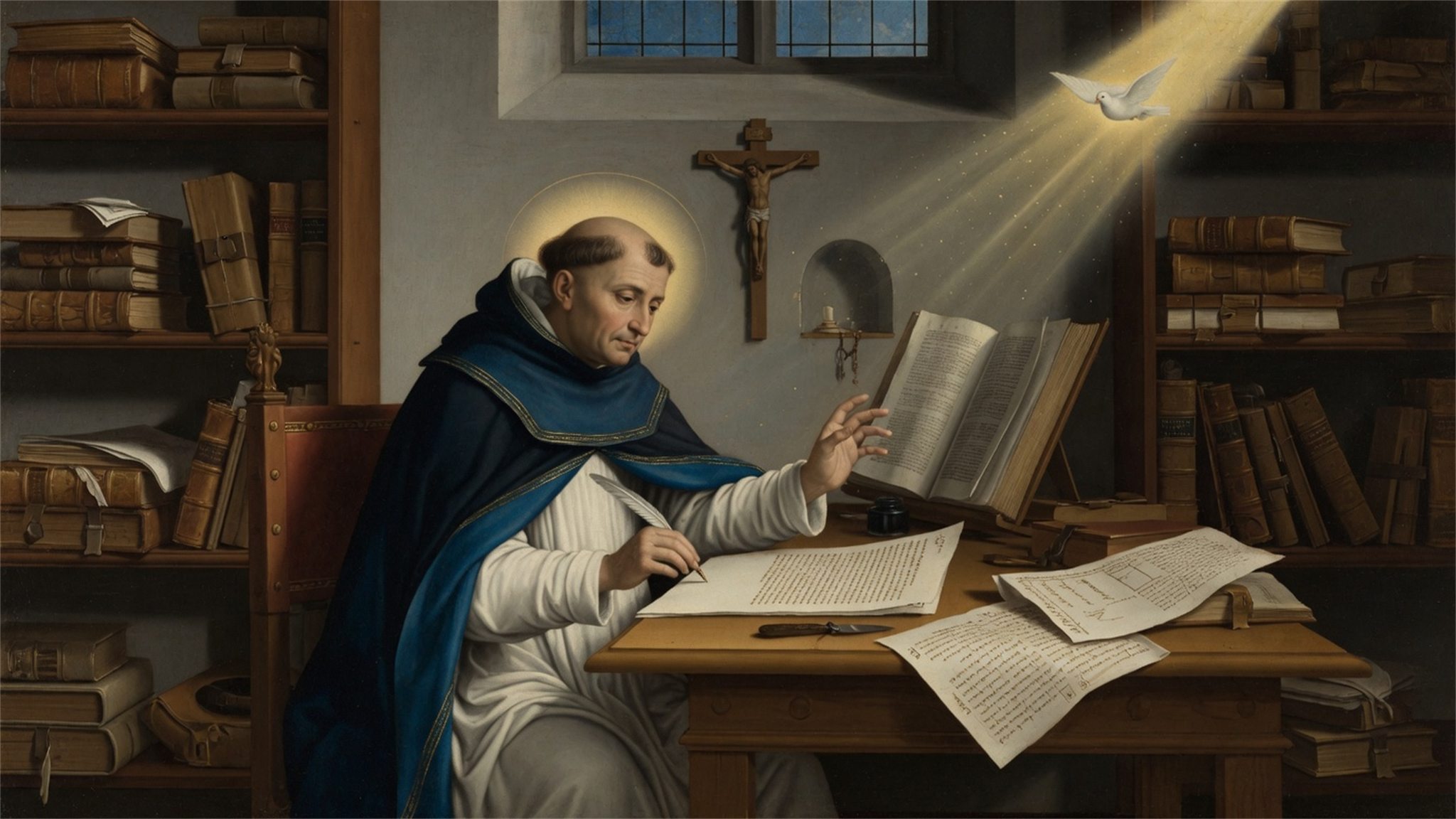
However, the authority of the Sovereign Pontiff was to struggle one last time with the humility of Thomas Aquinas. Clement IV, who had succeeded Urban IV on February 5, 1265, seemed to have inherited the feelings of the late Pope for the Angelic Doctor. The bull conferring upon him the see of Naples was already signed; but then the affliction of the Friar Preacher became so profound, his prayer so touching, that Clement IV consented to suppress this authentic act of his power.
It is in the first year of the pontificate of Clement IV that we must place the beginnings of the Summa Theologica. This Somme de Théologie Major theological work by Albert. was to be, as is well known, the principal monument of the thirteenth century, the highest formula that ever existed of Catholic teaching, and as we shall see, the total goal of the existence of Thomas Aquinas. Disgusted, as he says himself in the preamble of this great work, by the exuberance, the obscurity, and the disorder of the scholastic Theologies existing until that day, he conceived the plan of a substantial, luminous, and methodical summary, in which the whole of Christianity would be comprised, from the existence of God to the last precept of evangelical morality; a true religious encyclopedia, stripped of all foreign elements, of all useless superfetations, comprising in their logical and natural order all the speculative and practical points of revealed faith; so that each would form a complete whole, and that, in their interconnection, they would all contribute to the composition of a vast body of doctrine, a faithful image of that religion whose inflexible lines and admirable proportions were traced by a divine hand, an image consequently of the Divinity itself, which, of all its works, willed that revelation should bear the most striking and glorious traits of its eternal beauty.
To appreciate the influence and the results of the Summa Theologica, one would have to retrace the history of all Catholic schools since the thirteenth century. The Sovereign Pontiffs, the Councils, the religious Orders, and the writers of all centuries have united to accept the teachings and to exalt the merit of this great work. When the ambassadors of the kingdom of Naples came to ask for the canonization of Thomas Aquinas from Pope John XXII, the pontiff, who received them in full consistory, said to them: "He alone has enlightened the Church more than all other doctors together; and one will profit more in one year with his books than during a whole lifetime with the books of others." And as someone, in the course of the canonization process, remarked that he had performed no miracles, the Pope replied: "He has performed as many miracles as he has written articles." The Greek Church concurs in its praises with the Latin Church. Cardinal Bessarion, the glory of Catholic Greece, one of the finest geniuses of the fifteenth century and one of the most ardent promoters of the Renaissance, used to say that Thomas Aquinas was the most learned of saints and the holiest of the learned. Tolet, another prince of the Roman court, involved in all the religious and political events of the following century, proclaims, without hesitation, that the books of Thomas take the place of all others for him. In the impossibility of reporting here all the glorious testimonies rendered to the Angelic Doctor, and to his Summa in particular, let it suffice for us to report a fact that summarizes magnificently, it seems to us, this unanimous concert of all ages and all intelligences of Catholicism in his honor. In the Council of Trent, a table was placed in the middle of the hall where the Fathers of the Council sat, and on this table were the Holy Scripture, the decrees of the Popes, and the Summa of Saint Thomas. After that, let us conclude, with the poet of the thirteenth century, that the Doctor inhabits a sphere where praises can no longer reach, or else, with a writer of our days, that God alone will be able to praise this great man in the eternal council of his saints.
The composition of the Summa Theologica occupied the last nine years of Saint Thomas's life, without, however, his renouncing any of the functions or any of the duties that heaven had imposed upon him. For a long time, Bologna had desired to possess a professor so capable of sustaining its ancient renown. The presence of Thomas in this city revived the love of rigorous studies.
partim quidem, quia secundum frequens repetitio et fastidium et confusionem generabat in animis auditorum.
Hæc igitur et alia hujusmodi evitare studentes, tentabimus, cum assistentia divini auxilii, ea quæ ad sacram doctrinam pertinent, breviter ac dilucide prosequi, secundum quod materia patietur. (Sum. Theol. prol.)
The glory of the learned professor was not so dazzling, however, that it was not sometimes misunderstood, as we have seen that it had been insulted more than once. One day, therefore, as Brother Thomas was walking with slow steps under the cloister of the convent of Bologna, completely absorbed in his deep meditations, a lay brother told him that, being obliged to go out for some business, the superior had permitted him to take with him the first religious he encountered. The Doctor, without alleging either the pain he was currently suffering in one leg or the more serious occupations that filled all his moments, immediately set about accompanying this good brother; but the latter walked with such precipitation that Thomas often remained behind. The great man was promptly recognized in the city; and the procession of citizens took it upon itself to remind the religious of his duty and to learn the name of his companion, so completely a stranger to the greatest preoccupations of his century, as to the most vulgar attentions of charity. Returned to the convent, he threw himself at the feet of the Angelic Doctor and asked his pardon for his ignorance and his indiscretion. Thomas raised him with his ordinary gentleness and said to him with a smile: "It is not you, my brother, who need an excuse, it is I; I should have remembered that the state of my leg did not allow me to walk as fast as would have been necessary!"
Thomas had just published the first part of his Summa then. Two years of such an active life had sufficed for him to elaborate the five hundred and eighty-four articles of which this magnificent work is composed!
After the death of Clement IV, that devoted friend, that powerful auxiliary of his generous thoughts, Thomas interrupted the theology lessons he had been giving for three years in Bologna to go once again to the capital of France, as if he had felt the need to bid his final farewells to that great and noble city, and to the holy and glorious monarch who then reigned over it. As for the real motive that called him to Paris, it was very probably the general chapter of 1269, held in that capital, and no doubt also the call of Louis IX, who, at the moment of embarking on a new crusade, desired to receive the advice and the blessing of a religious as great in his learning as in his holiness.
At the beginning of 1272, the general chapter of the Preachers, held in Florence, received at once from almost all the Universities of Europe requests that formed the most magnificent concert in praise of the Angelic Doctor. As if a strange premonition of his approaching death had suddenly spread through the world, every learned city attempted its final efforts to obtain the inappreciable advantage of possessing and hearing him.
Bologna, whose stay had been so favorable to his genius; Paris, where he had laid the first foundations of his glory and which had raised him like a son; Rome, which seemed to be the only theater worthy of this king of thought; Naples, which, after all, had given the Angelic Doctor to the Order of Saint Dominic, and which alone, among the great cities of Europe, had not yet possessed him, all claimed him equally and took turns asserting their rights before the Assembly. Naples prevailed over its rivals. The new king of Sicily, Charles I of Anjou, made such lively entreaties to the Dominican superiors that Thomas received the order to go to the city of Naples.
Rome was on his route: the illustrious traveler came to prostrate himself, and it was for the last time, on the venerated threshold of the holy Apostles; obedience even obliged him to stop for a few days under the hospitable roof that sheltered the Dominicans at Santa Sabina. But this halt of genius was not unfruitful for Catholic science and for the old city. It was there that he began the last part of the Summa and that he wrote his Commentaries on some books of Boethius. He was even compelled to reappear, if only for an instant, in his chair of theology; and the crowd was only the more eager to gather his words. Rome then saw one of those intellectual phenomena that will always seem incomprehensible, and for that very reason incredible to certain minds; they manifest, however, in the highest degree the power of reflection and meditation with which the soul of Thomas Aquinas was endowed. He was explaining the book of Boethius that deals with the mystery of the Trinity; the candle he held to light himself was consumed between his fingers, and burned them for some time, without the feeling of this physical pain being able to distract a soul absorbed in the contemplation of truth. Profane antiquity had seen an energetic will operate this sort of divorce between soul and body; but the intelligence, never!
Before resuming the road to Naples, Thomas had finished his work on Boethius, carefully collected by his inseparable friend Father Reginald, and currently forming the sixty-ninth and seventieth of his opuscula. Upon leaving the city of Rome, they were both received in that house of Cardinal Richard, where the Angelic Doctor had subjected the two proud rabbis to the sweet yoke of the Gospel. Thomas fell ill at his host's; but this illness was short and light. Father Reginald, his companion, fell ill in his turn, in the same villa; and this time the malady declared itself with such intensity that it soon inspired the most serious anxieties in the doctors. But holiness possesses resources that science cannot even suspect: our Saint prays for his companion; he places the relics of Saint Agnes upon him, and the sick man suddenly recovers the strength and health necessary to continue the journey begun with his illustrious friend. Thomas had always professed a profound veneration and a tender confidence for this amiable and chaste spouse of Jesus Christ; he constantly carried with him relics imprinted with the virtue of the martyr and the brilliance of chastity. The memory of this Christian virgin, whose weak childhood triumphed over pleasures and tortures, had I know not what powerful charm for the austere soul of the Catholic Doctor. One can no doubt find some reasons for this in the very history of the first years of Thomas; but one cannot refuse to see in it a new proof of those intimate relationships, of that natural sympathy, that we have already grasped between genius and chastity.
Thomas's entry into Naples was a true triumph. The crowd, moved and respectful, accompanied him to the gates of that Dominican convent where Thomas had embraced the religious profession. What would Princess Theodora have said if she had seen the triumph of her son in that same house that she had looked upon as the tomb of her glory?
The University of Naples came as a body to lay at the feet of Charles I the public homage of its gratitude: it had not forgotten that it was to the credit and benevolence of this prince that it owed the count among its professors of a master henceforth without rival. The king, for his part, assigned the Doctor a monthly pension from the royal treasury, rather as a striking testimony of his esteem and veneration than as a reward, above which Thomas rose with all the height of his genius and all the abnegation of his holiness. The pilgrim who still visits the Dominican convent in Naples today stops with respect before the entrance of a large hall. The image of a Friar Preacher, crowned with the halo of the saints, first fixes his gaze; and under this image he reads this inscription, engraved on marble: "Before entering, venerate this image, and this chair from which the famous Thomas Aquinas once made his oracles heard by an infinite number of disciples, for the glory and felicity of his century; King Charles I procured this advantage for his kingdom, and assigned an ounce of gold as a pension for each month."
The highest personages themselves no longer approached Thomas Aquinas except with a respect mixed with a sort of religious fear. The Cardinal, current legate of the Holy See in the kingdom of Naples, ardently desiring to have a conference with him, wanted the Archbishop of Capua, a former disciple of the Doctor, to accompany him on his visit. Having arrived at the convent of Saint Dominic, they had Brother Thomas called to the cloister. The latter immediately set about obeying; but, on the way, his mind was so absorbed by the object of his studies that, once he had descended into the cloister, where the two noble visitors were waiting for him, he continued his walk and his meditation gravely, no longer remembering those who had asked for him, not even perceiving them when they happened to pass before his eyes. Thomas did not have here, as at the table of the King of France, a confrere present to recall him to the exterior life. The legate would willingly have been offended by such a strange reception, if the Archbishop, who knew the master's ordinary raptures, had not made this particular trait of his character known to the Cardinal. Returned to himself, Thomas asked their pardon for his forgetfulness; he cast the cause of it upon the weakness of his mind, which had only allowed him with such difficulty and slowness to find the solution to a theological difficulty! The Cardinal-legate withdrew, not knowing what he should admire more, the science or the humility of the holy Doctor, but admitting that both far exceeded the greatness of his renown.
In the short space of a year and a half, during which the city of Naples was to have the happiness of possessing him, he composed the five hundred and forty-nine articles that remain to us of the last part of the Summa. Soon the Doctor wrote very little on philosophy and theology properly so-called: the meditation of the Scriptures absorbed the activity of his mind and that of his heart almost exclusively. Some commentaries on various passages of the holy books still escaped his pen. The earthly and passing elements faded little by little from his thought; his eye perceived other horizons; the angel unfolded his wings more frequently to escape the influences of life and to launch himself toward the abode of immortality.
Mystical Visions and the End of Writing
After supernatural revelations, he ceased writing, considering his works as straw compared to the divine splendor he had glimpsed.
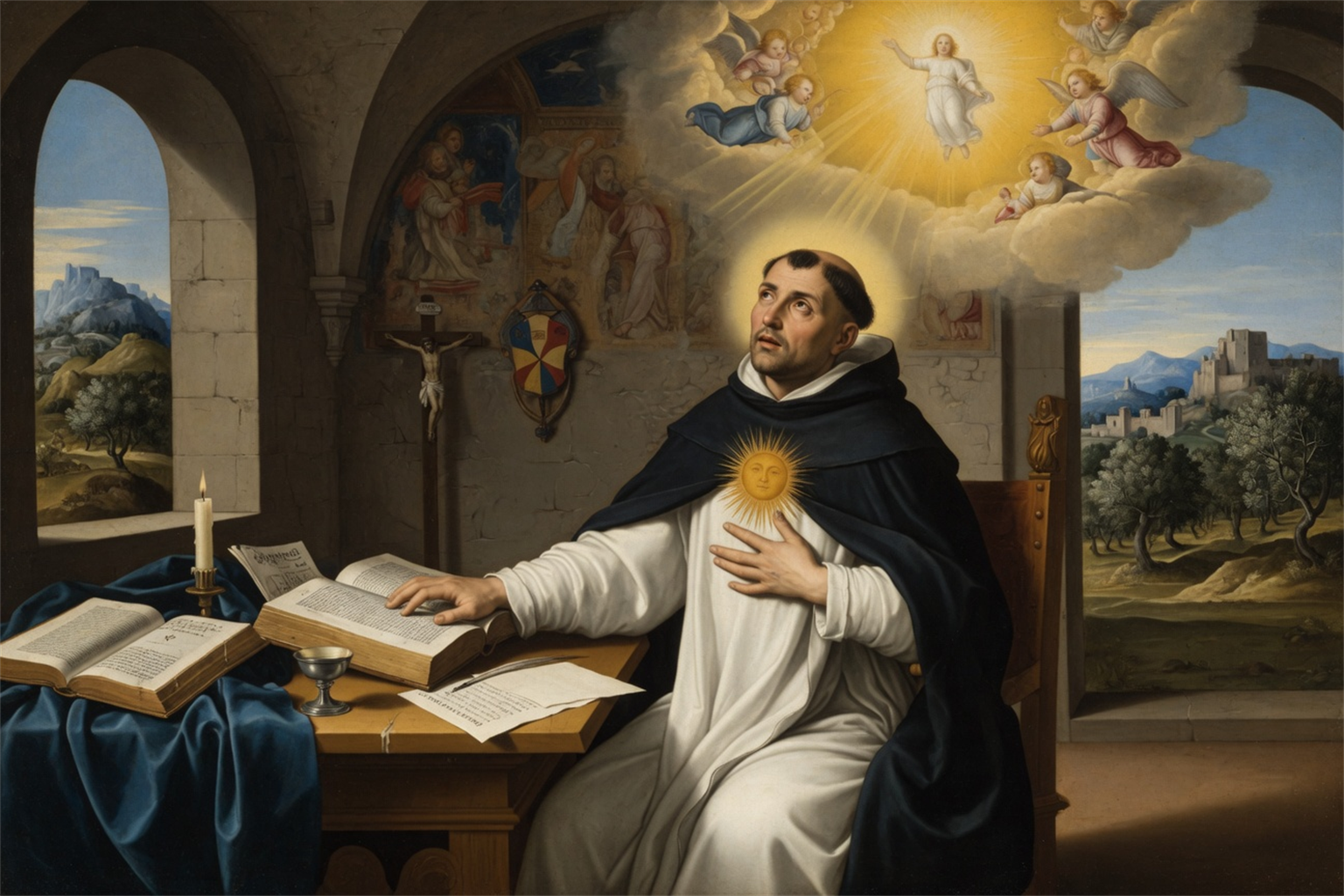
The ecstasies and raptures he had always experienced in prayer became more habitual and intense every day. In such moments, one would have said that his soul had entirely abandoned his body, so completely did he return to the total inertia of matter. Upon his return to his earthly prison, he was heard sighing, with the very words of Saint Paul, after the day of deliverance and vision. Thomas often repeated at that time: "Who shall deliver me from this body of death? Oh! how I desire to leave this slavery and go to Christ."
Thomas was then writing his Commentaries on Scripture; he was explaining the prophet Isaiah, the mysterious evangelist of the Old Covenant. A passage from the inspired book presented him with insurmountable difficulties: he strove in vain to discover its meaning; the obscurity remained the same. The interpreter suspended his work, or rather redoubled his activity; he had recourse to prayer. Like all true commentators of the divine text, he asked for understanding from the One who dictated it. Following the example of Augustine, his most constant model, he cried out: "O God, source of light, grant that I may find grace before you, so that the secrets of your intelligence may finally open to the persevering ardor of my desires!" To the power of prayer he joined the efficacy of fasting. According to the promises of the Gospel, heaven was to answer his vows. One night, Father Reginald, who slept next to his cell, heard the Doctor speaking in a loud voice and conversing with someone, without, however, being able to distinguish the words of this strange conversation. A few moments later, Thomas called him. "Take a lamp," he said to him, "and the manuscript already begun on Isaiah." And immediately he began to dictate with the same firmness and the same abundance as if he had drawn from the treasures of his memory or from the pages of a book open before him. Then he dismissed his secretary; but the latter threw himself at his feet and said to him: "Father, I will not consent to withdraw until you have revealed to me with whom you have conversed this night." "It matters little for you to know," replied the holy Doctor; "go, for you still have several hours for rest." "In the name of your friendship for me," resumed Father Reginald, "in the name of religion, in the name of God, give your child this proof of trust." The adorable name that the religious had just invoked did not allow Thomas to resist any longer: he confessed to him that, to initiate him into the understanding of the Scriptures, God had deigned to give him Saint Peter and Saint Paul as masters, and that it was with the Princes of the Apostles that he had the happiness of conversing during that night. "But, in the name of God," added our Saint, "I order you to reveal nothing of all this before the hour of my death."
Sometimes it was while walking toward the conquest of a theological truth that the profound thinker entered into communication with the inhabitants of another world. Thomas spent the night in prayer in that church of Saint-Dominique-le-Majeur, which still keeps the memory of his fervor and his ecstasies so alive; Father Romanus, who had succeeded him in his chair in Paris, suddenly appeared to his gaze, before the news of his death could have reached Naples, and informed him that after having suffered for sixteen days in purgatory, he now enjoyed the bliss of heaven. Here was a man descending from the very abode of light; Thomas hastened to address several questions to him. By a movement that one could call that of a holy selfishness, he first asked him if he had knowledge that he was in a state of grace, and if his work was pleasing to God. He then asked him if the data that science acquires here below persist or fade in a better life; he finally conjured him to teach him the mode of the beatific vision. Father Romanus reassured the fearful humility of the holy Doctor on the first point; his answer was less explicit on the second and third questions: he did not try to lift the veils that Saint Paul respected. His words confirmed those of the great Apostle, encouraging human science, according to some historians, condemning it, according to the testimony of others, and ended with a prophecy in which he clearly announced to Thomas the imminent possession of that happiness which he could not manifest to him.
The death of a person whose salvation was partly his work was announced to him in an equally marvelous way. His sister, who had recently died as Abbess of Saint Mary of Capua, came to ask him for the help of his prayers and sacrifices, to finish satisfying the justice of God. Thomas took care not to refuse such touching solicitations; and in a few days he had the happiness of learning of the success of his efforts. This beloved sister, twice brought to life by fraternal eloquence and piety, crossed the limits of eternity once more to console the hope of the pious Doctor and express her gratitude. Thomas wished to learn further from her mouth the fate of his two brothers, who had died, and the state of his own conscience. This blessed soul had received the mission to satisfy such a legitimate curiosity. Count Landulf was still in purgatory; Raynald was already in heaven; the setbacks suffered for the cause of the Church had served not only to bring them back to the path of salvation, but also to make them partially expiate the errors and excesses of their youth. One remembers the violent attacks directed by these two brothers, Raynald in particular, against Thomas's vocation. Since the death of Raynald, Thomas had not ceased to ask God for the salvation of his soul: it was a third prayer that he added each day to two others, which also each day, throughout the course of his religious life, fell from his heart toward that divine heart, whose humility was the most touching characteristic. Thomas regularly asked the Lord for perseverance in the fervor of charity, and the happiness of dying in the state of a simple religious.
The assurances that the Angelic Doctor received in this vision, of the purity of his soul, of the orthodoxy of his doctrine, and of the happy results of his whole life, were transmitted to him again in a vision a thousand times more glorious. The Queen of Heaven deigned to unveil her divine features to the gaze of her faithful servant; she let a mortal hear the sound of her divine voice. This is what our Saint revealed, but only on his deathbed, for the glorification of grace and for the consolation of his last friend. The love and trust of Thomas for the august Mary, this mysterious affection which, in his heart, had preceded, as we have seen, the consciousness of himself, thus received from here below the most magnificent of rewards, and, so to speak, reached by anticipation the goal of his sublime aspirations. She who is called the Seat of Wisdom, the Mother of Chastity, she whose venerated image then presided over all the movement of Catholic science and piety, thus showed herself to this genius so luminous and so pure.
In the mysterious path upon which we have entered, as in the ordinary pilgrimage of life, so piously described by the authors of the Middle Ages, the Virgin-Mother marks only a station, the highest no doubt in the sphere of created beings; but the true end of the journey is in God. God had already shown, at least once, that he judged the soul of Thomas worthy of entering into communication with him, by means of external and sensible vision. It was when, in the church of Saint-Jacques in Paris, he had deigned to approve in such a solemn manner a writing of the pious Doctor on the divine Eucharist. Such a favor was to be renewed, for the whole of his works, in the church of Saint-Dominique in Naples. Thomas felt the end of his scientific labors approaching; he was then writing the last articles of the Summa Theologiae. He redoubled his fervor in his mortifications and prayers, to obtain from heaven that error could not slip, despite himself, into this vast multitude of coordinated articles and diverse compositions. While he was praying in a chapel dedicated to Saint Nicholas, and pouring out the solicitude of his soul in the presence of the Lord, he was seen to rise from the ground by several cubits, his eye fixed on the crucifix. The elevation of his body was not the only sign that revealed to those of his brothers who happened to be in the church the miraculous power of that gaze. The venerated image came to life under his action; these words came from his mouth: "Thomas, you have written well of me; what shall be your reward?" The Doctor immediately replied: "None other, Lord, than yourself!"
On another occasion, it was on Passion Sunday of the year 1273, Thomas was celebrating the holy mysteries in the church of Saint-Dominique; he entered into such a deep rapture that it was necessary to use a kind of violence to recall him to the feeling of external things. Several officers of the King of Naples and some Dominicans, witnesses of this wonder, conjured him in vain to let some rays of grace shine before their eyes; they attempted useless efforts to obtain knowledge of what had happened in his soul during the precious moments that it fled far from men and from the earth. A few days later, Thomas confessed, in the intimate outpourings of friendship, that the very greatness of the things that were revealed to him had held him in the silence of astonishment. The tongue of man, he added, following the example of the great Apostle and almost with his expressions, is powerless to properly render the wonders of God. "So many great things have been revealed to me," he said again, "that everything I have written, everything I have taught in my life, seems to me but a pale reflection of the truth, an image unworthy of the supreme beauty."
From that day on, the Angelic Doctor condemned himself to silence; he resolved to write no more, to teach no more.
Despite this ever-growing repulsion for earthly objects, and these inflamed aspirations toward a better world, one sees him move away for a moment from his pious solitude to pay a last visit to his sister, Countess Theodora, at her castle of San Severino, not far from the city of Naples. There he was seized by an ecstasy longer and more intense than usual; he remained for several hours without giving any sign of life; so much so that Father Reginald, his companion, could not dispel the alarms of his sister with all that he told her of the marvelous life of the Angelic Doctor, forced as he was to admit, moreover, that he did not remember having ever seen him, for such a long time, rapt out of himself. When this state of ecstatic contemplation had ceased, Thomas could only repeat to his friend the only words that the great Apostle let be heard upon his return from the third heaven: "I have seen, I have heard ineffable things." The Doctor added with certainty: "My life must soon end, as my teaching."
Passing at Fossanova and Legacy
En route to the Council of Lyon, he died at the Abbey of Fossanova in 1274, leaving behind a body of work that would illuminate the Church for centuries to come.
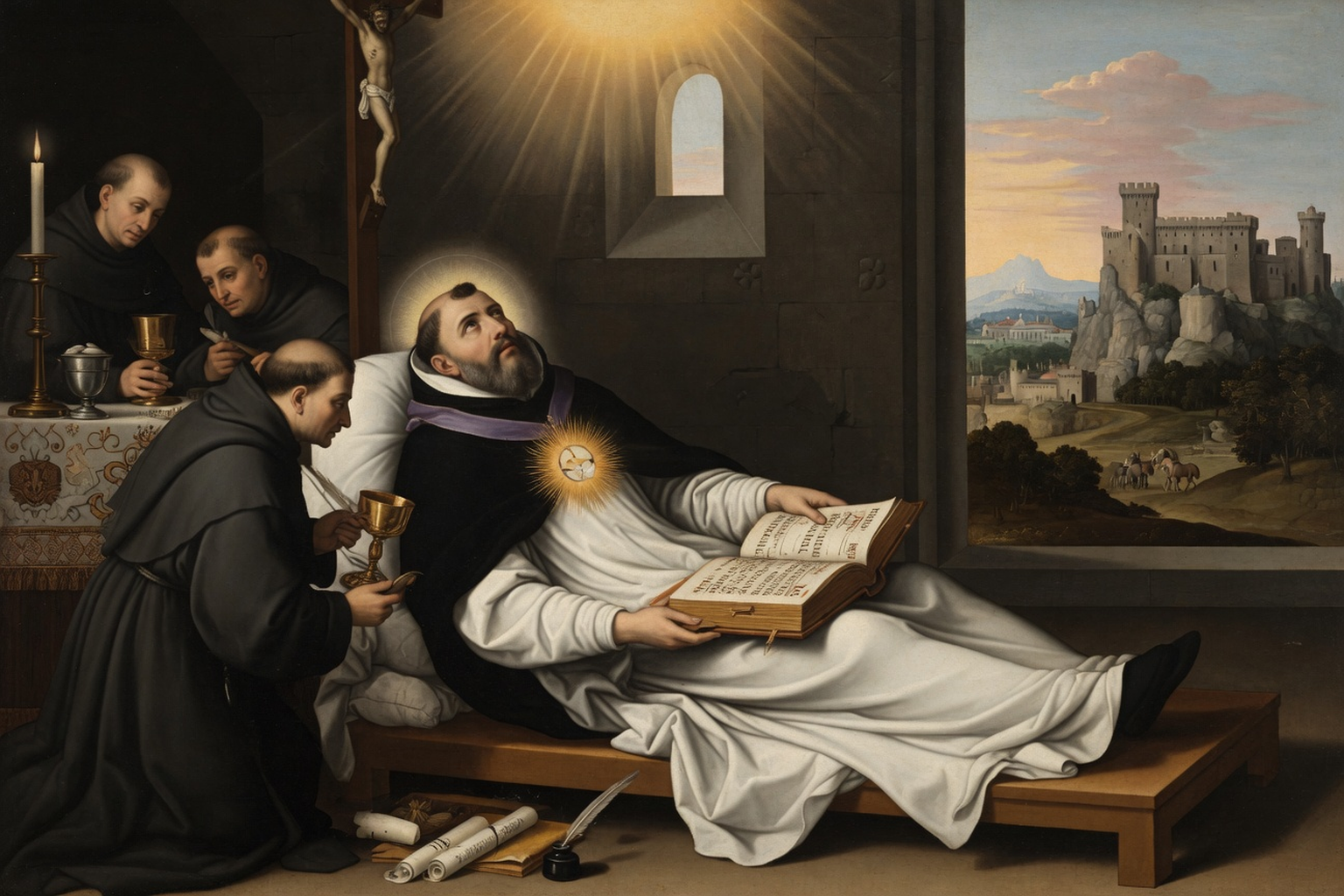
To prepare himself more immediately for taking possession of his eternity, Thomas Aquinas had once again withdrawn into that quiet and meditative taciturnity which had been the distinctive character of his early youth, that period of life when a man must prepare himself for the serious practice of existence. But while he was living thus in retreat and prayer, Gregory X drew him from his dear solitude in order to send him to the council he had just convened in Lyon to work toward the extinction of the Greek schism and to procure aid for the Holy Land. As the ambassadors of Emperor Michael Palaeologus were to attend, as well as several prelates of the Eastern Church, a man such as Thomas could render important services to the Church. The Sovereign Pontiff therefore enjoined him, by a special brief, to go to the council, the opening of which was set for May 1, 1274; he ordered him at the same time to prepare to defend the Catholic faith in the presence of the Greeks. The Saint's health was in poor condition at the time; but that did not prevent him from leaving Naples, where he was, toward the end of January. He was given as a traveling companion Father Reginald of Piperno, who was charged with taking care of him, because he was so little occupied with his body that he would often have forgotten to provide for the most indispensable necessities if someone had not watched over them particularly.
Thomas, having found the castle of Magenza on his route, spent some time there to see Francesca d'Aquino, his niece, married to the Count of Ceccano. There, his illness increased considerably, and he was seized with a general disgust for all kinds of food. As he was pressed one day to say what he wanted to eat, he replied, to rid himself of the importunities of his relatives, that he might eat a certain fish very common in France, but very rare in Italy. They went to such lengths, however, that they found some and served it to him; but he would not touch it out of a spirit of mortification. This universal disgust having diminished a little, and his strength beginning to return, he continued his journey, despite the certainty he had that his last hour was not far off. However, the fatigues of the journey redoubled his ailment, and the fever became so violent that he was forced to stop at Fossanova, a famous abbey of the Cistercian Order, in the diocese of Terraci Fosse-Neuve Cistercian abbey where Thomas Aquinas died. na. The first thing he did upon entering was to go and greet the Blessed Sacrament, according to his custom. With his face prostrate against the ground, he poured out his soul in the presence of Him who was soon to call him into His kingdom. Having then passed into the cloister, he pronounced these words of the Psalmist: This is my place of rest forever. He was placed in the abbot's apartment, where he remained ill for nearly a month. The religious of Fossanova gave him every possible mark of respect and veneration. They vied for the advantage of serving him, deeming themselves happy to be able to be useful to a man they regarded as an angel clothed in a mortal body. They were as surprised as they were edified by his patience, his humility, his recollection, and his fervor in prayer.
The more the Saint saw the hour of his death approaching, the more he sighed for the happy moment that was to make him enter into the glory of his God. He was heard repeating continually these words of Saint Augustine: "I will not begin to live truly, O my God, until I am entirely filled with You and Your love. Now I am a burden to myself, because I am not yet full enough of You." The religious of Fossanova having begged him to explain the Canticle of Canticles to them, as Saint Bernard had once done in a similar circumstance: "Give me," he said to them, "the spirit of Saint Bernard, and I will yield to what you require of me." He nevertheless yielded at last to their repeated instances, and dictated to them a short exposition of this mysterious book. This exposition was less the fruit of his science than of his charity: it could indeed only come from a soul which, running after the odor of the perfumes of the celestial spouse, hastened to break the bonds of its slavery to go and enjoy the delights of eternity. However, our Saint found himself very ill. His weakness became so great that, after recommending himself to the prayers of the religious who surrounded him, he conjured them to leave him alone, so that he could consecrate to God alone the few moments he still had to live. When he saw himself in freedom, he produced, with the sentiments of the most lively faith, acts of adoration, love, thanksgiving, humility, and contrition. He then made a general confession of his whole life to Father Reginald, and this with a great abundance of tears. It was not that he had committed grave faults; but his love for God represented the slightest faults to him as considerable infidelities: for those to whom he had manifested his interior have always been persuaded that he had never rendered himself guilty of any mortal sin. He said to Father Reginald, before dying, that he thanked God for having constantly anticipated him with His grace, for having always led him as if by the hand, and for having preserved his soul from those falls which destroy charity; then, following the example of Saint Augustine, he added that it was by a pure effect of divine mercy that he had been delivered from all the sins into which he had not fallen.
The holy doctor, having received absolution with all the sentiments of a perfect penitent, asked for the holy Viaticum. While the abbot and his religious were preparing to bring it to him, he begged those who were around his bed to place him on the ashes, so that he could, he said, receive Jesus Christ with more respect. It was thus that he wished to await the Savior, despite the extreme weakness to which he was reduced. When he saw the holy host in the hands of the priest, he pronounced the following words with a tenderness of devotion that drew tears from the eyes of all those present: "I firmly believe that Jesus Christ, true God and true man, is in this august Sacrament. I adore You, O my God and my Savior! I receive You, O You who are the price of my redemption and the viaticum of my pilgrimage! You for whose love I have studied, worked, preached, and taught! I hope I have advanced nothing contrary to Your divine word, or if that has happened to me through ignorance, I retract it publicly, and submit all my writings to the judgment of the holy Roman Church." The Saint, having then recollected himself to form some acts of religion, received holy communion, and did not permit them to carry him back to his bed until he had made his thanksgiving. As his strength diminished more and more, he wished them to administer the sacrament of Extreme Unction to him while he was still in full consciousness. He himself answered distinctly to all the prayers of the Church.
He remained tranquil after that, enjoying a profound peace, which was manifested by the serenity of his face. One heard him repeat often: "Soon, soon the God of all consolation will crown His mercies, and will fulfill all my desires; soon I will be satiated in Him, and I will drink from the torrent of His delights. He will intoxicate me with the abundance of His house, and will make me contemplate the true light in its essence, which is the source of life." Having noticed that those who surrounded him were melting into tears, he said to them, to console them, that he saw death arrive with joy, because it was a gain for him; and as Father Reginald expressed to him the regret he had not to see him triumph over the enemies of the Church in the Council of Lyon, and occupy a place where he could render important services to the spouse of Jesus Christ, he replied with his ordinary humility: "I have always asked God, as a rare favor, to die as a simple religious, and I thank Him presently for the kindness He has had to grant my request. In calling me to the abode of glory at such an early age, He has done me a grace that He has refused to many of His servants. Do not grieve, therefore, over the lot of a man who is penetrated with the most lively joy."
He then testified his gratitude to the abbot and the religious of Fossanova for all the acts of charity they had exercised toward him. A religious of the community having asked him what one must do to live in perpetual fidelity to grace: "Whoever," he replied, "will walk ceaselessly in the presence of God, will always be ready to render an account of his actions to Him, and will never lose His love by consenting to sin." These were his last words. He prayed for a few more moments, then fell asleep in the Lord on March 7, 1274, a little after midnight. He was in the fiftieth year of his age.
"As the Doctor was breaking the shackles of this mortal life at Fossanova, Brother Paul of Aquileia, a doctor himself and great inquisitor of the faith, residing at that time in the convent of Naples, thought he saw, in the ecstasy of his imagination, Brother Thomas giving his lecture in the Neapolitan university, in the presence of a prodigious number of students. Saint Paul enters the school, in the company of some other saints. The professor rises and immediately descends from the chair to come to meet the Apostle. The latter signals to him to continue his reading and to pursue the lesson he had begun. But the Doctor conjures the Apostle to tell him, as a favor, if he has well understood the meaning of his epistles. Paul answers him: Yes, as much as a man plunged in the darkness of this life can understand; but come, I will lead you to a place where you will have a clearer view of all truth; and pulling him by the hem of his scapular, he led him out of the schools. The brother then began to cry with all his might: Help; they are taking Brother Thomas away! The other religious, attracted by his cries, asked him the object of his vision, which he recounted to them. The hour was noted; and later it was known that it was the hour when the holy Doctor had gone to receive his reward!"
But the impression produced by this death crossed the greatest distances with the same rapidity. Here is what was happening at the other extremity of Europe, in that old city of Cologne, whose schools had been the first theater of Thomas's successes, as a student and as a professor: "Master Albert of Saxony, an old man of more than eighty years, white-haired and venerated, crowned with all the glories of science and all the honors of religion, to which he had shown himself superior by laying them aside; a magnanimous heart toward a student especially who was to eclipse the halo of his successes; Albert the Great, the master of Thomas, also felt, by a divine communication, the irreparable loss that the Church and his Order had just experienced. He was at table with the other religious of the convent of Cologne; suddenly he bursts into tears. The prior asks him the motive of his sorrow; Albert replies: It is sad and great news that I must tell you; Thomas Aquinas, my son in Jesus Christ, the torch of the whole Church, has just died; God has revealed it to me. The prior took note of the day; and a few weeks later it was known that it was the very day of the death of the Angelic Doctor!". We are much mistaken, or history presents few scenes as striking as that of an old man such as Albert the Great, weeping, in similar circumstances, the death of a student such as Thomas Aquinas. Has friendship that survives death ever taken on more majestic and touching features?
The fatal news, before arriving in the depths of Germany, had necessarily crossed the city of Lyon, where the deputies of the universal Church were currently assembling: it circulated from mouth to mouth with sadness and discouragement. The fathers of the Council only approached each other with the silence of surprise or the tears of sorrow. Bonaventure was there, no doubt; but the intelligence and the heart of this great man seemed struck by an anticipated death at the news of the death of a friend impatiently awaited, and who was accustomed to carry with him the hope of all triumphs. Without pretending to attach to this single fact the little success of this assembly in one of its principal objects, which was the reunion of the Greeks with the Latins; making, moreover, allowance for human passions in the resistance they oppose to the reign of truth, we can affirm, according to all historical documents, that the absence of Thomas Aquinas was regarded by all the members as the greatest of the misfortunes that could happen to Christendom in such circumstances. A veil of mourning seems to spread over the first deliberations. Nothing could, better than the aspect of the Council, inspire this trait of an ancient historian: At the death of Thomas, barely arrived in the middle of his career as a doctor, the world felt a commotion similar to that which it would experience if the sun were to suddenly lose itself in space at high noon!
Let us summarize, by means of iconographic data, the principal traits of the life and the principal virtues of Saint Thomas Aquinas:
Angels place a belt around his loins during the mystical sleep of which we have spoken; he puts to flight with a firebrand a woman who comes to tempt him; he lets himself down through a window to escape his family; one can place an ox near him: one has seen in his life why.
The chalice or the monstrance that is placed in his hand recalls the composition of the office of the Blessed Sacrament. Kneeling before a crucifix, he holds a scroll bearing these words: Bene scripsisti de me, Thoma; quam mercedem postulas! — Non aliam nisi te, Domine; one conceives that there are various ways of arranging the cartouche translating to the eye this great favor of which Saint Thomas was the object. It is above all the sun, as we have already seen, which serves painters to characterize the genius of Saint Thomas: one places the sun on his chest or on his hand; sometimes it is suspended from a necklace; perhaps this is a way of designating that one of his works which is called the Golden Chain. In an engraving reproduced by Fr. Cahier, the star with brilliant rays is supported by an open book on the Saint's chest. This book is undoubtedly the Summa Theologiae. One sometimes finds him represented with two wings to recall his title of evangelical doctor; but we do not advise this manner, which does not seem to us special enough. Indeed, this emblem is suitable for all the Doctors of the Church, and notably for the seraphic doctor, Saint Bonaventure; one must say as much of the dove that some painters have given as an emblem to Saint Thomas and to some other Saints of the Order of Saint Dominic: nothing authorizes its use; the star, although it indicated the instant of his death, is not sufficiently characteristic either: it belongs more especially to Saint Dominic. He carries the lily, as a symbol of his virginity. He is often joined to Saint Bonaventure, his fellow student in Paris.
In 1860, Mr. Gandolfi, an Italian artist, published a statuette of Saint Thomas, standing, calling for the blessing of God on the Summa, which he has just finished. A miter at his feet recalls his humility and his refusal of ecclesiastical dignities. Casini represented him accompanied by two angels; Erasmus Quellinus, kneeling before the Virgin who hands him a paper; Abraham Diepenbeeck standing, holding a palm and a holy ciborium; Sébastien Leclerc, kneeling before an altar; the same, holding a quill from which rays depart that go to unite with as many volumes as the Fathers of the Church hold, etc.
Fra Angelico da Fiesole painted Saint Thomas full-length, surrounded by the evangelists, the prophets, and the pagan philosophers: a fresco executed in the Vatican, in the chapel of Nicholas V. In an enamel painting of a reliquary belonging to the cathedral of Orvieto, one sees him presenting the office of the Blessed Sacrament to Urban IV. The print cabinet of Paris possesses several figures and portraits of Saint Thomas. See the collection of Saints in alphabetical order. Finally, the old topography of Toulouse, which is found at this same print cabinet, reproduces the tomb and the marvelous shrine of Saint Thomas, which were in the church of the Dominicans of Toulouse, before the Revolution.
Saint Thomas was of a tall and well-proportioned stature, but of a very delicate complexion. He was subject to great stomach ailments, which were further increased by his austerities and by his indefatigable application to work. As for the qualities of his mind, we have made them known when the occasion presented itself, and we have said nothing that is not still below the idea that has been had in all centuries; and what adds infinitely to this idea is that public opinion has formed its judgment on that of the persons who have most distinguished themselves by their science.
One of the greatest marks of his beautiful genius consists in the fact that he made great wonders understood in very few words; so that if antiquity did this honor to a certain Lacedaemonian, to write in letters of gold everything that came out of his mouth, all the words and all the sentences that came out of this incomparable spirit should be printed in letters of some substance more precious than gold, and more durable than the firmament, so much weight and energy do they have. We will report some of them for our consolation. He said, therefore: "That the poverty of the impatient religious is a useless expense; — that the soul without prayer does not advance in anything, and that the religious without orison is like a naked soldier, and who fights without arms; — that the religious must always walk accompanied, just as Saint Augustine commands in his rule, because the religious alone is a solitary demon; — that he did not know how a man, who saw himself in mortal sin, could laugh and rejoice; nor how it was possible that a religious thought of anything other than God; that idleness was the hook with which the enemy did his fishing; that with it every kind of bait was suitable." One day he was asked the means of knowing if a man was perfect and spiritual; he said: "He who speaks in his conversation of nonsense and foolishness, who is afraid of being despised, and who gets angry at being so, whatever wonders he may do, I do not esteem him perfect, for all that is a virtue without foundation: and whoever cannot suffer is very close to falling." His sister asked him once how she could be saved; he answered her: "By willing it." Another time when she desired to know what was most desirable in this life, he told her that "it was to die well." She also begged him to tell her what Paradise was: "Until you have earned it," he said, "no one could teach you." Being at the point of death, the religious asked him how they could pass their lives without fault; he answered them: "If you can render an account of all your actions when you do them." As they asked him in what way a man could become learned: "By reading," he said, "only one book."
Annexes & related entities
Structured data for exploration: events, miracles, quotes, places, attributes, patronages, and important entities cited in the text.
Key Events
- Born at the castle of Roccasecca in 1226
- Education at the Abbey of Monte Cassino from the age of 5
- Studies at the University of Naples
- Joined the Dominican Order at 19 despite family opposition
- Two-year captivity in a tower of the family castle
- Studies in Cologne under Albert the Great
- Doctorate at the University of Paris in 1257
- Composition of the Summa Theologica and the Office of the Blessed Sacrament
- Died at Fossanova Abbey while en route to the Council of Lyon
Miracles
- The crucifix of Naples speaks to him: 'Bene scripsisti de me, Thoma'
- Apparition of Saints Peter and Paul to help him comment on Isaiah
- Levitations during prayer
- Healing of a woman by touching his habit in Rome
- Vision of the girdle of chastity bestowed by angels
Quotes
-
No other reward, Lord, than yourself!
Response to Christ on the cross -
Bene scripsisti de me, Thoma
Words of Christ -
Tantum ergo Sacramentum / Veneremur cernui
Pange Lingua Hymn