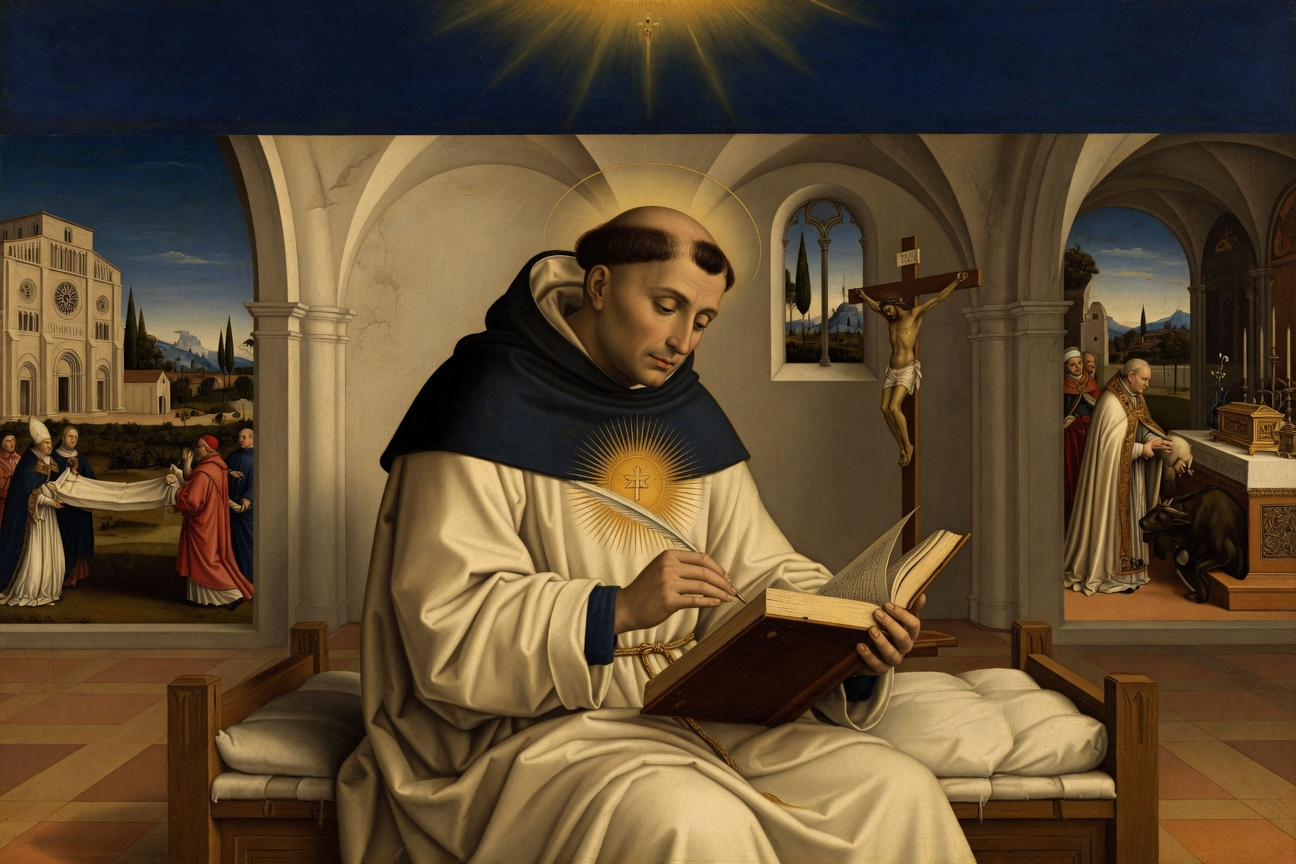
An illustrious 13th-century Dominican theologian, Saint Thomas Aquinas is the author of the Summa Theologica. Canonized in 1323, his relics were transferred to Toulouse by order of Pope Urban V. He is honored as the principal patron of the Kingdom of Naples and one of the four great Doctors of the Western Church.
Guided reading
7 reading sections
RELICS OF SAINT THOMAS AQUINAS. — ANALYSIS OF HIS WRITINGS.
Posthumous cult and translation of relics
After his death at Fossanova, the body of Saint Thomas was the object of much covetousness before being entrusted to the Dominicans of Toulouse by Pope Urban V.
No sooner had the news of his death spread than people flocked from all sides to attend his funeral. Some religious of Fossanova, and several other sick persons, were miraculously healed by the virtue of his relics.
The universities of Paris, Rome, Naples, and other cities, several princes, and different Orders requested his body. After many disputes, Pope Urban V gave it to the Dominicans, allowing them to take it to Paris or Toulouse, because Italy already possessed that of Saint Dominic, deposited in Bologna. In 1288, Countess Theodora, the Saint's sister, had obtained one of his hands, which she had preciously encased to be placed in the chapel of the castle of San Severino. After the death of Theodora, this relic was given to the Dominicans of Salerno. The rest of Saint Thomas saint Thomas Saint cited as an example of resistance to temptation. 's body was secretly transported to France, and it was received in Toulouse with the greatest solemnity. There was a prodigious gathering at this ceremony. At the head of the attendees were Louis, Duke of Anjou, brother of King Charles V, the archbishops of Toulouse and Narbonne, and a large number of bishops, abbots, and lords. The body of the holy doctor was formerly kept in the Dominican church of Toulouse; it was enclosed in a gilded silver shrine, over which a superb four-sided mausoleum had been erected. Since the Revolution, this church having been suppressed, the body of Saint Thomas was transferred to the church of Saint-Saturnin in Toulouse, where it still remains. An arm was detached from it to be sent to the great Dominican convent of Paris; it was placed in the chapel of Saint Thomas.
The church of the Minerva, in Rome, has just acquired a precious relic: the humerus of the right arm of Saint Thomas. Before 1789, this relic belonged to the Dominican convent of Saint-Jacques, in Paris, to which it had been given by Pope Urban V, at the time when the holy Doctor was transferred from Italy to Toulouse. When, in 1792, the Jacobin club installed itself in the Paris convent, the Dominicans entrusted the relic to the Duke of Parma, who allowed it to be sent to the General of the Order. In 1800, the daughter of the Duke of Parma, traveling to Rome to enter the Dominican nuns, brought the reliquary there. These nuns kept it until recent times. But as the Dominicans of Paris, in 1792, had intended this relic for the General, the Holy Father addressed it to him on March 3, 1871.
The Neapolitans, after the most pressing solicitations, finally obtained a bone from the other arm of our Saint. It was granted to them in 1372 by a general chapter. This relic was deposited in the Dominican church of Naples and remained there until 1603, at which time it was transferred to the metro Naples Place of the saint's death. politan church on the occasion of a public calamity from which they had been delivered by the intercession of Saint Thomas: it was placed among the relics of the patrons and protectors of the country. The Kingdom of Naples honors Saint Thomas as its principal patron, by virtue of the briefs of Pius V and Clement VIII, confirmed by Paul V.
Canonization and ecclesial recognition
Canonized in 1323 by John XXII, he was elevated to the rank of the great doctors of the Western Church by Pius V in 1567.
Saint Thomas was solemnly canonized by John X XII in 13 Jean XXII Pope who placed the diocese of Rieux under the protection of Saint Cizy. 23, and Pius V orde Pie V Successor to Pius IV, he supported Charles Borromeo in his reforms. red in 1567 that his feast be celebrated in the same manner as that of the four doctors of the Western Church, that is to say, Saint Ambrose, Saint Augustine, Saint Jerome, and Saint Gregory the Great.
The Philosophical Work and the Legacy of Aristotle
Saint Thomas achieved a major synthesis by Christianizing the philosophy of Aristotle, using it as a tool for the defense of the faith against the errors of his time.
The works of Saint Thomas Aquinas can be divided into four different classes. In the first are the works of philosophy; in the second, those of theology; in the third, the commentaries on Holy Scripture; in the fourth, the opuscula, which may be called miscellaneous works, because of the diversity of subjects explained therein.
It is necessary to go back a little further to make known the philosophical works of Saint Thomas. The elegance of style had given the writings of Plato the greatest vogue among the pagans, and the most learned Fathers of the Church had been raised in the maxims of the school of this philosopher. His doctrine seemed to favor the Christian religion. Indeed, no author had ever spoken in such a sublime manner of the attributes of the Divinity, of Providence, of the punishments and rewards of a future life. It was concluded from this that Plato, in the course of his travels in Egypt and Phoenicia, had learned there several of these primordial truths that tradition had preserved there despite the darkness of paganism. It was not the same with the philosophy of Aristotle: besides the fact that it did not present such beautifu Aristote Greek philosopher whose doctrine was taught by Anatole. l knowledge, it also contained several dangerous principles which the heretics of the first centuries had used to undermine the foundations of Christianity. It therefore had less currency than that of Plato, and this is why Tertullian called Aristotle the patriarch of heretics, and why a council of Paris proscribed his works around the year 1209. This does not, however, prevent those who judge without partiality from regarding him as the greatest genius of antiquity, and perhaps even as the most profound and penetrating genius that has ever appeared. He is the only one of the ancients who knew, deepened, and developed the rules of reasoning, and who gave a complete system of philosophy; and if he fell into errors, as one cannot deny, this comes from the fact that he relied too much on human reason, which is very weak when it is not enlightened by the lights of revelation. The ancient heretics are not the only ones who abused the principles of Aristotle; they had imitators in the 12th and 13th centuries, such as Peter Abelard, the Albigensians, etc. But of all those who wrote then on the principles of the Greek philosopher, there are none who pushed subtlety further than the Saracens of Arabia and Spain. Saint Thomas attacked the enemies of truth with their own weapons; he made the very philosophy of Aristotle serve th Sarrasins Group targeted by efforts of conversion and philosophical refutation. e defense of the faith, and it can be said that he succeeded in his enterprise beyond all hope. He distinguished the errors in order to refute them, and presented, in the most striking light, truths that reason had discovered, but which were often wrapped in darkness that not everyone was in a position to pierce. Finally, Aristotle, who was called the terror of Christians, was rendered as if orthodox by Saint Thomas, and provided religion with new weapons against atheism and idolatry. What our holy doctor wrote on this philosopher constitutes the subject matter of the first five volumes of his works. If one sometimes finds things of little consequence there, it is less his fault than that of the sophistic genius of the Arabs.
The Summae and the Commentaries
Presentation of the Summa Theologica and the Summa contra Gentiles, major works intended for teaching and conversion.
2° Saint Thomas's commentaries on the four books of the Master of the Sentences contain a methodical course of theology and form volumes VI and VII of his works. 3° Volumes X, XI, and XII contain the Summa Theologica. This work is admi Somme théologique Major theological work by Albert. rable, although death did not allow its author to put the finishing touches to it. Saint Augustine is the one among all the Fathers whom he followed the most; which led the learned Cardinals Noris and Aguirre to say that Saint Thomas was his most faithful interpreter. He drew primarily from Saint Gregory's Morals on Job the practical rules of duties and virtues. Maximus Planudes translated the Summa Theologica into Greek. Three manuscripts of it are known: one that was kept in Venice in the library of Cardinal Bessarion; another that is found in Rome in the Vatican Library; and the third in Paris, in the library of the Rue Richelieu. Dom Mechitar published a translation of it in the Armenian language in Venice at the beginning of the last century. Father Ragni made a translation of it into Chinese. De Murande, de Hauteville, and Father Griflois provided translations of it into French, more or less complete and more or less accurate. Abbé Drioux has just published an integral translation of it, with notes full of erudition and interest, 1851-1853, 8 vol. in-8°. It was at the solicitation of Saint Raymond of Penyafort that our holy doctor composed the Summa saint Raymond de Pennefort Commissioner of the Summa contra Gentiles. contra Gentiles. The goal of this work was to provide the preachers of Spain with the means to work fruitfully for the conversion of the Jews and the Saracens. The Summa contra Gentiles was translated into Greek and Hebrew during the very lifetime of the illustrious doctor.
Scriptural commentaries and liturgical works
In addition to the Catena aurea, Thomas composed the office of the Blessed Sacrament and famous hymns at the request of Pope Urban IV.
4° We also have from Saint Thomas commentaries on the greater part of Scripture. His Explanation of the four Gospels appeared under the title of Catena aur ea (the gold Catena aurea Commentary on the Gospels by the Church Fathers. en chain). This work is a commentary on the Gospels through a sequence of passages drawn from the holy Fathers, such that these immortal doctors seem to continue and explain one another; a miraculous work, says William of Tocco; a work more resplendent than the sun; *sole elatior*, according to the expression of the venerable Cardinal Bellarmine. Abbé Castan translated this beautiful work into French. Paris, 8 vol. in-8°, 1854. Saint Thomas had undertaken his work on the holy Gospels at the invitation of Pope Urban IV. The same pontiff charged him with composing the office of the Blessed Sacrament, which the Church still sings today. The canticles *Sacris solenniis*, *Pange lingua*, *Verbum supernum*, and *Lauda Sion* are as elevated by the sentiments they express as they are by the lyrical tone that reigns within them.
Spirituality and Editorial Posterity
His opuscula define the rules of the interior life, while his complete works have seen multiple editions throughout Europe.
5° His Opuscula cover various subjects. One finds therein the refutation of the errors of the schismatic Greeks and of several heresies; the discussion of certain points of philosophy and theology; and explanations of the Creed, the sacraments, the Decalogue, the Lord's Prayer, and the Angelic Salutation. The holy doctor, in his treatises on piety, reduces the rules of the interior life to the following two: 1° to work, through the practice of mortification and self-denial, to destroy the reign of pride and the disordered love of creatures; 2° to constantly kindle in one's heart the fire of divine love, through the exercise of prayer and meditation, and through a perfect fulfillment of the will of God in all things.
The complete works of Saint Thomas have been edited: in Rome (1571), in 18 folio volumes; in Venice (1593); in Antwerp (1614), in 19 volumes; in Paris (1636), in 23 volumes; in Venice (1745-1760) (1765-1788), in 28 volumes; in Venice (1858), in 24 volumes; in our day, in Parma, 24 volumes; and in Paris, at Vivès, approximately 30 volumes.
As for the Summa, after an interruption of about a hundred years, it has once again become, as in the past, a classic: it is in the hands of all theology students. The edition that is indisputably the most complete, the one containing the best commentaries, is that which the Célestins, successors of M. Louis Guérin, in Bar-le-Duc, publish under this title: *Sancti Thomæ Aquinatis Summa theologica, diligenter emendata, Nicolai, Sylvii, Billuart et C.-J. Brioux notis ornata*. 8 volumes, square octavo.
Biographical and hagiographical sources
A census of ancient and modern biographers, from Guillaume de Tocco to the works of Abbé Bareille.
The Roman Martyrology makes honorable mention of Saint Thomas. Saint Antoninus, Antoninus of Pisa, David Hoeschel, Paul Regius, Surius, and Ferdinand del Castillo have written about his virtues. Father Touron published a life of Saint Thomas in 1797. To compose this new life of Saint Thomas, we have made use of the History of the Saint by Abbé Bareille; the Dominican Year, 10 vols. in-8°; Godescard; and the Acta. But it is the work of Abbé Bareille that must be read if one wishes to see how Saint Thomas was the light, the engine, and the center of his century.
The oldest life of Saint Thomas Aquinas is that which was provided, during the very lifetime of the Saint, by Gérard de Frachat, a Dominican religious of the convent of Limoges (1254-1363), and Thomas of Cantimpré; the latter was a guide for Thomas Aquinas in Cologne. After them come Stephen of Salanches, who died in 1290, and Ptolemy of Lucca, both of the Order of Preachers. The Annals of the latter go from the year 1060 to the year 1274. The Bollandists did not reproduce these lives or notices: they begin with the biographical work of Guillaume de Tocco, an other child of Sai Guillaume de Tocco Contemporary biographer and witness to the saint's life. nt Dominic, who asserts having seen and heard Brother Thomas. Guillaume de Tocco wrote this life with a view to the canonization of the Saint: it is divided into one hundred and twenty-five chapters. After Guillaume de Tocco, the Bollandists provide the acts of the canonization process. Then follow extracts from Bernard de la Guichnie, Bishop of Lodève; from a manuscript life found in Utrecht and Milan, etc., etc.
Annexes & related entities
Structured data for exploration: events, miracles, quotes, places, attributes, patronages, and important entities cited in the text.
Key Events
- Died at Fossanova Abbey
- Canonization by John XXII in 1323
- Solemn transfer of the body to Toulouse
- Proclaimed Doctor of the Church by Pius V in 1567
- Transfer to the Church of Saint-Saturnin in Toulouse after the Revolution
Miracles
- Miraculous healings of religious and sick people through the power of his relics after his death
- Deliverance from a public calamity in Naples through his intercession
Quotes
-
sole elatior
Cardinal Bellarmine