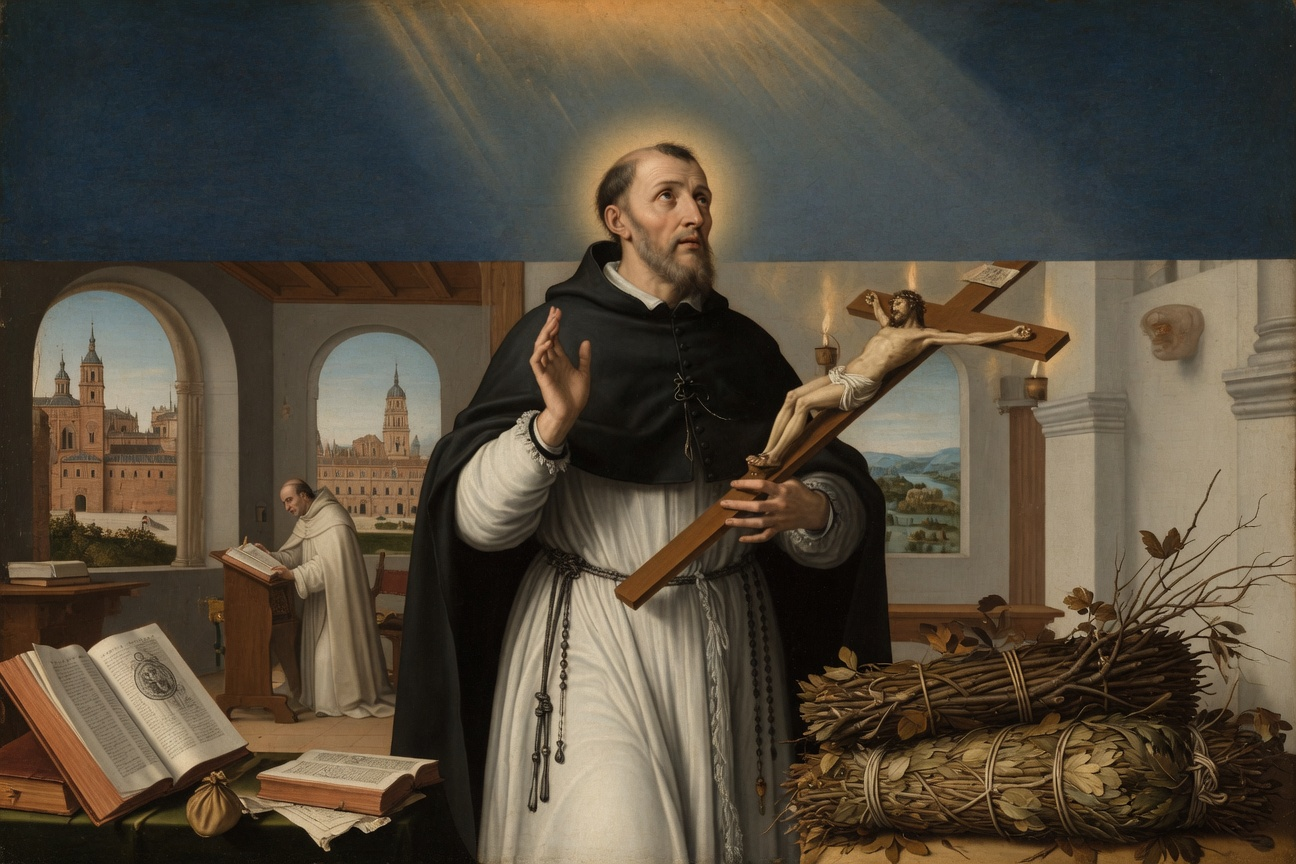
A 16th-century Spanish priest, John of Avila was an indefatigable preacher in Andalusia and the spiritual director of great saints such as Teresa of Avila. Despite an ordeal before the Inquisition, he dedicated his life to evangelical poverty and the propagation of divine love. He left behind significant spiritual writings before passing away in 1569.
Guided reading
6 reading sections
THE VENERABLE JOHN OF AVILA (1569)
Youth and intellectual formation
Born in the diocese of Toledo, John studied law at Salamanca and then theology at Alcala under the direction of Dominic Soto.
The Venerable John of Avi Le vénérable Jean d'Avila Spanish priest, preacher, and spiritual master of the 16th century. la, who may be called the father of so many Saints who appeared in Spain in the 16th century, was born in the diocese of Toledo. He was sent to Salamanca at the age of fourteen to study law. From his childhood, he was seen to apply himself with the greatest fervor to all exercises of piety. He embraced the ecclesiastical state early on, for which he had always felt a great inclination. His main goal was to work with all his strength to kindle in hearts the sacred fire of divine love.
His parents, having called him back home, were no less surprised than edified by the ardor with which he practiced all that is most heroic in perfection, and as they feared God, they took great care not to resist the impressions of the Holy Spirit acting in their son's soul. They allowed him to follow his attraction to mortification. John knew how to take advantage of this permission. He sought, though without affectation, the simplest and coarsest food. He slept on bundles of vine branches, wore a hair shirt, and often took the discipline. To the mortifications of the body, he joined those of the spirit. He died to himself every day through the practice of absolute renunciation, deep humility, and entire obedience. He devoted all his free moments to prayer and frequently approached the sacraments, especially that of the Eucharist, for which he had the tenderest devotion. His custom was to receive Holy Communion only after having prepared for it for a long time through acts of virtue most suited to purifying the heart and inflaming it with love for Jesus Christ.
Sent to Alcala to continue his studies, he distinguished himself at the university of that city as much by his piety as by his progress in the sciences. The famous Dominic Soto, a Dominican, under whom he took lessons, conceived a tender affection and high esteem for him; he even declared more t han once that Dominique Soto Famous Spanish theologian, student of Thomas at Alcala. his disciple was destined to be a great man one day; which was confirmed by the event. Peter Guerreca, later Archbishop of Granada, was one of the principal admirers of John of Avila, and he formed a friendship with him that only grew from day to day.
Renunciation and beginnings of the priesthood
After the death of his parents, he sold his possessions for the poor and dedicated himself to preaching, taking Saint Paul as his model.
It was around this time that John lost his father and mother: he thought only of preparing himself to receive holy orders. On the day he celebrated his first Mass, he clothed twelve poor people, gave them dinner, and served them with his own hands. Having learned that a young priest had just died after his first Mass, he said: "That is enough to have a rigorous account to render at the tribunal of Jesus Christ."
Upon returning to his homeland, he sold his patrimony and distributed the proceeds to the poor, in order to imitate the Apostles to whom Jesus Christ had recommended detachment from all the things of this world. He then entered into the ministry of preaching; proposing to himself unceasingly the example of Saint Paul, whom he had taken as his patron and model, he prepared himself for the sublime functions of the apostolate. Not only through the study of the dogmas of religion and the rules of Christian morality, but also through the practice of humility, charity, and self-denial. His maxim was that knowledge is only useful insofar as it is joined to solid piety. When a young ecclesiastic once consulted him on the means to preach with fruit, he replied that he knew of no better way than to love Jesus Christ greatly. His example was a proof of the wisdom and truth of his answer.
The Apostle of Andalusia
He traveled throughout Andalusia, converting crowds through his eloquence and guiding great figures of Spanish spirituality.
The man of God shared all his time between prayer and the duties of his ministry. The most arduous labors and the most pressing dangers held only charms for him when it was a question of working for the conversion of sinners; it even seemed that obstacles gave his zeal a new degree of strength and activity. His discourses, to which divine love communicated an admirable unction, touched the most hardened hearts. He considered it a crime to seek the applause of men rather than the increase of God's glory. He never ascended the pulpit without having implored divine assistance, in order to draw heavenly blessings upon himself and his listeners. One would have said that the Holy Spirit Himself spoke through his mouth, so filled were his discourses with those fiery darts that convert and change hearts. He withdrew from vice those who were plunged into it, and confirmed in goodness those who had not strayed from the paths of justice. Those who could not hear him were not for that reason deprived of his instructions; he wrote letters to them to indicate the means to take to sanctify themselves.
We have a collection of the letters of the Venerable John of Avila, which have been translated into several languages: they can only be the work of a man burning with charity and well-versed in the knowledge of the ways of salvation. The ease with which they are written announces a man perfectly instructed in the principles of morality, and gifted with the talent of rendering his ideas with method and clarity. One feels that the heart dictated them. Virtue is painted there with such amiable colors, and vice is represented under such hideous traits, that one cannot help but cherish the one and detest the other. Finally, one finds there rules of conduct appropriate to all circumstances, instructions as wise as they are solid for the various states of life, and powerful motives of consolation for all the trials in which a Christian may find himself.
John of Avila recited his office and said Mass with an angelic fervor. He only ascended the altar after having long prepared himself for the celebration of the august sacrifice; he also gave much time to his thanksgiving. Besides this, he still performed four hours of meditation per day: two in the morning, and two in the evening. He went to bed at eleven o'clock and rose at three. Toward the end of his life, infirmities having rendered him incapable of exercising the functions of the ministry, he devoted almost all his time to prayer. He was always poor in his clothing and in his food, and never wished to have servants. He never ceased to recommend to others the love of poverty. The practice of this virtue, he said, causes several passions to die and makes us similar to Jesus Christ, who was born, lived, and died in poverty. He carried detachment from the world to such a point that he has since had very few imitators. A nobleman, having one day shown him his gardens and his buildings, where all the beauties of nature and art were united, was very astonished to see that John contemplated all this only with indifference; he asked him the reason. "I confess," replied the holy man, "that there is nothing there that satisfies me, because my heart takes no pleasure in it." Indeed, his heart was so perfectly filled with God and the love of invisible goods that he had a distaste for everything that did not relate directly to such a noble end.
This holy priest preached with the greatest success in Seville, Cordoba, Granada, and throughout all of Andalusia. Through his instructions, he brought several persons of both sexes to the most eminent virtue, among others Saint John of God, Saint Francis Borgia, Sai nt Teresa, Andalousie Region in southern Spain where the saint primarily exercised his ministry. Louis of Granada, the Countess of Faria, and the Marchioness of Pliego. He had a singular talent for the direction of souls. He first inculcated the necessity of knowi ng God and kno sainte Thérèse A mystic saint who prophesied the greatness of John the Baptist. wi ng oneself, this Louis de Grenade Spiritual author cited as a source for further study on the subject. double knowledge being the base and foundation of Christian perfection. But if one wishes to know to what point he was versed in the interior life, one has only to read the treatise he composed on these words of Psalm XLIV: *Ecce, filia, et audi, et inclina aurem tuam*... This was the occasion for this work:
Spiritual Direction and Writings
He diverted Dona Sancha Carilla from the court to a devout life and composed for her a major spiritual treatise on Psalm 44.
Dona Sancha Carilla Dona Sancha Carilla Daughter of the lord of Guadalcazar, spiritually guided by the saint. , daughter of D. Luis Fernandez de Cordoba, Lord of Guadalcazar, who combined great virtues with rare beauty, was on the point of going to court to serve the queen as a lady-in-waiting. Everything was already prepared for her journey, but she wished, before leaving, to confess to John of Avila. Upon her return from the church, she was no longer recognized, so great was the change that had taken place within her. All the advantages of the world were in her eyes nothing more than vanities unworthy of capturing a Christian heart; she renounced them and decided to remain in her father's house, where she led the most edifying life until her death. It was for her instruction that our holy priest composed the treatise mentioned above. He indicated the means she should employ to overcome her passions, especially that of pride; to mortify her senses and her will, and to kindle in her heart the sacred fire of divine love. He recommended that she meditate often on the passion of Jesus Christ and on the excess of love that led this divine Savior to suffer for us.
One sees, through all the writings of John of Avila, that he had a very tender devotion toward Jesus crucified. The same is attested by all the authors who write about him. It was by meditating on the passion of the Savior that he perfected himself in the practice of all virtues; it was by this means that he kindled within himself that ardent desire to suffer for Jesus Christ; and this is also why he so strongly exhorts men to give thanks to the Lord when He provides them with the opportunity to suffer something for His holy name. "The good use one makes of trials," he said, "strengthens the soul and makes it capable of suffering even more."
The Trial of the Inquisition
Falsely accused of excessive rigorism, he was imprisoned by the Inquisition in Seville before being fully exonerated.
God permitted that His servant should for a time become the victim of envy. Although he had never preached anything but the morality of the Gospel, he was nonetheless accused of an extreme rigorism that supposedly led him to exclude the rich from the kingdom of heaven. The accusation was devoid of any plausibility; he was, however, arrested in Seville and placed Inquisition Ecclesiastical institution that investigated the holiness of Joseph. in the prisons of the Inquisition. He suffered the mistreatment of his persecutors with admirable patience and gentleness; and when his innocence had been recognized, he carried his heroism to the point of thanking those who had sought to ruin him.
Illness, death, and legacy
Afflicted by illness for seventeen years, he died in 1569, leaving behind the image of a spiritual master revered by Saint Teresa of Avila.
He was afflicted with various infirmities at the age of fifty. In the midst of the acute pains he felt, he was often heard repeating this prayer: "Lord, increase my sufferings, but grant me patience." Finally, after having suffered for seventeen years beyond what one can imagine, he died on May 10, 1569.
The Venerable John of Avila was a man powerful in works and in words, a prodigy of penance, the glory of the priesthood. He deserved, by his doctrine, by his zeal, and by his other virtues, to be the edification, the support, and the oracle of the Church. He was a universal genius, an enlightened director, a famous preacher, a man revered by all of Spain, known to the Christian world, a man, finally, whose reputation had reached such a point that princes submitted to his decisions, and scholars asked him for the help of his insights. We will finish his portrait by saying that Saint Teresa regarded him as her protector, consulte d him as her m sainte Thérèse A mystic saint who prophesied the greatness of John the Baptist. aster, and followed him as her guide and model.
Annexes & related entities
Structured data for exploration: events, miracles, quotes, places, attributes, patronages, and important entities cited in the text.
Key Events
- Law studies in Salamanca at age 14
- Studies at the University of Alcala under Domingo de Soto
- Sold his inheritance for the poor after the death of his parents
- Preaching in Andalusia (Seville, Cordoba, Granada)
- Imprisonment by the Inquisition in Seville
- Writing of the treatise for Dona Sancha Carilla
- Died after 17 years of infirmity
Quotes
-
To love Jesus Christ greatly.
Response to a young clergyman on the art of preaching -
Lord, increase my sufferings, but grant me patience.
Prayer during his infirmities