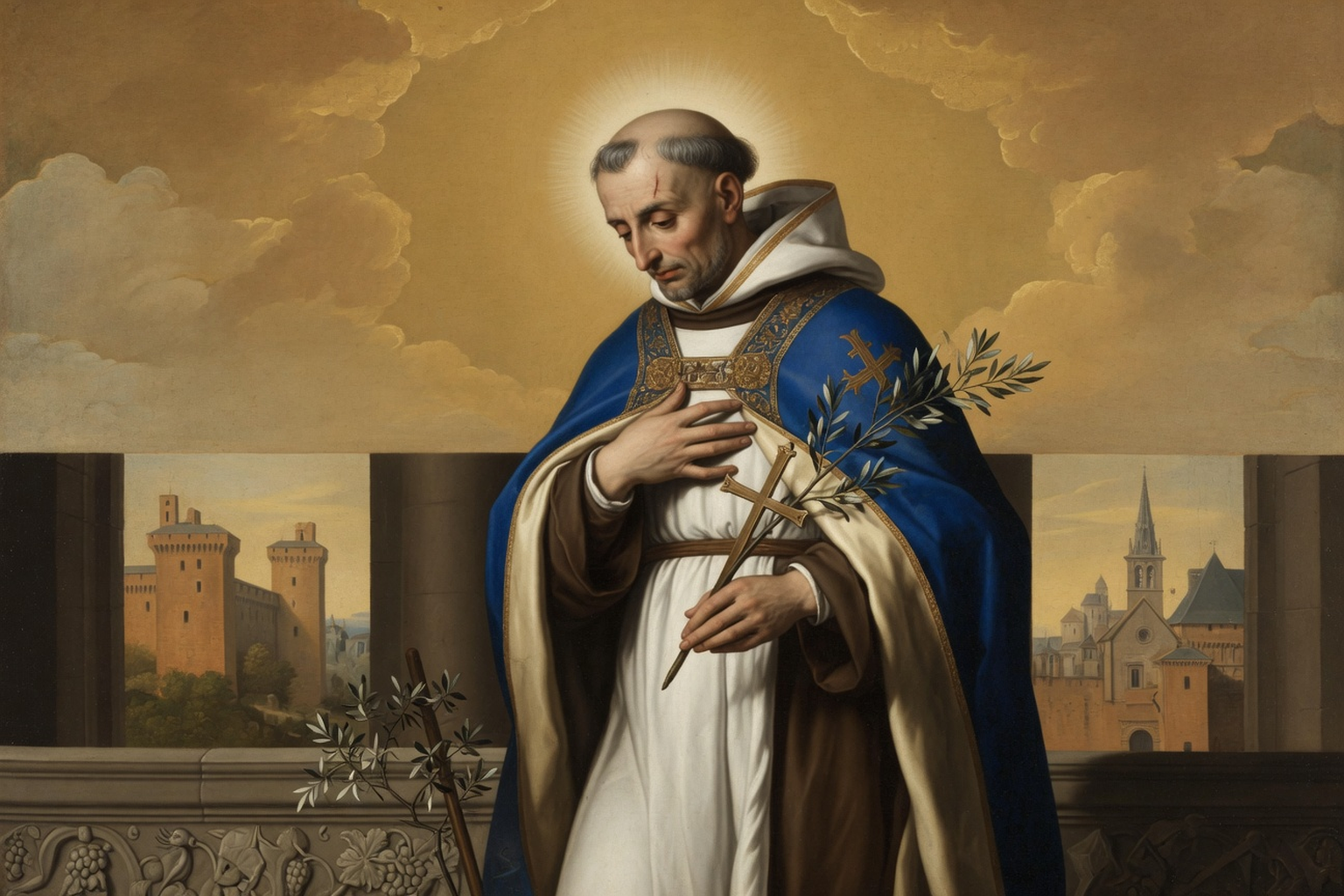
Saint Peter Thomas
OF THE CARMELITE ORDER, PATRIARCH OF CONSTANTINOPLE AND MARTYR
Patriarch of Constantinople and Martyr
A Carmelite religious from Périgord, Peter Thomas became an influential diplomat and Patriarch of Constantinople in the 14th century. He worked for the unity of the Church and preached the crusade against the Turks. Wounded during the capture of Alexandria, he died in Cyprus, honored as a saint and martyr for his apostolic zeal.
Guided reading
8 reading sections
SAINT PETER THOMAS,
OF THE CARMELITE ORDER, PATRIARCH OF CONSTANTINOPLE AND MARTYR
Youth and entry into the Carmel
Born poor in Périgord, Pierre Thomas studied thanks to benefactors before joining the Carmelite Order in Condom.
The birth of Sai nt Pierre Thomas ha saint Pierre Thomas Famous Carmelite, papal diplomat, and Patriarch of Constantinople. d nothing striking about it according to the world, and his greatness was founded only on the particular graces that God bestowed upon him from his childhood, and on the fidelity he brought to corresponding to them until his death. He was born in a small village in Périgord, named Sales, to parents so poor that they were obliged to earn their living by tilling the earth, and had no means to send him to school. This poverty compelled him, as soon as he was of an age to know himself, to leave his father's house and quit the village to retire to the town of Montpazier, which is nearby. There he found honest people who assisted him with their alms and provided him with the means to study. As God had endowed him with an excellent mind, he made such marvelous progress that, in a very short time, from a small schoolboy he became a great master, and taught others what he himself had just learned; he then went to Agen where, with the help of other charitable people who provided for his subsistence, he advanced more and more in the knowledge of the liberal arts. The prior of the Carmelites of Lectoure, seeing h Carmes de Lectoure Religious order to which the cited blesseds belong. im so capable, although he was only twenty years old, took him with him to have him teach humanities and logic for a year. Then he went, with the prior of the same place, to Condom, where he took the habit of this holy Order, and after a year of trials, he made his profession there, at the age of twenty-two.
After his vows, the superiors employed him to teach the young brothers, first in that same convent of Condom, and then in the town of Agen, until, having reached the age required to receive holy orders, he was made a priest by an express command of his provincial, which he could not resist; from then on, he made such progress in virtue that he was considered not only as a treasure of science, but also as a model of modesty, purity, and charity. He had above all a very great devotion to the most holy Virgin, whose love was so strongly engraved in his heart that the blessed name of Mary returned in all his discourses. He never sat down to table without having said or done something in her honor; and the food would have seemed insipid and tasteless to him if it had not been seasoned with the memory of this Queen of Virgins. In all his labors, in all his affections, it was the altar of Mary that served as his asylum; it was there that he continually found weapons against the snares of his enemies, and he won, by this help, admirable victories over them. Finally, the ardor of this piety possessed him so much that he could almost no longer taste, pronounce, or hear anything but the name of MARY, and it is said that this holy name was found engraved on his heart after his death, like the adorable name of JESUS on that of Saint Ignatius the Martyr. Desiring to increase the honor due to the Queen of Angels, to the benefactress of men, he wrote a book expressly to prove her Immaculate Conception, and always showed himself an intrepid defender of this mystery. In return, the Blessed Virgin assisted him with her favors, and obtained graces for him from her Son; appearing to him one day in the dormitory, she promised him that she would never forsake him; and once, when the convent of his residence found itself in extreme scarcity, this dispenser of the treasures of heaven sent him, through an unknown man, who is believed to have been an angel, a notable sum of money to provide for the needs of the religious.
Academic Excellence and Preaching
A Doctor of Theology in Paris, he became a renowned preacher at the papal court of Avignon under Clement VI.
Such a brilliant light was certainly not to be hidden under a bushel: this is why his superiors wished to take advantage of our Saint's talents; they employed him to teach philosophy and theology, first in Bordeaux, Albi, and Agen, then in Cahors, and finally in Paris, where, out of obedience, he was obliged to take the degree of bachelor and then that of doctor; but this was in an extraordinary manner, because instead of the five years he was to spend completing his course, according to the statutes of the University, this time was reduced for him to three years, after which he became a doctor of theology, to the applause of the chancellor and all the doctors; he then went to Avignon, where the Holy See had been transferred. Pope Clement VI, French by birt h, created Clément VI Pope who approved the order. him regent doctor of theology in his papal court, where he was admired by the greatest minds of his century.
He excelled not only in the schools, but also in the sacred pulpit. He was a truly apostolic preacher who spoke the truth loudly, without ever disguising or diminishing it out of any human respect, not even in the presence of the cardinals and the Sovereign Pontiff; which he did prudently and with such good grace that everyone found what he said to be good and remained edified by it. He softened hearts and won the affection of his listeners, sometimes by making their tears flow, sometimes by leading them to joy, and often by leaving them with extraordinary feelings of contrition for their sins, and as if enraptured and beside themselves by the force and energy of his words, which persuaded them of everything he wished. Indeed, having preached once in the city of Avignon against the luxury of the ladies, there was not one in all that great city who did not bring to the Saint's feet all her finery, her pearls, and her other ornaments of vanity, to do with them as he pleased. One should not be surprised at this, for one day when he was preaching, his voice had such efficacy that it opened the heavens to draw down rain, at a time when the fruits of the earth were perishing for lack of water. But what I admire most in all the functions that this great man fulfilled—teaching, preaching, auricular confession—is that all this never prevented him from rising at midnight to sing Matins with the other religious, nor from celebrating Holy Mass every day early in the morning, and he himself confessed that he received much more light in the celebration and in the silence of this holy mystery than in all his studies: thus he often said very beautiful things that came to him while preaching and of which he had never thought; he recognized himself as being particularly indebted for this to Our Lord and to His most holy Mother, who always assisted him, just as she had promised him. When he preached in any city where there was a convent of his order, he never failed to retire there, and he usually took his meals in the refectory with the other brothers, thus avoiding the singularity which is the plague of monasteries.
Legate and diplomat in Europe
Innocent VI entrusted him with crucial missions to Genoa, Venice, Naples, and Emperor Charles IV.
While the Saint was producing such great fruits in Avignon, Pope Clement VI died on December 6, 1352. And as there was a question of transporting his body to France, to the Abbey of La Chaise-Dieu in Velay, of which he had been a monk and abbot, the conduct of this was given to Blessed Peter Thomas, who preached once each day at the place where the body stopped. It happened that in the cathedral church of Notre-Dame du Puy, in Velay, the Saint found his voice so hoarse, because of the fatigues of the journey and the preceding preachings, that when he wanted to begin his sermon, he could not say a single word; then, turning his gaze upon an image of the Blessed Virgin, his particular protectress, he suddenly recovered a voice so clear and intelligible that he never preached better.
Innocent VI, wh o succeeded Innocent VI Pope reigning at the time of the saint's death. Clement, had no less esteem than his predecessor for Blessed Peter, and he always used him in important affairs. He first sent him to the Genoese, to negotiate their reconciliation with the Republic of Venice. Then he made him his apostolic nuncio to the Kingdom of Naples, to King Louis and Queen Joanna. By a third legation, he deputed him to Emperor Charles IV, as well as to the King of Rascia, who called himself Emperor of Bulgaria; but, because this legation was more important than the other two, the Pope wanted his nuncio to be honored with the dignity of Bishop of Patti and Lipari, in Sicily. The Saint spent more than a year on this embassy, during which various events happened to him, even miraculous ones; for one day, traveling by sea along the coasts of Slavonia, the boat he was in was attacked by a Turkish vessel; but a great cloud having placed itself between the two, hid the Christians' ship from the sight of these enemies of the faith. Another time, the same boat finding itself in great peril because of a furious storm in which everyone thought themselves lost, the Saint offered a prayer with complete confidence in the Blessed Virgin, his powerful protectress, and immediately the vessel was miraculously transported into a neighboring lake and separated from the sea, until the storm had ceased. We leave these wonders to be recounted by the authors who have written more amply of his life, to follow him to the Pope's court, where he went towards the end of the year 1355.
Union with the East
He negotiates the return of Emperor John Palaiologos to the Catholic faith and visits the Holy Places in Jerusalem.
The following year, he was again honored with a new legation for Louis, King of Hungary, who was of French blood through the branch of the kings of Sicily, in order to negotiate some accommodation between him and the Venetians, against whom he was at war; our holy nuncio discharged this mission with very happy success. But here is the most famous embassy with which the blessed Peter Thomas was honored: the Pope, having learned that John Palaiologos, Emperor of Constantinople, wished to return to the fold of the Catholic Church, the entire Roman court cast its eyes upon the Bishop of Patti to charge him with this reunion. He worked at it with such success that the emperor, renouncing the schism and all the errors of the Greeks, made his profession of faith and promised obedience to the head of the Church, the Roman Pontiff, legitimate successor of Saint Peter.
On his return, he passed throug royaume de Chypre Place of preservation of the cross of the Penitent Thief. h the kingdom of Cyprus, where King Hugh, of the illustrious house of Lusignan, gave him the best welcome he could; the Saint fell ill there, and Queen Eleanor, daughter of the Prince of Aragon, prepared and served with her own hands the dishes he needed. For the rest of the time he stayed in Famagusta, where he had landed, he always lodged at the convent of his Order, in order to observe more freely all the holy practices of religious life. He then traveled to Jerusalem to visit the Holy Sepulcher and the other sacred places, watered by the precious blood of Jesus; everywhere he celebrated Mass and preached publicly, although at the peril of his life, because he was often sought out to be put to death. The King of Cyprus, seeing that he had recovered his health, attributed this to a miracle. It is said that after his return, while he was once saying his night prayers, globes of fire were seen descending and stopping over his room.
This legation to the kingdom of Cyprus having been happily concluded at the end of the year 1358, Peter Thomas returned to Avignon, where the Pope, fully informed by the letters of the emperor and the King of Cyprus, and by his own experience, of the great qualities of the Saint, had a bull dispatched, with the advice of the cardinals, by which, after praising his virtue, he established him as general and special legate of the Holy See throughout Thrace: namely, in the patriarchate of Constantinople, in the kingdom of Cyprus, and in the archbishoprics of Crete, Smyrna, Athens, and other cities of the East, revoking all other particular legates of those regions. Furthermore, the Holy Father transferred him from the bishopric of Patti to those of Coron and Negroponte, the latter depending on the archbishopric of Athens, and the former on that of Patras.
War and Reform in the East
As legate in the East, he participated in the battles against the Turks and worked for the conversion of the Greeks in Crete and Cyprus.
The servant of God, provided with this commission from the Pope, set out for Constantinople with a multitude of ships and galleys, well-stocked with Christian soldiers whom he had gathered from several places, to lead them to the Emperor in order to assist him in the war he was waging against the Turks; and, as legate, he kept him faithful company, often running the danger of his person and his life, exposing himself freely to hazards for the glory of God. It was he who caused the castle of Lepséke, somewhat distant from the sea, to be taken by force, because from there the Turks notably inconvenienced Christian travelers; and as, upon his return, his small troop found itself surrounded by a large body of enemies, with no appearance of being able to escape this peril, he alone, fortified by a heavenly virtue, encouraged the soldiers so much that they trampled the Turks, killed their leader, and left three hundred of them dead on the spot. We omit several other martial actions that this invincible soldier of Jesus Christ performed by the material sword during the four years that his legation lasted, because the account of them would undoubtedly be too long, and beyond the bounds that we have prescribed for ourselves in this abridgment. But we shall add that he used the spiritual sword and ecclesiastical censures no less usefully, in order to purge all the provinces of the East of the errors of the Greeks and other abuses he found there. On the island of Crete, now Candia, he had all the leaders of a pernicious error that had arisen there cited before him, as inquisitor general against heresy, and condemned them.
He did not behave with less energy in the kingdom of Cyprus, where, after having crowned Pri prince Pierre de Lusignan King of Cyprus crowned by Peter Thomas and leader of the crusade. nce Peter of Lusignan king, in the presence of his father and the Queen his mother, he undertook to restore the purity of the Catholic faith on that island. Indeed, God so blessed his zeal that he finally brought back, through his exhortations and his care, the primate of the Greeks with all their bishops and all their priests to the obedience of the Roman Church; all the powers of the world had worked in vain until then to obtain this result.
From Cyprus, our holy legate set sail for Achaia to visit his bishopric of Coron; it was there that he made his dignities of legate and bishop count more than ever, preaching there and working ceaselessly to bring the Greeks back to the obedience of the Holy See. He reformed the churches of the Latins and their pastors; he strengthened and fortified the princes in the faith; he nourished the people with the divine word, and performed many other beautiful actions that admirably increased devotion and the fear of God in the hearts of the faithful; but the miracles he performed during his travels made him singularly commendable to everyone. Through his prayers, he obtained a son for one of the lords of the province of Arcadia; he calmed a furious storm at sea when all those on the ship believed themselves lost; he took a cross, and attaching it to a rope, he threw it into the waves, after having knelt and raised his eyes and his heart to heaven to implore its help: instantly the storm calmed; he caused the plague to cease throughout the kingdom of Cyprus by ordering public penances and general processions, where he appeared first, covered in a sack and a hairshirt, ashes on his head, a rope around his neck, and barefoot, in order to appease the wrath of God. He himself, arriving at the port of Paphos for the coronation of the King of Cyprus, was delivered from a grave illness, against all human expectations, by the merits of Saint Gregory, as he expressly told the Dean of the church of Nicosia. But I return to the continuation of his history.
Patriarch of Constantinople and Crusade
Appointed Patriarch, he organizes a new crusade with the King of Cyprus and pacifies Bologna for the Pope.
The holy legate, seeing that the affairs of Christianity were in a fairly good state in the provinces of the East, and that the new King of Cyprus, Peter of Lusignan, whom he had crowned, as has been said, was resolved to pass to the Holy Land to recover the kingdom of Jerusalem, persuaded him to come first in person to ask for help from the princes of the West, and to confer with the Pope who was then Urban V. The King found this ad Urbain V Reforming pope of French origin, 200th pope of the Catholic Church. vice good: he arranged his household and left Cyprus towards the end of the year 1362, taking with him the blessed Peter Thomas; the latter, leaving the King in Genoa for some business, went to wait for him in Avignon. He was received there with all possible honor by the cardinals and particularly by the Pope, who, to further highlight the merits of the servant of God, appointed him of his own motion to the archbishopric of Candia, vacant by the death of Urso, formerly legate of the Holy See in Smyrna.
At this same time, a great dispute arose between His Holiness and the Duke of Milan, over some respective claims they had on the city of Bologna; this was the reason that the Pope, who knew the experience of our blessed one in the conduct of affairs, cast his eyes upon him and chose him to end this quarrel. Indeed, he acquitted himself with such prudence that, against all human appearances, he finally brought this prince to return the city of Bologna to the power of the Holy See; God, no doubt, granted this happy success to the fervor of the prayer and the penances of the Saint, who did not cease to importune His divine Majesty for the conclusion of peace, for fear that this particular war might hinder the enterprise of the Holy Land. To further ensure this treaty (during which he was miraculously delivered from several dangers and ambushes, which enemies of the public peace had set for him to assassinate him), he was obliged to remain for some time in Bologna; there, having given proofs of his rare spirit and his great holiness, he was chosen by the doctors of the University of this city to be the cornerstone of a faculty of theology that they established there at this same time, with the authorization of the Pope; they have preserved the memory of it until today, recognizing the blessed Peter Thomas as their principal founder. When he was in this same city, having learned that some restless spirits were speaking ill of the Order of Mount Carmel and the favors it had received from heaven, he had recourse to the Mother of God, his ordinary a ordre du Mont-Carmel Religious order to which the cited blesseds belong. sylum, and did not cease to pray to her until she appeared to him on the day of Pentecost, after Matins; she said to him: "Peter, have confidence: for the Order of Carmel will persevere until the consummation of the ages, this grace and favor having already been obtained for it a long time ago by Elijah, its founder". After which she disappeared, leaving the Saint filled with consolation.
It was during these important negotiations of Saint Peter Thomas that the crusade was decided upon. The Pope appointed as leader and general of this great enterprise John, King of France, who had come to Avignon to visit His Holiness, and as universal legate the Cardinal of Talleyrand-Périgord. As for the King of Cyprus, he was asked to prepare and arrange all things, as being a neighbor to the infidels. But the death of the King of France, leader of this pious party, having occurred, to the great regret of all Christendom, and the Cardinal of Talleyrand having also passed from this life to the other, the whole affair was entrusted to our Peter Thomas, upon his return from Bologna and Venice, with the title of universal legate of the Holy See in the Holy Land and in all the other provinces of the East. In order to honor him even more and to give him more power in the East, the Pope, on the advice of the cardinals, appointed him to the patriarchate of Constantinople. The bulls for both were dispatched to him towards the end of the month of June of the year 1364; the Vicar of Jesus Christ, in these bulls, qualifies him as "a man according to the heart of God, shining with the purity of his life, excellent in science, admirable in humility, very learned in the law of the Lord and in the Catholic faith, prudent, generous and clement".
Peter Thomas took leave of the Holy Father and received his blessing to go to Venice in order to hasten the aid he had obtained from the Republic. While waiting for the King of Cyprus to arrive on the appointed day, our zealous legate did not remain idle: he occupied himself in winning many souls to the service of God, as much by his familiar discourses as by his preachings animated by a celestial fire that inflamed hearts. Indeed, a great number of gentlemen joined him, and, to give him a more assured mark of their fidelity, received from his hand the cross of Jesus Christ, protesting that they were ready to give their blood and their life for the glory of his name. But the King of Cyprus not having arrived on the appointed day and having brought, since then, only a very mediocre aid from the Christian princes, almost caused the whole enterprise of the Venetians to break, who withdrew their word, and the crusading nobility began to grow weary of such a long delay. Nevertheless, neither this disgrace, nor a new dispute arising from the Genoese who, holding themselves offended by some insults received from the officers of the kingdom of Cyprus, were on the point of declaring war on their king, abated the courage of our holy legate, leader of the crusade; he appeased the Genoese by his prudence, and made the King of Cyprus resolve to trust in the power of God and to pursue his design.
The Capture of Alexandria and the Martyrdom
Wounded by arrows during the capture of Alexandria, he died from his injuries after the withdrawal of the troops.
The island of Rhodes was designated for the general rendezvous of the army. When nearly twelve thousand combatants had arrived, the entire care of our Saint was to establish good order among the troops, particularly regarding the conscience of the crusaders. He prepared them all, from the first to the last, to receive the body of Jesus Christ, which he administered with his own hand to the king, to all the lords, and to the greater part of the soldiers; they received from it very sensible strength and an intrepid courage to attack the enemies; two Turkish leaders who learned of these dispositions were afraid; they sent their ambassadors to the king of Cyprus to place themselves under his protection and become his tributaries; furthermore, they gave him notable assistance in men of war and provisions.
Finally, towards the last days of the month of September, in the year 1365, the army departed from Rhodes, and the navigation was so fortunate that in less than four days all the vessels, which a furious storm had scattered here and there at sea, found themselves, despite a troublesome and contrary wind, assembled in sight of one another, to the great as tonishment Alexandrie Place of refuge and study during the persecution. of the pilots, opposite Alexandria, which they wished to attack first. The enemies had no sooner perceived this fleet than, coming out well-armed, they placed themselves in defense between the city and the port to prevent the landing of the Christians, who were not a little frightened at first to see so many infidels before them. But the holy legate, having recourse to his ordinary weapons, that is to say, to tears, to prayer, and to the powerful exhortations he made to the soldiers, climbed to the highest place on his ship, without wishing to use a shield to cover himself, and from there, holding a cross in his hand, he encouraged the Christians so well that, despite a continuous hail of arrows fired at them from all sides, they approached and were finally able to disembark; after an obstinate combat of an entire hour, the infidels turned their backs and fled into the city. But they were soon forced and compelled to abandon it; so that the king, the holy legate, and the entire army entered it triumphantly on the fourth of October of the same year 1365, rendering a thousand praises and a thousand thanksgivings to God for having given them such a beautiful victory without them having suffered almost any loss.
However, if one can call the death of a good man whose life should last for centuries a loss, this same victory was very disastrous for the Christians, because the Blessed Pierre Thomas, who, in the heat of the attack on this city of Alexandria, stood in the middle of the army, cross in hand, was pierced by so many arrow and dart wounds that, if his injuries did not take his life on the spot, they were nevertheless so grave that he died from them three months later, as we shall see. Not pursuing with enough energy the consequences of the victory that God placed in their hands, the Christians did not even have the courage to retain and preserve the city they had taken with such good fortune. Whatever the holy legate and the king of Cyprus could do to raise the cowardice of the soldiers, promising them very great rewards, it was quite impossible to dissuade them from returning; which could only be extremely shameful and disastrous for Christendom. God, who ardently desires the glory of his name, did not leave the authors of such cowardice unpunished; for, on their unfortunate return, they were so strongly agitated at sea that they made the journey from Alexandria to Cyprus, and from Cyprus to Alexandria, three or four times, until, touched by repentance, but too late, they finally confessed that these disasters were happening to them for not having followed the counsel of the holy man and the command of their king.
Last days and posterity
He passed away in Famagusta in 1366. His cult as a saint and martyr was confirmed by the Congregation of Rites in 1618.
Thus our holy legate returned to Cyprus, burdened with labors and years, exhausted by vigils, fasts, and penances, and suffering from his wounds, but suffering even more from the sadness caused by the loss of Alexandria and the cowardice of the Christians. He followed the king to the city of Nicosia, from where he took leave of His Majesty for Famagusta, with the Famagouste City in Cyprus where the saint died. intention of making one more journey to Avignon to report on their expedition to His Holiness. But God, who holds the moments of our life in His hands, was preparing for him a longer and happier journey, that of heaven, where He was to recognize and reward the labors that His servant had suffered on earth. He therefore went to Famagusta for the feast of the Nativity of Our Lord and lodged, according to his custom, at the Carmelite convent, from where he went to the cathedral church, attended the entire office, and sang the three high masses: one at midnight, another in the morning, and the third during the day. During the following feasts, he also celebrated pontifically in various churches. On the day of Saint John, he went to say it outside the city, at Our Lady of Cena, where he went barefoot, despite the mud, and remained the same way on the pavement during the service. As his servants represented to him that he was overdoing it and harming his health, he replied to them: "What! Did our ancient Fathers of the desert not always go barefoot? Why should we not imitate them?"
Towards the end of the feasts, he was seized by a fever that made him aware of the approach of that blessed hour for which he had sighed for so long, and of which he positively predicted the day to the grand chamberlain of Cyprus, Pierre Marcelli. The chancellor of the same kingdom, named Philippe Mazzeri, who was his very Philippe Mazzeri Chancellor of Cyprus and the saint's first biographer. intimate friend, having come to visit him in this illness, the Saint made a declaration of his whole life to him, down to the least of his faults, which he wanted to pass off as great offenses. On Sunday morning, he made his general confession to Father Arnould de Solins, a Carmelite religious, his confessor; then he heard mass with very fervent devotion, and wanted all his servants to receive communion in his presence; after which he exhorted them to persevere in the fear of God, the best of all masters, the most powerful to reward them; then he distributed to them with his own hand a thousand florins, anticipating by this action what he would have wanted to be done after his death.
He covered himself with a torn sack, put a thick rope around his neck, and had himself laid on the bare ground, and in this state, they brought him, according to his desire, the holy body of the Son of God, which he received with joined hands and eyes bathed in tears, having previously asked pardon of all those present and made a generous profession of faith; he was then put back on the bed, still with this sack and this rope that he never wanted to leave. Then the enemy of the human race wanted to frighten him with specters and phantoms; but the most holy Virgin, his powerful protectress, appearing to him in this extremity, soon made them vanish by her presence; the holy sick man was so consoled by this that he could not hide his joy from two holy priests who had come to visit him. As his illness continued to increase, he asked for the sacrament of Extreme Unction; and, to prepare for it, he had himself placed on the ground once more with the cross and the holy water stoup at his side, and several lit candles around him; then he ordered that his room be opened to anyone who wished to enter. In this state, he received with all possible devotion this last Sacrament which was administered to him by the bishop; they begged him to allow himself to be carried back to his bed, but he refused, saying "that a Christian should not die anywhere but on ashes and haircloth." He gave his blessing to those present and asked the bishop to return with his clergy; then he had the passion of Our Lord Jesus Christ read to him. This divine Savior often consoled him by His presence during the greatest pains of his illness; He made known to him the day and hour of his death and gave him assurances that he was among the number of the elect; hence it is that he assured all those present, before giving up his soul, that he was dying content and in peace of mind. They offered him some food to give him a little strength; but he turned towards the cross, and taking it in his hands, he uttered these words with a marvelous confidence: "This is the only food I desire, and no other; it is the fruit of life that governs and sustains me and in whom I have placed all my hopes." Finally, after having thus put his conscience and his affairs in good order, provided for the interest of his servants, and ordered that he be buried at the entrance of the choir, in order to be more often trampled underfoot, he peacefully rendered his soul to God on the day of the Epiphany, at two o'clock at night, in the year of Our Lord 1366. His body exhaled, after his death, like an excellent perfume, and his face became rosy and beautiful like that of an angel. Rays of light were seen on his body, which was so heated by them that a certain sweat flowed from all parts; it had to be wiped with cotton which has since been used for several miraculous healings. This sacred deposit was kept for six whole days, exposed in the choir of the Carmelite convent in Famagusta, where he had died, without the slightest trace of corruption being seen during all that time. All the honors that are ordinarily rendered to Saints were rendered to him by the people, even by the schismatics who, during his life, held him for an antichrist and for their mortal enemy. The title of saint has remained with him among Catholics as well as that of martyr, because he died following the wounds he had received in combat, in a holy war against the infidels. This is not a small subject of joy and consolation for our generous Christian soldiers who, when they are led against the enemy of this glorious name, freely give their lives to oppose his conquests; for they can expect from it the most illustrious and most glorious title of martyrs of Jesus Christ, just as the saintly King Louis called his soldiers who died in a similar war. Indeed, as for our Blessed Pierre Thomas in particular, the Holy See has never refused him the qualities of saint and martyr, since it has permitted the entire Carmelite Order to celebrate masses and perform the office for him, as for a holy Martyr, on February 14, because the day of his death is occupied by the feast of the Epiphany: such is the meaning of a decree of the sacred Congregation of Rites, given in Rome, on June 11 of the year 1618.
Blessed Pierre Thomas is represented with an olive branch in his hand: it is the symbol of the numerous missions of pacification that, in his capacity as legate, he accomplished, whether in the East or in the West.
The life of this great Saint was first written by Philippe Marzori, canon of the kingdom of Cyprus, according to what he had seen with his own eyes and what he had heard from the mouth of the blessed one himself, a little before he passed from this world. And since then, all the chronicles and all the Martyrologies of the Carmelite Order, as well as that of France, recognize him under this quality of Saint and Martyr.
Annexes & related entities
Structured data for exploration: events, miracles, quotes, places, attributes, patronages, and important entities cited in the text.
Key Events
- Entered the Carmelites in Condom at age 21
- Doctorate in theology in Paris in three years
- Apostolic Nuncio to Naples and to Emperor Charles IV
- Conversion of Emperor John Palaiologos to Catholicism
- Capture of Alexandria in 1365 where he was wounded by arrows
- Died in Famagusta from his wounds
Miracles
- Obtaining rain through preaching in Avignon
- Protection of a ship against the Turks by a miraculous cloud
- Calming of storms at sea through prayer
- Healing of the plague in Cyprus
- Apparition of the Virgin Mary confirming the permanence of the Carmelite Order
Quotes
-
The Christian must not die anywhere but on ashes and haircloth.
Words reported during his agony