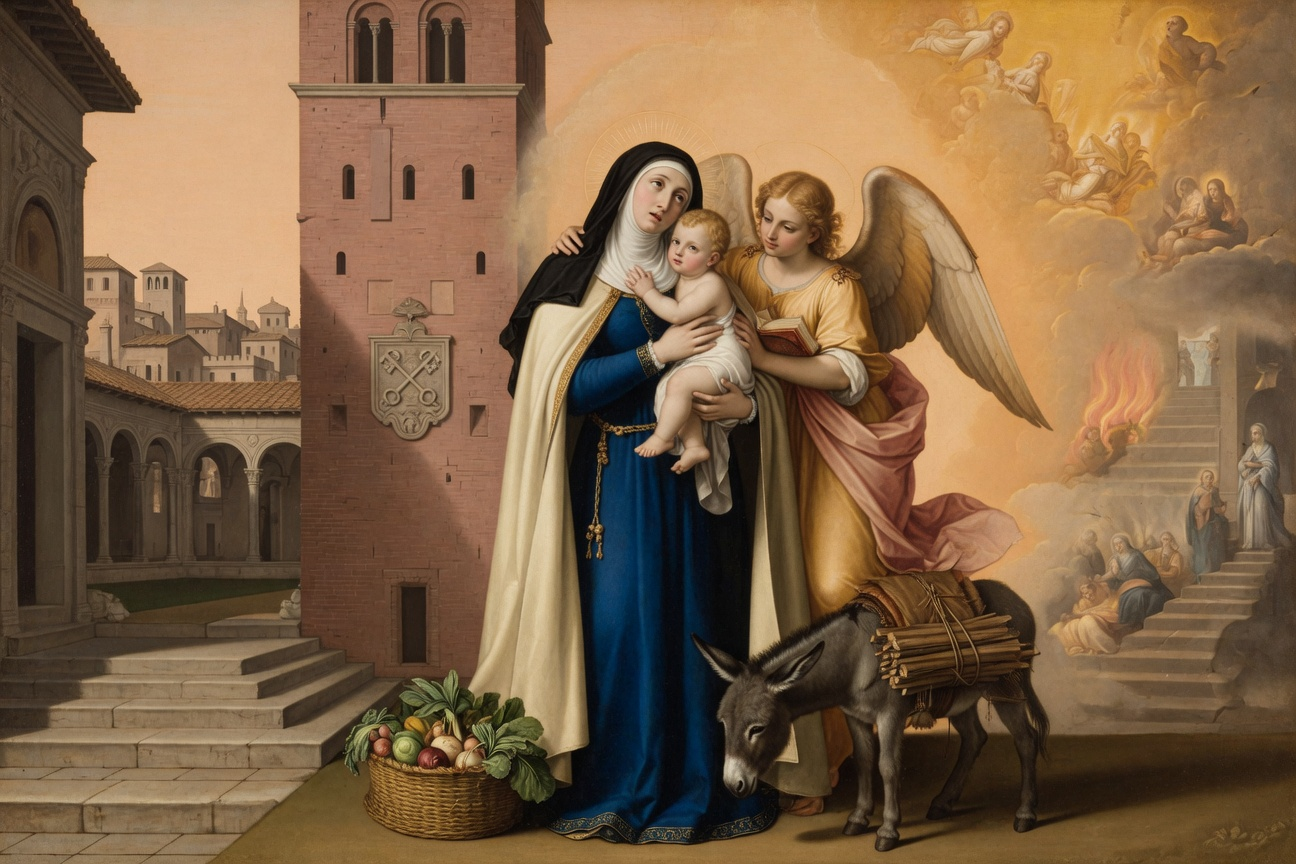
Saint Frances of Rome
FOUNDRESS OF THE OBLATES
Widow and Foundress of the Oblates
A Roman noblewoman married against her will, Frances lived forty years of exemplary marriage before founding the congregation of the Oblates under the Rule of Saint Benedict. A mystic favored with celestial visions and visibly accompanied by an angel, she dedicated herself to the poor and to penance. She is famous for her revelations on Hell, Purgatory, and Heaven.
Guided reading
10 reading sections
SAINT FRANCES, OF ROME, WIDOW,
FOUNDRESS OF THE OBLATES
Youth and forced marriage
Born into the Roman nobility in 1384, Frances early on manifested a desire for religious life but was compelled to marry Lorenzo Ponziani in 1396.
For being born into opulence, Saint Frances would say, a woman of the world is no less obliged to follow the maxims of the Gospel.
We shall see, in the life of this illustrious widow, the portrait of that strong woman of whom the Wise Man speaks, and whom he praises so highly. She was born in the year of grace 1384. Her father was named Paul Bussa, and her mother Jacqueline Roffredeschi, both from the first families of Rome Birthplace of Maximian. Rome. From the cradle, she showed such an aversion to everything contrary to purity that she could not bear for any man, not even her father, to use the caresses and liberties that nature authorizes toward a child. At the age of twelve, she would have much desired to shut herself away in a cloister to serve there for the rest of her days the only Spouse of virgins; she even made every effort to do so: but her parents, without consulting her inclinations, forced her to marry, in 1396, despite all her repugnance, Lorenzo Ponzi ani, a young Rom Laurent Ponziani Husband of Saint Frances of Rome. an lord whose fortune equaled his birth: there were few marriages as happy, because there are few as holy; the esteem, respect, and love were mutual, the peace and union unalterable; these spouses lived together for forty years without the slightest misunderstanding, without a shadow of coldness.
Domestic life and obedience
Frances transforms her home into a school of virtue, reconciling her duties as a wife with intense piety, illustrated by the miracle of the verse written in letters of gold.
However, no sooner had Frances changed her condition than she fell dangerously ill; which made known the displeasure she had felt in entering into marriage. Nevertheless, her illness did not last long; for Saint Alexis, appea ring to her saint Alexis Saint cited as a model of renunciation for Robert. at night, restored her to perfect health in an instant. Her house was a true school of virtue: she looked upon her domestics, not as her servants and handmaids, but as her brothers and sisters in Jesus Christ, without, however, this gentleness causing her to relax in any way her zeal and justice when it concerned the offense of God; for she could not suffer anything to be done against the interests of His glory. Her first care was to study the nature of her husband, and to scrupulously avoid everything that might have displeased him. She considered him as her master, and as the one who held for her the place of God on earth; she was so submissive, so obedient to him, that, even when she was occupied with prayer or some practice of piety, she would leave everything to satisfy him and attend to the obligations of her state: which should be the principal object of the devotion of a woman engaged in marriage. Thus, God made it appear, by a marvel, how pleasing this obedience was to Him. Our Saint, reciting one day the Office of Our Lady, was so pressed to interrupt it to satisfy some duty of her house, that she left the same verse four times; but the task done, returning to her devotion, she found the verse written in letters of gold, although beforehand it had been written only in common characters. Some time later, the Apostle Saint Paul, appearing to her in an ecstasy, told her that her good angel had himself traced these new characters, to make her know the merit of obedience.
Motherhood and Bereavements
Mother of several children, she faced the loss of her son John and her daughter Agnes, while receiving the visible protection of an archangel.
The sacrament of marriage having been established by God to populate heaven through the birth of children on earth, this faithful wife prayed to Our Lord to grant her some. She had, among others, a son who, by a happy omen, had for his patron John the Evangelist, unlike his elder brother called John the Baptist. He lived only nine years; but in that short time he made it known that he was born more for heaven than for earth: for he was endowed with the gift of prophecy, and predicted to his father that he would receive a dangerous blow in a part of the body he indicated to him, and, to a mendicant friar, that he would soon change his habit: these predictions were verified; Lorenzo Ponziani was wounded in a war that broke out in the year 1406 between the Romans and the Neapolitans, and the religious was made a bishop. This holy child was struck by the plague when it afflicted the city of Rome at the beginning of the 15th century. Foreseeing his death, he warned his good mother and begged her to give him a confessor, because he saw Saint Anthony and Saint Onuphrius, to whom he had a particular devotion, advancing toward him to lead him to heaven: which happened the same day; and he was buried in the church of Saint Cecilia, beyond the Tiber. A year later, the Saint, praying in her oratory, perceived her little John all shining with light and assisted by another even more radiant than he; he revealed to her the state of his glory in heaven: he was in the second choir of the first hierarchy, and the angel he accompanied appeared more beautiful because he was in a higher degree of glory than he. He added that he had come to fetch his sister Agnes, only five years old, to be placed with him among the angels. Finally, as he was leaving, he left her, as a guardian, that archangel who, from then on, always remained with her; and she confessed to her confessor that when she cast her eyes upon this celestial spirit, the same thing happened to her as to a person who stares fixedly at the sun and cannot bear the brilliance of its light.
Wars and life of penance
During the political troubles in Rome caused by Ladislaus of Naples, she practiced rigorous asceticism and devoted herself to the poor with her sister-in-law Vannosa.
Heaven showered upon her those sweetnesses of another world, which are the foretaste of divine joys; but it reserved for her a cross, and a terrible cross. Rome having been taken by the King of Naples, Ladislaus, Frances saw her house pillaged, her property confiscated, her husband banished: she bore these reverses with admirable constancy. The storm agitated her from without; but calm was in her soul and serenity on her face. The storm passed; her husband was recalled from exile, her property was restored to her; peace returned to her family. The virtuous lady took advantage of these misfortunes to persuade her husband to live together in perfect continence. This husband, sanctified by the heavenly virtues of his tenderly loved wife, granted her everything she wished. From then on, she ate only once a day, nourished herself only on bread and water, and, at most, on a few insipid vegetables which she took only once a day. She forbade herself forever and until death the use of fine linen, and wore nothing under her serge clothes but a harsh hairshirt and a belt made of horsehair; she also wore another iron circle that pierced her skin. Not content with this instrument of penance, which she never took off day or night, she added to it, on various occasions, a discipline made of iron links with sharp points: obedience alone, which she preferred to all her own feelings, sometimes made her diminish these rigors, when her confessor felt obliged to bring moderation to them. She joined to this austerity the practice of works of mercy, by assisting the poor whom she regarded as the images of her crucified Savior. To do this with more advantage and freedom, she joined her sister-in-law Vannosa, a very virtuous soul: they went together, from door to door through the streets of Rome, begging alms f Vannosa Sister-in-law and companion in charity to the saint. or the needy. God so greatly accepted this conduct that He often performed miracles in their favor, multiplying the bread and wine they gave for His love.
She usually confessed every Wednesday and Saturday, and received communion at least once a week; she frequented the church of Saint Peter at the Vatican; that of Saint Paul outside the walls; that of Our Lady of Ara Coeli; that of Santa Maria Nova and that of Santa Maria in Trastevere, always in the company of her sister-in-law. It is said that one day they went to the church of Saint Cecilia to perform their devotions: a priest, who did not approve of married women receiving communion so often, gave them both unconsecrated hosts; but Frances noticed it immediately, not feeling the presence of her Spouse, as she was accustomed to do when she received Holy Communion; she complained about it to Father Antonio de Monte-Sabellio, her confessor, who came to find the priest: the latter confessed the truth of the matter to him, and did penance for his fault.
Struggles against the demon
The saint endured violent physical and psychological attacks from the demon, which she overcame through prayer and exorcism.
The demon, who saw the virtue of our Saint only with regret, resolved to fight her. Employing all his efforts to ruin her, he presented himself to her in a thousand dreadful postures, with ridiculous and immodest gestures. He often attacked her during her prayers, rolling her face against the ground, dragging her by the hair, beating her, and whipping her cruelly. One night, as she was taking a little rest after a harsh combat, he transported the body of a dead man into her room and held her upon this corpse for a long space of time: this made such an impression on her that, since this accident, it seemed to her that this object was always near her, without her being able to rid herself of the odor it exhaled: what more can I say? The mere sight of men was a torment to her, feeling upon their approach a universal trembling in all her limbs. It would be impossible to report here all the persecutions that the demon inflicted upon her, and the victories she won over him. She triumphed over his malice, not only when he employed it against her, but also when he employed it against others: sometimes she converted women abandoned to vice, sometimes she drove them from Rome, or from other asylums where they had retreated, to prevent them from perverting innocence.
She obtained, through her prayers, that her confessor be delivered from an evil spirit that pushed him to anger. She foresaw the temptations of many souls and preserved them from falling into them through her good advice. Once, the demon threw Vannosa from the top of a slope to the bottom, and broke almost her entire body; but Frances, through her prayers, immediately restored her to perfect health. Thus, the demon remained defeated on all sides.
Since she had associated herself with the pious Vannosa, her sister-in-law, she did nothing except in concert with her. One day God wished to show, through a marvel, how pleasing their holy union was to Him: as they had withdrawn aside to one side of the garden, in the shade of a tree, to deliberate together on the means of leaving the world, extremely beautiful and tasty pears fell at their feet, even though it was spring. These two holy women brought these fruits to their husbands, in order to strengthen them, through this prodigy, in the will to serve God, and to give them complete freedom to do so.
Foundation of the congregation
In 1425, she founded the congregation of the Oblates under the rule of Saint Benedict, approved by Pope Eugene IV.
In the year 1425, our Saint undertook to establish a congregation of maidens and widows, who would devote themselves perfectly to piety and devotion, under the rule of Saint Benedict. She was strengthened in this pious design by several heavenly visions in which appeared to her the apostles Saint Peter and Saint Paul, Saint Benedict, and Saint Mary Magdalene, who prescribed rules for her religious. It seemed to her one day that Saint Peter, after having veiled and blessed her solemnly, offered her to Our Lady, to be received under her protection and special safeguard; it was then that, having returned to herself, she wrote down the rules which have been observed, since then, in her monastery, just as they had been dictated to her in these admirable visions; and, having communicated them to her spiritual father, she had them approved by Pope Eugene I pape Eugène IV Pope who sent Nicholas Albergati to the Council of Basel. V.
The blessed Frances was then about forty-three years old; she had already spent twenty-eight in marriage. In the twelve she spent there afterward, God made her holiness shine forth through several wonders and miraculous healings; but her humility caused her to disguise them by the application of remedies to the wounded part, although these remedies were quite contrary to the ailment. We say nothing of the particular assistance that the angels rendered her. We have already seen that, besides her guardian angel, God gave her a second, who accompanied her visibly: if it happened that the demon borrowed the figure of an angel of light to deceive her, this faithful guardian never failed to reveal to her the artifice of her enemy, and her soul was immediately filled with an odor so pleasant that she was admirably consoled by it. If, when she was in company, an action or a word less necessary escaped her, or if she allowed herself to be carried away by superfluous thoughts concerning her household, or other subjects, this celestial spirit, a continuous witness of her whole life, would hide from her eyes, and, by his absence, force her to return to herself and to recognize her faults. Hence it is that this Saint is depicted having at her side an angel who serves as her guide and governor.
Death, which spares no one, having taken her husband from her in the year 1436, she settled all her affairs in a short time, and, abandoning her goods to the children she still had in the world, she went to the monastery she had founded; there, prostrating herself on the ground, with a rope around her neck and eyes bathed in tears, she very humbly begged the daughters, of whom she was the mother in Jesus Christ, to receive her into the monastery in the capacity of a little servant; which they did with all the joy imaginable. Soon after, they elected her as their superior, notwithstanding all her reluctance.
These reli gious a oblates Religious congregation founded by the saint. re called oblates, because in consecrating themselves to God they use the word oblation and not that of profession: instead of saying like the others, I make profession, they say I offer myself; they do not make vows; they simply promise to obey the mother president. They have pensions, inherit from their parents, and can go out with the permission of their superior. There are in the convent they have in Rome several ladies of the first rank.
Thus, Saint Frances was absolutely the mother of the pious congregation that she herself had established. She brought it thereafter to such perfection that one can say she left there the most perfect idea of religious life. They were at first not very comfortably housed: that is why they acquired another house, cleaner and better situated, at the foot of the Capitol, where they went solemnly after having all received communion; this house was called the Tower of the Mirror, becau se of a tower tha la Tour du Miroir Motherhouse of the Oblate congregation at the foot of the Capitoline Hill. t is in the same place, and which has been adorned, on the surface, with some reliefs resembling mirrors.
Miracles and community life
After the death of her husband in 1436, she joined her monastery where she multiplied healings and acts of profound humility.
God continued, and even increased the favors He bestowed upon our Saint, and performed many miracles through her, which can be seen in the bull of her canonization. She delivered a five-year-old child from the falling sickness by placing her hand on his head. By the same means, she cured another of a rupture; she restored health to several other sick people by the mere laying on of her hands. A woman named Angela, who was crippled in one arm by the violence of gout, having met the Saint on the road, implored her help, and received from her, at that very hour, perfect health. One day, she gave a very abundant dinner to fifteen nuns with a few pieces of bread that would barely have sufficed for three, and yet a whole basketful remained. Another time, some nuns having followed her to cut wood outside the city, as they were suffering from thirst, God caused as many bunches of grapes to grow in a vineyard as there were girls with her, although it was the month of January. We pass over the rest of her miracles in silence, to say a word about her virtues, particularly her humility, by which she raised herself to true greatness.
Never did she suffer, neither in the cloister nor in her husband's house, to be served, although she was the mistress and the superior; but, practicing the word of Our Lord to the letter, she preferred to serve others and be treated as a servant: she even took singular pleasure in being considered the least of all, and, had she been believed, one would have given her no titles more honorable than that of "sinner, vessel of impurity, and a very vile and miserable woman." This humility appeared even more in her actions than in her words: for she was seen returning from her vineyard, which was outside the suburbs, with a bundle of vine shoots on her head, and leading before her a loaded donkey, which she used for the service of the poor; she showed by this that nothing is difficult for charity; and that, when this virtue makes us act, we trample underfoot human respect, even that which appears the most reasonable. In suffering, her patience was invincible: when her husband was sent into exile, his property confiscated, and his whole house ruined (during the troubles that followed the invasion of Rome by Ladislas, King of Naples, and during the Great Schism that tore the Church apart, under the pontificate of John XXIII, in the year 1413), she never said anything other than these beautiful words of Job grand schisme qui déchira l'Église Period of crisis in the Church mentioned as context for the saint's trials. : "The Lord gave, and the Lord hath taken away; blessed be the name of the Lord!" She had a great devotion to the Blessed Sacrament of the altar; in its presence, she rose to God with such fervor that she sometimes remained for a long time motionless and completely enraptured in spirit. As for the Passion of Our Lord, she meditated upon it with such great tenderness that she shed abundant tears, and even actually experienced acute pains in the parts of her body where Jesus Christ had suffered in His own, as the bull of her canonization expressly states. Finally, God wished to end such a holy life with a happy death.
Death and ecclesial recognition
She died in 1440 and was canonized in 1608 by Paul V after numerous miracles were observed at her tomb.
John the Baptist, her eldest son, having fallen into a very dangerous illness, Frances felt obliged to lavish her care upon him, since she did not refuse it to strangers. Her confessor ordered her to spend the night there, because it was too far to return to her monastery beyond the Tiber; but she herself was seized that night with a burning fever, which increased so much that, not being in a state to be able to leave that place, she was obliged to prepare herself for death by the reception of the sacraments. God having made known to her that the seventh day of her illness would be the last of her life, she gave notice of it four days before, saying: "God be blessed! Thursday at the latest I shall pass from this life to a better one." The event verified this prediction; indeed, the following Wednesday, March 9, 1440, she rendered her spirit to Him who had created her, with admirable tranquility, and without any sign of pain. She was fifty-six years old: she had spent twelve in her father's house, forty in her marriage, and four in religion.
Her body was carried to the church of Santa Maria Nova, where it remained for three days exposed to the sight of all the people, who ran there in crowds to admire the wonders of God. There exhaled from this precious treasure an odor so pleasant that one would have said the whole church was filled with jasmine, carnations, and roses. Several miracles were performed at her tomb by the touching of things that had belonged to her; especially in favor of persons afflicted with the plague. A perfumer, named Jerome, being at the point of death, was brought back from it for having touched the habit of our Saint; and a woman, named Madeleine de Clarelle, was preserved from it by the sole invocation of her name. A crowd of sick people were cured by the merit of her prayers. A Turk, named Beli, was so hardened that one had never been able to gain anything over his mind; all that one could draw from him was that he would say these words: "Frances, servant of God, remember me." He was converted.
All these wonders have often caused the sovereign Pontiffs to be urged to proceed to the canonization of this illustrious Roman. Eugene IV, Nicholas V, and Clement VIII worked on it; Paul V completed this hol y affa Paul V Pope who approved the bull of erection of the Oratory. ir on May 29, 1608. Innocent X ordered its feast to be celebrated with a double office: which is done on the 9th of this month. The body of Saint Frances remained in the ground for more than two hundred years. It was exhumed in 1638 and enclosed in a beautiful gilded copper reliquary.
The feast of Saint Frances is observed in Rome, as was that of Saint Roch in Paris before the revolution, that is to say that without being a day of obligation, it is the occasion of a great solemnity.
The Saint is sometimes represented pushing a donkey before her. — At other times, a little angel is placed near her, usually dressed in the manner of a deacon and radiating light. — It is known that her guardian angel appeared to her almost every day, and according to the greater or lesser brightness he shed, the Saint had learned to understand if God was pleased with her, or if she had something to reproach herself for. The clarity that the angel spread around him was sometimes such that the Saint could read at night without any other light. — She is also represented receiving the Child Jesus from the hands of Our Lady, who handed Him to her one day when she had just visited the church of Saint Stephen, so that she might carry Him to the neighboring church. — She is also seen carrying a basket of vegetables on her arm to show that she fulfilled with joy the lowly offices of the community.
Visions of Heaven and Hell
The text details the 93 visions of the saint, including precise descriptions of the celestial hierarchy, purgatory, and infernal torments.
Saint Frances left ninety-three visions that she dictated herself to her confessor. The treatise on hell, in particular, is highly remarkable.
In the thirteenth vision, she sees the Blessed Virgin whose head is adorned with three crowns: that of her virginity, that of her humility, and that of her glory.
In the fourteenth vision, she recounts heaven: it is divided into the starry heaven, the crystalline heaven, and the empyrean heaven. The heaven of the stars is very luminous; the crystalline is even more so, but these lights are nothing in comparison to those that illuminate the empyrean heaven: it is the wounds of Jesus that illuminate this third heaven.
In the seventeenth vision, God shows her His divinity: she saw it as a great circle that had no support other than itself, and cast a light so vivid that the Saint could not look it in the face: she read in the middle the following words: "Principle without principle and end without end." — She then saw how the creation of the angels took place: they were all created at once, and the power of God let them fall like snowflakes that the clouds pour onto the mountains during the winter season. Those who lost the glory of heaven forever form a third of the immense multitude of these spirits.
On February 13, 1432, — this is the twenty-first vision, — the choir of virgins, led by Saint Mary Magdalene and Saint Agnes, made her hear the following canticle:
"If anyone desires to enter into the heart of Jesus, he must strip himself of all things, both interior and exterior; — despise himself and judge himself worthy of eternal contempt; — act in all simplicity, affect nothing that is not in conformity with his feelings, never seek to appear better than one is in the eyes of God; — never go back on his sacrifices; — renounce himself and know his misery to the point of no longer daring to lift his eyes to look at his God; — hate himself to the point of asking vengeance from the Lord; — return to the Most High the gifts one has received from Him: memory, understanding, will; — regard praises as a torture and a punishment; — if it happens that one is shown aversion, regard this pain as a bath of rose water into which one must plunge with true humility; — insults must resound in the ears of the soul that tends toward perfection like pleasant sounds; — one must receive insults and mistreatment like caresses: this is not enough, one must give thanks to God for them, one must thank those from whom one receives them; — the perfect man must make himself so small that one should no more perceive him than a grain of millet thrown to the bottom of a deep river."
It was then told to her that only one soul had been found in the world adorned with all virtues in a supreme degree: that of Mary.
In the forty-third vision, she held Jesus on her knees: He had the form of a little lamb. She then saw an altar magnificently adorned on which was a lamb bearing the stigmata of the five wounds. At the foot of the altar were a large number of rich candlesticks arranged in beautiful order. In the first row — it was the most distant — there were seven which signified the principal virtues; in the second row, there were twelve which signified the twelve articles of the creed; in the third, there were seven which signified the seven gifts of the Holy Spirit; in the fourth, there were seven others which represented the seven sacraments of the Church.
This vision, which took place on All Saints' Day, lasted thirteen hours. She also saw the principal orders of saints who advanced under their banners. The patriarchs were led by Saint John the Baptist; — the apostles by Saint Peter and Saint Paul; — the evangelists by Saint John and Saint Mark; — the martyrs by Saint Lawrence and Saint Stephen; — the doctors by Saint Gregory and Saint Jerome; the religious by Saint Benedict, Saint Bernard, Saint Dominic, and Saint Francis; — the hermits by Saint Paul and Saint Anthony; — the virgins by Saint Mary Magdalene and Saint Agnes; — the widows by Saint Anne and Saint Sabina; — and the married women by Saint Cecilia.
The treatise on hell, we have said, is the most remarkable of the writings that Saint Frances dictated. Here is an idea of it:
One day when the servant of God was very ill, she shut herself in her cell to devote herself to the exercise of contemplation. It was about four o'clock in the afternoon. Immediately she was rapt in ecstasy, and the archangel Raphael, whom she did not see then, came to take her to lead her to the vision of hell. Arrived at the door of this frightful kingdom, she read these words written in letters of fire: "This place is the place of hell; hell without hope, hell without interval in torments, hell without rest." The door opened and Frances looked: she saw an abyss so deep, so appalling, from which escaped cries so dreadful and odors so unbearable, that since then she could not speak of it without her blood freezing in her veins. Hell appeared to her divided into three regions, one superior, another inferior, the other intermediate. The torments were more severe in the lower region than in the other two. In the upper region are placed the Jews who, apart from their obstinacy, lived exempt from great crimes; those of the Christians who neglected confession during life and were deprived of it at death.
In the deepest part of hell are the Sodomites and all those who gave themselves up to sins against nature; the demons pierce them with flaming mouths. Then come the workers, who are stretched out on tables of brass reddened by fire; the demons pour buckets of liquefied metal into their mouths; — to the blasphemers, the ministers of celestial vengeance pull the tongue with hooks; — to the traitors and hypocrites, they incessantly tear out the heart, which they incessantly put back in place; — the homicides and women who cause their fruit to perish in their womb are led endlessly from a vat where there is boiling blood to another vat where there is ice; — the apostates are sawed in two; — the incestuous are plunged into vats full of stinking filth; the enchanters, the sorcerers, and those who believe in their ridiculous art receive flaming pucks that the demons throw at their faces. Then come the punishments of the seven capital sins; finally the torture of thieves, unnatural children, religious who violate their vows, slanderers, foolish virgins, vicious widows, women idolatrous of their beauty. We regret not being able to give all these details, but those whom the subject would interest can read the Bollandists.
At the fall of the bad angels, a third remained in the air, another third remained on the earth, and the last third fell into hell. This difference comes from the difference of the common fault.
Lucifer is the monarch of hell, but a monarch in chains and more miserable than all the others; he has under him three princes to whom all the infernal spirits divided into three bodies are subjected by the will of God. The first of these three princes is Asmodeus; he was a cherub in heaven. He presides over dishonest sins. The second is Mammon; he was a throne. He is the demon of money. The third is Benizhuth; he belonged to the choir of dominations; he is established now over the crimes that idolaters commit. These three chiefs, as well as Lucifer, never leave their prison, only, when God permits it, they start on earth legions of subordinate demons. The subordinate demons of hell are classified in the abyss according to hierarchical order: cherubim, seraphim, etc. One finds these same hierarchies among the demons who inhabit the earth and the air, but they have no chief and live in a kind of equality. It is they who do harm to men, and by this means diminish their confidence in Providence, and make them murmur against the will of God. The demons who live on earth concert and help each other to lose souls. The only way to escape this infernal plot would be to rise promptly from the first fall, and this is precisely what one does not do. Nothing paralyzes the efforts of the demons better and causes them greater torments than to pronounce the holy name of Jesus. When souls live in the habit of mortal sin, the demons install themselves in their heart; but when they receive absolution, they move out as quickly as possible and place themselves beside them to tempt them again; but their attacks are less lively, and the more one confesses, the more they lose their strength.
Limbo is contiguous to hell, but does not communicate with it: an angel guards the door, one suffers no other pain there than the privation of light. It is there that the dwelling of children who died without baptism is found. In the first of the three regions of which limbo is also composed, are found children born or conceived of Christian parents; the intermediate part is inhabited by the children of Jews and pagans; in the lower part are enclosed children born or conceived by a crime contrary to the solemn vow of chastity or spiritual affinity. There reigns a night deeper than in the other two parts.
Purgatory is distributed like hell; the servant of God saw written at the door these words: "This is purgatory, place of hope." In the lower part burn the souls who have not satisfied for mortal sins: seven years of suffering correspond there to the temporal punishment deserved for a single mortal sin. It is the guardian angel of each soul who collects the suffrages offered for it on earth. When a soul — let this be well noted — has made pious bequests before its passing, God accepts them immediately, and rewards them even if they do not receive their execution by the fault of those who were charged with them. But for souls who postpone their good works after their death, out of attachment to riches, God does not reward these works until the expiration of the time fixed for their accomplishment. The masses, indulgences, and good works offered for certain souls by their parents and friends are not integrally applied to them; they indeed receive the best part of them, but the rest is distributed among all the souls in purgatory. The offerings made in favor of souls who enjoy celestial beatitude profit first those who make them on earth, and then the souls remaining in purgatory. The help granted by the living to unfortunately reprobate souls profits their authors integrally, God not permitting that they be applied to the souls in purgatory.
The hottest part of the lower purgatory is reserved for religious and priests, even if they had committed lesser sins than seculars. Frances saw in this dungeon a very pious priest, but who had sacrificed too much to his weakness for the table and good wine. The intermediate purgatory is destined for the expiation of venereal sins, and the superior purgatory for the purification of imperfections.
Sources of the saint's life
The biography is based on the accounts of her confessor Jean Mattiotti and on the bull of canonization.
The life of Saint Frances was written by the Roman Jea n Mattiotti, w Jean Mattiotti Confessor and biographer of the saint. ho had been her confessor for twelve years. There is another, under the name of Maria Maddalena de' Anguillara, superior of the Oblates, which Hollandia reported along with the previous one, together with the admirable visions that she herself wrote by the order of her confessor. André Valladier, Abbot of Saint-Arnoult in Metz, who was in Rome at her canonization, recounted her eulogy in Latin and French, under the title Mirror of Matronly Wisdom: it is from them that we have gathered this summary, as well as from the Bull of her canonization, which we have mainly used, as it is a purer source of the truth.
Annexes & related entities
Structured data for exploration: events, miracles, quotes, places, attributes, patronages, and important entities cited in the text.
Key Events
- Born in Rome in 1384
- Forced marriage to Lorenzo Ponziani in 1396
- Foundation of the Oblate congregation in 1425
- Death of her husband in 1436 and entry into the monastery
- Canonization by Paul V on May 29, 1608
Miracles
- Instant healing by Saint Alexis
- Office verse written in letters of gold by an angel
- Multiplication of bread and wine for the poor
- Appearance of grapes in the middle of January
- Healing of the plague and various infirmities
Quotes
-
The Lord gave, and the Lord hath taken away; blessed be the name of the Lord!
Words of the saint quoting Job during her husband's exile -
Blessed be God! By Thursday at the latest I shall pass from this life to a better one.
Prediction of her own death