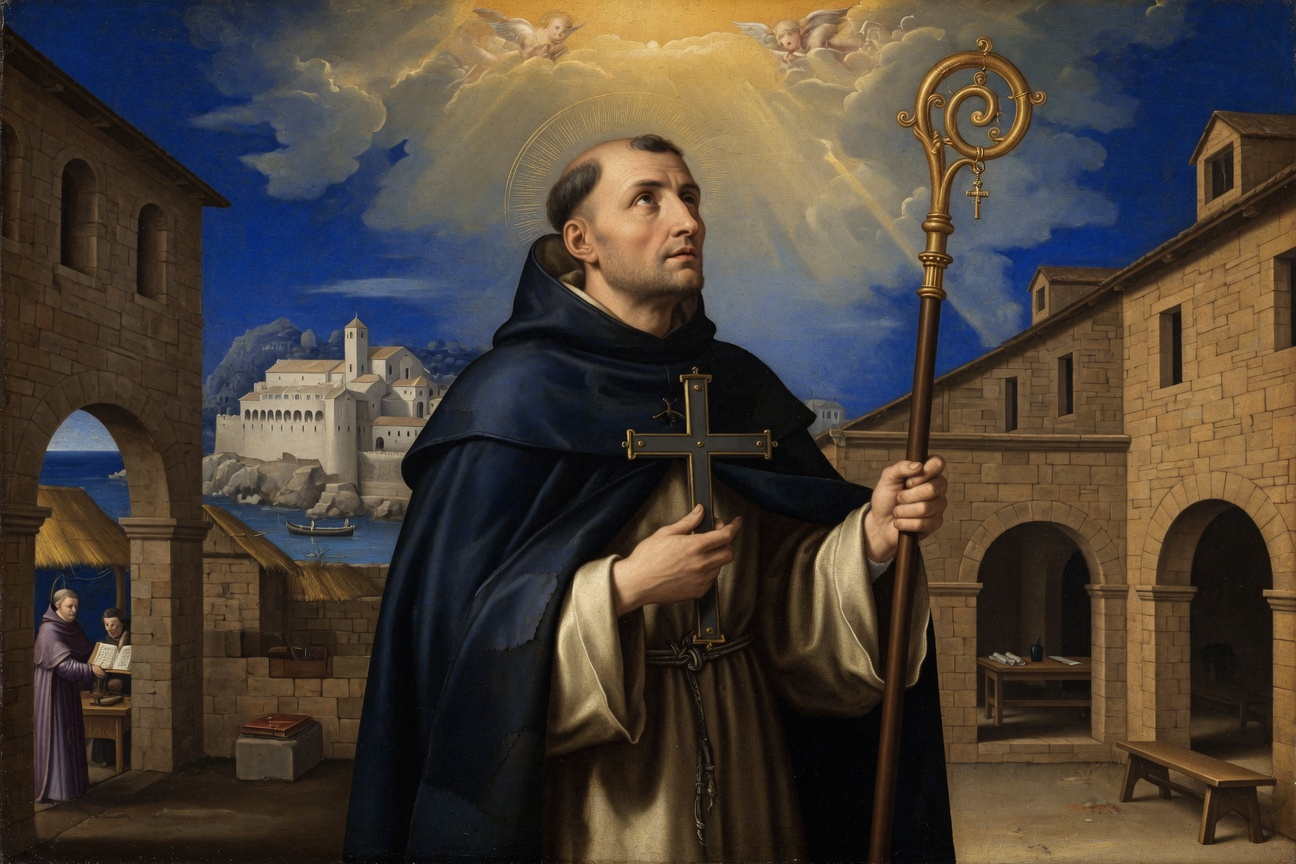
Born in Burgundy, Saint Attala was a disciple of Saint Columbanus at Luxeuil and later at Bobbio, where he became the second abbot in 615. He firmly maintained monastic discipline in the face of revolts, combated Arianism in Italy, and performed several miracles, including the healing of a severed limb. He died in holiness in 627 after having a vision of heaven opened.
Guided reading
8 reading sections
SAINT ATTALA, ABBOT OF BOBBIO
Youth and formation
Born in Burgundy to a noble family, Attala was entrusted to the bishop of Gap for his education before choosing the monastic life at Lérins.
Saint Attala Saint Attale Second abbot of Bobbio and disciple of Saint Columbanus. , second abbot of Bobbio, in Lombardy, was born i n Burgund Bourgogne Region where the saint died. y to parents very illustrious for their piety and nobility. His father, noticing that Attala had a great aptitude for letters, placed him under the guidance of Arigius, bi shop of Arigius Bishop responsible for the education of Attalus. Gap, so that he might learn virtue and the sciences at the same time. But Attala, seeing that he profited little in the episcopal palace, and aspiring to a higher perfection, secretly resolved to embrace the monastic life and withdrew to the monastery of Lérins.
Companion of Saint Columbanus
Disappointed by the laxity at Lérins, he joined Saint Columbanus at Luxeuil, then followed him into exile in Lombardy where they founded the monastery of Bobbio.
He lived there for some time with marvelous purity; but, seeing that the religious of that house were relaxing the rigors of their rule, he believed he should seek another place of refuge to which to retire. He therefore left Lérins and went to find Saint Columbanus, who had recently founded the monastery of Luxeuil, to be received among his religious. This holy personage, noticing in Attalus an inclination entirely directed toward virtue, was delighted to have him, and became very diligent in his spiritual advancement. He also took him with him to Lombardy when he was exiled from France by Theuderic. Our Saint made such great progress under the discipline of such a good master that, after the death of Saint Columbanus, he was judged worthy to govern the f amous monastery of monastère de Bobbio Abbey founded by Columbanus in the Apennines, a center of scholarship and orthodoxy. Bobbio, which the same Saint had founded during his exile with the help of Agilulf, King of the Lombards.
Internal conflicts at Bobbio
Having become abbot, Attala faced a rebellion of monks who refused the severity of the rule; divine justice struck the rebels while the repentant were forgiven.
But Attala did not encounter little difficulty when he wished to maintain the religious in the strict observance of their rule; some of them murmured loudly against him, complaining of the severity of his conduct and the heaviness of the yoke he imposed upon them. In vain, he did his utmost to bring them back to their duty, and employed gentleness with all the marks of a truly paternal love; in vain he showed them that the holy Fathers had all walked the path of mortification and contempt for the things of this present life, he could never gain anything from them. Several shook off the yoke of obedience entirely, and, under the pretext of leading a solitary life, they left the monastery to be at liberty, charging this holy abbot with an infinity of calumnies and impostures; but divine justice did not long leave these rebels unpunished.
Indeed, soon after, the principal author of this disorder and the one who spoke of this excellent superior with the most impudence, was seized by a fever so violent that he soon recognized that it was a blow from the hand of God punishing him for his sin; that is why he asked, with great cries, that he be permitted to speak to the holy Abbot and ask his pardon: but the means was taken from him by a sudden death. Some of his companions, touched by repentance at the sight of such a terrible punishment, went to throw themselves at the feet of the one they had offended, and begged him to forgive their temerity. Attala granted them their grace with great generosity, receiving them as sheep saved from the jaws of the wolf; he restored each of them to their order. As for the others who, out of shame or obstinacy, would not return to the monastery, where they were to obtain the remission of their crime, they ended their lives miserably and with visible marks of divine justice: one was killed by a sword blow, and two others drowned.
Miracles and testimonies
The saint performed several miracles, including the calming of a river and the healing of a severed limb, facts attested to by the historian Jonas.
Following these exemplary punishments, God authorized the guidance of his servant through several miraculous actions, which made him increasingly esteemed. The monastery mill was in great danger of being swept away by an overflowing of the Bobbio river, which gave its name to this abbey; he sent the deacon Sinoalde there, and, placing his crosier in his hand, charged him to make the sign of the cross and to command the waters to take another course. Sinoalde went there and found more obedience in this element than the holy man had found in the minds of his wicked monks. He stopped the waves and immediately returned to recount this prodigy to the holy Abbot, who forbade him from speaking of it during his lifetime. A monk, who was tilling the land half a league from the monastery, having cut off the thumb of his left hand, had recourse to the holy Abbot to be healed. The Saint sent him back to fetch his thumb which he had left on the spot; and, rubbing it with saliva, he rejoined it so perfectly that one would have said it had never been cut. He also restored health to a child abandoned by the doctors. The histo rian Jonas, who r L'historien Jonas Monk and biographer of Saint Bertulf. ecounts these facts, was an eyewitness to them.
Virtues and character
A moral portrait of Attala, described as a model of gentleness, wisdom, and universal charity, combining humility and courage.
Although our Saint did everything in his power to hide his holiness, his humility, however, could not prevent him from being considered the marvel of his century. He had great gentleness toward his inferiors, extreme moderation and honesty toward his equals, admirable wisdom in rewarding merit, sovereign condescension in instructing the ignorant and in raising up and supporting the weak, a particular prudence and talent for settling disputes, inflexible courage in opposing the proud and in fighting the enemies of the truth, consummate intelligence for all kinds of affairs, and universal charity for all those who depended on him or who dealt with him. His patience never grew weary in adversities, and his heart never swelled nor was it ever lifted up in prosperity; in a word, he was an excellent model, in whom all Christian and moral virtues appeared with brilliance.
Struggle against heresy and paganism
Attala vigorously opposed the Arianism supported by King Arioald and sent monks to evangelize the pagan populations of Tortona.
Like Saint Columbanus, his predecessor, Attala vigorously fought the Arianism that still infected Italy, especially the Milanese region. Thu s, Arioa Ariowald King of the Lombards, of Arian confession. ld, King of the Lombards, who professed this heresy, greatly hated our Saint and his monks. One day, when one of them passed by without greeting him, for at that time they often followed the precept of Saint John to the letter: "Do not even greet the one who is excommunicated," the king ordered one of his men to wait for him on the path where he was to pass during the night and to kill him. This order was carried out. But God resurrected the dead man, and the murderer, seized by the demon, suffered horrible pains; Attala alone was able to deliver him. Another religious, whom the holy Abbot had charged with destroying the remnan Tortone Site of a mission against paganism. ts of paganism in Tortona, was seized by the inhabitants, who threw him into the water and piled enormous stones upon him. By an effect of divine power, the Martyr emerged from the water safe and sound, while most of the persecutors died a violent death.
Death and posterity
After a heavenly vision, Attala died in 627 and was buried in Bobbio alongside Saint Columbanus and Saint Bertulf.
Fifty days before his death, Attala was warned by revelation to prepare himself for a great journey; and not understanding whether God truly destined him for some foreign land, or if death was to end his pilgrimage in this world, he put everything in order in his monastery and made all the necessary preparations to undertake a long course, and would set out on the path if it were the will of God. But feeling himself seized by fever toward the end of the marked term, he understood that this journey concerned eternity. Finally, knowing by the redoubling of the attacks that his last hour was near, he had himself placed at the door of his cell, where there was a cross that he always touched when entering and leaving, before making upon himself that sign of salvation; he greeted it lovingly and with all the affections of his soul, then, shedding torrents of tears, he humbly prayed to the divine Goodness to forgive him all his past faults and not to exclude him from His paradise. Then, he dismissed those present and asked to be left alone for some time; nevertheless, Saint Blimond , that illust saint Blimond Abbot of Saint-Valery, present at the death of Attala. rious abbot of Saint-Valery, whose life we gave on the third day of January, remained secretly near him in order to assist him if needed. Saint Attala, believing himself alone, gave his heart full freedom to express its feelings. He implored with tears the divine mercy and conjured it to look upon him with an eye of pity. In the midst of his sighs, lifting his eyes to heaven, he saw it opened and contemplated it for the space of several hours; after which, having called his religious, he asked them to carry him back to his cell. The next day, he had them all assemble, gave them a pressing exhortation to perseverance, told them several things to console them; and finally, having given them his last blessing, he rendered his soul to Him who had created him, on March 10, 627. He was buried in the monastery of Bobbio, next to his illustrious master Columbanus. Later, the body of Saint Bertulf was deposited in the same tomb, and the three Saints have s saint Bertulfe Successor of Attala at Bobbio, buried with him. ince shared the same honors.
Hagiographic sources
The life of the saint was recorded by his disciple Jonas and transmitted by Bede the Venerable and Surius.
Jonas, who became his disciple after having been a disciple of Saint Columbanus, wrote his life, as it is found in the third volume of the Venerable Bede, from where Surius collected it. The two continuators of Britannien place it in the second volume of this month, after having collated it against four ancient manuscripts.
Annexes & related entities
Structured data for exploration: events, miracles, quotes, places, attributes, patronages, and important entities cited in the text.
Key Events
- Education under Bishop Arigius in Gap
- Entered the monastery of Lérins
- Joined Saint Columbanus at Luxeuil
- Exile to Lombardy with Saint Columbanus
- Election as second abbot of Bobbio
- Struggle against Arianism and paganism
- Died after a revelation fifty days prior
Miracles
- Changing the course of the Bobbio river by the sign of the cross
- Reattachment of a severed thumb using saliva
- Healing of a child given up by doctors
- Deliverance of a possessed person (the murderer of a monk)
- Divine protection of a monk thrown into the water at Tortona
Quotes
-
Do not even greet the one who is excommunicated
Reference to Saint John cited in the text