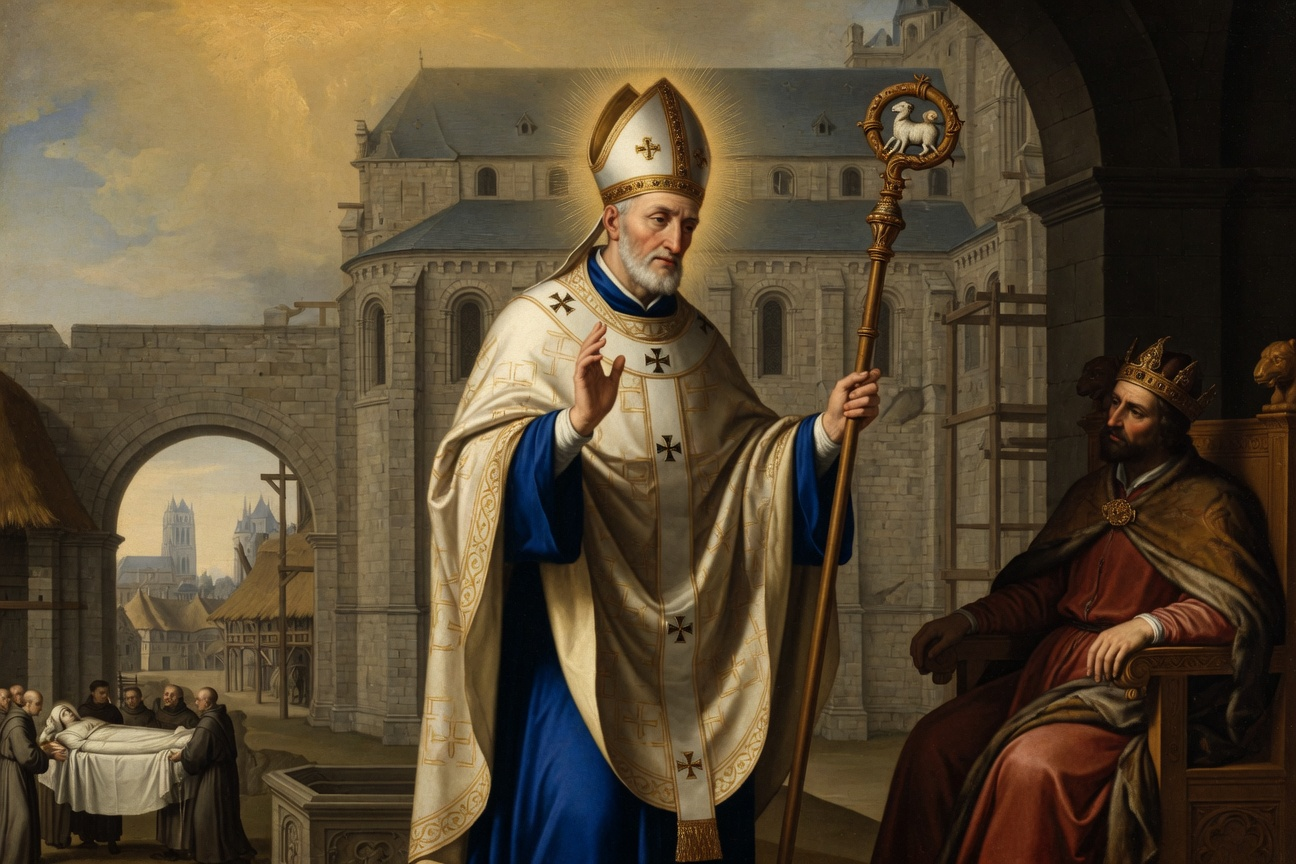
Bishop of Cambrai and Arras in the 7th century, Vindicien was a tireless pastor and a great builder of monasteries, notably that of Saint-Vaast. He is famous for his apostolic courage, having dared to publicly rebuke King Theuderic for the murder of Saint Léger. He died in Brussels at the age of about 80 after a life dedicated to charity and ecclesiastical discipline.
Guided reading
7 reading sections
SAINT VINDICIEN, BISHOP OF CAMBRAI AND ARRAS
Youth and spiritual formation
Born around 620 in Artois, Vindicien led a pious and solitary youth before being formed by the great bishops of his time, notably Saint Eloi and Saint Aubert.
Vindicien Vindicien Bishop of Cambrai and Arras in the 7th century. came into the world in a village called Bul Bullecourt Birthplace of the saint. lecourt, in the territory of Bapaume in Artois, around the year 620. The magnificent foundations he later established with the income from his patrimony sufficiently show that he was born of wealthy parents, among the most considerable in the country. His childhood was spent in perfect innocence. As the fear and love of God grew in him with age, his main occupation in his youth was to go often to Arras, by a secluded path that has since been called by his name, to spend hours and entire days praying in the churches and hearing the word of God. At the same time, he built a small oratory near the city; after fulfilling his external duties of devotion, he would retire there all alone to practice fasting, vigils, and the contemplation of divine things. In this way, he won great victories over himself, restraining his passions, subduing his flesh, and adding to this continual study of mortification the works of charity toward the poor: all things which made him, in a short time, a model of perfection and a man excellent in all kinds of virtues.
He was aided in these beginnings by the great Saint Eloi, Bishop of Noyon, who had built, on a mountain quite near the place w here our S saint Éloi Contemporary bishop and friend of Aubert. aint made his retreat—which is called today Mont-Saint-Éloi—a small dwelling where ten solitaries lived in great silence, separated from one another. As this holy bishop often visited this place of piety to breathe more freely the air of eternity after the great occupations of his office, Saint Vindicien, who would meet him there at the same time, profited admirably from his conversation and drew abundantly from this source the science of salvation and the holy skills of Christian perfection. He also had frequent communications with Aubert, Bishop of Arras and his pastor, and with other holy personages in his vicinity. And as he learned from one gentleness and patie Aubert Bishop of Arras and predecessor of Vindicien. nce, from another untiring zeal in helping his neighbor; from this one, modesty, temperance, and chastity; from that one, a general contempt for all earthly things, there was formed in his soul a blessed concert of all that was most rare and holy in these great men, who were regarded as the wonders of their century.
Ascension and early foundations
Noted for his prudence during the drafting of Saint Rictrude's testament, he became grand-vicar of Arras and actively participated in the foundation of the Abbey of Saint-Vaast.
His prudence and merit shone particularly in an assembly held at Arras for the conclusion of Saint Rictrude's testament, before she retired to her abbey of Marchienne. The great Saint Amand, Bishop of Maastrich t, having r saint Amand Missionary bishop and founder of monasteries. equested his presence, he worked on this matter with such judgment and good sense that it was clear that if he had retired into solitude, it was not for a lack of insight to handle the most important affairs, but out of a desire to serve God more perfectly. From then on, Saint Aubert set his sights on him to be his successor and named him his grand-vicar at Arras. This leads one to believe that our Saint contributed greatly, through his counsel and his vast wealth, to the foundation of the famous Abbey of Saint-Vaast, which Saint Aubert had already begun; he must also h abbaye de Saint-Vaast Place of imprisonment for Hildeman during his disgrace. ave assisted, with his bishop, in the translation of the body of Saint Vaast to the new church of that abbey, and in that of the body of Saint Fursy, when Saint Eloi transferred the relics of the latter Saint from his first burial place to that of the collegiate church of Péronne.
Episcopate and miracle of Saint Maxellende
Having become bishop in 675, he distinguished himself by the translation of Saint Maxellende, marked by the miraculous conversion of her murderer, Harduin.
Vindicien, having been elected bishop of Arras and Cambrai after the death of Saint Aubert in the year 675, fulfilled all the duties of a true pastor perfectly. He traveled through all the parishes of his diocese with tireless charity; and, although he did not lack vigor and severity toward those who persisted in vice, he had such admirable gentleness and kindness for others that he generally remedied all their bodily and spiritual ills, consoling the afflicted, strengthening those who lost courage, giving large alms to the poor, and above all winning an infinity of sinners to God.
But the events that signaled his episcopate will make him better known to us than simple praise.
The first, following the order of time, is the solemn translation he performed of the body of Saint Maxellende, martyred at Caudry a few days be fore the death of sainte Maxellende Virgin and martyr of Caudry. Saint Aubert by a lord she had refused to marry, and whose bloody remains had been deposited in the church of Pommereuil. It was there that a pious widow, who was accustomed to address her prayer to God near the tomb of the young martyr, heard these words: "Go find the Pontiff of Cambrai, Vindicien, and tell him to come here with priests and clerics to raise the body of the virgin Maxellende, carry it to the place where she was killed, and bury it there. The Almighty, to glorify His name, must work many wonders in this place, where, for love of Jesus Christ, she was put to death by the impious." Saint Vindicien listened to the widow's account with religious attention, asked her all the questions that prudence suggested to him; then, recognizing without a doubt that this was a manifestation of the will of heaven, he ordered all the preparations for this ceremony. On the appointed day, he proclaimed a fast to attract the blessings of heaven, and then traveled with a portion of his clergy and a great number of the faithful to the place where the body of the Saint rested.
One of the most striking circumstances that signaled this translation, the one above all that filled the heart of Saint Vindicien with consolation, was the conversion and miraculous healing of Harduin, the murderer of the Saint. Having been led, at his request, before the procession that the bishop was following, he had thrown himself on his knees beside the stretcher on which the body of the martyred virgin rested. Saint Vindicien, motionless in the midst of his clergy, followed this touching scene with his gaze, when, suddenly, he saw Harduin rise full of joy and run toward him, telling him of his healing and the mercies that the Lord had just shown him. At the sight of this great culprit prostrate at his feet, shedding tears in abundance, the holy bishop was at the height of happiness. He could not contain the feelings that filled his soul, and, addressing the crowd, moved by such a spectacle: "My brothers," he said, "you have all seen the work that the Lord has just performed in your presence. Let us give Him thanks and thank Him that He deigns to glorify the virgin Maxellende in this way. There is no doubt that what we are doing here is His will. Let us therefore finish this holy ceremony with respect and devotion." Having spoken thus, Saint Vindicien gave his blessing to the multitude, who continued their march praising God until the village of Caudry. After he had celebrated the holy mysteries and placed the relics of Saint Maxellende in a suitable place, the worthy bishop thought to perpetuate, through a pious foundation, the memory of the triumph she had won. For this, he established a community at Caudry, charged with watching over the sacred deposit and serving God in the practice of virtues.
Consecrations and monastic networks
Vindicien consecrated numerous monasteries and collaborated with the great hagiographic figures of the 7th century such as Saint Amand and Saint Lambert.
The year that Saint Vindicien paid this glowing tribute to a young martyred virgin, a house of prayer was rising at Honnecourt for a few people who asked to live there in perfect chastity and the love of God. It was founded by a lord of the land, called Amalfride, and his wife Childeberte, in favor of their daughter Auriana. Saint Vindicien consecrated the church of this monastery with the venerable Lambert, Bishop of Maastricht, who, soon after, shed his blood for the cause of Jesus Christ.
Between the already flourishing abbeys of Elnon and Marchiennes, two other monasteries were rising, which promised even more fruits of salvation to this privileged region. Jean, lord of the place, and Eulalie, his sister, had formed the desire to dedicate themselves to the Lord, and to retire into the community they would gather, one of pious men, the other of virgins and widows, all disposed to live only for God. The work completed, Saint Vindicien came to bless and consecrate these two churches, placed under the patronage of the holy apostles Peter and Paul. Almost upon leaving this place, Saint Vindicien was invited by Saint Amand to attend the consecration of the church of his monastery of Elnon. This time, he found himself in the company of Saint Réole, metropolitan of the province of Reims, of Saint Mommolin, Bishop of Tournai and Noyon, of Saint Bertin, Abbot of Sithiu, and of several other holy personages, disciples of Saint Amand. All together they offered their prayers to God for the exaltation of religion, the propagation of the Gospel, and the sanctification of souls. All also heard the testament that Saint Amand then made in their presence, and which he begged them to confirm by adding their names. The holy Bishop of Arras did so in these terms: "In the name of Christ, I, Vindicien, a sinner, have subscribed." This took place on April 17 of the year 679.
The Embassy to King Theuderic
After the martyrdom of Saint Leodegar, Vindicien courageously confronts King Theuderic to reproach him for his crime, obtaining his repentance and favors for the Church.
Saint Vindicien was returning to Cambrai when another bishop arrived in the diocese of Arras, his eyes gouged out, his lips mutilated, his body all bruised, and retaining barely a few drops of blood that he would soon shed. It was Saint Leodegar, one of the bishops persecuted by Ebroin, and the one whose memory has left the deepest impression in the memory of the people. Put to death in the forest of Sarcing, in Artois, by the orders of the implacable mayor of the palace, he had consumed his long martyrdom with a glorious death, which God immediately crowned with wonders. Indeed, all the bishops and faithful Christians of France, whom the news of the attack committed against Saint Leodegar had at first deeply afflicted, felt filled with consolation when they learned of the miracles that were taking place at the tomb of the martyred Pontiff. Some time later, several bishops, gathered in an important city of the kingdom, were discussing the affairs of the Church and especially the sacrilegious murder of Saint Leodegar. Among them was Saint Vindicien. They decided with a unanimous voice that respectful representations would be addressed to King Theuderic reg arding the roi Thierry King of the Franks who made donations to Saint Condedus. attack committed against the person of the holy bishop of Autun. All also agreed to defer this dangerous honor to the bishop of Cambrai and Arras, whose character and virtue seemed to make him more capable of successfully fulfilling such a difficult mission. Without being frightened by the consequences that such a step might have for him, Saint Vindicien submitted to the decision of his colleagues. He placed his fate in the hands of God and courageously approached the monarch in the midst of the principal lords of his court. After a few words full of wisdom, which won him the benevolence of the spectators, he began to represent to the king with respect "that it is a duty for the bishop to rebuke the one who has failed, for fear that he may die in his sin, and that the bishop may be punished with him." Then, after this preamble in which the interest of the culprit was especially invoked and put forward, Saint Vindicien, addressing Theuderic directly, added: "that he should listen with submission to a few words of reproach regarding the murder of Saint Leodegar, committed with his knowledge; that this crime was so great that bishops gathered in council hardly knew what remedy to order for such a wound; that the king must reconcile himself with God in all humility, that he must acknowledge his fault, and that with the righteous Job who, he too, was powerful in his country, he should pronounce these words: 'I have not hidden my sin, but I have confessed it in the presence of all the people'; that he should likewise imitate King David in the conduct he held after his sin, confess his fault publicly like him, and like him prostrate himself before the Lord to weep for it. Then," he added in closing, "the king will deserve to hear like David this promise: 'Because you have repented of your iniquity, it is forgiven you; you shall not die'." Theuderic listened to the bishop with respect, declared that he acknowledged his fault, and that he would strive to make amends for it: "so much so," continues the biographer of the Saint, "that the spectators asked each other if Vindicien had been firmer in his reproaches than the king had been prompt in his submission.
The assembly of bishops had happily accomplished one of the most important objects it had proposed to itself. Another question, very grave in the eyes of these men of faith, now presented itself: it was a matter of knowing to whom the body of the holy martyr would be given. Three Pontiffs had presented just claims, and it seemed difficult to decide to which it was more appropriate to yield. Ansoald of Poitiers represented that Saint Leodegar, besides being his relative, had governed this diocese in the capacity of archdeacon, and directed, for six years, the monastery of Saint-Maixent, located not far from his episcopal city. For his part, Hermenaire of Autun, the successor of Saint Leodegar, asked that they return to his people the one who had been their pastor and father. The assembly was already moved and edified by the speech of this pious prelate, when Saint Vindicien, taking the floor, claimed the bloody and mutilated remains of this martyr, whom Providence had brought into the midst of his flock to give him his crown. "Venerable Pontiffs," he said to them, "the thing cannot be done as you say. It is to me that the privilege of possessing this blessed body must remain: such honor is due to the place where he deigned to take his rest. If you weigh everything with justice, neither of you two will claim the body of the holy martyr; for if your churches had him, one as archdeacon, the other as bishop, ours has him as martyr. It is among us that he has happily fought under the banners of Christ, it is in our midst that he has conquered. But what is the use of these deliberations? Has he not himself manifested his will? If he had wanted to rest with you, he would never have illustrated our diocese with so many miracles. Put an end, therefore, to all these debates, and do not seek for the holy martyr any other asylum than the one he has chosen. This place, we can embellish with magnificent buildings and place new ministers there." Thus spoke Saint Vindicien: the gathered fathers decided that they must consult the will of the Lord by lot; and their faith, as naive as it was sincere, thus ended this pious debate. The holy body fell to Ansoald, bishop of Poitiers. Saint Vindicien received a part of the head which he deposited in his abbey of Saint-Vaast d'Arras. According to an ancient tradition, it is believed that this house possessed, among other precious relics, the stone upon which the bloody eyes of the Pontiff had been collected.
King Theuderic, for his part, took pleasure in giving striking marks of his repentance; and the multiplied good works that signaled the last years of his reign confirmed the truth of the impression made on his soul by the word of Saint Vindicien. "And because," adds the historian of the Saint, "the blood of Saint Leodegar, unjustly shed in the land of the Atrebates, had been an occasion of great troubles for this part of the territory of the Franks, where Saint Vaast had brought the faith, Bishop Vindicien obtained from the monarch that the monastery of Arras (since called Saint-Vaast) felt above all the effects of his generous repentance."
Final years and death in Brussels
He consolidated the Abbey of Saint-Vaast with the help of Abbot Hatta before passing away in Brussels at the age of 80.
This monastery, begun by Saint Aubert on the site of the oratory where Saint Vaast usually retired to devote himself to prayer and contemplation, had become for Saint Vindicien an object of special solicitude. It was his intention to fulfill in all things the will of his venerable predecessor, and to establish in the episcopal city of Arras a community of fervent men, for the sanctification of souls. With this design, he spared no sacrifices, no expenses; so much so that he has always been considered the first and most distinguished benefactor of this abbey. If we are to believe certain authors, Saint Vindicien made a journey to Rome at this time, and obtained from the Sovereign Pontiff bulls confirming the donations and privileges granted to the monastery of Saint-Vaast. Until then, he had kept its direction: the still precarious state of the community, the small number of members who composed it, and the continuous need for his advice and help required this immediate supervision by the founding bishop. But when Saint Vindicien saw the development that this house was taking, he thought of placing an abbot there, upon whom he could rest this care, and who could assist him in the administration of the church of the Atrebates. King Theuderic was not a stranger to this determination: the ever-increasing interest he took in this abbey, where he wished to be buried with his wife, made him seek all means to ensure its prosperity. After conferring with the prince, Saint Vindicien called to govern it the blessed Hatta, a monk of Blandinberg, near Ghent, and one of the disciples of Saint Amand. This wise and timely choice produced all the fruits that were expected. Saint Vindicien, trusting in a man filled with the spirit of God, went away to other places where his presence was also to procure great good.
These events lead us to 685, the date to which the arrival of the blessed Hatta at the monastery of Saint-Vaast is fixed. The following year, Saint Vindicien called this holy abbot to the consecration of the new church, built at the monastery of Hamage by the care of Gertrude, who had just succeeded Saint Eusebia. The Pontiff performed at the same time, in the midst of a gathering of the faithful, the translation of the body of this abbess and of Saint Gertrude, her grandmother.
From this moment on, the biographer of the holy bishop signals no more particular facts, and exposes to our eyes his conduct in the midst of his flock.
"Saint Vindicien," he says, "had done so many and such great things in the house of God, that he surpassed or at least equaled the other Pontiffs. All his life, he refused no help, and recoiled before no fatigue, to fill the churches and monasteries of his diocese with spiritual and temporal goods, and to win souls for Jesus Christ. And because, according to the sentence of the Holy Spirit, it is not words but life that persuades, he brought extreme care to the fulfillment of his duties as a pastor, and offered unceasingly to his flock, by his words and his works, admirable examples of virtue and piety. He distributed with abundance to the poor and the unfortunate the riches that his patrimony provided him, and, in accordance with the oracle of the Gospel, he stored up in heaven a treasure that shall never perish." Even in his final years, Saint Vindicien occupied himself, with the most active solicitude, with the salvation of souls. When he wanted to rest from his fatigues and restore to his limbs, weighed down by age, the strength and vigor they needed, he retired to the monastery of Saint-Vaast, to Mont-Saint-Éloi, or to some other retreat. There, he lived like a father in the midst of his children, praying to God for his flock and finishing his sanctification through all kinds of good works. Important business, or perhaps simply the desire to visit these distant parts of his diocese of Cambrai, having led him to Brussels, he was seized by fever and lost his strength in a few days. Feeling that his end was approaching, he called the disciples who had a ccompanie Bruxelles City near the monastery where the court of the Count of Brabant resided. d him, gave them his final warnings, and asked them that after his death, his body be transported to the monastery of Mont-Saint-Éloi, which he chose as the place of his burial. These words spoken, he gathered himself in spirit and committed his soul to his Creator, in the midst of the prayers and tears of his spiritual children. Saint Vindicien had then reached his eightieth year.
Cult and peregrinations of the relics
The saint's body endured the Norman invasions and civil wars before being saved from revolutionary destruction by Antoine Le Gentil.
## RELICS AND CULT OF SAINT VINDICIEN.
His body, brought back from Brussels with respect, was deposited by bishops and other prelates in the monument that had been prepared for him at Mont-Saint-Éloi. It remained in this place until the day it was raised from the ground, due to the numerous healings that occurred there. Word of this spread far and wide, and a crowd of pilgrims arrived to commend themselves to his protection. Kings and princes sent their offerings there. Italigiaire, Bishop of Cambrai and Arras, asked before he died (531) that his body be buried there, and Hincmar of Laon sent his niece there around the same time, who recovered the use of her sight, which she had completely lost.
Days of mourning and desolation halted these outbursts of the people's devotion. The Normans, after committing frightful damage throughout the country, came to attack the abbey of Mont-Saint-Éloi and destroyed it from top to bottom, after massacring the religious who had not been able to escape their blind rage. For sixty years, this place presented nothing more than a heap of ruins. Providence having permitted the tomb of Saint Vindicien to be discovered then (940), Bishop Fulbert, accompanied by several prelates, raised his precious remains with solemnity. A few words found engraved near the body left no room to doubt his identity. After enclosing them in a beautiful reliquary, Fulbert entrusted the deposit to eight clerics as canons, whom he placed in a church built by his care on the site of the former monastery. This place was again defiled by the murder of several canons who opposed acts of rapine and brigandage at the time when Richard, Duke of Normandy, crossed Artois to attack Emperor Henry II, then occupied with the siege of Valenciennes (1006).
When Bishop Gerard I performed, on October 18, 1030, the dedication of the new church of Notre-Dame in Cambrai, which he had repaired and considerably enlarged, he ordered the relics of the ancient pontiffs who had governed this diocese to be brought for this ceremony, and among others those of Saint Vindicien. It is also found that on several occasions, these venerable remains were carried in procession through Artois, Flanders, and Hainaut, according to the custom of the Middle Ages.
During the wars that took place in France between the factions so well known as the Armagnacs and the Burgundians (1419), Michel Dalenne, then abbot of Mont-Saint-Éloi, sent to Douai the reliquary that contained the relics of the holy bishop: they remained there for thirty years, after which they were transferred to the church of Notre-Dame in Arras. It was on July 7, 1453, that they were replaced in the abbey. It was on this occasion that Hugues, apostolic legate, granted an indulgence of one hundred days to those who, on the anniversary of this translation, or on any other feast of Saint Vindicien, would come to adore God in this place. Two years later, Cardinal Nicolas de Sainte-Croix, then in Arras to restore peace between Charles VII, King of France, and Philip the Good, Duke of Burgundy, granted new privileges in favor of those who, after having confessed their sins and given alms to the poor, would come, within the octave of this same translation, to implore the help of God through the merits of his servant. All these spiritual favors were only an increase to those already granted, as early as the year 1252, by Pope Innocent IV, for all the faithful who piously celebrated the feast of Saint Vindicien. During the wars of Philip II of Spain against Henry IV, King of France, these precious relics were again enclosed in the refuge that the religious of Mont-Saint-Éloi had in Channe, to protect them from the pillaging to which the northern provinces were exposed (1599). They remained there until 1601, when they were brought back to Mont-Saint-Éloi.
The relics of Saint Vindicien were saved, at the time of the Revolution, by the venerable M. Antoine Le Gentil, a religious of Saint-Éloi, successively professor of theology, arc hivist, prior of Antoine Le Gentil Religious figure who saved relics during the French Revolution. Rebreuve, and prior of Gouy-en-Ternois. The then-reigning Abbot of Saint-Éloi, Augustin Laiguel, was under an illusion regarding the scope that the Revolution was to have; he did not take enough precautions to protect himself, as well as the sacred deposits entrusted to him, from the excesses to which impiety was about to resort. He himself, however, was to be one of the victims of this Revolution and pay with his head for his unwavering fidelity to his God.
M. A. Le Gentil had better grasped the true point of view and better assessed the situation. Thus, taking advantage of the absolute and well-deserved trust that his superior had in him, and with the goal of saving, in a way despite him and without his knowledge, what was most precious in their treasures, he took advantage of a visit he was making to the abbey, where the trust of M. Laiguel often called him, to remove the relics of Saint Vindicien, along with the lead plates and other authentic documents, deposit them in a chest, and hide them in the tower, in the middle of a garden of his priory of Gouy, in a place known to him and to several people on whose faith he could count.
It was there that the holy relics rested during the storm that broke over France, once so venerated and surrounded by so much honor and splendor! Scarcely did M. Le Gentil see the turmoil subside that he returned from exile, and his first request was, not regarding the other precious objects he had also saved, but rather: "Is the body of Saint Vindicien still there?" And, upon the affirmative answer he was given: "Well be praised!" he exclaimed, and with a piety full of the most vivid expansion, he went to venerate and retrieve his holy deposit.
High positions, in keeping with his well-known merit, were offered to him by Mgr de La Tour d'Auvergne, then Bishop of Arras; he refused them modestly and with a constancy that nothing could shake. He wanted to die in his priory of Gouy, where he only consented to exercise the functions of parish priest. It was not without pain that he resigned himself to parting, in favor of the cathedral of Arras, with the relics of Saint Vindicien. He understood, however, that a simple priest could not have in his possession one of those treasures that have always been the property of a church and not of a person, however high in dignity they might be. The abbey of Saint-Éloi was no more; the cathedral of Arras succeeded it in its rights and privileges, at least in such matters; it was therefore to the Bishop of Arras that the delivery of this treasure should regularly be made.
He did indeed make this delivery, by act, in the form of a letter, still preserved today in the reliquary of Saint Vindicien. Two fairly large bones (kneecaps) were left at Gouy; they had been extracted from the temporary reliquary on July 26, 1596, and the permit for the exhibition of these relics is dated July 28 of the same year.
It was on July 12, 1599, three days before the great feast celebrated in Arras in honor of the blessed Benoît-Joseph Labre, that, by commission of Mgr Parisis, the relics of Saint Vindicien were deposited in the new and beautiful reliquary where they now rest.
This reliquary is adorned with two paintings where one sees, on one hand, Saint Vindicien reproaching King Thierry, in front of his entire court, for the murder of Saint Léger, and on the other hand, Saint Vindicien offering to Pope Sergius the monastery of Saint-Vaast, of which he can be considered the principal founder.
Saint Vindicien was formerly the patron of the arquebusiers and crossbowmen of Arras.
His life was written first by Baldéric, in his Chronicle of the Bishops of Arras and Cambrai; in the 17th century, by François d'Orcomieux, abbot of the monastery of Mont-Saint-Éloi. The summary that we give here is partly borrowed from the Lives of the Saints of Cambrai and Arras, by M. l'abbé Doutembos, and partly from the Sacred Treasury of the Cathedral of Arras, by M. l'abbé E. Van Drival.
M. Leglay, in his edition of the Chronicle of the Bishops of Arras and Cambrai, proved that its author should not be confused with a Bishop of Noyon of the same name. (Note by M. Corbitz.)
Annexes & related entities
Structured data for exploration: events, miracles, quotes, places, attributes, patronages, and important entities cited in the text.
Key Events
- Born in Bullecourt around 620
- Election as Bishop of Arras and Cambrai in 675
- Translation of the relics of Saint Maxellende to Caudry
- Public reprimand of King Theuderic for the murder of Saint Leodegar
- Foundation and development of the Abbey of Saint-Vaast
- Died in Brussels during a pastoral visit
Miracles
- Healing of the niece of Hincmar of Laon (vision)
- Numerous healings at his tomb at Mont-Saint-Éloi
- Conversion and miraculous healing of Harduin, murderer of Saint Maxellende
Quotes
-
In the name of Christ, I, Vindicien, a sinner, have subscribed
Testament of Saint Amand (679) -
It is the duty of the bishop to rebuke the one who has failed, lest he die in his sin, and the bishop be punished with him.
Speech to King Theuderic