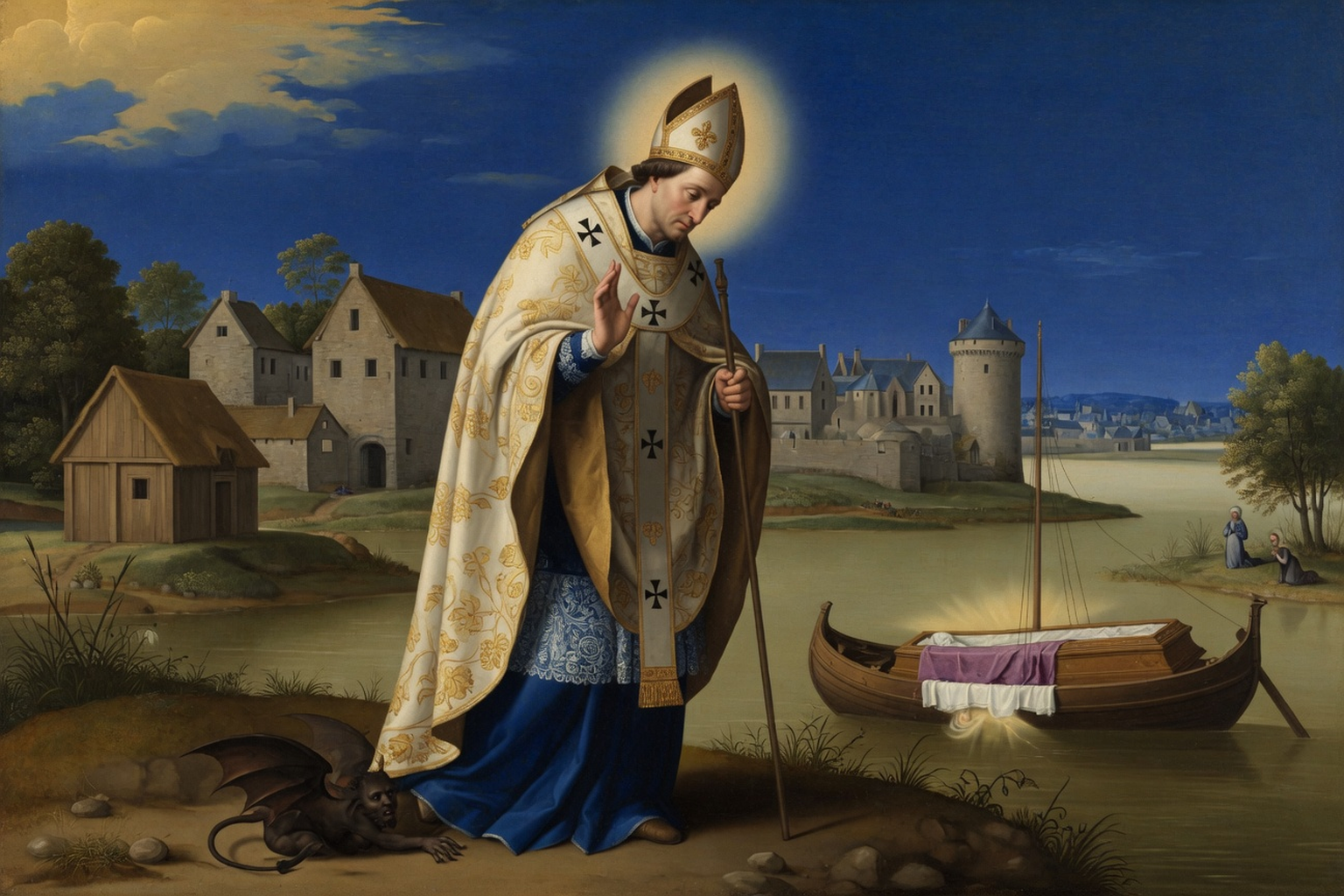
Bishop of Rennes in the 6th century and advisor to King Clovis, Melaine was a great thaumaturge and a peacemaker in Brittany. Born in Platz, he led a monastic life before being elected bishop against his will, distinguishing himself through his miracles and his role at the Council of Orléans. His remains miraculously traveled up the Vilaine to Rennes, performing numerous healings along the way.
Guided reading
9 reading sections
SAINT MELAINE, BISHOP OF RENNES
Origins and Episcopal Election
Born in the diocese of Vannes, Melaine led an austere life in the monastery before being designated by Saint Amand to succeed him on the see of Rennes.
SAINT MELAINE SAINT MELAINE Bishop of Rennes in the 6th century and advisor to Clovis. , called Saint Malani by the Bretons, was born in the diocese of Vannes, in the year 442 or 456, at Platz, on the banks of the river Vilaine, in approximately the place called Brain today. Illustrious by his origin, he was even more so by his virtues. Raised from his earliest childhood by great prelates, he made wonderful progress in the sacred letters; his faith was already so vivid that he performed miracles. From this august school, he passed into a monastery where he perfected himself, in a short time, in the exercises of the most austere life. Beautiful in his body, more beautiful in his soul, he had everything necessary to please heaven and earth. God revealed his merit to Saint Amand, Bishop of Rennes, and made i t know Rennes Episcopal see where the saint exercised his ministry. n to him, on his deathbed, that he would be his successor. The clergy and the people of Rennes, having learned from the mouth of their holy bishop what the divine will was, had no sooner rendered him the last duties than they went to take Melaine, despite his resistance, from the cloister he did not think he would ever leave except for the earth: and despite his reasons, his prayers, his tears, he was elected and consecrated bishop. Charged with this heavy burden of the episcopate, he believed that he could not bear it without extraordinary help from heaven: to merit it, he redoubled his vigils, his fasts, his macerations, and his prayers. He applied himself with new attention to the study of Scripture, to the presence of God, whom he consulted before undertaking anything; he frequently visited the churches of his diocese, preaching more by his examples than by his words, and choosing, as a charitable physician of souls, suitable remedies for each sick person. While he deprived himself of the necessities, he took care that not one poor person remained in indigence, so that the prayers of those he assisted might obtain mercy for him. For he had constantly before his eyes the day of judgment, and this thought made him shed abundant tears. Raised thus almost above the human condition, he received from God the gift of miracles: we will not speak of the blind to whom he restored sight, the lame whom he straightened, the mutes whom he made speak, the languishing persons whose strength he restored, the sick of all kinds whom he returned to health, the possessed whom he delivered, nor the dead whom he resurrected; we will report only one of the extraordinary wonders of this last kind. One day when the Saint was in the country of Vannes, a venerable old man, either by his rank or by his age, presenting himself before him, begged him to resurrect his son who had just died. The holy bishop, turning toward the crowd that surrounded him and toward those who carried the corpse, said to them: "Vannetais, what use will it be for you to see wonders performed in the name of Jesus Christ, you who for so long have refused to embrace his faith?" He spoke to them thus because this part of Brittany was still almost entirely pagan. "Be sure, man of God," the assistants replied, "that if you resurrect this dead man, we will all believe in the God you preach." Immediately Melaine began to pray and placed a cross on the chest of the deceased, who suddenly returned to life. After this prodigy, there remained no one in the country who did not receive baptism and profess the Catholic faith. The humble wonder-worker hid his miraculous works as much as he could: he rarely laid hands on the sick without using at the same time either holy water or holy oil on them, so that the healings would be attributed to these sacred objects.
Advisor to King Clovis
Having become one of the principal advisors to Clovis, he encouraged him to build churches, found monasteries, and practice charity.
So many virtues did not allow Saint Melaine to remain unknown to Clov is, Ki Clovis First king of the Franks to convert to Catholicism. ng of the Franks. This prince made him one of his principal advisors; and it was through the docility he showed toward the holy bishop's counsel that he built several new churches, restored those that had been brought down by the misfortune of the times, and founded several monasteries with the decency befitting such establishments. It was also through the advice of Melaine that Clovis bestowed his liberality upon the needy, honored the servants of God, of whatever state they might be, governed his peoples with justice, and usefully employed his authority for the propagation of the faith and the increase of divine worship. Finally, our Saint was one of those who contributed most to the assem bly of the first Council premier concile d'Orléans Council of 511 (noted as 544 in the text) in which Melaine participated. of Orleans (544), and he distinguished himself there in a particular manner among all the others, whether by refuting the objections of the heretics or by solidly establishing the sacred dogmas of the Gospel.
The miracle of the eulogia at Angers
During a meeting in Angers with other bishops, a miracle involving a eulogia turned into a serpent recalls the primacy of charity over fasting.
Several years after this council, Saint Melaine and several others found themselves in Angers on the first day of Lent: all these prelates deferred to him the honor of celebrating the sacrifice in the church of the Mother of God, which has since been called the Ronceray (a famous monastery for women), and Melaine, after the sacrifice, distributed sacred eulogiae (a type of blessed bread) to the four bishops as a sign of charity and communion, and gave them his blessing. Thr ee of them, Saint Au saint Aubin d'Angers Bishop of Angers, traveling companion of Lubin. bin of Angers, Saint Victorius II of Le Mans, and Saint Laud of Coutances, consumed their eulogia; the fourth, Saint Mars, preferring fasting to charity, let his eulogia fall into his lap instead of eating it. But when the holy prelates, after having exchanged the kiss of peace, had returned to their dioceses, Saint Mars felt great remorse, accusing himself of having lacked respect for a sacred thing, and of having placed fasting after charity, which Saint Paul places as the first of the virtues; it is said that God, to enlighten him, had changed the eulogia into a serpent. He therefore went to find Saint Melaine, then Saint Aubin, then Saint Victorius II, to prostrate himself before them and obtain his pardon; he finally returned to find Saint Melaine, who gave him absolution, and thus delivered him from his torments. The holy bishop was then at Platz, in the monastery he had built on his own inheritance.
Healing of King Eusebius and Aspasia
Melaine heals the King of Vannes and his daughter Aspasia, obtaining in return the land of Comblessac for his monastery of Platz.
One of his neighbor s, Eus Eusèbe Convert who had a church erected in memory of the martyrs. ebius, King of Vannes, was forced to have recourse to him due to a fault followed by a great misfortune. This prince had caused cruel devastation with his troops in the canton of Comblessac; following the outbursts of a blind fury, he had had the eyes gouged out and the hands cut off of a great number of inhabitants; but the following night he felt himself tormented by insurmountable pains, and the doctors he summoned could give him no relief. At the end of three days, his daughter, named Aspasia Aspasie Daughter of King Eusebius, delivered from possession by Melaine. , fell into such violent convulsions that they were attributed to demonic possession. Saint Melaine was asked to come see the sick at Primeville. He went there from Platz with some of his religious; Eusebius confessed his crime with tears, acknowledged that he was suffering justly, and begged the holy bishop to use his influence with God for his healing and that of his daughter Aspasia. Melaine, after imposing upon him a penance proportionate to his fault and his repentance, said to him for his consolation: "This infirmity, my brother, was not sent to you by God to make you die, but to put you on the path of salvation and to lead you to render to your Creator the honor that is due to Him." Having said this, he anointed him three times with holy oil, invoking the name of the Lord, and the sick man, finding himself immediately better, rose and gave thanks to God. After that, Melaine approached the place where Aspasia was and restored her health of body and mind through the efficacious virtue of his prayers. As he could not endure praise, he immediately asked for permission to withdraw; Eusebius granted it to him only with regret: at the same time, at the prayer of Aspasia, and to mark his gratitude toward God, he made a gift to Saint Melaine of all the land of Comblessac, to help with the maintenance of the holy disciples he was raising in his monastery of Platz.
Death and funeral
The saint died on November 6, 530, at Platz after announcing his end to his disciples and receiving the last sacraments.
Melaine went to Rennes, where he continued to combine the virtues of a perfect solitary with those of a vigilant and zealous pastor. He often returned to his establishment at Platz to enjoy at leisure the solid rest that is found only in God. It was there that God made known to him the day of his death; he announced it himself to his disciples, to prepare them for the pain of this cruel separation. As this moment, happy for him and sad for them, approached, he gave them, along with his blessing, general absolution, according to the custom of bishops; he tried to console them, and gave them a pathetic discourse on their duties and on the manner in which they should conduct themselves, both for their own sanctification and for the edification of the faithful. He then took the body and blood of Jesus Christ, and provided with these holy viatics, he left the earth on the day he had marked, that is to say, November 6 of the year 530.
It is said that the four bishops mentioned above, Saint Aubin, Saint Victorius II, Saint Laud, and Saint Mars, were present at his funeral with a great multitude of the faithful. First, the recommendations ordered by the Church were made for his soul. The following night was spent watching and praying, and the next day mass was celebrated early in the morning.
Miraculous translation to Rennes
His body travels up the Vilaine by boat in a prodigious manner, performing healings and freeing prisoners along its path.
Following this, the body was placed in a boat which, fortunately, was found nearby, and traveling up the V ilaine, Vilaine River where the miracle of the boat took place. the bishops and religious led the mortal remains of the holy prelate to Rennes, twelve leagues beyond Platz, while chanting litanies. The people followed, singing hymns of thanksgiving to give glory to God for the eternal happiness they were convinced their holy bishop was already enjoying. At the approach of the holy body, the entire city of Rennes, people and clergy, went out to meet it with crosses, candles, and banners, singing and praising God for having granted them the grace of honoring them with this precious deposit. The sound of these chants penetrated to the depths of a tower that was to the south of the city, near the walls, and which served as a prison. Twelve thieves who were held there in chains, informed of the universal joy, began to join their lamentable voices to these melodious chants, invoking the mercy of our Savior and the help of his holy pontiff. Immediately, the tower, which was built of stone, opened from top to bottom, and the prisoners were unbound and set free. A noblewoman from near Rennes, who had her lands on the banks of the Vilaine, obtained a no less signal grace on this day of blessing. She had been blind for a long time and did not dare to hope for her healing. At the approach of the body of Saint Melaine, she felt confidence arise; having had herself led to this sacred relic, she prostrated herself on the ground to address her prayer to God; then, kissing the feet of her holy pastor, she recovered the sweet light that her eyes had lost for so many years. To leave a mark of gratitude that future centuries could not erase, she donated to the deceased the land she possessed as an inheritance beyond the Vilaine. The four holy prelates, of whom we have spoken, carried with their own hands the body of Saint Melaine to the place that Providence had destined for him, where it pleased God to honor his memory with several miracles.
Testimonies of Gregory of Tours and Fortunatus
Ancient authors report the construction of a church over his tomb and his visionary appearance to Saint Paternus.
Gregory of Tours, Grégoire de Tours Bishop of Tours, contemporary historian, and friend of Palladius. who lived at the end of the following century, recounts that the Christians erected a church of surprising height over the tomb of Saint Melaine, Bishop of Rennes, who, with his spirit always attached to heavenly things, had been an object of admiration in his time for the multitude of his miracles; subsequently, fire having accidentally caught this church and entirely consumed it, the cloth (a most combustible material) that covered the sepulcher of the holy confessor was not damaged, nor was the body of the holy bishop. Venantius Fortunatus recounts a no less marvelous trait of Saint Melaine: he says in the life of Saint Paternus, Bishop of Avranches, that Melaine, Leontius, Bishop of Coutances (probably Saint Laud), and Vigor, Bishop of Bayeux, three holy prelates whom it had pleased God to call to Himself, appeared one night to Saint Paternus, and in this vision ordained him bishop. It is to be believed that Saint Paternus showed himself very grateful toward Saint Melaine, and as it is known that he established many monasteries in various regions, and among others in the country of Rennes, the abb ey raised on the spot where the body of Saint Melaine rested and wh l'abbaye élevée sur l'endroit où reposait le corps de saint Melaine Abbey built over the saint's tomb. ich bears his name is undoubtedly indebted for its foundation to Saint Paternus.
Translation and preservation of relics
The relics traveled from Rennes to Bourges to escape the Normans before being partially returned and authenticated over the centuries.
The most considerable portion of our Saint's relics was kept in the church of Saint-Melaine and taken to Bourges in 853, during the ravages of the Normans. It is not known by what chance Rorans, grandmother of Gervais, Archbishop of Reims, had obtained a part of these same relics, which she kept with extreme veneration at Argentré, land which was part of her dower; but it is certain that Gervais, her grandson, presented them to Even, abbot and restorer of Saint-Melaine, and later Archbishop of Dol; in the letter accompanying this gift, he recounts many miracles due to the holy relics, of which he was a witness or which he learned of from eyewitnesses. The body of a Saint Melaine (it is unknown if it is ours) was exhumed in 1231, at the castle of Preuilly, by the Archbishop of Tours. Hervé, second of the name, Abbot of Saint-Melaine of Rennes, who lived in 1258, took care to bring to his abbey a portion of these blessed ashes which he obtained from the monks of Preuilly. Finally, in the year 1679, Jean-Baptiste d'Estrades, former Bishop of Condom and Abbot of Saint-Melaine, authenticated the relics of the patron saint of his abbey and placed them in a new gilded wooden reliquary.
There remains today (1872) in the church of the former abbey only a piece of the saint's tibia, and fragments at the cathedral of Rennes.
Attributes and iconography
Saint Melaine is traditionally depicted with a demon at his feet or a boat sailing upstream without sails.
Saint Melaine has been depicted with a demon under his feet, a symbol common to him and all missionary saints who have cast demons out of the hearts of the people; delivering a possessed person by giving him a slap: this miracle was performed before his death; but what characterizes him above all is a dismasted boat sailing up the Vilaine and carrying his coffin without the help of sails and against the current of the waters. This life is taken from Dom Labineau (new edition published by Abbé Tressaux) who wrote about a contemporary author whom Dom Rivet considers entirely trustworthy and, moreover, very learned for the time.
Annexes & related entities
Structured data for exploration: events, miracles, quotes, places, attributes, patronages, and important entities cited in the text.
Key Events
- Born in 442 or 456 in the diocese of Vannes
- Entry into the monastery and austere life
- Forced election to the bishopric of Rennes upon the death of Saint Amand
- Advisor to King Clovis
- Participation in the First Council of Orléans in 511 (noted as 544 in the text)
- Miracle of the resurrection of a young man in the region of Vannes
- Healing of King Eusebius and his daughter Aspasia
- Died at the monastery of Platz on November 6, 530
Miracles
- Resurrection of a Vannes old man's son by the imposition of a cross
- Instantaneous healing of King Eusebius and exorcism of his daughter Aspasia
- Miraculous liberation of twelve prisoners as his body passed by
- Healing of a blind woman kissing the feet of his remains
- Boat carrying his body moving upstream without sails
- Preservation of a sacred cloth during the fire of his church
Quotes
-
Nonne spes nostra est de hoc sæculo?
St. Aug., serm. 156 (Lesson from the Office of St. Melaine) -
People of Vannes, what use will it be for you to see wonders performed in the name of Jesus Christ, you who have for so long refused to embrace his faith?
Words of Saint Melaine before a resurrection