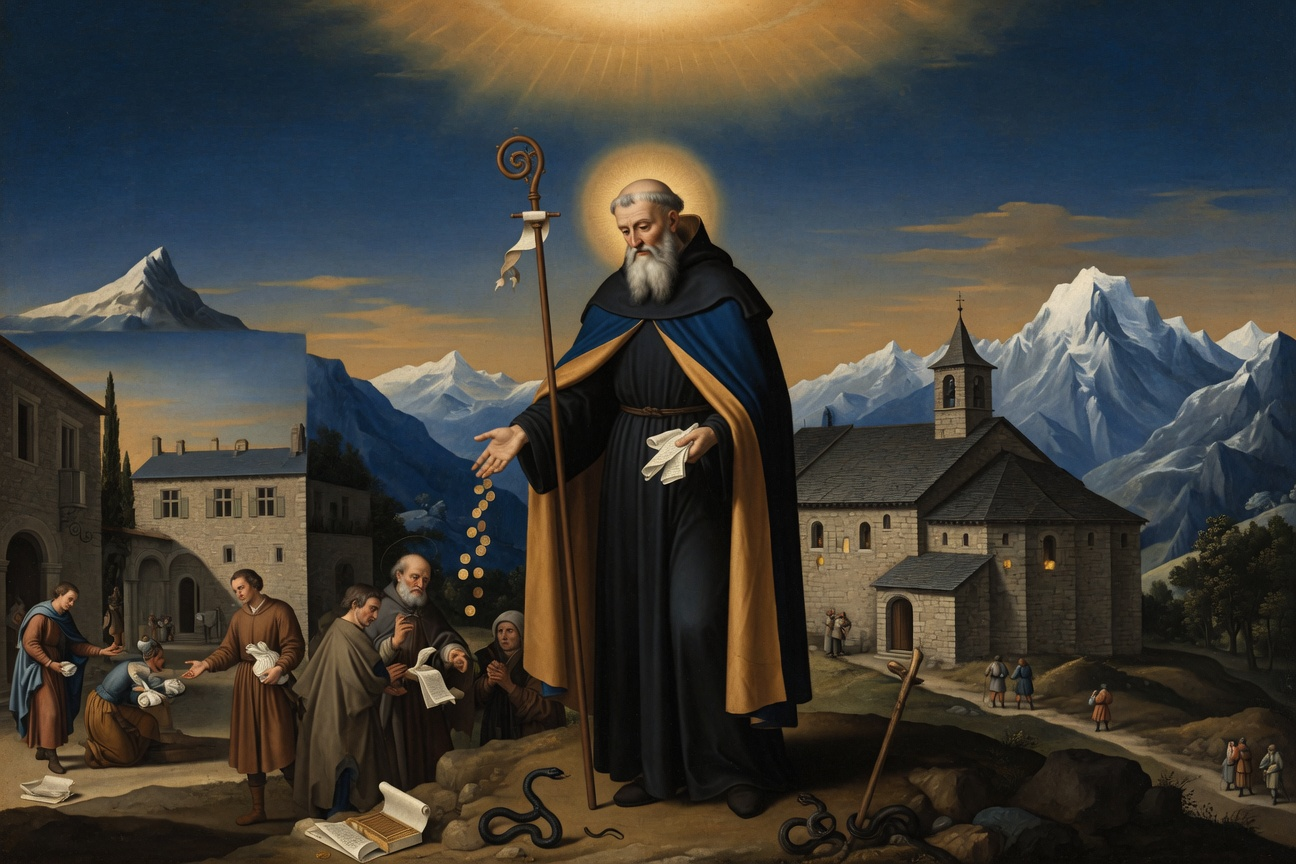
A lord of Lambesc who renounced his fortune, Heldrad became Abbot of Novalesa in the 9th century. He dedicated his life to the heroic hospitality of travelers crossing Mont Cenis and founded several Alpine hospices. Renowned for his miracles and charity, he died nearly a centenarian, leaving a major spiritual and material legacy in the Cottian Alps.
Guided reading
10 reading sections
SAINT HÉLDRAD, ABBOT OF NOVALESA, IN PIEDMONT
Origins and youth in Lambesc
Heldrad was born in Lambesc into a noble and pious family at the end of the 8th century, receiving a careful education before losing his parents.
Towards the end of the 8th century, the town of Lambesc (Bouches-du-Rhône), then the chief town of an important valley, was governed by a Leude, faithful to his prince and to God. He who understood his duties so well, received from heaven, as a reward, a perfect wife, who made him the father of a son gifted with the best nature.
This son nam Heldrad Abbot of Novalesa in the 9th century, originally from Provence. ed Heldrad never ceased to be an edification to his contemporaries, first as a secular and later as a monk; so much had his parents taken care to develop in him, from his early age, the best sentiments, especially from a religious point of view.
It is unknown to which famous school Heldrad was sent to pursue his studies, and the names of the teachers who initiated him into the humanities are also unknown today; but it is known that he had barely entered the world when he had the misfortune of losing his father and his mother. He mourned them bitterly, and it was only with great regret that he collected their inheritance.
Early foundations and ascetic life
Heir to vast estates, he renounced luxury to dedicate himself to the poor, building a church dedicated to Saint Peter and a hospice (xenodochium) for travelers.
From then on, it was incumbent upon Heldrad to administer considerable estates, and also to ensure the well-being of numerous populations, for the monarch had maintained him, in Lambesc, in all his paternal honors.
Let us say quickly that riches, no more than social distinctions, were never able to prevent him from recognizing the nothingness and vanity of the most sought-after things here below: he thus used everything as if not using it. Soon he was seen, through self-denial and humility, to cut out all luxury from his clothing and furnishings, as well as from his hunting or war equipment. If he kept horses, he ceased to have them richly harnessed. Similar reforms also had the advantage of increasing Heldrad's resources for the good works in which he took the most pleasure.
In order to bring help and consolation to the poor and the afflicted, as well as with the goal of instructing the inhabitants in their religious duties, he willingly traveled through the regions that depended on Lambesc, and even the neighboring lands.
However, the locality that most fixed Heldrad's solicitude was not far from his native town.
In a fairly nearby quarter, which one reaches by heading east, there existed several intersections of the ancient communication routes of the Salyes. The people of Marseille had taken advantage of this to establish a market there, and, if necessary, even a sort of customs house or toll; the fact remains that, in Heldrad's time, there was almost constantly, in this place, a congestion of travelers, for the most part not inclined to good, and above all an abundance of merchants who had not yet renounced the practices of paganism, in the hope of more easily deceiving buyers regarding the origin and quality of imported goods.
To come to the aid of so many souls worthy of pity, and to do so in a sustained manner, Heldrad had a vast and beautiful church built at the entrance of said market, which he dedicated to the Prince of the Apostles. This church was enriched by him with all the objects necessary for the exercise of worship, and he took care above all to have it provided with ministers of the altars, whose existence he ensured in a suitable manner.
Finally, as a complement to his work of moralization towards the foreigners crowded at the gates of Lambesc, Heldrad established, without delay, near the church of Saint Peter, a large Xenodochium or charitable establishment, which he endowed generously, so that the guests, whether rich or poor, healthy or sick, would be well treated there without paying anything.
He even wished, with the help of shade and gardens, planted with fruit trees, to have the chance to prolong, for convalescents and travelers, the care of charity and even more the lessons of piety.
There was no lack, as we can see, for Heldrad, a few steps from his palace, of poor in body or spirit to care for. And the mission he had given himself in this regard would have sufficed for a soul less ardent than his; whereas, for him, the desire to come to the aid of his neighbor, while accomplishing his personal salvation, still remained incomplete.
Heldrad aimed at an immense action of charity, at something supernatural in this genre, and in his thought, he associated this with the most complete immolation of his person, not finding, it seems, his body yet sufficiently submitted to a passive obedience.
Renunciation and wandering
He distributes his remaining assets and leaves Provence to seek an ideal monastery, traveling through France, Spain, and Italy.
To follow his future plans more freely, he then determined to divest himself of the fortune that might remain to him, and to leave Lambesc and its valley forever.
The interest he took in the pious foundations he had just established, the attachment of the populations, the family memories, and the beauty of the countryside that belonged to him, were not enough to inspire in him regrets that he could not overcome.
He therefore disposed of all his goods, and distributed their value to the poor of Lambesc, after having retained, for the Chorepiscopus of the region, considerable sums which he destined for the maintenance of all the religious and charitable houses established, as well as for the foundation of a good number of others, whether in the valley or outside it.
Heldrad now no longer feared for himself the judgment pronounced against the rich by the sovereign Judge; he had become a voluntary pauper. Very quickly, for his already most humble clothes, he substituted the simple costume of the inhabitants of the countryside. He enclosed, in a coarse cloth bag, food for two or three days at most, and loading it all onto his shoulder, where in its time the military baldric had shone, he set off like the most wretched traveler.
He went almost at random, from one famous sanctuary to another, kneeling and praying; but above all, seeking a sanctuary or religious establishment of perfect regularity, in which he could devote himself to God as a monk, and have to perform acts of charity much greater than those that Providence had entrusted to him until then.
Having found nothing, according to his views, in all of Western France, even after having crossed the Pyrenees and passed into the Spanish March, included, at that time, in the Carolingian Empire, he was in the position of taking the road back to Lambesc.
Heldrad saw his dear establishments of Saint-Pierre again without too much emotion, and after a few days of rest, he resumed his investigative journeys for a place of retreat, such as his soul demanded.
This time, crossing Provence from west to east, he headed towards the Italy of the Franks and explored it with attention. Even there, even in Rome, no more than in Provence, his homeland, which abounded in model monasteries, did Heldrad find for himself the port of salvation as he wished it, and he was about to carry his research into Eastern France, after having crossed the Cottian Alps, when he heard from the mouths of some pilgrims the praise of Novalesa.
Arrival at the Abbey of Novalesa
In 814, he joined the Abbey of Novalesa at the foot of Mont Cenis, where Abbot Amblulfe recognized him through divine inspiration and admitted him as a monk.
This praise, which consisted of representing this ancient abbey as a center of charity and Christian perfection, such as few existed, was deserved, given that the monks of Novalesa, not limiting themselves to exercising hospitality day and night at their monastery at the foot of the Alps on the Piedmont side, had taken on the arduous service of the hospice established at the summit of the Mon t Cenis pa mont Cenis Alpine pass where the monks of Novalesa maintained a hospice. ss, and performed it with great care.
During the long snow season, the monks of Novalesa would go to both slopes of Mont Cenis to search for travelers, and after gathering them at the hospice on the mountain, they would amply provide for their needs before letting them resume their journey.
The warm season that followed, moreover so brief in the Alps, barely sufficed for the monks of Novalesa to gather, at the top of Mont Cenis, the wood and other provisions necessary to assist the unfortunate travelers. They were reaching the end of this arduous resupply for the winter of the year 814 when Heldrad, who had the Mont Cenis pass precisely on his itinerary, reached the monastery of Novalesa at the very entrance of said pass. He found in the vestibule of the guest house Abbot Amblulfe, a Provençal by origin, who that day was fulfilling t he dutie Amblulfe Abbot of Novalesa who welcomed Heldrad. s of guestmaster; but who would never have recognized the lord of Lambesc, his compatriot, under the livery of poverty without an inspiration from the Holy Spirit. Heldrad was therefore running the risk of receiving the ordinary kiss of peace, and then being led to the altar to pray before passing to the refectory; they would have especially provided for his material needs, as was practiced for common travelers. Instead of that, thanks to the light coming from heaven, Amblulfe already saw all the profit that Novalesa could derive from the arrival of Heldrad. He ran to him, embraced him affectionately, and once the adoration was finished, he urged him to stay, promising to come visit him often for the sake of his soul.
Heldrad, in his relations with the Abbot of Novalesa, was well forced to admit that he was not a man of nothing, burdened with miseries, for whom one only had to have pity. Amblulfe even led him to admit that he had sacrificed his goods to be able to give himself more entirely to God. And later, he heard him declare that everything he saw at Novalesa proved to him that he had finally found the shelter from the storms of the world that he was seeking, and all the conditions to serve God and his neighbor, as he had wished for a very long time.
Be that as it may, Abbot Amblulfe felt he had to test Heldrad's determination before admitting him as a novice, and he was seen during this time in lay clothing cultivating the abbey's vineyards, located at the very bottom of the Novalesa valley. When Amblulfe found himself well edified regarding Heldrad's desires, and perfectly certain that the lord of Lambesc truly believed he had reached the end of his search, he finally gave him the religious habit.
Life of prayer, study, and service
Heldrad distinguished himself by his zeal for manual labor, his study of the rules of Saint Benedict and Saint Basil, and his service to travelers at Mont Cenis.
Heldrad, participating in the regular life as a professed monk, had no less ardor for manual labor than upon his arrival at Novalesa; but it is said that, in the intervals between these tasks, in order to come to a good understanding of his new duties, he was in search of all the teachings that come to us from the founders of monastic life.
If he placed Saint Benedict and the rule left by him at the forefront of his readings and meditations, he willingly paused to consider Saint Columbanus and his cenobitic prescriptions, as well as the writings of Saint Basil.
Heldrad was not only noted for his zeal for religious studies; one admired his eagerness to help the unfortunate and, above all, his perfect obedience and angelic sweetness; so much so that Amblulfe did not delay in having him ordained a priest and allowing him to pronounce absolute vows as a choir monk.
The sacrifice of himself, which he had so desired, was about to begin: he was now a soldier of Christ, in a monastery that had as its patrons two apostles who died on the cross: Peter and Andrew. He could count on his hopes of salvation with less fear than ever, for he was definitively admitted into a seminary of Saints.
He was sent, in his turn, to Mont Cenis to care for travelers, or to provide them with assistance amidst the snows, and this particular use of his aptitudes and strength never seemed to him to be commanded often enough.
At other times, Amblulfe entrusted him with a certain number of young religious to instruct and familiarize with the exercises of piety and charity.
Heldrad, surrounded by his students, constituted a sort of small monastery apart. Indeed, as a means of regulating instruction, and also as an easier mode of maintaining order among five hundred religious, the cells formed, in those days, various groups around the numerous chapels scattered within the enclosure of Novalesa.
While overseeing the studies of others, Heldrad did not neglect to add to his own knowledge, for no one more than he loved to combine science with charity. It was, moreover, easy to learn at Novalesa, where there existed a library provided with great treasures, whether religious or purely literary, a library that was enriched every day with the help of copies made by the monks of the abbey and the exchanges that could thus be accomplished abroad.
It is perhaps to the current period of Heldrad's life that one must date his correspondence with the deacon Florus of the church of Lyon. The letters exchanged reciprocally, long preserved by the monks of Novalesa, are currently lost: but, according to the other correspondences of Florus that have reached us, one can assume that these letters dealt thoroughly with the affairs of the Church, as well as those of the State, in a style which, on one side as on the other, was not without charm, for the deacon of Lyon knew how to choose his interlocutors.
The monks were not to be strangers to the great interests of the world, since sovereigns could find nowhere more surely than in the convents the learned and capable men they needed for their council or to fulfill the difficult functions of *missi dominici*. Heldrad, no more than other learned religious of his time, was not forgotten in the depths of his cloister; if we rely on charter no. 55 of the cartulary of Saint-Vincent de Mâcon, he would have been at Cluny in the year 825 in the retinue of Louis the Pious to assist in the settlement of important affairs.
However, it was very much against his will that Heldrad could thus be taken away from the sweetness of his solitude, from th at contemplati Louis le Pieux Son of Charlemagne, whose accession to the throne was predicted by Alcuin. on which he cherished at Novalesa itself, in that grotto which is still shown to us and before which all the wonders of creation unfold in miniature, especially in summer, when one can see and hear the numerous waterfalls of the streams that have resumed their course in the valley.
The Abbacy and the Expansion of the Work
Elected abbot in 844 after Hugh, he strengthened discipline, developed the hospice of Mont Cenis, and obtained imperial protections from Lothair.
Heldrad willingly raised himself toward God while admiring His works, and he hoped to be able to continue doing so with some freedom, when he was called by degrees to a life of the most active and absorbing nature.
Abbot Amblulf had died, and it was thought necessary to elect in his place, aro und th Hugues Brother of Odile who interceded for her return. e year 837, Hugh, brother of Louis the Pious: it was an act of compliance toward the monarch who liked to know that Novalesa was in good hands, given that this monastery, because of its importance, was held, in addition to prayers for the salvation of the State, to the most real military service.
Unfortunately, Hugh, who had other abbeys to oversee, was often absent from Novalesa, and the most important services would have suffered if Heldrad had not had the kindness to attend to them constantly.
The opportunity for Heldrad to make himself known as an administrator of the entire monastery was such, during all the time that Hugh enjoyed the status of abbot of Novalesa, that upon the latter's death, which took place in 844, he was unanimously called to succeed him.
Heldrad, who had never thought of the honors of the prelacy, protested against the choice that had just been made. Observing that there were more worthy religious in the monastery, he prayed and begged to be spared a burden too heavy for an old man.
The monks of Novalesa, on the contrary, persisted in their decision; they finally managed to overcome Heldrad's resistance by showing him the danger of opposing the views of the Most High, regarding the monastery and himself. Heldrad, upon taking office, imparted a redoubling of life to everything. The *Laus perennis*, or incessant singing of God's praises, went hand in hand with charitable works at every moment. More than ever, poor travelers were affectionately cared for in this hospice of Mont Cenis, where everything was then accomplished under the beautiful invocation of Jesus Christ *Savior* and His divine mother, Mary ever *Virgin*.
To find the unfortunate ones lost in the midst of the snows, the monks themselves went to search even to the bottom of the precipices, already realizing everything that has since been said about the devotion of the religious of Saint Bernard.
In order to inspire in his collaborators a charity toward travelers, pushed to the point of martyrdom, he was accustomed to say to them, with that amenity that perfection gives: — "I affirm to you that we have nothing to expect in another life, if not the just proportion of what we will have done for our neighbor, with a view to pleasing God. *Juxta mensuram, mercedem crede futuram*."
At the request of Heldrad, Lothair, who had succeeded Louis t Lothaire Emperor and son of Louis the Pious, sovereign of Everard in Italy. he Pious as emperor, confirmed more particularly, in favor of the hospice of Mont Cenis, all the donations of his predecessors, and united in the most formal manner to Novalesa the opulent abbey of Saint-Pierre, founded near the city of Saluzzo by Aistulf, King of the Lombards.
Still to please Heldrad and to come to the aid of the hospice of Mont Cenis, one of those Marquises of Susa, whose lineage has continued in the House of Savoy, gave, at the entrance to the Novalesa valley, at the village of Venaux, arable lands and the wooded mountains above. In addition to the offerings of princes, those of private individuals were every day more considerable.
If the new abbot was eager to increase the revenues of Mont Cenis, he was no less jealous of preserving the faculties that the hospice could already dispose of; this is why he had certain serfs from the villages of Exilles and Oulx condemned to continue the services conventionally owed by them.
Under the government of Heldrad, nothing remained, in a way, incomplete, even from a material point of view. For example, we might say, a tower was missing in the middle of the fortified enclosure that then contained all the regular buildings of Novalesa: he had one of the tallest and most ample ones built, whose upper floors could serve for signals, while the lower floors would shelter the most precious objects of the abbey, without forgetting its rich collection of books.
Miracles and protection of the populations
He performed numerous miracles, notably the expulsion of snakes at the Lautaret and the healing of the sick and infirm in the region.
When there were no further improvements to be made, either at Novalesa or at the hospice of Mont Cenis, Heldrad used the funds remaining in his hands to assist travelers in other parts of the Cottian Alps. Thus, the Lautaret pass in the Dauphiné caught his attention, and he sent monks there to build a hospice near its approaches, in a place known today as Le Monestier-de-Briançon. The walls were already well rai sed when the monks in Monestier de Briançon Place where Heldrad founded a hospice and drove away the serpents. charge of this work arrived at Novalesa, declaring the enterprise rendered impossible by the presence of snakes that were devastating the entire country. Upon learning this, Heldrad commanded the messengers of such distressing news to set themselves to prayer to implore the mercy of the Most High, and after having done so himself, he set out with them toward the new hospice. Arrived on the scene, he ensured its discipline and began to drive the snakes before him, in such a way that they were very quickly all gathered and confined in a crevice of rocks not far from there, so as to be unable to do any more harm.
God used the hand of Heldrad, this time and many others, to modify physical effects in the natural order.
Assisted in this manner, the delegate of the Almighty stopped several times the progress of contagious diseases, for men and animals, which were invading the Novalesa valley and the neighboring countries.
It was attributed to the prayers of Heldrad, not without some foundation, the healing of a mute, a lame man, and a leper, whose infirmities were well known in the region.
Passing through the city of Asti on business for his abbey, he restored health to a sick woman, abandoned by those charged with caring for her. Finally, one owed to Heldrad, after God, the return to life of several dead people.
These benefits, undoubtedly very great, were nothing in comparison to those that Heldrad rendered, with the help of the aptitude he drew from the Holy Spirit, to read into the depths of consciences and to bring back with ease, to the fulfillment of their duties, all the persons with whom he was brought into contact.
Passing and final instructions
Heldrad died peacefully on March 13, 875, at the age of 94, after exhorting his monks to unity and the observance of the rule.
Whatever the utility of Heldrad's presence on earth, the ninety-fourth year of his age having arrived, God did not deem it necessary to delay any longer the moment to settle accounts with His servant.
This moment, so formidable even for the Saints, was revealed four days in advance to Heldrad, who neglected nothing to take advantage of this precious favor.
He gathered around him all the religious who were under his obedience, and after announcing to them himself that he was going to part from them, which made them melt into tears, he consoled them as much as he could, and begged them to forgive him for not having edified them more than he had done.
Heldrad, while awaiting his end, spoke with his religious about the sweetness of life in Jesus Christ, and renewed the most touching instructions for the time when he would no longer be there, advising union, concord, and peace, which result from the strict observance of the rule of the great Saint Benedict.
At the moment he felt his strength failing, he requested the last sacraments and received them with the most ardent faith. Soon after, while he was still praying, adoring the Holy Eucharist he had just received, he raised his arms to heaven and his soul separated from his body without agony.
This death, so worthy of envy, took place when Louis, son of Lothair, was emperor and king of Italy in 875, on the 3rd of the ides of March, or the 13th of the said month.
If one wishes to reconcile as chronologically as possible all the facts of Heldrad's life, one must admit that he had left the world at thirty-three years of age, and spent sixty-one years at Novalesa, the last thirty of which as abbot.
What mortal will ever be able to say how much the entire duration of such a long existence was pleasing to God and useful to one's neighbor!
Eventful History of the Relics
His relics, hidden during the Saracen invasions, underwent several translations across Europe before being shared between Novalesa, Susa, and Lambesc.
## RELICS AND CULT OF SAINT HELDRAD.
At the time of the funeral, Heldrad's body was solemnly placed in a stone tomb, in front of the entrance to the chapel of Saint-Nicolas, at one of the steepest points of the Novalesa enclosure. A few years later, at the request of the faithful, Heldrad's body was raised from the ground onto the very altar of the chapel of Saint-Nicolas, and this chapel was thereafter known only by the name of the blessed Heldrad. In the 10th century, the elevation of the body, performed with pomp, took the place of the canonization whose forms were only regulated by Pope Alexander III. There had been a reburial of Heldrad's body on the eve of the Saracen invasion of the country in 906, and after the long depopulation of the abbey, one could say or believe Heldrad's body was lost, when a young blind man signaled its existence in a cave from which the monks retrieved it in the year 1021. According to the chronicle of Novalesa, in 1040, there was a translation of Heldrad's body from a modest reliquary into a rich silver reliquary which has always been considered one of the fine examples of 10th-century goldsmithing. This new reliquary, so precious because of its contents, was carried from Novalesa to the extremity of Northern Italy in 1042, for the greater edification of the faithful, on the occasion of a great assembly of princes and bishops held in Ferrara to discuss ways to pacify the country. Also with the goal of favorably impressing the populations, the reliquary, containing the entire body of the blessed Heldrad, was transported in 1114 through Savoy, Burgundy, and other provinces to Beauvais, where a council or synod was then to meet. A great extension of the relics of the blessed Heldrad took place in 1368. On this occasion, Rufino, prior of both Novalesa and the monastery of Saint-Just of Susa, retained, outside the silver reliquary, the head, a portion of an arm, and some other bones. The head was placed in a silver bust, and the arm bones in a silver arm as well. These two relics thus became the property of the monastery of Saint-Just of Susa. The other bones, which had not been replaced in the silver reliquary in 1368, were distributed to various churches, in Turin and elsewhere, or became the property of the princes of the House of Savoy, who long cherished and respected holy things. It is from the House of the princes of Savoy that H. Aubert, parish priest of Lambesc, received in 1743 the significant bone fragment that adorns the altar of the blessed Heldrad in his hometown. The delivery of this relic took place diplomatically through the mediation of the Ferrara embassy in Turin. As for the remainder of the body of the blessed Heldrad, since 1568, it has continued to rest in its ancient and beautiful silver reliquary at the monastery of Novalesa itself, and pious pilgrims could still see it in 1855 in the abbey church, on the right side upon entering. Let us hope that this treasure, both religious and artistic, escaping the profanations of the Italian government at the time it dispersed the Benedictine monks of Novalesa, will have remained under the guard of the inhabitants of the valley, who held the memory of the blessed Heldra moines bénédictins de la Novalèse Monastic order to which the Abbey of the Oratory belonged. d in great veneration. The abbey of Novalesa and its dependencies were secularized a few years ago and sold for a derisory sum by the sacrilegious government of Victor-Emmanuel II, King of Sardinia, who had become, so-called, King of Italy.
The accounts of Heldrad's first hagiographer not having reached us in their entirety, the supernatural part that we know is incomplete, as is, for that matter, the rest of his life; but what we know in this genre is enough to lead us to believe in great holiness. However, if we could wish to increase our conviction, it would be good to realize the power of the blessed Heldrad in heaven by stopping to consider the number and extent of the graces obtained through his intercession since the time of his death. The record of miracles of the 10th and partly the 11th century fills a certain number of the lessons of the oldest office of Heldrad. We must note the several healings of blind people and other infirm persons brought by their families to the tomb of the Blessed, and we must read there, no less willingly, the touching story of that woman who, rushing to pay homage to Heldrad's relics when they were being transported along the Po Valley in 1042, had met her death in the river and was recalled to life by the strength of her children's prayers. The miracles of the end of the 10th century and the following four or five centuries are reported in the works of Dom Rocher and Dom Carretin, as extracted more particularly from the Sanctorale of Novalesa, where they had been recorded following the life of the blessed Heldrad. Among these miracles, one cannot admire enough the one that concerned knights from Piedmont or Provence who, in 1099, after the capture of Jerusalem, having to struggle against a frightful storm, implored their compatriots and succeeded in finishing the crossing happily to return to their country. It is no less touching to see the faith of that unfortunate cripple, healed at Aiguebelle in 1114 on the occasion of the passage of the relics of the blessed Heldrad through Savoy. Dom Rocher and Dom Carretto also make known other very edifying miracles, verified after the time when the Sanctorale had been written, and even give the enumeration of favors obtained by people of their time, or from 1670 to 1693. For the period closer to us, the confidence placed in Heldrad not diminishing, there would still be many miracles to report; but, regarding them, we must await a canonical examination. Of this number is perhaps the return to health of a paralyzed woman that took place in 1743, at the happy moment when it was granted to the parish of the town of Lambesc to possess a piece of Heldrad's body. The populations, showered with benefits in a superhuman manner by Heldrad during his mortal life, were easily led to believe that their protector would pass from this world to heaven to continue to protect them.
As for ecclesiastical authority, after having prudently studied the judgment to be made in this regard, it soon permitted the honoring of Heldrad as Blessed.
Before the year 906, the small chapel of the Novalesa enclosure, originally under the name of Saint-Nicolas, was dedicated to Heldrad. This same chapel, after having been destroyed by the Saracens, was restored in 1246 by the prior Jacques Scalis, who had it adorned with paintings reproducing the main circumstances of Heldrad's life. These curious paintings, which still exist, are accompanied by numerous inscriptions in ancient characters intended to explain them.
An altar was reserved for the blessed Heldrad as early as 1029 in the Benedictine church of the town of Susa. Since 1020, there had been an altar in the abbey church of Saint-Pierre of Novalesa on which the reliquary of Heldrad's relics has never ceased to rest. This altar, located on the south side, had been decorated in 1568 at the expense of the prior André Provana with very beautiful paintings which, unfortunately, no longer exist. Very anciently, the villages of the Novalesa valley had, in each of their churches, an altar dedicated to the blessed Heldrad. Dom Rocher and Dom Carretto, in their works relating to Heldrad, affirm that there were several altars in the Dauphiné in their time. An altar perhaps more precious than all those already indicated is the one that has existed since the earliest times in the parish church of the town of Lambesc. This altar kept its original place during the sumptuous reconstruction of the church in 1744, at the expense, for the most part, of the States of Provence. And tradition, supported by titles, holds that this altar exists on the site of the palace of the parents of the blessed Heldrad in Lambesc. Holy souls find some consolation in thinking that the same could have been the private apartment inhabited by Heldrad during his life. One must also see a beautiful testimony of the constant memory of Heldrad's compatriots in the chapel of Saint-Pierre, in the territory of Lambesc; a Romanesque chapel, partially remodeled in September 1580. A good painting of the Vanloo school adorns the altar of the blessed Heldrad in Lambesc; but this painting, although edifying, must please less in terms of the subject than that of the altar of the village of Venaux in the Novalesa valley.
The Italian painter has happily represented Heldrad having before him a large number of unfortunate people with the most urgent needs, and, in the front line, a mother who brings her dead child in her arms. The Venaux painting served, at the time, as a model for an etching and for a very beautiful bronze medal, which, both very widespread at first, are very rare now. The Benedictines of Novalesa took care to have the image reproduced by lithography, Turin, 1845. They intended to render the same service to the faithful regarding the medal at the moment when the Italian Revolution forced them to abandon their monastery.
In memory of Heldrad's virtues, his name has not ceased to be taken at baptism, in Piedmont and Provence, from the time he was declared Blessed until today.
Heldrad's feast has always been celebrated in the Novalesa valley, and in Lambesc, on March 13, that is to say, the day of his death, which would have been that of his entry into heaven.
Father Terraris, in his *Catalogue dei Santi d'Italia: Milano*, 1613, indicates Heldrad's feast as fixed very anciently by the Benedictines on March 13. Father Ducelino, author of the *Menologio benedictino*, Turin, 1655, and the Bollandists assign the feast of the blessed Heldrad to March 13. Jean Molanus, in his additions to the martyrology of Umbert, places this feast on the same day. Until recent times, the populations of the Novalesa valley were in the habit of flocking to the abbey, not only on March 13, but also on the day of the second feast of Easter, which corresponds to some translation or relation of Heldrad's relics. It should also not be left unknown that it has always been close to the hearts of the inhabitants of this valley to be able to carry the reliquary of the blessed Heldrad each year around their territory on the occasion of the Rogations. A special office of Heldrad was composed around the year 1010; an office that was in its entirety in Volume III of the Sanctorale of Novalesa and in an ancient missal of the abbey. Dom Rocher and Dom Carretto, who both had promised to publish this office, did not keep their commitment. It is almost accidentally that Dom Rocher, in his book entitled: *Gloires de l'abbaye de la Novalèse*, pages 103, 112, 120, 121, and 122, gives some parts of responsories, hymns, and prayers that are of a nature to make one regret the rest of this primitive work. Dom Rocher also has, almost without wanting to, the merit of giving, according to the *Sanctorale*, lessons that are not found in the collection of acts of the blessed Heldrad transmitted to the Bollandists by Turinetto. This proper office, very ancient, in use at Novalesa, is signaled by Ducelino, page 194, of his *Menologio benedictino*, and by Terraris, in his *Catalogue dei Santi d'Italia*. Rome approved a proper office of the blessed Heldrad in 1782 and fixed his feast on March 13 as a precept for the Novalesa valley, which was maintained until 1792. After the return of the Benedictines to Novalesa, the cult of the blessed Heldrad having resumed with fervor, a decree of Pius VII, of October 2, 1821, authorized for March 13 the feast to which, the same year, was assigned the rank of second class. By concession of Leo XII, of April 12, 1825, the proper office of the blessed Heldrad was regulated. Finally, under Pius IX, a decision of the Congregation of Rites, of December 9, 1832, at the request of the Bishop of Susa, raised the feast from the rank of second class to the rank of first class for the Novalesa valley.
The office and the decree were printed in Susa by Gutti in 1853.
Sources and Historiography
The life of the saint is documented by the Chronicle of Novalesa and various works by Benedictine scholars and Provençal historians.
A life of Heldrad was written immediately after his death by a monk of Novalesa, who had seen and heard what he reported. — This first work, currently lost, was before the eyes of the elder who recounted the Acts of Heldrad very lucidly in the Chronicle of Novalesa. — Duchesne, Le Cointe, Muratori, and others citing this chronicle declare it very mutilated and note that it was written before 1030. — When the chronicle had barely been written concerning Saint Heldrad, a summary of this part was made to serve for his office as early as 1045. — The partial collection of the lessons of this office formed the life of Heldrad, which G. F. Turinetto sent in 1854 to the archives of the court of Savoy in Turin, and which was published in 1755 by the Bollandists, Vol. II of March, p. 233 et seq. — It is the same life that is found in the Monumenta historia patria, Turin, 1848. — Based on the life of 1848, but especially with the help of the not-yet-mutilated chronicle, a monk of Novalesa wrote a fairly extensive life of Heldrad very early on, in volume IV of the Sanctorale of Novalesa or collection of lives of the Saints, for the particular use of the abbey. — The Sanctorale of Novalesa, now untraceable, served Dom Rocher for the life of Heldrad provided by him in French, p. 90 et seq. of his book La gloire de l'abbaye de la Novalèse, Chambéry, 1670. — Benefiting from the Sanctorale of Novalesa better than Dom Rocher, Dom Carretto published, in Italian, a very edifying and remarkable life of Heldrad: Vita e miracoli di S. Eldrado, Turin, 1698. — One should only cite for the record the beautiful pages that Gioffredo devotes to Saint Heldrad in his Histoire des Alpes maritimes, because Gioffredo, whose work, written in Italian, remained a manuscript for a long time before finding a place in volume VIII of the Monumenta historia patriae, Turin, 1848, had no other goal than to try to subtract the cradle of Heldrad from Provence, and thus make this blessed one spend his entire life in the Sardinian States. — The true critical information on the life of Heldrad is provided by Canon Galimia, in volume III, p. 196 et seq., of his precious work: Vita dei santi degli stati della regia casa di Savoia, which, published in 1764, had been written before the year 1757. — Galimia localizes Heldrad's birth in Lambesc and fixes his death at 875. — For everything concerning the blessed Heldrad, one must consult Mabillon, Annales hagiographicae, Vol. II, annotations for the year 874 more particularly. — A small manual, now untraceable, and which, well before 1799, had been printed for the use of the priors of Saint-Pierre de Lambesc, presented the life of Heldrad in a few words. — An interesting notice on Saint Heldrad was recorded by Achard in the Dictionnaire des hommes illustres de Provence, Vol. III, p. 257 and 258, Marseille, 1786. — There is also good information on Saint Heldrad in the Statistique des Bouches-du-Rhône of 1820, Vol. III, p. 293. — M. Reinard, of the Institute, a native of Lambesc, placed a note on Saint Heldrad in his book L'Invasion des Sarrasins, p. 163 and 164, Paris, 1834. — A very abridged life of Saint Heldrad is part of a collection of prayers published in Aix, 1837, by M. d'Isoard, a native of Lambesc. — This same collection, with the aim of popularizing the life of Heldrad, was reprinted in Turin in 1851, under the care of the Benedictines of Novalesa. — The biography that we provide here was written by the Marquis Jessé-Charleval and was communicated to us by Abbé Ant. Ricard, honorary canon, director of the Semaine religieuse de Marseille.
Annexes & related entities
Structured data for exploration: events, miracles, quotes, places, attributes, patronages, and important entities cited in the text.
Key Events
- Born in Lambesc at the end of the 8th century
- Distribution of his goods to the poor after the death of his parents
- Entered the Novalesa Abbey in 814
- Elected abbot of Novalesa in 844
- Foundation of hospices at Mont-Cenis and Lautaret
- Died at the age of 94
Miracles
- Miraculous expulsion of snakes at Lautaret
- Healing of a mute, a lame person, and a leper
- Resurrection of several dead people
- Cessation of contagious diseases through prayer
Quotes
-
Juxta mensuram, mercedem crede futuram
Heldrad's words to his monks