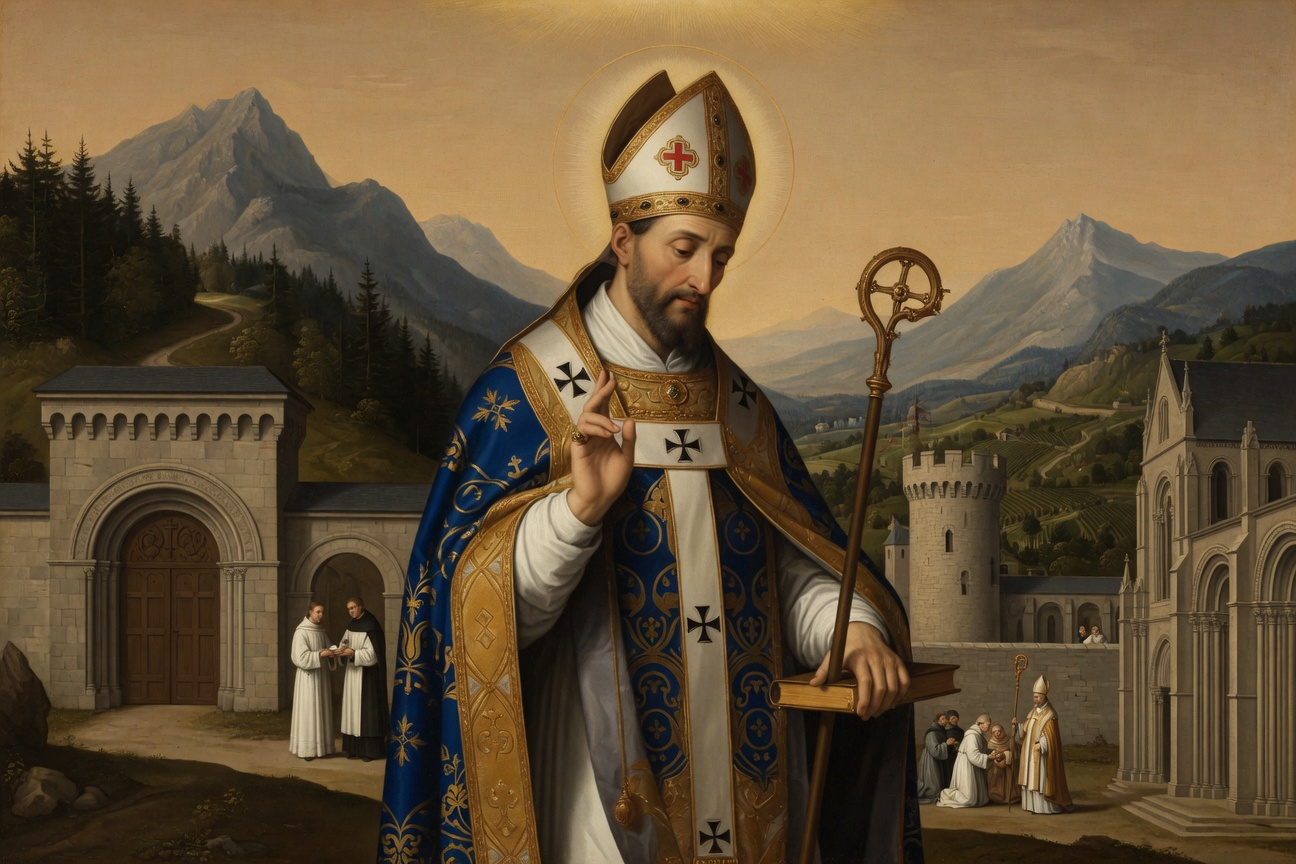
Blessed Boniface of Savoy
Bishop of Belley and Valence, Archbishop of Canterbury
A prince of the House of Savoy and a Carthusian monk, Boniface became Archbishop of Canterbury in the 13th century. He was distinguished by his reform of morals in England, his political prudence as regent, and his great charity. He died in Savoy in 1270 after twenty-five years of laborious episcopate.
Guided reading
7 reading sections
BLESSED BONIFACE OF SAVOY,
Origins and youth
Son of Count Thomas I of Savoy, Boniface is described as an accomplished prince of great beauty, endowed with several fiefs in Bugey and Savoy.
This prelate, one of the principal ornaments of the royal house of Savoy, was the son of Count Thomas comte Thomas Ier Count of Savoy and father of Boniface. I; he was the most accomplished prince of his time. His beauty had earned him the nickname of the Abaillon of Savoy. He held as an appanage the lands of Rossillon, of Virieu-le-Grand, in Bugey, and other fiefs in Savoy.
Religious Commitment
He joined the Carthusian Order at the Grande-Chartreuse to dedicate himself to prayer and the study of canon law and theology.
To escape the seductions of the world, he entered the Order of Saint Bruno and m Ordre de Saint-Bruno Religious order welcomed by Engelbert in Cologne. ade his profession at the Grande-Chartreus Grande-Chartreuse Place of retreat for Geoffroy in 1114. e. His time, in this pious solitude, was entirely divided between prayer, the study of theology, and that of canon law, in which he became very skilled.
Ecclesiastical Ascension
After administering the dioceses of Belley and Valence, he was appointed Archbishop of Canterbury in England, succeeding Saint Edmund.
His only ambition was to live unknown and to have his talents forgotten. But Heaven had other views for him. Violence was done to his modesty by appointing him to the priory of Nantua, and by entrusting him successively with the administration of the dioceses of Belley and Valence. Although still very young, he showed such maturity, prudence, and capacity for business that the church of Canterbur Cantorbéry Capital of the Kingdom of Kent and center of the Augustinian mission. y having become vacant by the death of Saint Edmun saint Edmond King of the East Angles and 9th-century English martyr. d, its archbishop, Boniface was judged worthy to ascend to this see, the most eminent in England. He was solemnly consecrated in Lyon by Pope Innocent IV, who wa Innocent IV 13th-century pope who testified to the saint's miracles. s in that city to hold a general council.
Reform and diplomacy
In England, he fought against social and religious abuses. He also held major political functions, ensuring the regency of the kingdom for Henry III.
The wars and calamities of those unhappy times had brought disorder to its peak in all classes of society, and it was certainly no easy task, especially for a foreign prelate, to attack abuses accredited by custom and by the most imposing examples. But the ascendancy of Boniface's virtues, his patience, his firmness, and his prudence triumphed over all opposition and all prejudices. Little by little, disorders were repressed, abuses corrected, vices condemned, and piety restored to honor.
A vigilant pastor, a zealous apostle, and a wise dispenser of heavenly mysteries, Boniface was always the man of God devoted to all kinds of good works. His charity embraced all misfortunes and all needs without distinction. Faithful to his God and to his king, he defended in turn, and with equal courage, the interests of the Church and those of the Sovereign, proving by his examples that the ministers of Jesus Christ have as their principle, like their divine head, to render unto God what is God's, and unto Caesar what is Caesar's.
Serious dissensions having broken out in the States of Savoy during the minority of the successor of Amadeus IV, the holy Archbishop hastened there and restored harmony through his intervention. The Sovereign Pontiff, to whom he went to give an account of all he had done in his diocese, approved everything and gave him signal marks of his esteem and confidence. King Henry III, obliged to leave England, left him the reg ency of t Henri III King of England who opposed the election of Richard. he kingdom, and, on another occasion, he wished for him to accompany him to France to assist him with his talents in difficult negotiations.
End of life and burial
He died in Savoy in 1270 after twenty-five years of episcopate. His body was buried at the Abbey of Hautecombe, where it was found intact three centuries later.
In 1269, he returned to Savoy, at the request of his brother Philip, to see his family. This was the end of his holy career. Stricken by a serious illness, and worn out by a laborious twenty-five-year episcopate, he died at Sainte-Hélène-du-Lac on July 14, 1270.
His body, buried in the Abbey of Haut ecombe and Haute-Combe Burial place of Boniface and necropolis of the House of Savoy. placed in a very beautiful tomb, was found without corruption nearly three centuries after his death. This extraordinary fact, joined to several miracles obtained through the intercession of the holy Prelate and the memory of his virtues, made him the object of the veneration of the faithful. People came from all sides to venerate his tomb, and it was daily visited by a large number of the faithful; but the French, having seized Savoy at the end of 1792, driven by revolutionary impiety, destroyed this monument and drove the religious of Hautecombe from their monastery. The King of Sardinia, having recovered Savoy in 1814, restored this abbey to its former purpose, and in 1826 had the tomb of the Blessed Boniface re-established, whose cult was approved by Gregory XV I on Septemb Grégoire XVI Pope who established the liturgical feast of the blessed. er 7, 1838.
Cult and posterity
Despite the destruction of his tomb during the French Revolution, his cult was officially approved by Pope Gregory XVI in 1838.
Drawn from the Genealogical History of the Royal House of Savoy, by Guichenon, vol. I, and the Proper of the Kingdom of Sardinia. Cf. Mgr Depéry, Hagiology of Belley, and a memorandum by Mgr Turtoaz (1839): this latter document was communicated to us by the Bishopric of Tarentaise.
Sources
The biography is based on the works of Guichenon, Mgr Depéry, and documents from the Bishopric of Tarentaise.
Taken from the Genealogical History of the Royal House of Savoy, by Guichenon, vol. I, and the Proper of the Kingdom of Sardinia. Cf. Mgr Depéry, Hagiology of Belley, and a memorandum by Mgr Turtoaz (1839): this latter document was communicated to us by the Bishopric of Tarentaise.
Annexes & related entities
Structured data for exploration: events, miracles, quotes, places, attributes, patronages, and important entities cited in the text.
Key Events
- Entered the Grande Chartreuse
- Appointment to the priory of Nantua
- Administration of the dioceses of Belley and Valence
- Consecration as Archbishop of Canterbury in Lyon by Innocent IV
- Regency of the Kingdom of England for Henry III
- Return to Savoy in 1269
- Died in Sainte-Hélène-du-Lac in 1270
- Burial at Hautecombe Abbey
- Confirmation of cult by Gregory XVI in 1838
Miracles
- Body found incorrupt nearly three centuries after his death
- Several miracles obtained through his intercession
Quotes
-
Render unto God the things that are God's, and unto Caesar the things that are Caesar's
Source text (life principle)