Saint Gregory of Armenia
Bishop of Nicopolis
Bishop of Nicopolis and Solitary in France
Bishop of Nicopolis in Armenia, Gregory abandoned his see to flee honors and the Manichaean heresy. He settled as a recluse near Pithiviers in France, where he led a life of extreme austerity for seven years. His holiness, manifested by numerous miracles, attracted crowds until his death at the beginning of the 11th century.
Guided reading
7 reading sections
SAINT GREGORY OF ARMENIA,
BISHOP OF NICOPOLIS AND SOLITARY IN FRANCE
Youth and formation in Armenia
Born in Armenia in the 11th century, Gregory received a solid Christian education and preserved his faith in the face of the influence of the Manichaeans.
Beginning of the 11th century. The solitary escapes the triple temptation of the eyes, the ears, and the tongue. For us who live in the world, let us watch over our senses. Saint Ephrem, de vita spirit. Gregory Grégoire Bishop of Nicopolis who became a hermit in France. was a native of Armeni Arménie Place of the martyrdom of Saint Jude Barsabas. a; but it was France, nevertheless, that was the principal theater of his finest actions. His history, which was composed by an anonymous but contemporary writer, does not tell us the names of his parents, and reports only that their piety led them to give their children all sorts of good instruction. When he was of age, he was entrusted to excellent masters who taught him the holy letters and the principal mysteries of the Christian religion, which was indeed professed in the country, but which was then so corrupted by the errors of the Manichaeans that it was enough, in the opinion of Baronius, to know that s omeone w Baronius Disciple of Philip, historian and cardinal, author of the Annales ecclesiastici. as Armenian to give cause to believe that he was a heretic. Gregory, aided by the help of his parents, and supported by the good doctrine of the chosen masters who had been given to him, always remained in innocence, and knew how to preserve the purity of his faith in the midst of heresy. Those who instructed him were soon surprised by the great progress he made in a very short time; for he became so penetrating and so enlightened in the science of the Old and New Testaments, as much for dogma as for morality, that he surpassed all his masters; and one should not be surprised at this, since he drew from prayer and orison such lights that only the Holy Spirit, the Master of masters, can give. He always took great care to prefer the duties of piety and virtue to those of science and other human exercises. He had, from his most tender years, a great horror of impurity and lying. The principal virtues that one saw shining in his conduct were humility, modesty, gentleness, sobriety, chastity, and especially a great compassion for the poor and an ardent desire to please his neighbor.
Monastic life in Nicopolis
After the death of his parents, he distributed his goods to the poor and retired to a monastery near Nicopolis where he led a life of extreme asceticism.
No sooner had the parents of our Saint been taken from this world than, finding himself at liberty and esteeming only the goods of heaven, he renounced both the goods he already possessed and the inheritance he could legitimately enjoy through the passing of his father and mother; he made a just and liberal distribution of them to the poor whom he knew to be in need; and, having thus renounced every kind of possession, he carried out what he had long planned in his heart: which was to abandon, like so many other servants of God, his own native land to go and live unknown in some remote desert, where he might have only God as a witness to his actions. His design succeeded quite happily; for, having set out on his way under the protection of divine Providence, he arrived at a monastery near the city of Nicopolis, an ancient episcopal see of First Armenia, Nicopolis City of origin of Eleutherius's father. formerly a suffragan of Sebaste. It was there that Gregory, joining in the fervor of those he found there, imitated them, and even surpassed them in the practice of all virtues, and particularly of fasting, vigils, austerities, prayer, psalmody, and the like; but his attraction to prayer and continuous adoration was so pressing that, to satisfy it according to his innocent intentions, he had found a way, with the consent of those who had charge of the church and locked its doors, to re-enter secretly at night, and to spend all the nights in acts of adoration and very frequent prostrations before the most Holy Sacrament. The historian of his life notes that he would prostrate himself and rise a hundred different times each night, and that, in this humbled posture, where his whole body adhered to the earth, only the two little fingers of his hands supported his head.
Ministry and Episcopate
Ordained a priest and then elected Bishop of Nicopolis, he fought against heresies and social injustices before desiring solitude.
Such great fervor soon made it known, even to those who observed him most closely, that Gregory was favored by heaven with a very particular grace: the Bishop of Nicopolis was informed of his way of life; he recognized his merit and capacity, and drew him to his side; he communicated his greatest secrets to him; he trained him in ecclesiastical functions, and, finally, he conferred the priesthood upon him, thinking that he might attain some higher dignity. Gregory, responding to the desire of the prelate who introduced him into the harvest of the field of his church, began, with new zeal, to purge the Lord's threshing floor, to wage war against the Manichaean heretics, to reunite the parties most opposed by the division of lawsuits, to combat the vices that reigned most in the country, to defend widows and orphans against the malice and violence of those who wished to oppress them, and to ensure that the worship due to God was rendered to Him, by destroying all the superstitions that reigned in the diocese.
It took no more than this, when the pious Bishop of Nicopolis had passed away, to engage all the people, and the ecclesiastics themselves, to carry Gregory to the episcopal throne; he could not defend himself from accepting this dignity, although he judged himself unworthy of it; but not wishing to resist the order of God, which he saw manifested by the common acclamations, he took on the burden, and exercised all its functions with an exactitude that met the hopes that had been conceived of him: he provided for all the spiritual and bodily needs of the flock entrusted to him: he was accustomed to have recourse first to God to obtain the pressing help that his diocesans needed; he often restored health to the sick who had not been able to obtain it by natural means; everything, in short, contributed to the belief that heaven, as well as men, approved of the choice that had been made of this worthy personage to lead this Church. Nevertheless, a rather singular thing, although this humble Prelate could not doubt that his election was canonical and even pleasing to God, by all the blessings he received from heaven in the conduct of his flock, this did not prevent him from meditating very seriously on a retreat, by means of which he could renounce the great applause he received, and the episcopal dignity he possessed. He remembered the sweetness and innocent pleasures that the holy anchorites enjoyed in the deserts; he compared the necessary and continuous cares and attentions of bishops with the tranquility of the life of solitaries in the forests; and, judging that the state of the latter was much safer for the salvation of his soul, he did not hesitate to take the step of leaving the state of greatness to which he had been raised against his will, to go and hide in some unknown place, where he hoped that the divine Goodness would lead him.
Exile and Seclusion in France
He left his episcopal see for the West and established himself as a recluse at Saint-Martin-le-Seul, near Pithiviers, practicing a rigorous fast.
He therefore departed in secret from the place where he was, and passed into the West with two Greek religious whom he had associated with himself; and, after having traveled through a part of Italy and France, he s topped nea Pithiviers Site of the translation of the relics of Salomon. r the town of Pithiviers, or Piviers, in Beauce, in the diocese of Orléans, which gave its name to the region of Piverais. He learned, by revelation, that there was, three-quarters of a league from there, a small church dedicated under the name of Saint-Martin de Vertou, and which was called Saint-Martin-le-Seul, that is to say, the Solitary; judging therefore that this place was perfectly in conformity with what he had desired for so long, he resolved to establish a dwelling there to become a recluse for the rest of his life.
To execute his resolution with more certainty, and to have no one in the future who could bring any obstacle to his stay, he asked the l ady of Odoric Bishop of Orléans at the time of Gregory's arrival. the place, who was named Avoye or Louise, mother of Odoric, bishop of Orléans, for permission to establish himself in this spot, which he obtained all the more easily, as this lady knew what were the distinguished merit and qualities of this pious Solitary. He therefore built himself a small hut of the height and length of his body, in which he enclosed himself to attend only to the contemplation of celestial and eternal truths, as he had conceived the design from his earliest years. The holy recluse, seeing himself entirely master of his actions, began to treat his body in a manner little known until then in the West; for, without speaking of other bodily austerities, he observed a very severe fast; he deprived himself of all food on Mondays, Wednesdays, Fridays, and Saturdays, and if he took anything on Tuesdays and Thursdays, it was only at the end of the day, after the setting of the sun; he nevertheless observed an exception every Sunday and on the great feasts of the year, during which time he did not fast, imitating in this the ancient Solitaries who ceased to fast during those days; but the meals of this recluse were so frugal that one could say he only took them so as not to die. Indeed, he never used meat or even food prepared with butter; he ate only lentils soaked in common water, which he contented himself with exposing to the heat of the sun; his custom, to measure the quantity, was to take as much as his left hand could hold. The bread he used was composed of barley; he ate only three ounces of it per day; he also sometimes used raw roots that were found in his desert, and which the poor inhabitants of the surroundings brought to him. This way of life could not be hidden by the servant of God; thus divine Providence seemed to have led him to this place to appear there as a torch destined to enlighten many people, as much by the austerity of his life as by the sweetness of his counsel and the depth of the instructions he gave to those who, having known him, came to his small cabin to receive the bread of life that he did not refuse to distribute there.
Radiance and miracles
His reputation for holiness attracts crowds; he heals a possessed lord and provides spiritual teachings.
The report of his reputation spread so far that not only the surrounding peoples, but even those who were most distant, came to admire and hear the oracles of this new preacher, who moreover led such an angelic life on earth. Everyone vied to bring him small gifts consistent with their station in life. So as not to sadden his benefactors, and not to deprive them of the merit of their alms, he received what was presented to him; but it was to distribute it afterwards, and share it with the poor of the region. He did not fail, in the relations he was willing to have with the people, to instruct them on all their duties, to speak to them of the last things, and to lift their spirits to console them in all their misfortunes. When this holy Prelate had finished his preachings, they would ask for his blessing, which he gave with great faith and profound humility: he also distributed eulogies to the people; these were blessed breads that were given to one another in those times, to maintain devotion and charity among each other.
The prudent recluse, seeing that not only the common people, but even ecclesiastics and priests came to see and hear him, believed, for the glory of God, that he should take advantage of their visits; he welcomed them warmly, respected them, honored them, and even had small meals prepared for them near his cell, so that while nourishing their bodies with the natural foods that had been presented to him, he could also share with them that supernatural abundance of heavenly lights with which heaven favored him in his prayers. A memorable thing happened on this occasion: a lord, who had come to see the saint, having been invited, like many others, to take some refreshments in the desert, and having refused it out of contempt, was no sooner back in his house, with his escort, than he felt himself possessed by the evil spirit, finding himself agitated by such violent convulsions that he wanted to throw himself into the river, despite the reasons and obstacles that were opposed to him. The charitable hermit, having been informed of this, prayed to God for his healing: he compelled the demon to leave his body; and the sick man, having very humbly asked for forgiveness for his fault, recovered perfect health.
Death and Cult at Pithiviers
He died at the beginning of the 12th century. His relics were transferred to the church of Saint-Salomon in Pithiviers, where numerous miracles occurred.
The holy Bishop remained for seven years in the small cavern that his piety had led him to choose, exercising himself, as we have said, in all kinds of virtuous actions that brought him to a very high degree of perfection, and joining the exercises of the solitary life to those of the greatest missionaries and most ardent preachers. Finally, God, wishing to reward him and call him to a happier life, made known to him the day on which he would leave this world. The Saint prepared himself for it; he asked for and received the body and blood of Our Lord Jesus Christ, in the form of Viaticum; and, provided with such powerful aid, he peacefully rendered his spirit to his God. The year is not known precisely; but it was towards the beginning of the 12th century, on March 16. It would be difficult to explain the tears and cries of all the people round about, and even from the most distant cantons, who believed they had lost everything upon seeing themselves deprived of the help and counsel of such a holy personage, whom they regarded as a powerful protector for them before God. The regrets of the people increased when they saw the new miracles that heaven wrought in favor of several sick people, who invoked the holy recluse to obtain their healing. As much as the holy Bishop had taken care to hide himself during his life, so much did heaven make his merit and holiness shine forth after his death. His body was therefore removed from the tomb, we mean from the small cell where he had enclosed himself; it was carried with solemnity into the church of Saint-Martin amidst the applause and praises of an infinite concourse of people; he was buried in the middle of the church, before the high altar; but the lady of Pithiviers, of whom we have spoken, recognizing more and more the treasure that was on her lands, had enough authority to obtain that it be carried, subsequently, into the town itself, and he was honorably deposited in the church of Saint-Sa lomon, where Saint-Salomon Place where the saint's relics are kept. new wonders were still performed: among others, a poor man of the country, who had lost his sight, having prostrated himself before the tomb of the holy Solitary, whom he had known, having implored his help, and, trusting in his power before God, received a perfect healing. It was also in this manner that a woman, whose right hand had become twisted in a fit of paralysis, with which she was attacked, was favored with perfect health, by praying with a lively faith near the tomb of our holy Bishop.
We read in the Proper of the church of Orléans, where the feast of Saint Gregory is marked as semi-double, on March 26, that the body of this Saint still rests today in the church of Saint-Salomon, in Pithiviers.
Sources and iconography
The account is based on contemporary testimonies, notably those of his relatives who came from Armenia, and describes his traditional iconography.
The reputation of the singular holiness of our admirable Anchorite having reached the land where he was born, his relatives, believing they would still find him alive, came to receive from him, like many others, the lights of salvation; but they had the affliction of learning, upon arriving, that he had passed away. Their journey, however, which had been led by the order of divine Providence, was not useless, since it is from them that one learned the circumstances of his life in the years that preceded his journey to the West.
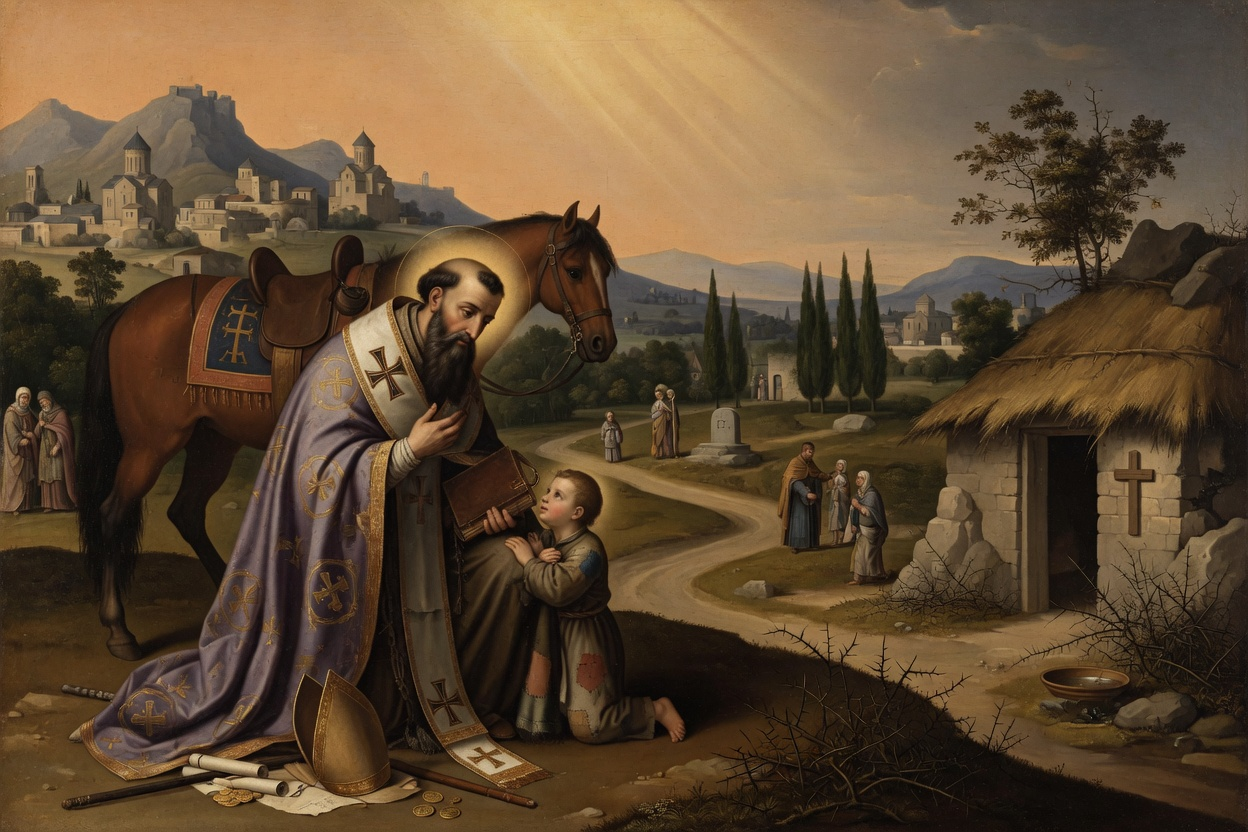
He is represented on horseback with a child behind him who guides him through Asia and Europe to Pithiviers, where his host directed him toward Saint-Martin de Vertou.
The Acts that we have just reported are all the more authentic, as the author who left them to us assures that he saw a large part of them with his own eyes, that he learned another part from several people of his time who had conversed familiarly with the Saint himself, and that one has the truth from the very mouths of his relatives, who came from Armenia to France, as we have said. We have drawn what we have just said from the originals that we found in Rollandus, also benefiting from the learned remarks that some modern authors have left on this subject.
Annexes & related entities
Structured data for exploration: events, miracles, quotes, places, attributes, patronages, and important entities cited in the text.
Key Events
- Christian education in Armenia
- Renunciation of paternal inheritance and entry into the monastery of Nicopolis
- Election to the episcopal see of Nicopolis
- Struggle against the Manichaean heresy
- Secret resignation and journey to the West with two Greek religious
- Installation as a recluse at Saint-Martin-le-Seul near Pithiviers
- Seven years of austere eremitic life in France
Miracles
- Exorcism of a nobleman possessed after showing contempt for the saint
- Healing of a blind man at his tomb
- Healing of a woman with a paralyzed hand
- Multiple healings of the sick through his intercession
Quotes
-
The solitary escapes the triple temptation of the eyes, the ears, and the tongue.
Saint Ephrem (cited as an epigraph)