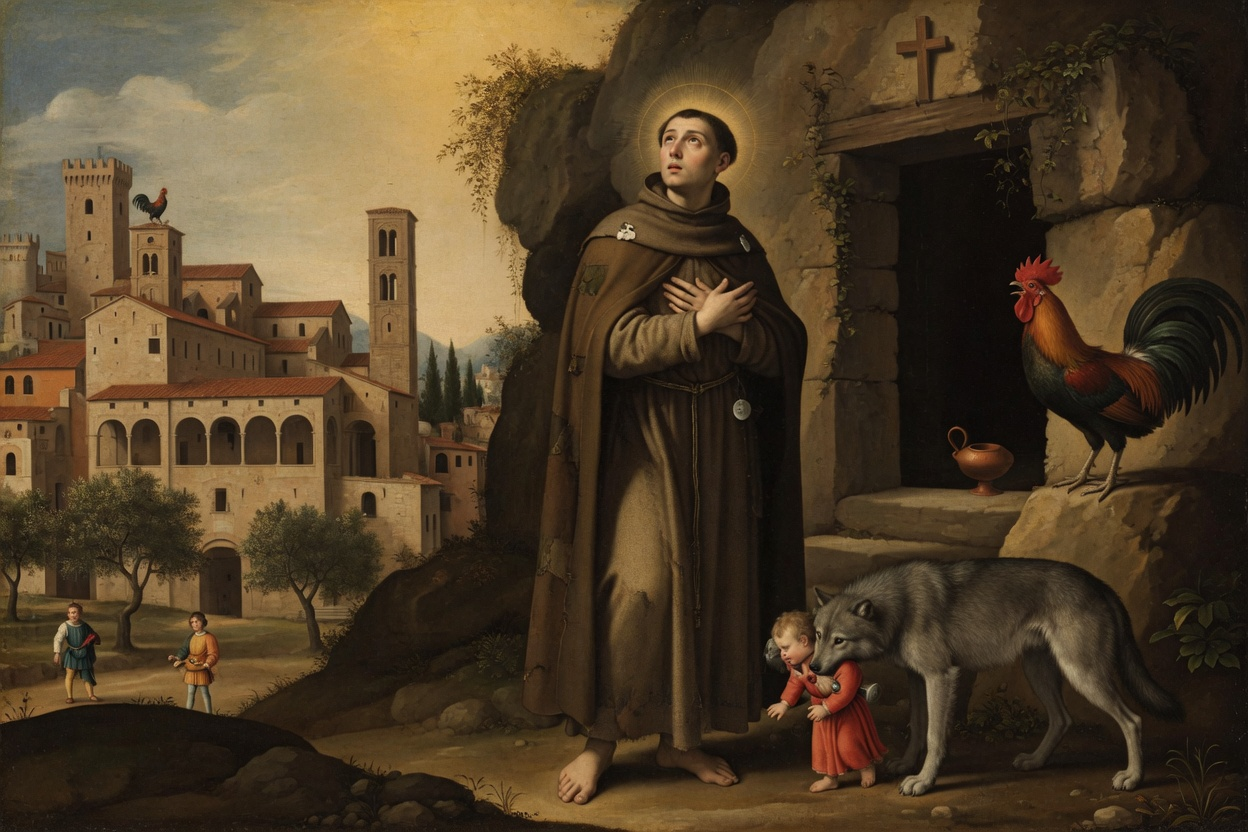
Born in Poppi in 1202, Torello led a pious youth before falling into debauchery. His sudden conversion, triggered by the crowing of a rooster, led him to the Abbey of San Fedele and then to a life as an austere hermit. He is famous for having saved a child from a wolf and died in the odor of sanctity in 1282.
Guided reading
5 reading sections
THE B. TORELLO, HERMIT OF THE VALLOMBROSAN ORDER (1282).
Youth and moral fall
Born in Poppi in 1202, Torello received a pious upbringing but fell into debauchery after his father's death, influenced by bad company.
One of the greatest blessings we can receive from the goodness of God is that of a Christian education. Doubtless, not all who have had this inestimable advantage profit from it; there are even some who render themselves entirely unworthy of it; but it is at least a precious seed in their soul which, being developed by grace, can produce fruits of salvation; and while the language of religion is often unintelligible to those who have not conceived it in their youth, its friendly voice is easily heard by those who had listened to it before their wanderings. The life of Blessed Torello offers us a new proof of this truth.
He was born in Poppi, in Tuscany, on March 16, 1202, and ha d the Poppi Birthplace and burial place of the blessed. happiness of having for a father a man filled with the fear of God, who took great care to inspire it in him from his earliest childhood and who was seconded by a very virtuous wife. Torello responded perfectly to the good care of his parents, and as he grew up, became a model of piety; he fled games and all other profane amusements, and lived in an innocence of manners that was the joy of those who gave him life. Unfortunately for him, he lost his excellent father at a time when he still had great need of his support to sustain himself in the practice of good. However, this death did not shake him at first. He took the resolution to attach himself more closely to God; and to obtain more abundant blessings, he distributed numerous alms into the bosom of the poor of the country. But in giving himself to these good works, he did not sufficiently distrust his own fragility and weakness; he forgot that the Lord makes Christian vigilance a duty for us all. The connection he formed with two young men from Poppi, whose morals were depraved, became for him the cause of the most deplorable fall; he abandoned the respectable societies he frequented, his good habits, his exercises of piety; and after having been an object of edification for his compatriots, he became a scandal to them, so dissolute was his life. A young person from the surroundings, more pleasant than virtuous, fixed his attention and captivated his heart so much that she made him bend to all her wishes. Thus this unfortunate young man forgot all the wise counsels of his father, and this tree which had shown such beautiful flowers produced no more fruit. He even despised all the advice that the most respectable people could give him. But God, who had particular designs of mercy for this unfaithful soul, enlightened him and made him know his misery. One day when Torello was playing bowls, in the presence of his mistress, with his treacherous friends, a rooster perched in the place where he was suddenly flew onto his shoulder and began to crow three times; it seemed to him that this rooster was saying to him: "It is time to come out of the mortal sleep of vices." Whether this event was entirely natural, or whether the Lord wished to use such a means to call this sinner back to Him, as He had used for Saint Peter, it is certain that Torello felt an impression so vivid and so profound that, leaving the game at that very moment, he ran to the Abbey of Saint-Fidèle, of the Vallombrosan Order, which was not far away, went to throw himself at the feet of the superior, and, with tears in his abbaye de Saint-Fidèle Vallombrosan monastery where Torello converted and was buried. eyes, begged him to help hi Ordre de Vallombreuse Monastic affiliation of the convent founded by the saint. m return to grace with God. The abbot, who was a holy man, welcomed him with kindness, and after having heard his confession, he admitted him in due time to the holy table. Entirely disgusted with a world that had been so fatal to him, the new penitent begged the abbot to be willing to clothe him in the habit of the secular lay brothers, regarding himself as unworthy to live in the monastery. The venerable abbot, seeing that Torello, who wanted to practice the eremitic life, was led by the spirit of God, condescended to his desire, and before he left the abbey, he wanted to give him a bag of wheat bread; but the latter refused them and accepted only three small barley loaves. He then left and departed with joy from the country of Poppi, without any of his relatives or friends noticing. Torello spent eight days looking for a solitude in which he could settle. Having found a cave that suited him, he returned to Poppi, distributed all his goods to the poor, and despite all the insistence of his family, who told him that he must not become a homicide of himself, he hastened to go to his hermitage. There he began a penitent and mortified life whose utility worldlings cannot understand, because they have never well meditated on these terrible words of Jesus Christ: "Unless you do penance, you shall all likewise perish." He ate only once a day, around three o'clock in the afternoon, drank only water and in small quantity, slept on brushwood, and rose every night to recite Matins. He afflicted his body in a thousand ways, in order to repair his past disorders and to triumph over his passions. The Father Abbot of Saint-Fidèle, who had reconciled him with God and who was his director in the ways of salvation, visited him often in order to provide him with the spiritual help he needed. Informed and surprised by the austere penance of Torello, he expressed to him one day the fear that it lacked discretion; but the fervent penitent gave him such good reasons to justify his way of acting, that the abbot, who recognized that the Holy Spirit was enlightening him, said to him: "My son, may God strengthen you in your good resolution and in His service until death." Then he gave him his blessing. The wish of the pious abbot was completely realized. Torello remained faithful to his vocation, however painful it was for nature. Overwhelmed by illnesses and infirmities, he rejoiced to suffer, in order to satisfy divine justice. The memory of the Passion of the Savior, on which he frequently meditated, made him shed abundant tears. Such a holy life made him venerable to those who knew him and who resorted with confidence to his lights; it earned him heavenly favors. He stopped by his prayers a wolf which, having carried off a child, was ready to devour him; he suddenly healed the wounds that the wolf's bites had made on this child, and returned him healthy to his mother. It is even said that since that time no wolf has attacked anyone in the country he inhabited.
Conversion and withdrawal to the desert
Stirred by the crowing of a rooster, he repented at the Abbey of Saint-Fidèle and chose a life of a hermit marked by extreme austerities.
Warned of the hour of his death, he informed the Abbot of Saint-Fidèle, confessed, and received Holy Communion. He also announced his death to a disciple he had with him in his hermitage; he gave him the wisest counsel; then, embracing him tenderly, he said to him: "I feel that God is calling me; I commend you to our Creator." Then, having knelt to pray, he raised his hands toward heaven and peacefully rendered his spirit, on March 16, 1282, at the age of eighty. He was buried in the church of the Abbey of Saint-Fidèle in Poppi, where his relics have a lways Poppi Birthplace and burial place of the blessed. been preserved with great respect.
Miracles and end of life
Renowned for having tamed a wolf, he died in 1282 after receiving the last sacraments and was buried in Poppi.
He is depicted with a wolf at his side. Here is why: in the name of God, he made a wolf let go of a child that it was carrying away, whom its mother had placed on the bank Arno River diverted by the saint to prevent flooding. of the Arno while she was washing her laundry there. Furthermore, the holy man forbade this animal from ever attacking anyone from Poppi: hence the devotion of the inhabitants of Poppi, who invoke Blessed Torello against wolves. He is also honor ed in Forlì City where the saint has been honored from time immemorial. Forlì from time immemorial.
Cult and representations
The saint is traditionally depicted with a wolf and is the object of particular devotion in Poppi and Forlì.
His life, written several centuries ago, has been reproduced by various authors and can be found in the second volume of March of the Bollandists' collection. Dom Soldani, a compatriot of the Blessed and a monk of Vallombrosa, published a new imitation of it under the title of *Apologetic Treatise*, to prove that the servant of God belonged to the Order of Vallombr Ordre de Vallombreuse Monastic affiliation of the convent founded by the saint. osa, and not to that of Saint Francis. 1 vol. in-4°, Lucca, 1731. (Godescard, Lille ed.)
Hagiographic sources
His biography is documented by the Bollandists and Dom Soldani, the latter defending his membership in the Vallombrosan Order against Franciscan claims.
His life, written several centuries ago, has been reproduced by various authors and is found in the second volume of March of the Bollandists' collection. Dom Soldani, a compatriot of the Blessed and a religious of Vallombrosa, published a new imitation of it under the title of *Apologetic Treatise*, to prove that the servant of God belonged to the Order of Vallombrosa, and not to that of Saint Francis. 1 vol. in-4°, Lucca, 1731. (Godescard, Lille ed.)
Annexes & related entities
Structured data for exploration: events, miracles, quotes, places, attributes, patronages, and important entities cited in the text.
Key Events
- Born in Poppi in 1202
- Period of dissolute life after his father's death
- Conversion following the crowing of a rooster during a game of bowls
- Entered the Abbey of Saint-Fidèle as a secular lay brother
- Eremitic retreat in a cave for many years
- Rescue of a child from the jaws of a wolf
- Died at the age of 80
Miracles
- Prophetic crowing of a rooster leading to his conversion
- Rescue of a child carried off by a wolf on the banks of the Arno
- Instantaneous healing of the child's bites
- Permanent protection of the region against wolf attacks
Quotes
-
It is time to wake from the mortal sleep of vices
Words attributed to the crowing of the rooster in the text -
I feel that God is calling me; I commend you to our Creator
Last words to his disciple