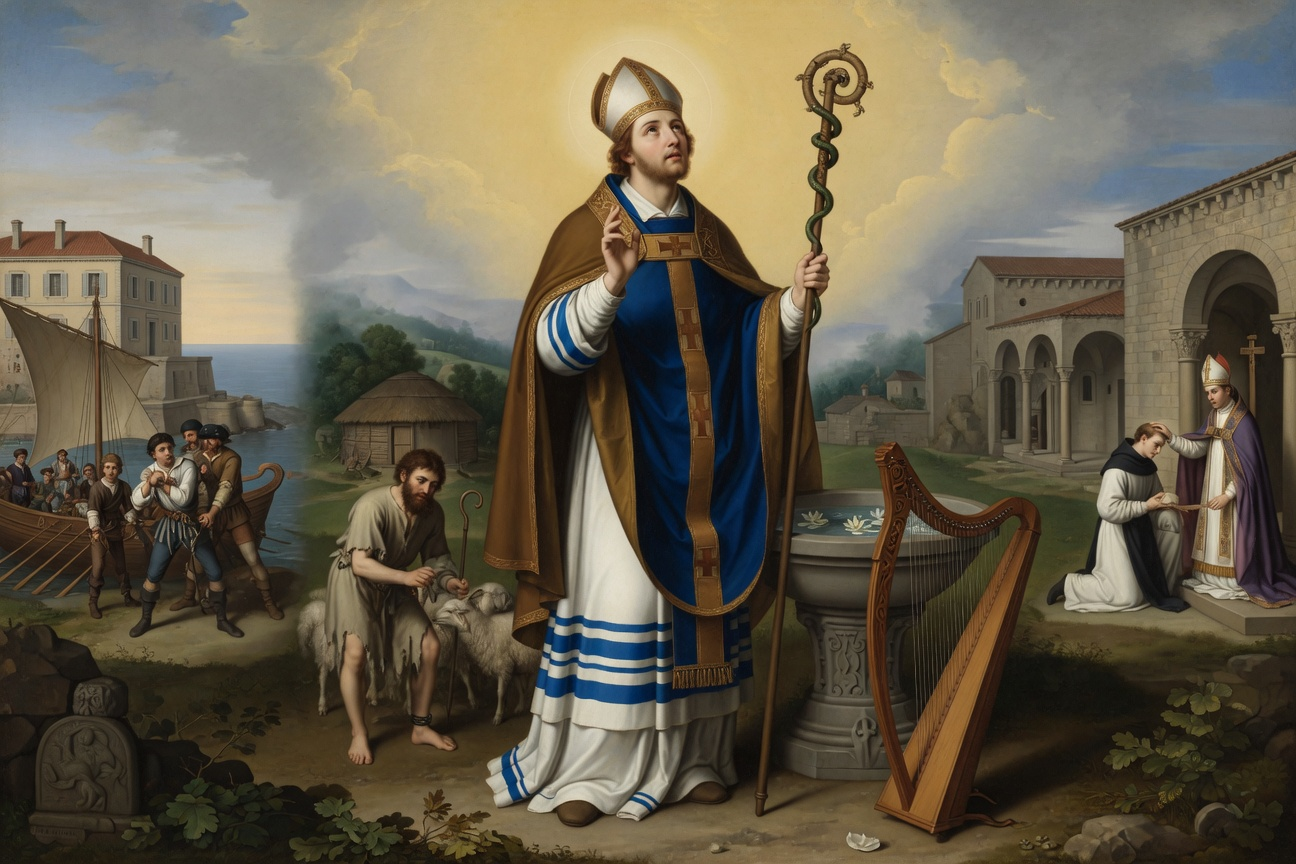
Born in Gaul and captured by pirates, Patrick lived six years in slavery in Ireland before escaping. Trained by Saint Germanus of Auxerre and sent by Pope Celestine I, he returned to Hibernia as a bishop to convert the entire island. He is famous for driving out snakes, overthrowing druidic idols, and establishing the famous 'Saint Patrick's Purgatory'.
Guided reading
10 reading sections
SAINT PATRICK, APOSTLE OF IRELAND
Context and early missions
Ireland, historically linked to the Holy See, saw its first attempts at evangelization fail with Palladius before the arrival of Patrick.
I will send the heralds of my word to Greece, to Italy, and even to the most remote islands, to those who have not heard of me and have not seen my glory. Isaiah, LEVITICUS, 19. It is with good reason that the close union of the Church of Ireland with the Holy See, during the three centuries of persecution it has just endured, has been regarded as the source of the heroic courage displayed by its children in the defense of the Catholic faith. Irish Catholics have believed for 1400 years that this union of their homeland with Rome is the work of Saint Patrick: thus, their l saint Patrice Evangelizer of Ireland and spiritual master of Guigner. ove and gratitude for this great apostle are equaled only by their attachment to the See of Peter. As for the Irish Protestants, although they have never shown much respect for the name and works of Saint Patrick, they have not failed, on occasion, to claim him as one of their own; and in order to show that this great missionary thought as they did, they have dared to maintain that since Rome had not sanctioned his mission, Saint Patrick had simply established something like the Anglican Church, a Church if not hostile to the successors of Saint Peter, at least completely independent. The entire life of Saint Patrick refutes this mendacious assertion and demonstrates the union that existed from the beginning between the Church of Ireland and Rome, the center of all spiritual jurisdiction. It was only from the pontificate of Saint Celestine I that Ireland could be called a Christian land. Doubtless, some of its children had already ranged themselves under the banner of Christ; but they lived in isolation as long as no Apostle visited their shores. At that time (431), Palladius was a deacon of Rome: now, we know the importance of this office in the first centuries of the Church: most of the first Popes had occupied it before being promoted to the sovereign pontificate, and during the vacancy of the Apostolic See, it was the deacon of Rome who took charge of the administration. Celestine I, then reigning, parted with P alladius, wh Célestin Ier Pope who confirmed the election of Maximian. o was his right-hand man, and whose knowledge and piety he knew better than anyone, to send him as the first bishop to the Scots of Ireland who believed in Jesus Christ. While passing through Auxerre, Palladius requested, in the name of the Pope, tha t Saint Auxerre City and episcopal see of the saint. Germanus go to combat Pelagianism in Great Britain. The preaching of Palladius in Ireland produced little fruit, "for no one can receive anything on earth unless heaven sends and gives it." His stay was of short duration in that country: he had, however, the time to found three churches or Christian communities: Teach-na-Roman or house of the Romans; Kill-fine, present-day Dunlavin, and Domnach-Ardech or Donard, near Dunlavin: it was at Dunlavin that, before leaving for Rome, he left the books and relics that Saint Celestine had given him, as well as the tablets he used for writing. But Rome was not to see him again. Having crossed the first sea, as the Irish say, that is to say the strait that separates Ireland from England, he traveled through a part of that country and went to die at Fordun, in present-day Scotland. There were at Donard, in Ireland, the ashes of his two disciples Sylvester and Salonius, who were honored as Saints. Such are the beginnings of the faith on this land which was later to be called the island of Saints; such is the mustard seed which, cultivated by the hands of Patrick, became a great tree.
Youth and Captivity
Born in Gaul, Patrick was captured at sixteen by pirates and enslaved in Ireland, where he discovered prayer before escaping.
We only know the beginnings of Saint Patrick through his Confessio n, which h confession Spiritual autobiography written by the saint. e left to us: we shall be thanked for reproducing this precious monument of autobiography, by interspersing it with a few notes in parentheses.
"I, Patricius, a miserable sinner and the least of the servants of Jesus Christ, had for my father the deacon Calpurnius, son of the priest Potitus. I was born (377) at Bonaven Tabernic (in the vicinity of Boulogne-sur-Mer), in a villa that my father owned, and where I was later captured by pirates, in the circumstances that I am about to relate. I was then sixteen years old, and had never seriously concerned myself with the service of God. The barbarians carried me off with several thousand other captives. We were crowded onto boats, and we were transported to Hibernia. The Lord wished to punish our past offenses and ingratitude. Thrown thus, a poor adolescent, among these foreign nations, my heart opened to grace; I wept for my faults, and resolved to change my life. In his merciful kindness, the Lord deigned to accept my still-sterile vows; his hand protected me among so many dangers and saved my life. I was deeply ignorant. From my childhood, I had manifested a true horror of study. The free life, in the open air of the fields, pleased me alone. Now, a captive and an exile, I had to lead the flocks to pasture. The taste for prayer seized me little by little. I spent the days and part of the nights in this holy exercise. I knelt on the snow, on the frozen earth, or soaked by the winter rains. Six years passed thus, and I was happy in my captivity, because the Lord consoled my soul. One night, I heard, in a vision, the voice of an angel who said to me: Your prayers and your fasts have touched the heart of God. You will soon see your homeland again. The ship that is to take you away is waiting at the port. — However, I was two hundred miles from the coast, and did not know the port of which I was told. Nevertheless, full of confidence in the God who directed me, I took flight, and arrived happily at the port of Ben (Boyne). A ship was stationed there; I boarded it and asked the pilot to take me with him. He refused brutally, and I was already taking the land route again, weeping and praying, when the pilot shouted to me: Come if you wish; only be faithful to us! — Now, these men were pagans (and likely also pirates). How I had wished that they had wanted to follow me in the faith of Christ! However, we weighed anchor. After three days of navigation, we landed in an uninhabited place, where we walked for twenty-seven days. Provisions and water ran out, and hunger was felt dreadfully. The pilot said to me: You are a Christian and you claim that your God is all-powerful. Pray to him then for us, so that he may come to our aid. — Convert from the bottom of your heart, I replied, and God will save you. — Scarcely had I finished these words when we perceived a herd of wild boars. A great number were killed and abundance returned to the caravan. All praised the Lord, and showed me the liveliest gratitude. Sorrows, trials, and temptations did not fail me, however. One day, one of my traveling companions presented me with a piece of meat, saying to me: It has been offered to the gods. — I give you thanks, I replied. — And, that day, I went without food. Another time, during the night, while I was sleeping, I felt the jolt of an enormous stone thrown at me. I thought at first that a rock had detached itself from the mountain, and was going to bury me under its weight. I invoked the Lord. At that moment, the sun was beginning to dawn on the horizon. It seemed to me that the Son of God, in his glory, was coming to my aid. I rose and felt no harm. I finally arrived in my homeland. I had been there for two years when, for the second time, a band of pirates carried me off again. I prayed to the Lord, and a divine voice made itself heard. Your captivity will last only two months, it said to me. — Indeed, on the sixtieth day, I was delivered and returned to my parents who welcomed me with tears of joy. They promised themselves that after so many tribulations, I would no longer be snatched from their tenderness. They repeated these words to me incessantly, and wanted to make me promise never to leave them. Now, one night, I saw a celestial personage standing before me, holding in his hand a volume that seemed a collection of letters. I am Victricius, he said to me. — And he presented to me the collection of his letters. On the first page I read: Voice of the Hibernians. As I continued reading, it seemed to me that I heard the woodcutters of Foclutum (Foclayd) who, addressing me, said: We beseech you, holy young man, come back among us, and teach us the way of the Lord. — I felt moved to tears, I wept, and the vision disappeared. Blessed be the Lord! for since then, the peasants of Foclutum have responded to the hope that this prophecy gave birth to in my soul. The following night, in the depths of my being or at my side, I could not say, but the Lord knows, I heard something like canticles of a holy psalmody, but I saw no one, and I do not know where these voices came from. I began to pray, and I heard this word whispered in my ear: It is I who gave my soul to redeem yours. — At that moment, it seemed to me that within me someone was praying with groans and tears; I had the consciousness that the Spirit of God was praying in me. — The next day, I opened up about these mysterious visions to a childhood friend. He replied: One day you will be bishop of Hibernia. — This word threw me into consternation, I, a miserable sinner. And yet it came to pass."
Formation and divine call
After a second captivity, Patrick trained at the monastery of Marmoutier, then under Saint Germanus of Auxerre and at Lérins.
Some time later, the parents of young Patrick had to make a journey to Armorica. Upon arriving, they found the entire province invaded by barbarians. Patrick's father and mother were slaughtered. The young man was reserved as a valuable slave. He was sold to Picts, who took him onto their ships. The flotilla was heading toward Great Britain when Gallic ships, coming to meet them, seized them. Patrick changed masters without regaining his freedom. They set course for Bordeaux. There, Christians ransomed the captive, who came to knock at the door of the monastery of Saint-Martin of Tours. He was admitted among the religious, and he soon distinguished himself there by his piety and fervor.
However, divine visions did not cease to show him Hibernia as the land where he was to carry the heavenly seed of the faith. After four years of cenobitic life, he left the hospitable monastery, crossed the strait, and came to evangelize the Irish city of Temoria (Temair). It was not yet the hour marked by Providence. The missionary was welcomed by the pagan populations as an enemy. He had to leave this ungrateful land and return to the Gauls. He placed himself for three years under the direction of the illustrious bishop of Auxerre, Saint Germanus. Then, for nine years, he went to ask the rocks of the island of Lér saint Germain Saint cited as a model of public confession for Gervin. ins, with the solitude they offered him, for the secrets of grace and conversion he needed for the distant country he had a mission to convert. Germanus of Auxerre, who had traveled through Great Britain as a legate of the Pope, knew that at the northern extremity of the known world existed a land that had not yet seen the sun of the faith rise: Patrick, who accompanied him on this journey, spoke to the holy Bishop of his hopes and his plans for apostolate. Germanus understood the necessity of sending evangelical workers to Hibernia. Upon his return from England, he had Patrick leave for Rome with letters of recommendation addressed to Pope Saint Celestine: he was to speak to the sovereign Pontiff of the advantage there would be in adding as a cooperator to Palladius a religious whom a long captivity had familiarized with the language and customs of the Irish.
Saint Patrick was accompanied to Rome by a holy priest of the clergy of Auxerre, named Segetius, who had received instructions from Saint Germanus to represent the future apostle "as a strong man and apt to reap the harvest of the Lord." A missionary whose talent and piety were attested by Saint Germanus, that is to say by a bishop who had the full confidence of the Pope, could only be welcome in Rome. Following a tradition long received in the capital of the Catholic world, the entire entourage of the Pope declared unanimously that no one more than Patrick was fit for the mission to Ireland.
The Apostolate in Ireland
Consecrated bishop, Patrick returned to Ireland in 432, converted local leaders at Tara, and founded the first Christian communities.
It was very shortly before the death of Saint Celestine that Saint Patrick asked the Apostolic See to bless his labors. Without delay, he resumed the road to Auxerre where his friend and protector, Germanus, awaited him. He was on his way to Ireland when two disciples of Palladius brought him the news of their master's death. Then, he made a detour to be consecrated by a bishop of England, named Amator, whose see is unknown. After receiving episcopal consecration, he set out for his destination, accompanied by Analius, Iserninus, and several others: the holy company landed in Ireland during the summer of the year 432.
During his passage through Cumbria and Cornwall, his words and miracles had wrought striking conversions. People wanted to keep him. They sought to frighten him with the prospect of the dangers he would run among the pagans of Hibernia. "But," he says in his Confession, "the Lord reassured me in heavenly visions. One night, His angel made me read this word of the prophet Zechariah: He who touches you, touches the apple of my eye!" Arriving in Ireland, he went to the general assembly of the chiefs and warriors of Hibernia, which was held annually at Tara, or Temoria, in the province of East-Meath. There resided the principal chief, called the king of the island; the college of druids was installed there and formed the religious center alongside the political center of the whole country. Patrick fearlessly preached the faith of Jesus Christ before these fierce warriors. The son of Neill, the principal monarch, interrupted the discourse and threatened the audacious stranger with all his wrath: but several other chiefs were converted, among others the father of Saint Benen, or Benignus, who was later to succeed Saint Patrick on the see of Armagh. Their example was soon followed by the kings of Dublin, of Mu Armagh Metropolitan see of Ireland. nster, and by the seven sons of the king of Connaught. Ultonia, rebellious to all the efforts of Saint Palladius, welcomed the new bishop with enthusiasm. One of his neophytes offered him a considerable estate, near the town of Down; a monastery was erected there under the name of Sabball-Padrigh (Patrick's Grange). It is indeed in a humble grange that the new missionary celebrated the divine office for the first time on the soil of Ireland, and it is to recall these modest beginnings of his apostolate that the missionary bishop gave the name of Grange to his first monastery. Two other foundations of this kind, Domnach-Padrigh (Church of Patrick) and Armagh, became in a few years considerable Christian communities. Surprised himself by the progress of his apostolate, the humble Bishop exclaimed: "From where can these wonders come? How have the sons of Hibernia, who had never known the true God and who worshipped impure idols, become a holy people, a generation of children of God? The sons and daughters of kings solicit the honor of being monks, or of consecrating their virginity to the Lord. Not long ago, I baptized a young girl of the Scots as noble as she was beautiful. Six days later, she came to find me and said: An angel appeared to me; he ordered me to remain a virgin and to have no other spouse than Jesus Christ. — She urgently requested the veil of the nuns. She received it, despite the threats, the very persecutions of her family. And how many other virgins and widows, who struggle thus against all human obstacles, to remain faithful to their heavenly spouse! I do not know the number; but God knows it, He who gives His humble servants heroic courage. Also, who will ever tear me away from this land of blessing? What remains of my family solicits me in vain so that for one last time I might go visit my homeland. I am called to the Gauls, where I would have so much happiness to contemplate the face of the Saints. But the Spirit chains me to this land that I am evangelizing. If I were to leave it, I would be a deserter!"
Defense of the Oppressed and Culture
Patrick violently opposed the slave trade, notably through his letter to Coroticus, and integrated the poetry of the bards into the Christian faith.
History and legend have vied with one another in seizing upon the life of Patrick.
In his legend, nothing is more poetic than the meeting of the Gallo-Roman apostle with the Irish bards, who formed a hereditary and priestly caste. It was among them that he recruited his most faithful disciples: it is Ossian himself, the blind Homer of Ireland, who allowed himself to be converted by him, and to whom he in turn permitted the singing of the long epic of the Celtic kings and heroes. The agreement between them was not established without being preceded by some storms: Patrick threatened with hell the warriors who were too profane, whose glory Ossian sought, and the bard replied to the apostle: "If your God were in hell, my heroes would pull him out." But triumphant truth brought peace between poetry and faith. The monasteries founded by Patrick became the asylum and the hearth of Celtic poetry. Once blessed and transformed, says an old author, the songs of the bards became so beautiful that the angels of God leaned over the edge of heaven to listen to them; and this explains why the harp of the bards has remained the symbol and the coat of arms of Catholic Ireland.
In his history, nothing is better attested than his zeal to preserve the country where he himself had suffered slavery from the abuses of servitude and especially from the incursions of those pirates, Britons and Scots, thieves and merchants of men, who made it a sort of stud farm where they came to recruit their human cattle. Nothing is more authentic than his eloquent protest against the king of a British horde who, landing in the midst of a people baptized the day before, had massacred several of them and carried off the others to sell them far away. "Patrick, an ignorant sinner, but constituted a bishop in Hibernia, a refugee among barbarian nations, because of my love for God, I write with my own hand these letters to be transmitted to the soldiers of the tyrant, I do not say to my fellow citizens nor to the fellow citizens of the saints of Rome, but to the compatriots of the devil, to the apostate Scots and Picts who live in death and who come to fatten themselves on the blood of the innocent Christians whom I have begotten for my God... Does the divine mercy that I love not oblige me to act thus, to defend those very people who formerly made me a captive myself and who massacred the servants and handmaids of my father?" Elsewhere he praises the intrepidity of the slave girls he had converted, who heroically defended their modesty and their faith against unworthy masters.
The trade in men and women was practiced then among all Celtic nations, as it was in the last century on the coast of Africa. Among them, slavery and the slave trade were much more difficult to eradicate than paganism. This trade was still in full activity in the 10th century between England and Ireland, and the port of Bristol was its main warehouse.
But let us return to the letter of Saint Patrick to Coroticus, f or that Corotic British chieftain denounced by Patrick for his slave-raiding. was the name of this barbarian, this clan chief who had devastated Patrick's flock: "Where will they go, however," cries the holy Apostle, "where will this Coroticus and the bandits he has raised against the Lord and his Christ go? What will be the fate of the villains who count as a feat the massacre of weak women, who share with bloodstained hands the inheritance of orphans, who believe they are founding a temporal kingdom in blood and tears, less stable than a cloud or smoke? Peccatores et fraudulenti a facie Domini peribunt." — The fierce spoiler was not softened by this letter; he did not return the captives. Patrick then spread copies of his letter to Coroticus throughout the island of Great Britain, in Armorica, in the Gauls, and in Germania. He added the following attestation: "In the presence of God and his angels, I certify that the future will be as I have predicted. Not that I wish to presume upon my ignorance or my weakness, but the Lord does not lie, and it is his word that I announce. I beg all the servants of God who will read this letter to publish it everywhere and to make it known to the Christian people. Let it be distributed especially among the subjects of Coroticus. Perhaps one day they will come to repentance; then they will regret having dipped their hands in blood, and they will restore freedom to the captives." — A few months later, Coroticus, struck by mental alienation, died in despair.
Structuring of the Church of Ireland
The saint organizes parishes, defines rules for the clergy, and obtains from Rome the erection of Armagh as a metropolitan see.
During the pontificate of Saint Leo the Great, Patrick had made a journey to Rome to obtain the canonical erection of the church of Armagh as a metropolitan see. Upon his return, he ordained new bishops in Hibernia, whose acts bring the number up to thirty. We know of only two of them, Auxilius and Iserninus, whose names, without any mention of a see, appear with that of the saint at the head of the canons of a council of Armagh. These canons are interesting from the point of view of the customs of Great Britain in the 5th century. The ransoming of captives was the work of charity par excellence, in a time of perpetual invasions.
Parishes were already established: the pastors who had charge of them bore the title of "abbots," no doubt because it was religious or monks who first gathered a nucleus of the faithful in each locality. They were prescribed not to welcome any foreign cleric or priest unless he carried a letter of communion issued by the diocesan bishop. The latter made pastoral visits each year to the territory subject to his jurisdiction. During the time he spent in a parish, all the offerings made at the altar by the Christians of the locality belonged to him: the abbot or parochus who wished to retain them for his own profit was struck with censure. Inferior clerics could not leave a church or move to another without the permission of the incumbent. Finally, foreign bishops were not to exercise any function of their order without the express authorization of the diocesan.
Last Days and Life of Prayer
Patrick died in 464 after a life of extreme austerities; he was buried at Down by Saint Brigid.
Such was the religious situation of the Church of Ireland after the thirty years of its founder's episcopate. Saint Patrick was then an octogenarian. In a final page of his Confession, he wished to inscribe the spiritual testament he was leaving to his successors. "If I have not done more," he said, "let it be imputed to my incapacity and my misery. May it please God that my sons surpass me in works of blessing and in fruits of salvation! This will be my glory: Filius sapiens gloria patris est. I humbly confess my insufficiency, but at least I can bear witness to myself that I have always practiced the most absolute selflessness. How many times, my brothers, did the Christians, the virgins of Jesus Christ, and the pious women place upon the altar the offerings intended for me! I always took care to have them returned to them. Often I was reproached for acting thus. But I wished thereby to honor my ministry in the eyes of the infidels, and to prevent even the shadow of a suspicion of avarice or greed. Thus, of so many thousands of neophytes whom I have baptized, none can boast of having made me accept a gift for my personal use. If there is even one, let him say so: I am ready to return everything. My beloved, it is you, not your riches, that I have sought. What had been given to me freely, I distributed in the same way; the clerics ordained by my mediocrity cannot complain that I received anything from them. Even the shoes on my feet, I would not have wanted to owe to the charity of anyone whatsoever. To you, your goods; to me, the fatigues, the dangers, the perils of every kind, at the price of which I was able to save some souls. Jesus Christ my master was poor; I thank him for having called me to the honor of sharing his chalice. How I ambition the lot of our martyrs who shed their blood for him! I would that my miserable corpse, torn to shreds, were abandoned as food for birds of prey or wild beasts. But since this happiness has been refused to me, I humbly beg the God who reigns in glory to take into account my desire and to have mercy on me."
The holy old man had a revelation that made him know his approaching death. "He had gone," say the Acts, "to visit the parishes of Ulster, and was preparing to take the road back to Armagh, when the angel of the Lord warned him that he would not return alive to his episcopal city. Near Duna (Down), there was a monastery of pious virgins, under the direction of Brigid, the pearl of Hibernia. The blessed Bishop, surrounded by a procession of re ligious Brigitte Irish saint who attended Patrick at his death. and ecclesiastics, wished to visit these holy maidens and address to them for the last time his paternal exhortations. While he was speaking, a brilliant light came to rest on a spot in the cemetery, to the east of the church. All those present asked the Saint what this supernatural manifestation meant. Patrick refused to answer, but, addressing Brigid: 'My daughter, explain to us yourself,' he said to her, 'the meaning of this apparition.' The virgin replied that the place thus marked designated the tomb of a venerable servant of God who was soon to receive burial there. Patrick did not press his questions further. On the point of leaving Brigid, he said to her in private: 'I am returning to the monastery of Sabhall. Prepare the shroud in which you are to bury me, and bring it promptly.' Arrived at Sabhall, the man of God stretched out on his bed to die. He received the divine mysteries from the hands of Bishop Thasach, his disciple. Then, raising his arms, he blessed his own, commended them to the Lord, and passed from this world to eternity, from faith to clear vision, from the sorrows of time to the endless joys of heaven (March 17, 464). The pious Brigid buried him in the shroud made by her. The tomb was dug in the cemetery of the church of Down, at the place previously designated.
His funeral was not without wonders; angels were heard singing there, and when they withdrew, they left around his body a pleasant odor, as if the most exquisite perfumes had been spread there. It is also said that, for twelve days, there was no night or darkness at all throughout the province; and even that the shadows were not as thick throughout the year as they are accustomed to be. As God promised Saint Patrick that those who would be devout to his memory, and who would perform some works of piety in his honor on the day of his feast, would obtain mercy at the hour of death and would not perish eternally, it is extremely advantageous to place oneself under his protection.
The holiness of his morals corresponded to his great and beautiful actions: he recited every day the entire Psalter of David and several other prayers with extraordinary devotion; his life was a prayer and a continuous application; he had such great respect for the sign of the cross that he made it upon himself at all moments, and that, when he encountered crosses, he would stop, prostrate himself on the ground, and adore them most profoundly; he never traveled on Sundays, being persuaded that these days must be used solely for the worship of God and for interior rest.
Let us add to this portrait some traits drawn from the Roman Breviary:
"By the preaching of Patrick, Ireland, previously a hotbed of idolatry, became the island of Saints... He enriched his metropolitan church with relics of saints, brought from Rome. The visions from on high, the gift of prophecy, and great miracles, with which God favored him, made him shine so brightly that the fame of Patrick spread very far... He adored God three hundred times a day on his knees; while reciting each hour of the breviary he made a hundred signs of the cross upon himself. Dividing the night into three parts, during the first he recited a hundred psalms and made two hundred genuflections; he spent the second reciting the other fifty psalms, immersed in cold water, his heart, eyes, and hands raised toward heaven; he devoted the third to a light rest, stretched out on the bare stone. Of a singular humility, he worked with his hands like the Apostle."
Iconographic Attributes and Miracles
The saint's iconography is marked by the driven-out serpent, the Irish harp, the baptism of kings, and the destruction of solar idols.
## ICONOGRAPHY AND LEGENDS; — SAINT PATRICK'S PURGATORY.
1° The Apostle of Ireland is represented with a baptismal font near him, not only because of the conversion of Ireland, but because, it is said, on the very day of his baptism, he restored sight to a man born blind who, inspired by a voice from above, went to take the right hand of the little Patrick and made him trace the sign of the cross on the ground. A spring gushed from the earth; he washed his mourning eyes with the miraculous water, and immediately he recovered his sight. His inner eyes opened at the same time to the gift of knowledge, and this man, who had never seen letters of writing, could read and understand what he was saying. This triple miracle, due to the sign of the cross, is recorded in the ancient office of Saint Patrick. This was later interpreted as a prophecy of the ministry he was to exercise by opening the eyes of the heart to the Irish. It is also said—to exhaust the question of baptism—that while baptizing a king of Ireland, he inadvertently rested the bottom of his crozier on the prince's foot. Now, as the pastoral staff ended in a point, he soon noticed his mistake upon seeing the neophyte's blood flow. The catechumen had not flinched, thinking that this ceremony was part of the Christian rite. Such faith deserved a miracle: the Saint healed the foot he had pierced.
2° He is also represented at the feet of Pope Saint Celestine, either to express that he asked the Pope for permission to bring the faith to Ireland—and this would not distinguish him from other converters of nations who all hold their mission from the Apostolic See—or more probably to show the inviolable attachment of the Irish to the Holy See.
3° A serpent coils at the base of his crozier. This reptile is given as an attribute to Saint Patrick because it is accepted by the Irish that he drove snakes and other venomous beasts from their island. The fact is that the English have tried several times in vain to acclimatize dangerous animals in Ireland.
4° Saint Patrick overthrows the idol of the Sun. While visiting the county of Leitrim, he encountered the plain of the massacre. There stood, from time immemorial, the principal Druidic idol of the Irish, called the head of the Sun. This frightful image, which was said to be of gold, appeared surrounded by twelve smaller idols, which represented, as is believed, the signs of the zodiac. The horrors of pagan superstition were renewed around this hideous idol, an object of worship for all the colonies by which the island had been successively conquered. As with the ancient Moloch of the Phoenicians and Carthaginians, small children were offered to it in sacrifice on certain days; and the cries of these innocent victims, and the tears of the poor mothers, had always remained powerless to abolish a barbaric custom of which one would find so many examples among the peoples of antiquity.
To Saint Patrick was reserved the glory of destroying at once the old Irish idol and the worship rendered to it. Arrived on the field of the Massacre, the new Apostle preached to the people the pure and holy doctrine of the Gospel: his powerful and persuasive voice was heeded. Soon, on the order of the envoy of God, the horrible idol was struck down; its worship was destroyed forever. A few days later, on this same theater of blood where the hideous head of the Sun had stood, one saw a great church arise, where the worship of the God of the Christians, the true Sun of justice and truth, came to replace these monstrous rites, which, for so long, had defiled and bloodied this plain of Ireland.
5° Saint Patrick commands death to return its victims, so that their own mouths might proclaim before the people the truth of the doctrines he announced to them; or else he ensures whether his order to plant a cross on the grave of Christians, and not of infidels, has been faithfully executed, by questioning the dead themselves and learning from their mouths if they have earned this consoling homage. There are few lives that are embellished with more numerous wonders than that of Saint Patrick. In Ireland, the blood of the martyrs did not sow Christians, since only one of the Apostle's companions fell victim to the hands of an Irishman during the course of this peaceful crusade—and what other nation can boast of being thus as if virgin of the blood of its first missionaries!—but in return, God granted his envoy the omnipotence of miracles to an extraordinary degree.
6° Here he is with the harp of the Irish in his hands, no doubt to express the ardent prayers of the afflicted homeland, for this attribute was only given to him after the cruelties exercised by Anglicanism, although, strictly speaking, this attribute, as emerges from the life of Saint Patrick, may recall his good relations with the bards.
7° He drives out demons. His 12th-century historian recounts that, when the man of God landed in Ireland, the demons, suspecting that they had to deal with a formidable champion, formed a circle with which they girded the entire island to bar his passage; but he raised his right hand, made the sign of the cross, and passed through. He alone had perceived the infernal cohort.
Saint Patrick's Purgatory
The legend of the expiatory well at Lough Derg became a major pilgrimage site in Europe, documented as early as the 12th century.
8° Kneeling before another smoking one. This is an allusion to the famous Purgatory of Saint Patrick. It was a cavern located on a small island i n Lough D lac Dearg Site of the famous Saint Patrick's Purgatory. erg, in the province of Western Ulster: it opened through a well from which one descended into the expiatory depths. The Saint, in order to touch the hearts of his flock, had an image of the sufferings of the damned depicted on the walls. It was there that he often retired himself to practice the austerities of penance and meditate on the rigor of God's judgments. Several other Saints, following his example, retired into this secluded cavern.
It was in this den that the purgatory took place. On the shores of the island, there were small mounds to receive the pilgrims, and near the well of Saint Patrick, six small round lodges, three feet in diameter, like so many discomforts, to exercise the pilgrims who went there in order to anticipate their purgatory in this world, by praying there and practicing the austerities of penance in imitation of Saint Patrick.
The popularity of this old Irish legend, according to which one could discharge any debt contracted toward God by previous sins by descending into the Purgatory of Saint Patrick as if into a place of expiation, persisted for a long time even outside the island, since the great Spanish playwright, Calderon, left a drama entitled: *El Purgatorio de san Patricio*.
The tradition of Saint Patrick's Purgatory deeply moved all the minds of the Middle Ages; it is one of the facts whose trace is best followed through the centuries, from the 6th to the middle of the 17th.
Messingham and numerous Irish authors trace the origin of this purgatory back to Saint Patrick, that is to say, to the beginning of the 5th century.
It would be too long to recall here the crowd of writers who have dealt with this great Christian tradition.
In the ancient office of Saint Patrick that was recited in Ireland, allusion is made to this purgatory. Several 16th-century breviaries prove that the veneration for the Purgatory of Saint Patrick had continued until that time. Better yet, at the beginning of the 17th century, in 1622, the Church of Paris inserted into its breviary, printed by order of Monseigneur de Gendy, this mention of the Irish purgatory: "Even now one goes to visit another of penance which is called the Well or the Purgatory of Saint Patrick."
In the 12th century, shortly after Jocelin, author of a very detailed life of Saint Patrick, a monk, a Bernardine like him, named Houri, collected all the traditions relating to the Purgatory of Saint Patrick and published them. Th. Messingham had this treatise printed for the first time, in 1624, in his *Florilegium*.
As early as the 12th century, the Order of Cîteaux was established in England and Ireland where Saint Bernard had founded some monasteries. The island of Saint Patrick's Purgatory found itself under his jurisdiction and the place retained all its celebrity, for we see that Caesarius of Heisterbach, who finished his history of miracles in 1222, tells wonders of it. Religious went to test the purgatory, and this author reports the story of a monk of his Order who was favored there with many visions.
In the 14th and 15th centuries, we find little concerning the purgatory: but the religious of Cîteaux celebrated it and had it celebrated in some particular churches: they even had the office of Saint Patrick with mention of the purgatory inserted into the Roman Breviary which was given in Venice towards the end of the 15th century. The Bollandists cite on March 17th the various editions of this Breviary.
In the middle of the 17th century, one could still see very ancient monasteries on the islands of Lough Derg. One of these islands was called the Island of Saint Dabence, and the prior of the monastery bore the title of *Prior of the Purgatory of Saint Patrick*. Quite near there, in the same lake, there was another small island called the Island of the Purgatory of Saint Patrick. It is very small: two hundred and forty feet long, by one hundred and twenty wide.
On this island, one saw a chapel with a small monastery guarded by a religious of Saint Debeoce. In the middle of the island was another, sixteen feet long, low and narrow, in which one was very uncomfortable.
Here is how the devotion of the purgatory was still practiced in the 17th century: When the pilgrims arrived at this place, provided with permission from the bishop and the prior of the purgatory, the religious of the island received them, questioned them; and, when he found them well resolved to enter into purgatory, he put them for nine days into the exercises. Then they were given as a room only one of the small round lodges, having three feet in diameter, which surrounded the well: they were called beds: beds very uncomfortable, however, where it was not possible to lie down. One only left there three times a day to go to the chapel. During eight days, no other food than a little bread and water; the ninth day one took nothing. The religious led the penitent in this state to the cavern and locked it with a key, not to reopen it until the end of twenty-four hours during which the penitent performed his purgatory.
Posterity and historical sources
Despite the desecration of his tomb during the Reformation, the cult of Patrick remains vibrant in Ireland and in France (Lisieux, Rouen).
At the time of the Reformation, the tomb of Saint Patrick was desecrated and his ashes scattered. His crozier, called the Staff of Jesus, so famous in popular traditions, was burned in Dublin. To make amends for so many outrages, Irish Catholics have redoubled their love for their father in the faith: it would be difficult to count the churches they have dedicated to him in their homeland as well as in the lands of exile to which Protestant intolerance has cast them.
In France, Saint Patrick may have had some relations with the church of Lisieux, which has always rendered him a particular cult and which believed it possessed some of his relics. In Rouen, the beautiful church of Saint-Patrice is still today, through its magnificent stained glass windows, one of the remarkable edifices of the old Norman city.
We have primarily followed the *Acts*; Darras, *Hist. de l'Église*, vol. XIII; de Montalembert, *Moines d'Occident*, vol. II; Gonnain, *Études germaniques*; Dr. Moran, vice-rector of the Irish College in Rome, *Essays on the origin, doctrines, and discipline of the early Irish Church*, Dublin, 1864, and the life of the Saint by Maxime de Nostrand.
Annexes & related entities
Structured data for exploration: events, miracles, quotes, places, attributes, patronages, and important entities cited in the text.
Key Events
- Born in Bonaven Taberniae around 377
- Captured by pirates at the age of sixteen and enslaved in Hibernia
- Escape after six years of captivity and return to his homeland
- Stay at the monastery of Saint-Martin de Tours and the island of Lérins
- Studies under the direction of Saint Germanus of Auxerre
- Mission to Rome to Pope Saint Celestine I
- Episcopal consecration by Bishop Amator
- Arrival in Ireland in 432 for evangelization
- Destruction of the idol of the Sun's head at Tara
- Foundation of the metropolitan see of Armagh
Miracles
- Healing of a man born blind on the day of his baptism
- Gushing forth of a miraculous spring
- Instant healing of a king's foot pierced by his crozier
- Expulsion of all snakes from Ireland
- Darkness disappeared for twelve days after his death
- Vision of Purgatory in a cave on Lough Derg
Quotes
-
I, Patricius, a miserable sinner and the least of the servants of Jesus Christ...
Confession of Saint Patrick -
I am the one who gave my soul to redeem yours.
Mysterious vision cited in his Confession