Saint Anastasia the Patrician
The Patrician
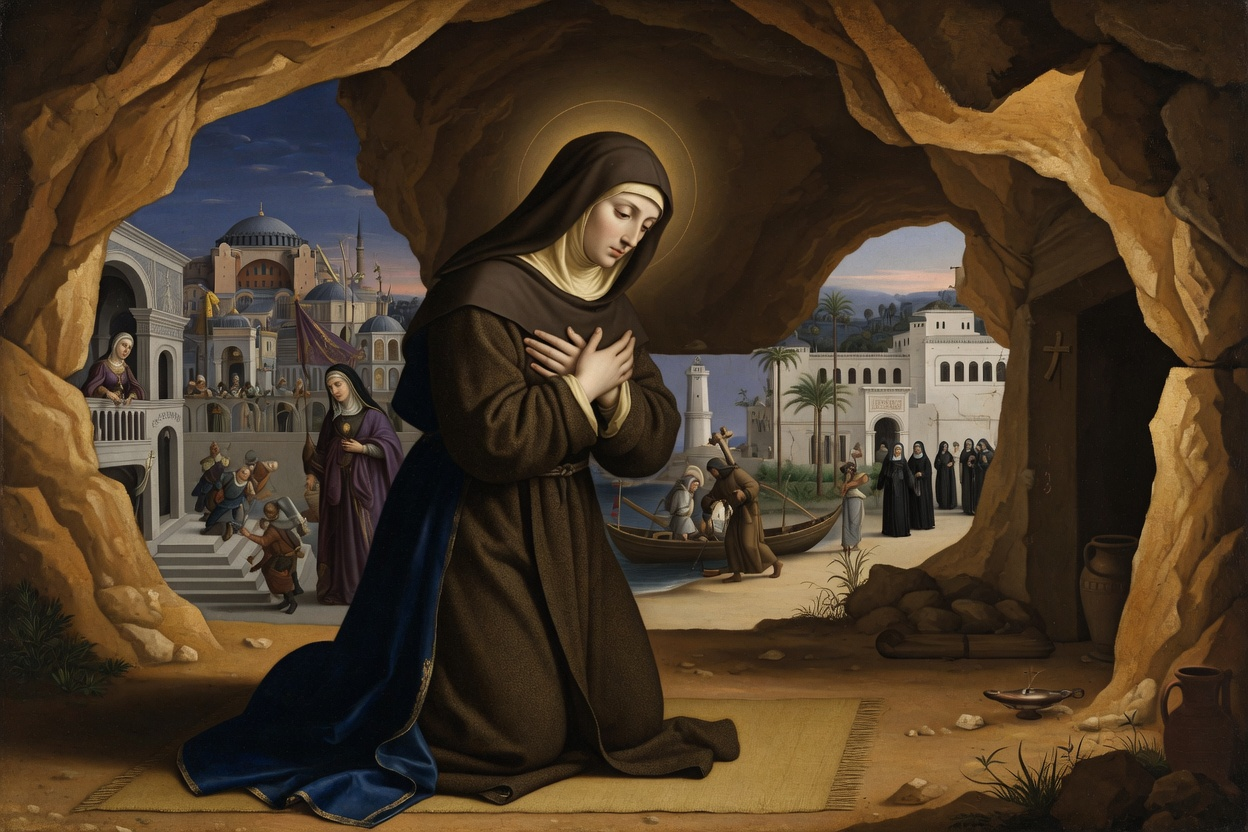
A patrician at the court of Justinian, Anastasia fled to Egypt to escape the jealousy of Empress Theodora. After founding a monastery, she withdrew for 28 years into the desert of Scetis, living as a recluse in a cave disguised in men's clothing to preserve her anonymity. She died around 576 after a life of continuous prayer.
Guided reading
6 reading sections
SAINT ANASTASIA, THE PATRICIAN
Distinction and origins
Presentation of Anastasia the Patrician, a woman of high rank at the court of Justinian, to distinguish her from another contemporary Anastasia who retired to Jerusalem.
There were two Anastasias who lived at the same time and held high rank at the court of the Emper or Justinian: one, w l'empereur Justinien Byzantine emperor under whose reign Simeon began his religious life. ho married the patric ian Pompeius, a r le patrice Pompée Relative of the Emperor Justinian. elative of the emperor, and who, after the death of her husband, abandoned the world and retired near Jerusalem on the Mount of Olives, whe montagne des Oliviers Site of the cell and monastery of Melania in Jerusalem. re she led a holy life; the other, of whom we must speak here, and who is surnamed the Patrician, a title of honor that remained with her to distinguish her from others of the same name, and which shows that she was of high station.
The Empress's jealousy
The favor Anastasie enjoyed with Emperor Justinian aroused the jealousy of Empress Theodora, precipitating her departure from the court.
Her beauty, virtue, and wit, combined with her birth, won her the esteem and affection of everyone. The Emperor also held her in high regard; but it was precisely this burgeoning favor that brought upon her persecution from Empress Theodora, and which gave rise to her retre at from the world and l'impératrice Théodora Empress regent who restored the veneration of icons in 842. her sanctification.
Theodora, who had risen from the theater to the throne, had retained the flaws of her former condition in the sublime rank to which she had been elevated. She was prone to jealousy, not to mention the errors she protected and the tragedies she caused in the Church. She could not, therefore, see the merit of Anastasie recognized and applauded by the Emperor without being alarmed, and from that moment conceived dire designs against her.
First exile and monastic life
Anastasia fled to Egypt where she founded a monastery near Alexandria, living there until the death of Theodora.
Anastasia was warned of this, and she was advised to avert the storm by distancing herself from the court for some time; but being even more prudent and generous than she was prompted to be, and recognizing more closely the fragility of human greatness through the lights of faith, she said to herself: "Anastasia, save your soul; cure the princess forever of her unjust jealousy, and strive to be yourself a princess of heaven."
She therefore took with her all the money she could carry, and went to Egypt, where she built a monastery for girls about two leagues from Alexandria, and began to work seri Alexandrie Place of refuge and study during the persecution. ously on her salvation. It was later called the monastery of the Patrician. She remained in this holy house until the death of Empress Theodora, and then it depended only on her to return to the court to resume her rank and benefit from the emperor's good graces; for this prince, who had always maintained a particular esteem for her virtue and merit, ordered that she be sought everywhere to bring her back to Constantinople. The news of this spread to the main plac es of the empi Constantinople City where the saint exercised his ministry and patriarchate. re, and reached Alexandria, to the monastery of Anastasia. She was frightened by it, because since she had tasted the advantages of piety in solitude, the court seemed to her only as a place of trouble and the theater of passions.
Anachoresis and Disguise
To escape the emperor's search, she retired to the desert of Scetis in male attire with the help of Abbot Daniel.
The fear of being recognized and forced to return compelled her to move further away from the city and to seek a more secure asylum in the depths of the desert. She slipped away from her monastery under the cover of night and went to seek, in the solitude of Scetis, with Abbot Da l'abbé Daniel Desert Father who guided Anastasia in her life as a hermit. niel, the means to ensure her safety. She threw herself at his feet, explained to him the motives that had led her to withdraw from Constantinople, the graces with which God had favored her in her monastery, and begged him to tell her what she should do to better ensure her salvation.
Abbot Daniel gave her a man's habit, enclosed her in a cave located at a reasonable distance from his hermitage, and at the same time prescribed the rules she was to observe. Among other things, he expressly forbade her to set foot outside her cell, or to allow anyone at all to enter it. He also charged his disciple to bring her every week a bucket of water, which he would deposit in front of her cell, withdrawing immediately without saying a single word.
End of life and burial
After twenty-eight years of seclusion, she died in 576, assisted by Abbot Daniel, who then revealed her secret identity.
Anastasia spent twenty-eight years there in fasting and almost continuous prayer; God, always generous toward those who are faithful to Him, made her final hour known to her. She wished to notify Abbot Daniel, but God revealed it to him as well. He came to her cell accompanied by his disciple, gave her the holy Viaticum, and received her last breath. Her cell served as her sepulcher, and Abbot Daniel taught his disciple and the other Fathers of the desert her entire story, to lead them to recognize the marvelous operations of divine grace upon souls, and to encourage them to glorify Him for it and to profit from those of their own state. She died around the year 576.
Note on sacred cross-dressing
Commentary on the exceptional practice of male disguise among certain saints, inspired by the Holy Spirit but not proposed as a general model.
Other saints are mentioned who hid their sex by taking on men's clothing. Other examples of this are still found among the Orientals; but these actions must be regarded as above the rules, having been inspired by an extraordinary movement of the Holy Spirit. An admirable conduct, but one which cannot be proposed as a model, since as a general rule this is not permitted, and has even been expressly forbidden by several councils.
Lives of the Desert Fathers.
Annexes & related entities
Structured data for exploration: events, miracles, quotes, places, attributes, patronages, and important entities cited in the text.
Key Events
- Life at the court of Emperor Justinian
- Fled Constantinople to escape the jealousy of Empress Theodora
- Foundation of a convent near Alexandria
- Retirement in the desert of Scetis under the guidance of Abbot Daniel
- 28-year reclusive life in a cave dressed in men's clothing
Miracles
- Divine revelation of her approaching death
Quotes
-
Anastasia, save your soul; heal the princess forever of her unjust jealousy, and strive to be a princess of heaven yourself.
Interior words reported in the text