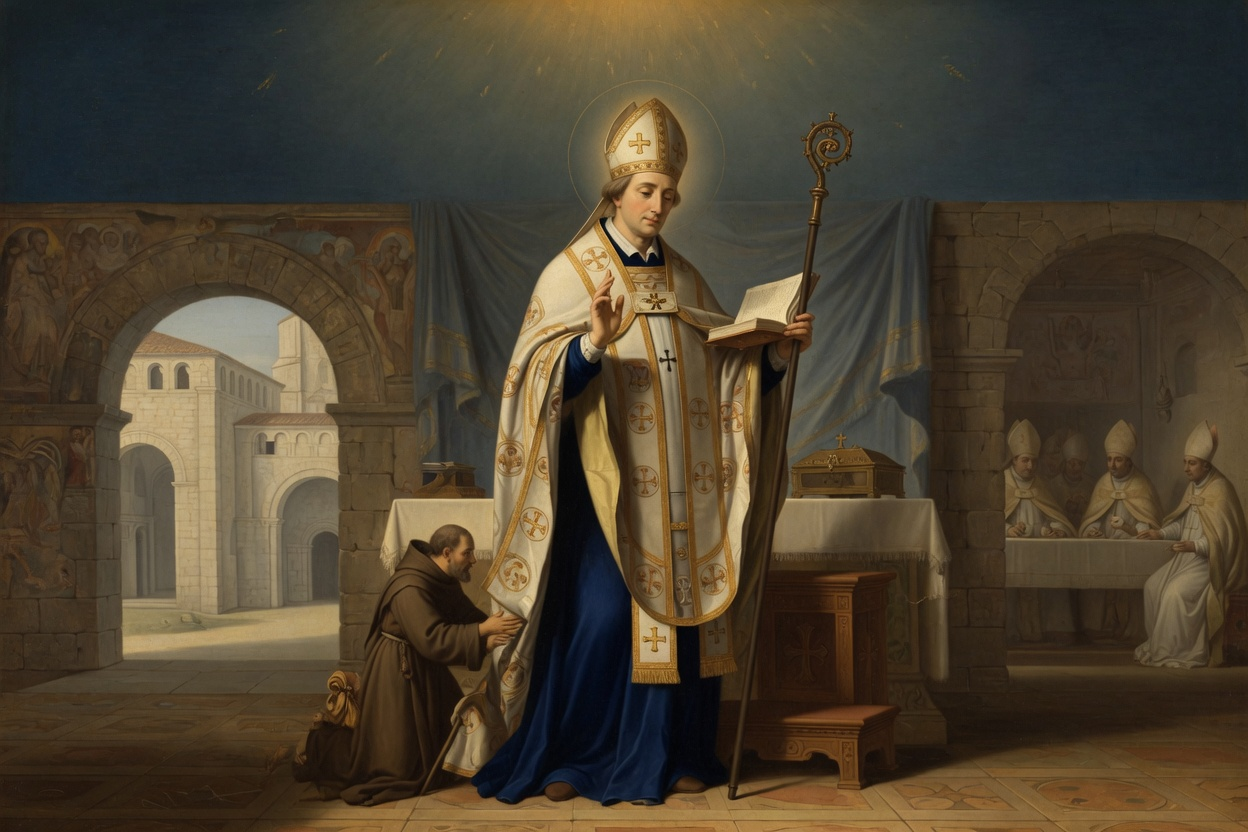
Bishop of Saintes from 596, Saint Leontius was recognized for his piety and learning. He welcomed Saint Macoux in exile, participated in the Council of Reims in 625, and died in 640, leaving the memory of a charitable pontiff whose relics rest near Saint Eutropius.
Guided reading
6 reading sections
SAINT LEONTIUS, BISHOP OF SAINTES (640).
The Episcopate of Leontius in Saintes
Leontius succeeded Saint Palladius around 596 and distinguished himself by his piety and his generous welcome of Bishop Macoux, who was fleeing Armorica.
Saint Leonti Saint Léonce Bishop of Saintes who welcomed Malo during his exile. us, born around the middle of the 6th century, began to govern the c hurch o Saintes City in Aquitaine where Psalmodius initially retired. f Saintes around the year 596. He was credited with an inexhaustible fund of knowledge and piety. He succeeded Saint Palladius.
One of the most prominent acts of this episcopate was the generous and eager reception giv en by Saint Leontius saint Macoux ou Molo Bishop of Aleth welcomed by Leontius. to Saint Macoux or Molo, Bishop of Aleth, in Brittany, who, fleeing the inhospitable shores of Armorica, had come to take refuge in the territory of the Santones. Leontius offered him a house close to the city, with sufficient income for the foundation of a small community.
The Île de Ré and the contemplative life
Description of the Île de Ré in the 6th century, a place of Marian pilgrimage and a land of welcome for the contemplation of Saint Amand.
It is reported that, during this pontificate, the Île de Ré, covered in woods, offered asylum only to fishermen or sailors beaten by the storm. From the 6th century, one could see, at the place still called Sainte-Marie today, a chapel dedicated to the Virgin, which was held in great veneration in Saintonge and Aunis. People came there on pilgrimage from all the surrounding areas. Around the 9th century, this pious edifice, as well as the leper house that depended on it, were destroyed by the Normans.
It was also during the time of saint Amand Spiritual advisor to Gertrude. Bishop Léonce that Saint Amand chose this island to devote himself to the contemplation of divine things.
Council of Reims and end of life
Participation in the Council of Reims in 625 and death in 640, followed by his burial near Saint Eutropius in Saintes.
In 625, a council met in Reims. More than forty bishops of Gaul were present, and with them Saint Leon tius. He end saint Léonce Bishop of Saintes who welcomed Malo during his exile. ed his holy life on March 19, 640: his body was buried next to the tomb of Saint Eutropius, which was by then placed in the crypt, in the very place where it can still be seen today. The feast of the holy pontiff Leontius is celebrated each year on March 22 or March 19, or else on November 22. As for his relics, it is presumed that they still rest in a pillar of the crypt, not far from those of Saint Eutropius. Biographie Saintengeoise, by P. D. Raingent, 1852.
The mission of Saint Amand and Saint Landoald
Saint Amand obtains the approval of Pope Martin in Rome to evangelize the pagans, accompanied by Landoald and other companions.
Saint Amand Saint Amand Spiritual advisor to Gertrude. , having resigned his bishopric of Maastricht into the hands of Saint Remacle, to resume his first vocation, which was that of evangelical missionary among the faithful and infidel peoples of various provinces, in the capacity of apostolic bishop, went to Rome to have Pope Saint Martin approve the plan he had to work as before for the conversion of the pagans, without attaching himself to any diocese. This holy Pope was not content with receiving him favorably and approving his conduct; he also chose, as he had requested, excellent workers in Rome to go with him to work on this ample harvest of the Gospel that the Lord was preparing in the country where he was to send him. The principal co-worker associated with Saint Amand was Saint Landoald, a priest of the Church of R ome, originati saint Landoald Roman priest and missionary associated with Saint Amand. ng from a Lombard family, considered for his eminent virtue. He believed he heard the voice of God calling him through the organ of the Vicar of Jesus Christ; and, burning with the love that He inspired in him for the salvation of peoples, he left his country and the habits he had there without deliberation, to place himself in the company of Saint Amand with the deacon Saint Amance, and several other pious persons whom Saint Martin joined to them: Saint Vinciane, Saint Adelirude, Saint Julien, and seven other persons, both men and women. They departed from Rome upon the news that Saint Amand received of the ordination of Saint Remacle, who was consecrated bishop of Maastricht in his place.
Evangelization and foundation at Wintershoven
Landoald settled in the diocese of Maastricht under Saint Remaclus and founded a church at Wintershoven thanks to the nobleman Aper.
When, after having visited various monasteries in France, they arrived in the country situated between the Meuse and the Scheldt, Saint Remaclus did so much with Saint Amand that he obtained permission for Landoald to remain near him to assist him in the episcopal ministry. Our Saint had a vast field throughout the extent of th e diocese Maëstricht City of which he was elected bishop. of Maastricht to exercise his patience and charity. His vigilance and zeal were tireless in all that he had to do and suffer to instruct the coarse rural populations, and to uproot the vices that reigned in the land along with ignorance.
A rich and noble man, named Aper, having given him a plot of land in the territory of Wintershoven, on the Herc Wintershoven Site of a church foundation by Saint Landoald. k river, to the west of Maastricht, he built a church there which he had dedicated by Saint Remaclus, around the year 629, in the name of Saint Peter. After the resignation of Saint Remaclus, Landoald continued under his successor, Saint Theodard, to work with his ordinary activity at the task to which God had called him.
Martyrdom of Adrian and the fate of the relics
After the assassination of the disciple Adrian and the death of Landoald, their relics underwent several translations between Maastricht, Liège, and Ghent.
King Childeric II, who at that time reigned only in Austrasia, having established his seat of residence at Maastricht, was not long in recognizing his holiness. He did not stop at the terms of excess and veneration he had for him, but he also wished to provide for his subsistence and that of the small community he had gathered at Wintershoven. This goodwill of the prince obliged Landoald to send a man from time to time to Maastricht to fetch his annuities. The one he employed for this was one of his disciples, named Adrian, who was assassinated on the way, near Villiers, while returning from Maastricht to Wintershoven, by thieves who believed him to be laden with gold and silver. The Church has since honored him as a martyr. Saint Landoald did not survive this accident for long, and there is reason to believe that he died before Saint Lambert had succeeded, in the bishopric of Maastricht, Saint Theodard, who was martyred in the year 668.
He was buried in his church of Wintershoven, where God performed various miracles through his intercession. His body remained in the ground until, in 735, it was raised by Saint Florebert, Bishop of Liège, son and successor of Saint Hubert, who had transferred the episcopal see from Maastricht to that city, along with the relics of the bishop and martyr Saint Lambert, his predecessor. The memory of this elevation was subsequently celebrated on the first day of December, the day on which it took place. The fear of the Normans, who came nearly two hundred years later to ravage these provinces, caused this holy body to be returned to the earth, which, by this means, was hidden from their fury. It was raised again along with those of the deacon Saint Amance, the martyr Saint Adrian, and several others who had been in the company saint Landoald Roman priest and missionary associated with Saint Amand. of Saint Landoald. This new ceremony took place during the time of the Bishop of Liège, Euracle, predecessor of Notger, who had a new life of the Saint written, after the one that had been made formerly had perished in the ravages of the Normans. The holy relics did not remain there long afterward, for the abbot and monks of Saint-Bavon of Ghent, in Flanders, who were lords of the land of Wintershoven, exercised their right and had them transported to their abbey in the year 980, where they were received on March 25 with much ceremony. Their elevation or solemn translation was performed on June 13, a day that has been established as a feast, and which is the principal one for our Saint and his companions, after that of March 15, which is believed to be the day of his death.
Annexes & related entities
Structured data for exploration: events, miracles, quotes, places, attributes, patronages, and important entities cited in the text.
Key Events
- Born around the middle of the 6th century
- Beginning of the episcopate in Saintes around 596
- Reception of Saint Macoux (Molo) fleeing Armorica
- Participation in the Council of Reims in 625
- Death and burial next to Saint Eutropius in 640