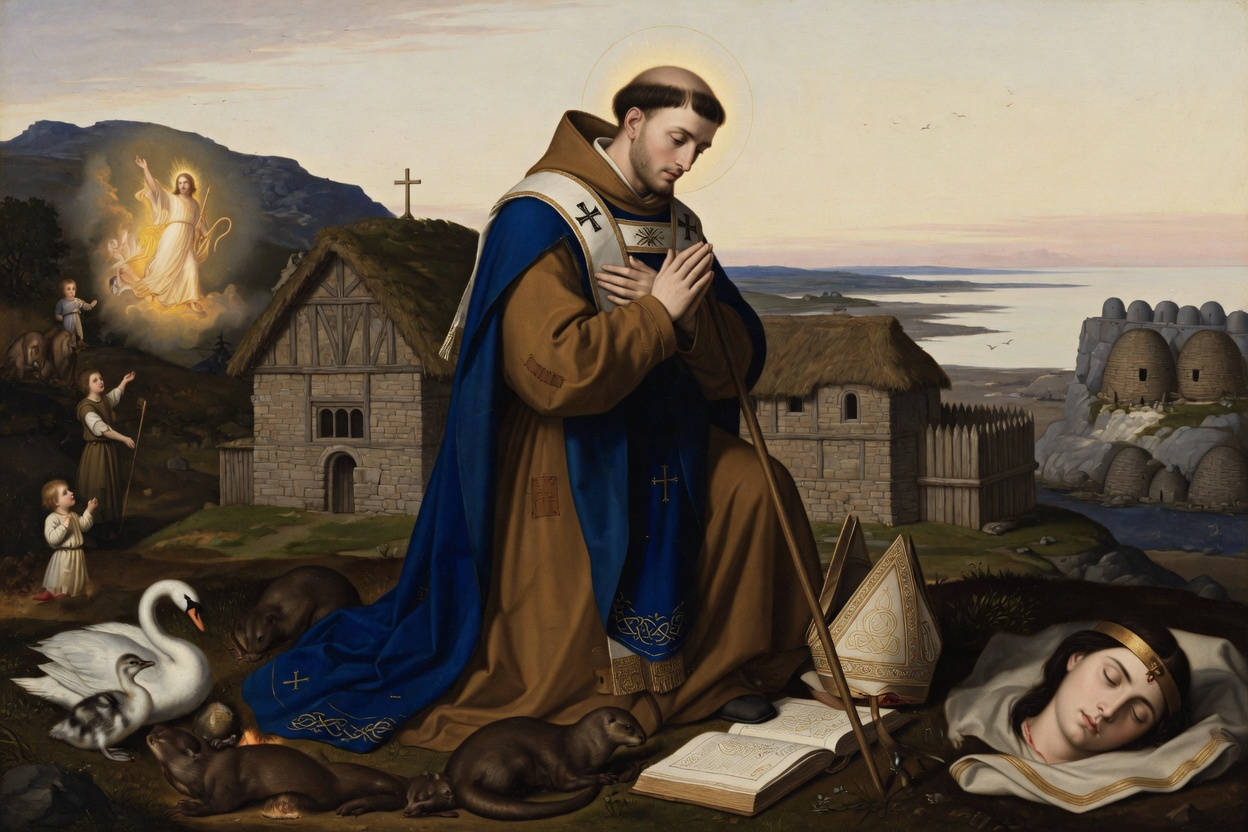
A monk and Bishop of Lindisfarne in the 7th century, Cuthbert began his life as a shepherd before joining the monastery of Mailros. Known for his apostolic zeal, miracles, and austere eremitic life on the Farne Islands, he became one of the most popular saints in England. His body, found incorrupt on several occasions, now rests in Durham.
Guided reading
9 reading sections
SAINT CUTHBERT, BISHOP OF LINDISFARNE
Sources and childhood
The Venerable Bede recounts the life of Cuthbert, emphasizing his virtue from childhood rather than his lineage. At the age of eight, a young child miraculously prophesies his future dignity as a prelate.
The Venerable Bed Le vénérable Bède Hagiographer whose martyrology attests to the antiquity of the cult. e, writing the life of Saint Cuthbert at the instance of Eadfrith, Bis hop of Lind Lindisfarne Episcopal see and monastery located on an island in Northumbria. isfarne, from where the see was later tra nsferr Durham Place where the relics of Bede were transferred in 1020. ed to Durham, seems to have observed what Saint Ambrose remarked in Holy Scripture regarding the patriarch Noah, namely, that in the genealogy of the Saints, one must have more regard for virtue, which is the ornament of souls, than for blood, which gives life to the body. This is why this most credible author, who protests in the preface of this same life that he has written nothing but what is most certain, passes over in silence the country and parents of our Saint, and, not stopping at what pertains to nature, begins his discourse with the wonders that God worked in him from his childhood.
He says, therefore, that Cuthbert, being still a child of eight years and thinking only of taking, with his companions, the ordinary amusements of that age, was called by God to Christian perfection in the following manner: One day, when he was with a child three years of age, the latter approached him and strongly exhorted him to leave his play and his idleness, and to think instead of sanctifying himself through the good use of the grace of God and the practice of virtue. Cuthbert, who was too attentive to his pleasure, at first took this for a child's talk; but this poor little one, throwing himself on the ground, wept so bitterly that everyone ran to console him, and particularly Cuthbert, to whom the child said these words: "Why, most holy priest and prelate, do you do things that are not becoming to your dignity and your Order? It does not befit you to play with children, you whom God has chosen to give lessons to those of more advanced age." Cuthbert, astonished by this remonstrance, was immediately changed, and, from the child he had been until that hour, became in a moment a most perfect man.
Monastic Vocation at Melrose
After a vision of the soul of Saint Aidan ascending to heaven, Cuthbert enters the monastery of Melrose under the direction of Boisil and Abbot Eata.
He withdrew to the countryside, where he occupied himself with tending the flocks; and then, taking advantage of the solitude and the convenience of the woods, he spent the better part of the day and the whole night in prayer: one night, while his companions were asleep and he alone was keeping watch in prayer, he found himself surrounded by a celestial light, in whi ch he Aldan Bishop whose soul Cuthbert saw ascending to heaven. perceived the soul of the blessed Aidan, Bishop of Durham, ascending to glory in the midst of a company of angels. At that very hour, the holy shepherd awakened his companions and exhorted them to sing the praises of God with him; then, the next morning, he returned his flocks to his master and set off at once for the monastery of Melrose, near Lindisfarne, to become a religious. As soon Boisil Prior of Melrose and spiritual mentor to Cuthbert. as the prior, named Boisil, caught sight of this young man, he said of him to those present what Jesus Christ once said of Nathanael: 'Behold an Israelite indeed, in whom there is no guile'; and, giving him a most charitable welcome, he inquired as to the cause of his journey; having learned that he wished to be a religious, he admitted him with joy into the monastery, where, a few days later, he receive d the mona saint Eate Abbot of Melrose and later Bishop of Lindisfarne. stic habit from the hands of Saint Eata, who was abbot of that religious house and was later Bishop of Lindisfarne. Then Cuthbert, seeing himself consecrated to the service of Jesus Christ, entered with such fervor upon the path of perfection that he did not merely study to imitate others, but also strove to surpass them through reading, work, vigils, prayers, and even abstinences; he was nevertheless compelled to moderate his austerities so as not to ruin his strength, which he was to employ so usefully for the glory of God.
A few years after his profession, he was sent to the monastery of Ripon, which King Alcfrith had newly founded. The abbot of this house having given him the charge of guests, he once had the honor of receiving an angel, who, in recognition of his charity, left on the table three loaves of such admirable whiteness and such extraordinary taste that one could easily judge them to be miraculous. And this is not the only time that this servant of God received good offices from the blessed spirits; for he often merited to see them, to speak to them, and to be nourished by their ministry; and, even before he was a religious, he had been healed by an angel of an abscess that had appeared on his knee and which prevented him from walking. Having returned to Melrose, he was soon struck by the plague that was infecting all of England; but he was delivered from it, against all human expectations, by the prayers of the religious, who had not ceased to importune heaven for his recovery, knowing how necessary the life of such a holy man was to them. Nevertheless, God permitted, to serve as a trial for him, that he should thereafter be subject to very sharp pains.
Apostolate and Miracles
Having become prior, he evangelized the rural English populations, fighting against superstitions through his preaching and numerous miracles of healing and exorcism.
Saint Boisil having been taken from this world during that contagion, our Saint was elected in his place. His charity and vigilance were not confined to this monastery alone, which he also edified by his good counsel and good examples; but his zeal led him to be useful to others as well. And because the simple English people were then extremely given to the superstitions of magic, which led them insensibly back to the worship of demons, he spared neither his effort nor his time to turn them away from it. He sometimes spent two or three weeks, even entire months, without being able to return to his convent, because he would travel even to the most remote mountains, where the difficulty of the paths and the poverty of the listeners deterred other preachers from going. Our Lord gave such strength to his words, and such great ease in persuading hearts, that the most hardened would come to throw themselves at his feet to ask to do penance. The grace of miracles, which he possessed eminently, was also very useful to him: by his prayer alone, he extinguished a great conflagration that was about to cause extreme devastation, just as a little earlier he had made an imaginary fire disappear that the demon had formed in the air to distract the listeners from attending his preaching. He also cast out, by his mere presence, that unclean spirit from the body of a holy woman whom it had possessed. And, since we have touched upon the subject of his miracles, we will say, in general, that he healed many sick people despaired of by doctors, and even those afflicted by the plague, with water, oil, and blessed bread; that he caused storms and tempests at sea to cease through his prayer; that by tasting pure water he changed it into good wine, and that he himself, while sick on his deathbed, gave health to the religious who was serving him. Finally, by sending his belt to a holy abbess named Elflæd, he cured her of a contraction of the nerves that had remained with her following a long illness; and this same belt served thereafter for other similar healings, upon which, however, we shall not dwell further, so as to return to our Saint.
Life at Lindisfarne and virtues
Called to Lindisfarne by Bishop Eata, he led a life of extreme austerity there, marked by intense devotion during the celebration of the Mass.
After he had governed the monastery of Mailros for some time, Saint Eata, Bishop of Li ndisfarne, Lindisfarne Episcopal see and monastery located on an island in Northumbria. brought him to his side to govern the one in his episcopal city; for he had no other priests than religious to lead his church, following the initial establishment that Saint Augustine, sent by Saint Gregory, had made throughout England.
It is not easy to express in a few words the virtues of our holy superior in this new government. He was truly the most patient and charitable man in the world in bearing the faults of others; he always remained, whatever happened, in perfect equanimity, and unpleasant or agreeable events were indifferent to him, because the anointing of the Holy Spirit that filled his heart made him despise all earthly things. His vigils were so excessive that they are almost incredible: he often spent two or three days without even giving himself the leisure to take a piece of bread, nor an hour of rest, dispelling sleep through preaching or manual labor. He could not understand how a religious could complain that his rest had been interrupted; "because," he said, "it is not doing him a wrong to wake him, since by breaking his sleep, one gives him the means to do something good, or to think about it." As for the Holy Mass, he celebrated it with such devotion that he never offered the holy mysteries without shedding abundant tears; thus he excited the people to raise their hearts to God, and to give Him thanks, more by his tears and groans than by the singing of his voice. If the zeal of justice led him to severely rebuke vices, the spirit of gentleness always made him easy to forgive penitents, and he himself was the first to weep for the sins of those who confessed before him at the tribunal of penance, showing them, by his example, what they had to do to obtain pardon for them. As for his clothing, it was such that no singularity appeared in it; but only an honest cleanliness, using only a garment of naturally black wool, and thus showing, by his example, to his religious, how they should dress.
Eremitic Retreat at Farne
Cuthbert retires to the solitude of the island of Farne, where he combats demons and lives by divine providence, receiving visits from numerous pilgrims.
He remained for several years in this monastery; after which he withdrew, with the permission of his superior, into the solitude of an island called Farne, where no one had ever been able to dwell because of the specters and ghosts seen there, and the demons who made it their retreat. But the man of God, who was equipped with the invincible weapons of faith and trust in His holy name, easily took possession of this place; he made for himself two small cells which he dug into the rock: one to serve as an oratory, and the other for the necessary uses of life, and surrounded them with walls of turf so high that he could see nothing but the sky; and as he lacked water, he obtained, through his prayers, a fountain of fresh water, which provided refreshment for him and for those who came to visit him. At the beginning, he allowed those who arrived to enter his cell, and it was only some time later that he withdrew entirely from the presence of men, and spoke to them only through a window; finally, he had it blocked up to converse only with God alone in continual vigils and prayers.
One might wonder where this holy man obtained food in this solitude; but Divine Providence, which never fails the elect, provided him with sustenance by means of ravens, as it did formerly for the prophet Elijah and Saint Paul the Hermit: a benefit that our Saint experienced not only in this solitude, but also in other circumstances of his life: for we read that on a journey, God provided him and his companions with food by means of an eagle that brought them a large fish. Another time, having been caught at sea by a horrible storm, which caused him to remain on that element for more days than he had expected, he found on the water three pieces of dolphin flesh, which served to feed him, as well as those in his company, for the space of three days. Needing a piece of wood twelve feet long to plug a crack that the sea waves had made in his cell, God caused the waves to bring him one, just as he desired, so that it could be said of him that the sea and the winds obeyed him.
Whatever effort he made to remain hidden, he could not prevent an infinity of people from finally coming to find him from all parts of Great Britain, even the most distant, whether to consult him about their conscience, or to obtain through his prayers the healing of their illnesses: and it was not in vain: one never left him without having received the consolation one hoped for, or without being delivered from the pain one suffered before. To encourage them in their troubles, he sometimes recounted his combats against the demon, and how many temptations he had overcome in this war; it had been so violent that he had sometimes seen himself on the point of throwing himself from the top of his rock into the sea, or at least of abandoning his solitude. He confessed to them that the cenobitic life, where religious remain subject to the will of a superior and do nothing except by his order regarding fasts, vigils, and prayers, was much safer than the eremitic life, and that he had even known several of these religious who did not surpass him less in purity of soul than by the grace of prophecy. Among others, he named particularly Saint Boisil, who had predicted everything that was to happen to him; he added that all his predictions had been fulfilled, except for one, namely, that he would be a bishop, but that he prayed to God to preserve him from it. saint Boisil Prior of Melrose and spiritual mentor to Cuthbert.
Episcopacy and prophecies
Elected Bishop of Lindisfarne despite his reluctance, he exercised an indefatigable ministry, visiting his diocese during the plague and prophesying the death of King Egfrid.
Since we are speaking of the spirit of prophecy, we can say that our Saint possessed it himself in an eminent degree. Indeed, among several other events, he predicted to Saint Elfleda, the abbess, that K ing Egfrid roi Egfrid King of Northumbria whose death was predicted by Cuthbert. , her brother, would die two years later, and that this same king would beforehand give him the bishopric to which heaven had destined him; which came to pass after the death of the Bishop of Lindisfarne: a provincial council having been assembled, Saint Cuthbert was named bishop of that see, in the presence of this most pious king, who, assisted by the prelates, went in person to fetch him from his hermitage to have him consecrated despite his resistance. It was by this same spirit of prophecy that he knew many things present and hidden, though far from the place where he was, such as the death of the same King Egfrid in a battle against the Picts or Scots; he promptly gave notice of it to the queen.
He showed his virtues no less in the prelacy than he had done in his cloister and his hermitage. Never was a bishop more vigilant or more laborious; the zeal he had for the salvation of souls prevailed over the weakness of an old man consumed by the exercises of rigorous penance; in the space of the two years that he occupied the see of Lindisfarne, he worked more than many others had done in many years. He visited his entire diocese, even in a time of plague, without leaving a single hamlet that he did not honor with his presence; and it was noted that once, having made his visit to a small village, he asked the priest who accompanied him if there were not still in that place some afflicted person whom he had not consoled. He was still speaking when he perceived a poor woman who had already lost one of her children to the plague, and who was embracing the other, who was on the point of expiring; he was moved with compassion, kissed the child, and blessed him with the mother, assuring her that her son would live, and that she, with all her family, would no longer be afflicted by this scourge: which came to pass. The extent of his diocese was not large enough to contain the flames of his charity; it spread even to the neighboring dioceses, where he dedicated churches, visited convents of nuns, and performed all the other functions of a truly apostolic man.
Death and final struggles
Feeling his end was near, he returned to Farne where he endured final demonic assaults before yielding his soul on March 20, 687.
After having spent two years working in this manner for the salvation of souls, he had a revelation that the time of his death was near; he therefore resolved to retire to t he small isl île de Farne Deserted island where Cuthbert lived as a hermit. and of Farne, to prepare himself there with more tranquility. He departed on Christmas Day, after having celebrated the divine mysteries of that solemnity; and, as he was boarding the vessel, one of the oldest religious who had accompanied him to the port asked him, with tears in his eyes, "when they could hope for his return"; he answered him simply:
"When you bring my body back to this country."
He remained for nearly two months in this solitude, where he enjoyed at his leisure the rest he had so desired. But, finally, the rigor of his penances caused him an illness that lasted three weeks. He never wanted to allow anyone to be left to assist him in his sufferings. He was even once five days without receiving any help, because the sea was so furiously agitated that it was impossible for the religious to cross to his island. In this strange solitude, he suffered interior pains that are inconceivable; for God, wishing to finish purifying him, left him without any sensible grace and without those consolations that he ordinarily received from heaven. The demons did not fail to take advantage of this occasion and to make their final efforts to shake his constancy; and the assaults they delivered upon him were so violent that he confessed to the Venerable Bede, whom he cherished tenderly, never to have felt more furious ones in all his life. The day of his blessed departure having arrived, he had himself carried to his oratory, where he received the last sacraments with admirable devotion. Finally, with his eyes and heart raised to heaven, he yielded his spirit on March 20, in the year of Our Lord 687. On the very day of his death, he healed a religious who had long been ill with dysentery.
Iconography and symbolism
The saint is often depicted with otters, seabirds (eiders), or carrying the head of Saint Oswald.
In paintings and sculptures of which Saint Cuthbert is the subject: 1° he sees a soul rising to heaven in the form of a column of fire: it is that of Sain t Aidan; — saint Aïdan Bishop whose soul Cuthbert saw ascending to heaven. an angel stands near his table, upon which are loaves of dazzling whiteness; — armed with the attributes of a shepherd, he leads his master's flocks to the fields; — he is in abbot's vestments, and a column of fire appears above his head;
2° But, according to Father Cahier, the Saint's principal attribute is the swan; this bird having been chosen to indicate men who have shown themselves particularly enamored of the solitary life, because of the silence that this bird ordinarily keeps.
However, we are inclined to believe that this refers to the eider duck, named Saint Cuthbert's bird, and not the swan. Let us judge by what M. de Montalembert says: "The Northumbrian legend had a field day regarding the solitary stay of the great national and popular Saint on the islet of Farne. It attributes to him the extraordinary gentleness and familiarity of a particular species of aquatic bird, which would come at the man's call, allow themselves to be caught, felt, and caressed at will, and whose down was extremely soft. They once swarmed on this rock and are still found there, although their numbers have greatly diminished since the curious came to steal their nests and destroy them with gunfire. These birds existed nowhere else in the British Isles and bore the name of Saint Cuthbert's birds. It was he, according to the account of a 13th-century monk, who had inspired in them a hereditary trust, by taking them as companions of his solitude and guaranteeing them that no one would ever disturb them in their habits".
3° Otters dry the water bathing his feet. Among the miraculous assistances that heaven lent him, it is indeed recounted that two of these animals would go to warm him on the seashore when he emerged from the waves where he was accustomed to immerse himself to chant his office. — These amphibians could also express, as a symbol, the Saint's retreat on the island of Farne.
4° The cathedral of Durham once possessed a representation of Saint Cuthbert carrying the crowned head of King Saint Oswald. This is because the head of the martyr-king, collected by his brother, had been sent to Lindisfarne and deposite saint Oswald Martyr-king whose head was preserved with Cuthbert. d in the shrine of the holy Bishop. The whole, later transported to Durham, was preciously preserved there in memory of the conversion of the Northumbrians, or inhabitants of Northumberland, among whom the cult of Saint Cuthbert was once very popular. The shepherds of this same country and the Saxon navigators in the North Sea had adopted him as their special patron. Today, Saint Cuthbert is known to the peasants of Northumberland and the Scottish Marches only by the legend of the compassionate otters.
History of the relics
His body, found incorrupt on several occasions, was transferred to Durham. Despite the desecrations under Henry VIII, his remains and his ring were preserved.
## RELICS OF SAINT CUTHBERT.
His body was placed in a coffin given to him by a holy Abbot named Cudde, and buried in a shroud which an abbess called Vesca had also gifted him: he kept both in his oratory. He was carried solemnly to Lindisfarne, where he was buried in his cathedral. He had some intention of being interred in his solitude; but, at the prayer of the religious, he changed his resolution and consented to be carried to his church, where several miracles occurred at his tomb. He was given other garments, in order to distribute his own as precious relics. Indeed, God performed such a great number of miracles through them that those who could touch something that had belonged to him were assured of obtaining the healing of their illnesses; a demoniac was even delivered after drinking water into which a little dust had been thrown, taken from the place where his holy body had been washed.
Eleven years later, he was found as whole and as fresh as if he had only just died; all his garments were also without corruption, as the Venerable Bede writes, both in his life and in the fourth book of the History o f England. Fou vénérable Bède Hagiographer whose martyrology attests to the antiquity of the cult. r hundred and eighteen years later, he was still whole; another English historian reports that, when the perfidious King Henry VIII had the most venerable monuments broken into, to extract the precious relics and cast them to the wind, the body of Saint Cuthbert was found, with his pontifical ornaments, without the slightest appearance of decay; the Bishop of Durham, also named Cuthbert, having been consulted as to what should be done with this precious treasure, ordered, although he then favored the prince's party, that it be covered with earth, in order to prevent any insult being done to it. It is this illustrious Bishop who, having recognized his fault in having followed the passion of a wicked king, repaired it gloriously by defending the Church with Queen Catherine, and finally dying for the faith in prison, under the tyranny of the detestable Elizabeth.
Among the precious things found in the tomb were: the Saint's ring, whose stone was a sapphire, which passed to the English canonesses of Paris; a copy of the Gospel of Saint John, made from the exemplar of Saint Boisil. The body of Saint Cuthbert was found in 1829 by workmen working in Durham Cathedral, whole, well-preserved, and clothed in his pontifical ornaments. It is now in the British Museum.
All martyrologies make mention of Saint Cuthbert on March 20. — Cf. Acta sanctorum and Moines d'Occident, IV.
Annexes & related entities
Structured data for exploration: events, miracles, quotes, places, attributes, patronages, and important entities cited in the text.
Key Events
- Call to holiness at the age of eight by a three-year-old child
- Vision of the soul of Saint Aidan ascending to heaven while he was a shepherd
- Entered the monastery of Melrose under the guidance of Boisil
- Monastic profession at the monastery of Ripon
- Elected Prior of Melrose after the death of Boisil
- Eremitic retreat on the island of Farne
- Election and consecration as Bishop of Lindisfarne
- Return to the solitude of Farne before his death
Miracles
- Healing of a knee abscess by an angel
- Multiplication of loaves by an angel at Ripon
- Extinguishing fires through prayer
- Changing water into wine
- Taming of the Farne birds and assistance from otters
- Incorruptibility of the body observed in 698, 1104, under Henry VIII, and in 1829
Quotes
-
Behold an Israelite indeed, in whom there is no guile
Boisil (quoting the Gospel regarding Cuthbert) -
It is no wrong to wake him, for by breaking his sleep, one gives him the means to do something good, or to think about it.
Saint Cuthbert