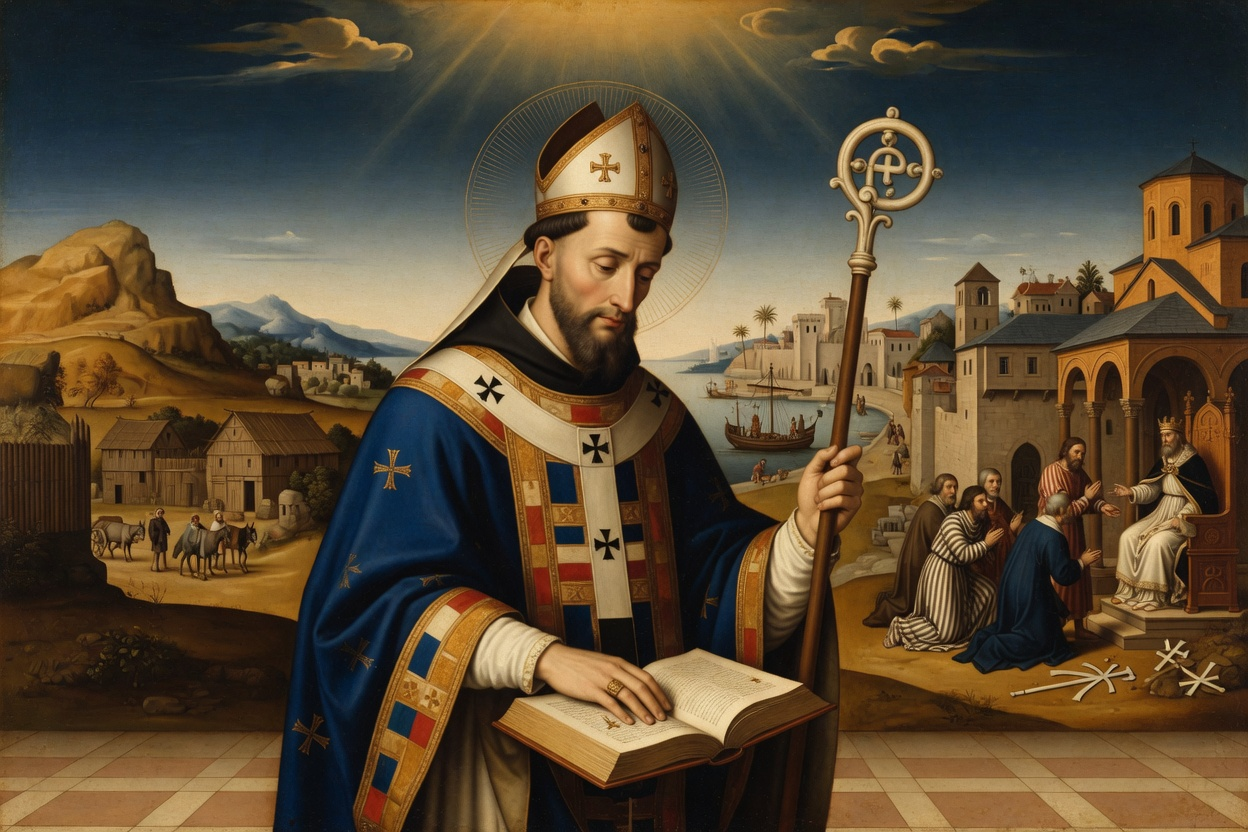
Saint Martin of Braga
ARCHBISHOP OF BRAGA, IN GALLAECIA, AND TODAY IN PORTUGAL (580).
Archbishop of Braga
Originally from Pannonia, Martin of Braga became the apostle of Gallaecia in the 6th century by converting the Suebi from Arianism to Catholicism. Founder of the monastery of Dume and Archbishop of Braga, he was a prolific scholar and advisor to kings. He died in 580, leaving behind a major theological and canonical body of work.
Guided reading
6 reading sections
SAINT MARTIN OF BRAGA,
ARCHBISHOP OF BRAGA, IN GALLAECIA, AND TODAY IN PORTUGAL (580).
Origins and formation
Originally from Pannonia, Martin acquired an exceptional erudition that earned him the admiration of his contemporaries, notably Gregory of Tours.
This Saint, who was originally fro m Pannon Pannonie Region of origin of Laurien, located on the banks of the Danube. ia, became so skilled in the sciences that, in the judgment o f Saint Gregory of Tour saint Grégoire de Tours Bishop and historian who mentions the martyrdom of Antolian. s, he surpassed all those of his century.
Mission and conversion of the Suebi
After a pilgrimage to Palestine, he settled in Galicia where he converted King Theodemir and fought against the Arian heresy to restore Catholic unity.
He made a pilgrimage to Palestine to visit the holy places; after which he went to Galicia, wh ere th Galice Region of Spain home to Compostela. e Suebi, infected with the Arian heresy, had established their dominion. There he instructed in the faith King T heodemir, who roi Théodomir Traveling companion of Saint Vigor. had been cured of leprosy through the intercession of S aint Martin of Tours. saint Martin de Tours Saint whose relics were honored by missionaries in Tours. Through his preaching, the new Apostle brought this part of Spain back to Catholic unity.
Monastic foundations and episcopal elevation
He founded the monastery of Dume and became bishop of this new see in 567, before being raised to the rank of metropolitan of Braga.
Around the year 500, he built several monasteries there, the principal one being that of Dume, near the city Braga Diocese in Portugal celebrating the feast of the martyrs. of Braga, in present-day Portugal. He took charge of this monastery. The bishops of the province erected it into a bishopric, out of respect for the extraordinary merit of the Saint, whom they raised to the new see in 567. The kings of the Suebi wished for Martin to be the bishop of their court; which caused him to be called Bishop of the royal family by the author of an ancient notice of the country. He continued his initial way of life, and always governed his religious with perfect regularity. He was subsequently r siège de Braga Diocese in Portugal celebrating the feast of the martyrs. aised to the see of Braga, metropolitan of all Galicia. He has always been regarded as one of the most brilliant lights of the Church of Spain, and as one of the finest ornaments of t he monas Fortunat Contemporary poet and primary source for the life of Leontius. tic state. Fortunatus, who addressed the first verses of his fifth book to him, says of him that he had inherited the name and the merit of Saint Martin of Tours.
Passing and posterity
Martin died in 580; his relics were transferred to Braga in the 17th century. He is celebrated on March 20.
He served the Church no less through his writings than through his virtues. He died on March 20, 580, and is honored on this day. His body was transported from Dume to Braga in 1606.
Writings and doctrine
A prolific author, he left behind ecclesiastical canons, moral treatises for kings, and collections of monastic sentences.
The writings of Saint Martin of Braga are: 1° A Collection of eighty-four Canons. It is addressed to Nitigias, bishop of Lugo, and divided into two parts, the first of which concerns bishops and clerics; the second concerns the laity. This Collection is found in the various collections of councils and in the appendix of the first volume of the Bibliotheca Canonica by Justel, Paris, 1661. 2° Formula for an Honest Life, or treatise on the four cardinal virtues. This book is addressed to Miro, kin g of Galicia, who ha Myron, roi de Galice King of Galicia and recipient of a treatise by Martin. d asked the Saint to give him instructions on how he should conduct himself. It was printed in the Bibliotheca Patrum, vol. X, p. 382, and in the Spicilegium of Father d'Achéry, vol. X, p. 626. 3° The preceding treatise is followed, in the Bibliotheca Patrum, by a book by Saint Martin, entitled On Morals. It is a tapestry of moral maxims, equally suitable for forming man in virtue and the practice of the duties of civil society. 4° There are also some other writings of our Saint, among others a collection of sentences of the solitaries of Egypt, which is found in the appendix of the Lives of the Fathers, by Rosweyde. See on the writings of Saint Martin of Braga, the learned Cardinal Aguirre, Notit. Conc. Hispan., p. 92.
Sources and references
Martin's life is documented by major authors such as Isidore of Seville and Gregory of Tours.
See Saint Isidore of Seville, in CataL and in Chron. Sacc.; Saint Gregory of Tours, Hist., bk. V, ch. 26, and de mirac. S. Martini; Mabillon, exc. I Ben.; Celliter.
Annexes & related entities
Structured data for exploration: events, miracles, quotes, places, attributes, patronages, and important entities cited in the text.
Key Events
- Journey from Pannonia to Palestine
- Arrival in Galicia to evangelize the Arian Suebi
- Conversion of King Theodemir
- Foundation of the monastery of Dume around 550
- Elevation to the episcopate in 567
- Accession to the metropolitan see of Braga
- Translation of the relics to Braga in 1606
Miracles
- Healing of King Theodemir's leprosy through the intercession of Saint Martin of Tours (prompting the mission of Martin of Braga)
Quotes
-
He had inherited the name and the merit of Saint Martin of Tours.
Fortunatus