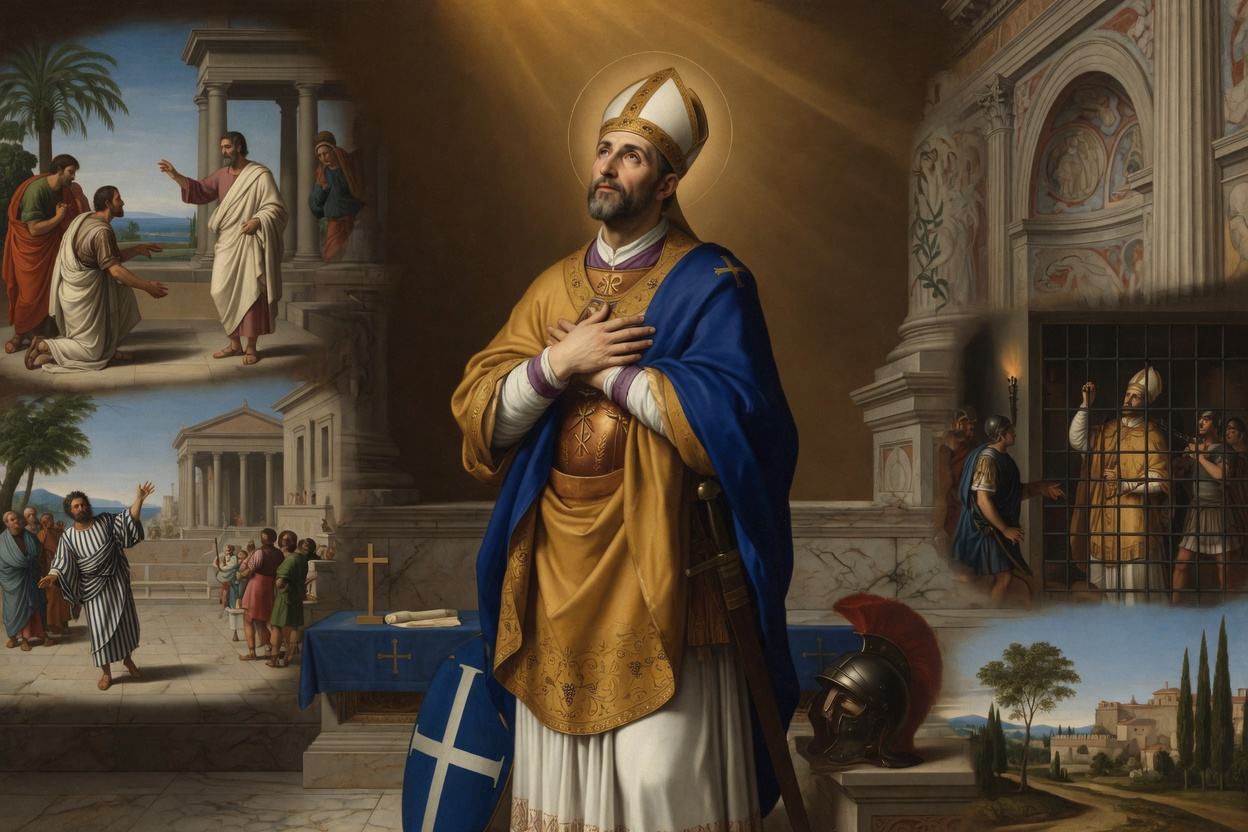
A former proconsul of Cyprus converted by the Apostle Paul, Sergius-Paulus became the first bishop of Narbonne in the 1st century. After surviving cruel tortures in Rome under Nero, he evangelized the south of Gaul and Spain. He died peacefully in Narbonne after organizing the churches of the region.
Guided reading
7 reading sections
SAINT SERGIUS-PAULUS, BISHOP OF NARBONNE
Identity and Tradition
The text identifies Saint Paul of Narbonne with the proconsul Sergius Paulus converted by the Apostle Paul in Cyprus, relying on ancient ecclesiastical traditions.
1st century.
Sergius Paulus, a prudent man... Acts of the Apos., XIII, 7. The prudent man is he who sees from afar... Isid. of Sev., book X of the Etym.
According to the ancient traditions of the churches of France, Italy, Spain, and the Catho lic world, Saint Paul, the first bisho saint Paul, premier évêque de Narbonne Converted Proconsul of Cyprus, first bishop of Narbonne and apostle to the Gauls. p of Narbonne, is the same as Sergius Paulus, the proc onsul, converted by l'apôtre saint Paul Apostle who converted Sergius Paulus in Cyprus and accompanied him on his missions. the Apostle Saint Paul on the island of Cyprus. Learned men, it is true, have contested this in the last century: nevertheless, as it is the testimony of several centuries, which many martyrologies, and especially the Roman one, have not hesitated to subscribe to, and since, moreover, if the contrary opinion has some evidence to support it, it has not failed to be answered very solidly, we have believed that, without entering further into the discussion, we could safely hold to the ancient tradition.
Conversion in Cyprus
Proconsul at Paphos, Sergius Paulus converted after the Apostle Paul struck with blindness the magician Elymas who was opposing his preaching.
The Paul of whom we speak was from the most illustrious families of Rome, and had held the most considerable offices of the Republic: sent as proconsul to Cyprus to gov Chypre Place of preservation of the cross of the Penitent Thief. ern it in the name of the emperor and the senate, he wished to hear Saint Paul, who was preaching the Gospel of Jesus Christ on that island with great reputation; for his preaching was supported by an admirable holiness of life, and by miracles so frequent and so unheard of, that he clearly showed that God Himself authorized his doctrine. Our Saint was then residing at Paphos; and as the Apostle also came there, he had him informed of the desire he had to see him. This was not, however, without difficulties: for he had with him a Jewish magician named Elymas, or Bar-Jesu s, who, acting as Élymas, ou Barjésu Jewish magician who opposed the conversion of Sergius Paulus. a prophet, diverted him as much as he could from listening to this new Teacher and from embracing the religion he announced; but the nascent grace was stronger in him than the suggestion of this instrument of the demon. The Apostle therefore came to find him, accompanied by Saint Barnabas, who was his colleague in the preaching of the Gospel; he pointed out to him the falsity of the pagan religion, which, by recognizing several gods, recognized no true one; and the solidity of the Christian religion, which worshipped no other God than the Creator of heaven and earth, with His Son Jesus Christ, who came into the world to draw men from the darkness of their ignorance. Elymas, present at this instruction, took pleasure in contradicting what the holy Apostle said, for fear that, if the proconsul converted, he would lose all the credit he had with him. But Saint Paul, looking at him with an indignant eye and a severe face, said to him, by a sudden movement of the Holy Spirit: "O wicked deceiver! child of the devil, enemy of all justice, will you never cease to obstruct the straight ways of the Lord? Know that the hand of God is about to weigh upon you, and you shall remain blind, unable to see the sun, for a certain time that His justice has marked." This terrible sentence was immediately executed: the magician lost his sight and was forced to ask for someone to lead him by the hand! As for the proconsul, he drew a marvelous fruit from it; and, admiring both the arm of God and the holiness of His doctrine, he believed in Jesus Christ and gloried in being the disciple of Saint Paul. It is said that it was from him that the Apostle borrowed this name of Paul, for, previously, he is called only Saul in the Acts of the Apostles, and it is only after this conversion that one begins to call him Paul.
Persecution in Rome
After his conversion, he followed the apostles to Rome where he endured cruel tortures under the Emperor Nero, which he miraculously survived.
This is all that the sacred text teaches us about Sergius Paulus; thus, we must draw from the tradition of the Church and ecclesiastical authors the rest of what we have to say about his life.
The new neophyte, brought to the faith in such a miraculous manner, did not hesitate for an instant to make the most painful sacrifices for his convictions. Faithful to the voice of God calling him to the apostolate, he put the affairs of his government in order and followed to Rome those from whom he had received the blessing of religion, wishing to share in their labors and their destinies. This was to run headlong into the greatest dangers. Inde ed, Claudius had l'empereur Néron Roman emperor under whom the martyrdom took place. been succeeded by the Emperor Nero, too well known for his cruelty for our holy apostles to be unaware that by going to the city of the Caesars, they were exposing themselves to torments and martyrdom. This consideration did not stop them; perhaps it was even a motive for them to undertake this journey, so great was their desire to suffer for the name of Jesus Christ.
No sooner had they arrived in Rome than the tyrant gave the order to arrest Saint Paul and throw him into prison. Paul-Sergius was likewise seized, and threatened with the most horrible tortures if he refused to renounce his faith and return to the worship of idols. But he generously refused to obey impious orders and confessed Jesus Christ with admirable courage in the midst of the most cruel tortures. « At the time, says the author of the Acts of the Saint, when a sacrilegious prince was pursuing Christians with fury and tearing their bodies to pieces, one noticed among the generous confessors our bishop Paul, a valiant soldier of Jesus Christ, running to the combat, girded with the sword of religion, covered with the shield of devotion, the breastplate of faith, and the helmet of confession. He gave glory to Jesus Christ, our leader, before the multitude, without fearing their threats. Nothing could shake the courageous athlete, neither hunger, nor contempt, nor the most frightful torments. The demon, irritated in a way by his heroism, invented new kinds of tortures hitherto unheard of. They tore his body, they ripped the nails from his fingers, and they bruised him with blows. But this refinement of cruelty served only to make him win a more brilliant victory over the enemies of religion. A crowd of confessors gathered the palm of martyrdom without having suffered as much as Saint Paul. God undoubtedly wished to preserve his life miraculously so that he might become the light of our regions and procure for us and our descendants the benefits of the vocation to the faith ».
Mission in Gaul and Spain
Accompanying Saint Paul, he evangelized the south of Gaul and Spain, founding communities in Béziers before establishing himself in Narbonne.
Indeed, the Apostle of the nations, restored to liberty after a two-year captivity, seriously considered executing the plan he had formed to go and evangelize Spain. He departed with several disciples, among whom were Saint Crescent and Saint Paul-Sergius, traversed the Gauls while preaching the Gospel, and, to finish winning these beautiful regions—conquered by Roman arms—to Jesus Christ, he left behind some of the zealous missionaries who accompanied him.
Saint Paul-Sergius first stopped at Béziers, which is located on the road to Narbonne and Spain. He preached there wi th great Narbonne City of origin and martyrdom of Saint Prudentius. success and built several oratories to celebrate the holy mysteries. The report of the wonders he performed there having spread as far as Narbonne, where the cult of pagan deities was held in high honor, the inhabitants begged him to come among them to instruct them in the new religion he was announcing. The Saint yielded to their prayers, not believing he should let such a favorable opportunity to extend the kingdom of God escape; and after ordaining Saint Aphrodisius as bishop, whose merit he knew, he entrusted him with the government of the saint Aphrodisius Disciple of Sergius Paulus, ordained as the first bishop of Béziers. Church of Béziers and went to Narbonne, where he was received like a father among his children. Soon the city changed its face; the temples of false gods were abandoned, and on their ruins rose several churches; ancient superstitions disappeared, and the truth, announced with the zeal that animated our Apostle, made new conquests every day, despite the obstacles it encountered in the passions and prejudices of this idolatrous people, strongly attached to their errors. This stay and these preachings of Paul-Sergius in Béziers seem all the more plausible as this city lies on the route he had to follow to go to Narbonne.
The Spanish also wish for him to have been their Apostle, and that, having received the mission from Saint Paul, he traveled through their most beautiful provinces to propagate the Gospel there. The short distance from Narbonne to Spain makes this opinion quite probable; moreover, as we see by a hundred examples, the first preachers of Christianity did not attach themselves so much to one church that they did not carry the faith into other provinces, and even into the most distant places, to verify these words of the prophet Isaiah: "Who are these who fly like clouds?" and these others of the King-Prophet: "The sound of their preaching has gone out into all the earth."
It is natural to think that, having left Rome with the apostle Saint Paul and having accompanied him in the south of Gaul, he had the desire to follow him into this region, where, according to the most serious testimonies, he announced the holy word with such great fruits of salvation that the pagan authorities were moved by it and resolved to drive all the evangelical workers out of the country. This mission, attested to by a host of respectable writers, finds a proof of great strength in an inscription that seems made to preserve the memory of it, and which historians report to us in these terms: "To Nero, Caesar Augustus, for having purged the province of brigands and of those who taught men a new superstition." Thus, in the time of the Emperor Nero, Christianity had been preached in Spain, since he is congratulated for having expelled the apostolic missionaries from it, so visibly designated by those who taught a new superstition.
But who are the missionaries who, at that time, spread the good news in this region? Do not the most ancient and universally accredited traditions speak to us of the apostle Saint Paul and of Saint Paul-Sergius, Bishop of Narbonne? Hence the popularity with which the name of this holy Prelate was surrounded in Spain from apostolic times, and the profound veneration that has been preserved for him there, to the point of attributing to him the first successes of evangelical preaching in these various provinces and of regarding him as their Apostle.
This tradition has been perpetuated from century to century, and according to the testimony of the authors of the Gallia christiana, it was still so vivid in the 17th century that one saw at certain times of the year a prodigious crowd of the faithful flocking from all parts of this kingdom to the places where his mortal remains rest.
Tamaius Salazar, in his martyrology of the saints of Spain, confirms this general belief in these terms: "Saint Paul-Sergius, disciple of the Apostles, came to Spain with the apostle Saint Paul and announced the gospel in Cordoba, in Barcelona, and in most of the cities of the province." The preaching of Saint Paul-Sergius in several parts of this region therefore appears to be a fact acquired by history.
Episcopate and Death in Narbonne
First bishop of Narbonne, he organized the local Church, appointed successors for Narbonne and Avignon, and died peacefully in his church.
Several authors even claim that he came there at two different times, and they say that after leaving Spain at the moment when the missionaries were expelled from it, as seen above, he returned there following a warning he received from heaven. Here is what Pierre Mulard, priest of the church of Saint-Paul in Narbonne, who composed the life of this holy Bishop in 1364 based on ancient manuscripts, reports on this subject: "The apostle Saint Paul, after his glorious martyrdom under the emperor Nero, appeared miraculously to Saint Paul-Sergius and ordered him to go to Narbonne and to Spain to preach the kingdom of God there once again."
"Upon his return from this mission, where he made numerous conversions, he came back to Narbonne, which he had the happiness of bringing entirely to the faith. Having learned through three successive apparitions of the apostle Saint Paul that his end was approaching, he consecrated the deaco Rufus Priest ordained Bishop of Avignon by Sergius Paulus. n Stephen and the priest Rufus as bishops, designating the former as his successor in Narbonne, and the latter to occupy the see of Avignon. This was the last act of his life; for soon after, he gently rendered his soul to his creator in his very church, where he was in prayer, and where he was buried amidst the tears of his diocesans."
Some authors have written that Paul-Sergius had shed his blood for the faith and gathered the palm of martyrdom. But this opinion does not appear to have any other foundation than the horrible tortures he had to suffer in Rome, which should have led him to death, had he not been miraculously preserved.
Cult and Relics
His relics, preserved in Narbonne, partially survived the profanations of the French Revolution and are the object of persistent popular devotion.
[APPENDIX: CULT AND RELICS OF SAINT SERGIUS-PAUL.]
The body of this holy Bishop, said Father Giry in 1685, rests in the faubourg of Narbonne, in a collegiate church dedicated under his name, except nevertheless for some part which is said to be at Rochechouart, in the diocese of Limoges.
At the time of the French Revolution, the body of Saint Paul was profaned and delivered to the flames. Fragments of this precious treasure were, however, stolen from the fury of impiety, placed in a reliquary made on the model of the old one, and placed, as in the past, on the tabernacle of the high altar of his church, where they are still the object of the cult not only of the inhabitants of the city, but of those of the surroundings and neighboring lands. Every day a large quantity of candles burn in honor of the glorious Apostle, and it is rare that a day passes without seeing pious faithful circling nine times around his tomb, as a form of novena of prayers.
But it is especially on March 22 and December 11 that one is witness to a spectacle that recalls the ancient days of faith. At these two times of the year, the whole city and the surrounding regions hasten in rivalry to pay their patron saint the tribute of their respect and their love: to the point that his vast church cannot contain the crowd that comes there from all parts, from four o'clock in the morning until six o'clock in the evening. And this is not a vain demonstration, nor a remnant of habit, without true religious significance. The people of Narbonne have so much confidence in his intercession that they invoke him in all their afflictions, and his memory is often enough to inspire in them at death the most Christian sentiments. It is also not rare to hear in houses, and sometimes in the middle of the streets, this invocation: My God! Saint Paul! which marks how much the name of the apostle of the region is still popular, despite the weakening of faith and the empire of material interests.
These sentiments, it must be said, are not particular to the inhabitants of the city; the following fact provides a very striking proof of this. For more than thirty years the feasts of March 22 and December 11 have not been announced in the parishes that neighbor Narbonne, and nevertheless they continue to provide these solemnities with a large number of pilgrims who offer in this religious pilgrimage the most beautiful examples of piety. Another remark has been made that is quite important, because it confirms the ancient traditions regarding the preachings of Saint Paul-Sergius, which is that on March 22 the greatest influx of strangers comes from the places that he must have passed through to come to Narbonne. If one believes an ancient tradition, the current church of Saint-Paul, built during the transition period between the Romanesque and the Gothic period, contains within its vast and magnificent enclosure the site upon which our Apostle had an oratory raised in honor of the Blessed Virgin, which had disappeared from the ground at an unknown time.
Sources and Authorities
The saint's life is based on the Acts of the Apostles, ancient martyrologies, and the works of historians such as Father Giry and Abbé Robitaille.
We believe it useful to provide the legend for the feast of Saint Paul-Sergius, of December 11, the day of his death, inserted into the Proper of the Saints of the diocese of Carcassonne, to which Narbonne now belongs, approved by the Congregation of Rites, because it contains the summary of the facts we have just reported and gives them high authority by clothing them with the approval of the bishop and that of the Roman tribunal.
"Paul, first bishop of Narbonne, so famous in the Church in the 4th and 7th centuries, was a disciple of the Apostles, according to the ancient tradition of Narbonne and Vienne, attested by Usuard and Ado, and designated by the apostle Saint Paul, on his journey from Rome to Spain, to preach the Gospel to the people of Narbonne, just as Saint Trophimus to the inhabitants of Arles and Saint Crescent to those of Vienne. If one believes the author of his acts, he suffered much in Rome for the faith before being sent to the Gauls. He traveled through its southern provinces, announcing the word of God with a burning zeal, which brought a great number of pagans to Christianity.
"Upon arriving in Béziers, he consecrated an altar to the true God; it is even commonly thought that he had a cathedral church built there. His reputation for holiness having then spread to the neighboring regions, the city of Narbonne sent him a deputation to beg him to come and preach the true religion there and to be its bishop. He yielded to their wishes, persuaded that by the number of its inhabitants and its relations with foreigners, it would provide him with easy means to extend the reign of Jesus Christ.
"Having therefore ordained Aphrodisias bishop of Béziers, he went immediately to Narbonne, where his happy arrival is still celebrated on the eleventh day of the Kalends of April (March 22). He first raised a small oratory there, and soon, the number of the faithful becoming considerable, he built another church, which he dedicated to the most holy Virgin. Finally, after having attracted general admiration both by the practice of the most sublime virtues and by the brilliance of his miracles and the extent of his conquests among the pagan populations, he fell asleep peacefully in the Lord.
"He was buried in the church he had built beyond the bridge, and this place became famous for the miraculous healings obtained through his intercession, and the cult rendered there to his pious remains, carefully preserved throughout the centuries. But towards the end of the 18th century, and during the troubles by which France was then agitated, his body, violently removed from the church that contained it, was thrown into a fire prepared expressly by impious men. Fortunately, some parts, snatched from the flames by persons animated by courageous zeal, were replaced in the church dedicated in his name, and are there the object of universal respect and veneration."
We have supplemented the life of Saint Sergius-Paul, by Father Giry, by means of the one composed in 1857 by M. l'abbé Robitaille, titular canon of Arras, which is followed by a dissertation in which it is proven that the *processus converti* is the founder of the church of Narbonne. We point out this excellent little work with all the more pleasure as it is sold for the benefit of a good cause. We regret that the lack of space prevents us from reproducing the part of M. l'abbé Robitaille's work entitled: *Testimonies on which the tradition of the apostolate of Saint Paul-Sergius is based*. We refer to it, as well as to the general dissertation on the evangelization of the Gauls in the 4th century, which will find its place in one of our final volumes.
Annexes & related entities
Structured data for exploration: events, miracles, quotes, places, attributes, patronages, and important entities cited in the text.
Key Events
- Proconsul of Cyprus converted by the Apostle Paul at Paphos
- Triumph over the magician Elymas (Bar-Jesus)
- Journey to Rome under Nero and imprisonment
- Tortures endured in Rome (fingernails torn out, beatings)
- Mission in Gaul and Spain with Saint Paul
- Foundation of the church of Béziers
- First bishop of Narbonne
- Died peacefully in prayer in his church
Miracles
- Instant blindness of the magician Elymas by the word of Saint Paul
- Miraculous survival of extreme torture in Rome
- Posthumous apparitions of Saint Paul to guide him
- Miraculous healings at his tomb
Quotes
-
Surget et Paule pretiosa Narbo
Prudentius -
Know that the hand of the Lord is upon you, and you will be blind and unable to see the sun for a time
Saint Paul addressing Elymas