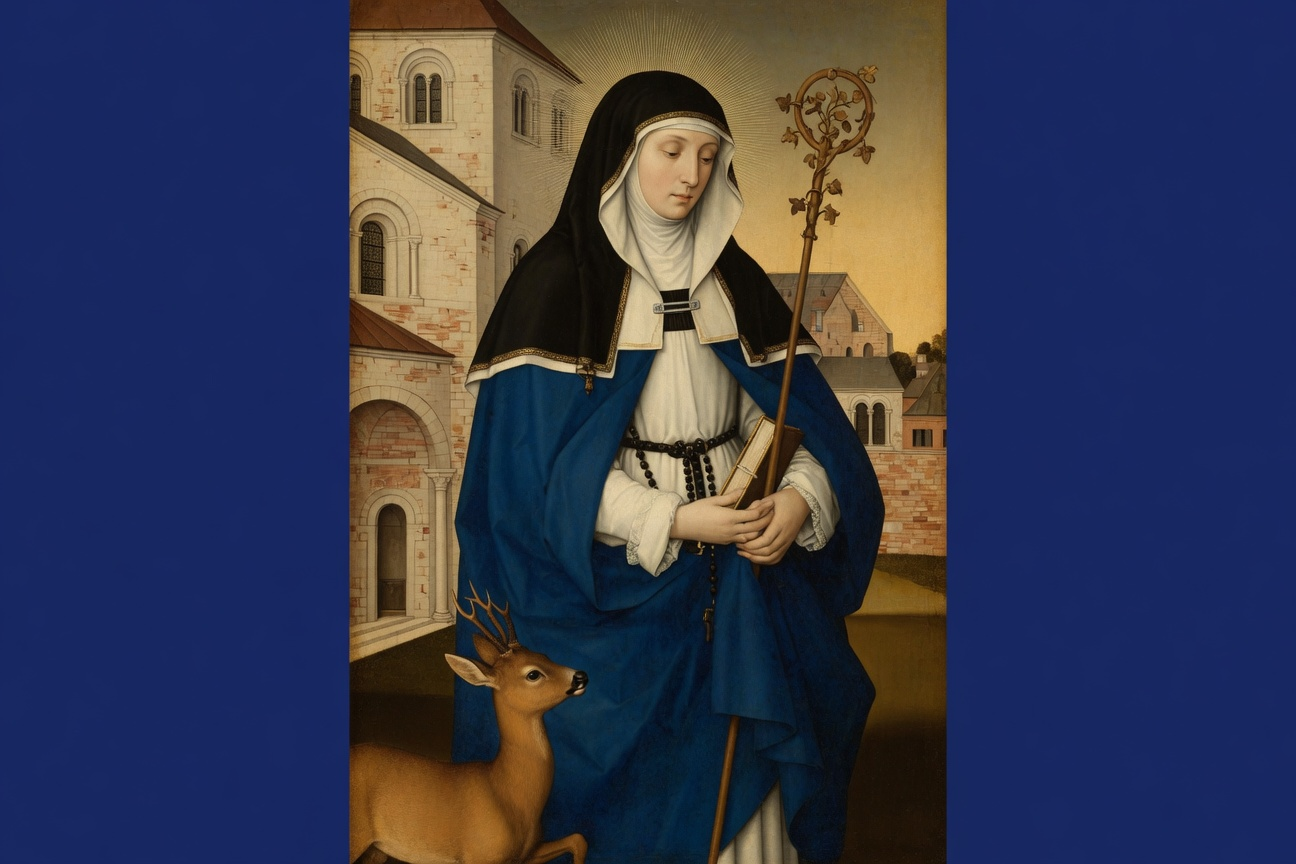
Daughter of Saint Bridget, Catherine of Sweden lived a virginal marriage before joining her mother in Rome. She dedicated her life to prayer, charitable works, and the direction of the Vadstena Abbey. She is famous for having been miraculously protected from kidnappers, notably by the appearance of a stag.
Guided reading
6 reading sections
SAINT CATHERINE OF SWEDEN
Origins and miraculous childhood
Daughter of Saint Bridget and Prince Ulphon, Catherine manifested exceptional piety from childhood and benefited from divine protection against demonic attacks.
The cross is the ladder to heaven. We shall see, in this story, a beautiful proof of these words of Our Lord: "A good tree produces only good fruit, just as a bad tree produces only bad fruit"; for the blessed one of Sweden was a branc h of a very holy stem bienheureuse de Suède Daughter of Saint Bridget and first abbess of Vadstena. , namely: of Saint Bridget, and of Ulphon, Prince o f Nericia, her sainte Brigitte Widow, mystic, and founder of the Order of the Most Holy Savior. husband. It appeared, from the be Ulphon, prince de Néricie Prince of Nericia and father of Saint Catherine. ginning of her childhood, that the heavenly Spouse had chosen her for one of his brides. She tenderly loved all those who were virtuous, and she showed aversion and distaste for all those who were not, thus making her aversion and distaste apparent. Being weaned, she was placed in the hands of a virtuous abbess, to be raised under her guidance. But one night when this nun was at Matins, the demon, taking the form of a bull, threw the child out of the cradle with its horns, to kill her, and left her half-dead in the middle of her room. The abbess, having found her in this state, took her in her arms, and then the evil spirit appeared to her and said: "Oh! How I would have finished her off with a good heart, if God had permitted me!" At the age of seven, she was one day playing with jackstraws with the other young boarders, at a time when her duty called her elsewhere; but the heavenly Spouse, who wanted to make a Saint of her, did not let this childish trait pass without correction, and, the following night, the demons appeared to her in the form of jackstraws, and whipped her so harshly, to wean her from these vain and childish recreations, that she no longer had any desire to linger over them.
A virginal marriage
Married out of obedience to Edgard, she persuaded her husband to live in chastity and influenced those around her, notably her sister-in-law Gidda, toward a more sober life.
No sooner was she of marriageable age than her father commanded her to marry. This command appeared entirely opposed to her inclination and to the resolution she had taken to remain chaste: she acquiesced nonetheless, counting on the help of God and the favor of the most holy Virgin, so that her marriage might take place without prejudice to her virginity: which came to pass; for, having married a lord named E dgard, Edgard Husband of Catherine, with whom he made a vow of chastity. she showed him so well the beauty of continence that she persuaded him to keep it, by making a vow of chastity; and in this way, they both deceived the world, under the name and appearances of marriage. She had a brother named Charles, who was a frivo Charles Brother of Catherine, described as a worldly prince. lous and worldly prince; unable to endure that his sister should live in this manner with his brother-in-law, and especially offended by the simplicity of her clothes, he tried to make her change her conduct; but Catherine, far from abandoning what she had so holily begun, advised, on the contrary, the wife of Charles, called Gidda, to strip herself of everything that smacked too much of the century and the pomp of the world: in which she succeeded very happily.
Stay in Rome and miraculous protections
Joining her mother in Rome, she escaped several abduction attempts thanks to divine interventions, such as the appearance of a stag or the blinding of her attackers.
After the death of her father, Saint Bridget, her mother, having go ne t Rome Birthplace of Maximian. o Rome by divine inspiration, she followed her there with the consent of her husband; having arrived there, she did not lack occasions for combat to preserve the flower of her inviolable chastity: for, some time later, the rumor of her husband's death having spread through the city, a nobleman set his sights on her to marry her; and, seeing that he could hope for nothing through ordinary means, he resolved to abduct her. Indeed, as she was going one day to the church of Saint Sebastian, accompanied by some pious ladies, this sacrilegious man prepared to execute his design; but a stag, which suddenly appeared in the middle of the path, distracted him, and while he ran to pursue it, Catherine escaped his grasp. When she returned to her mother, who had been revealed by God the danger her daughter had faced, she exclaimed: "Blessed be, my child, the stag that heaven used to deliver you from the trap that was laid for you." From then on, Catherine kept a stricter retreat and went out only rarely.
However, another time when she was going with her mother to the church of Saint Lawrence Outside the Walls, she found herself in a similar danger; but this nobleman who was waiting for her, being about to lay his hands on her, suddenly lost his sight. Recognizing his fault, he came to throw himself at her feet, and, having asked for her forgiveness, he recovered, through her prayers and those of her mother, the sight that his recklessness had caused him to lose. Afterwards, he himself bore witness to this miracle in the presence of the Pope.
She faced no fewer hazards elsewhere than in Rome; particularly once whe n goin Assise Site of the arrest of Saint Sabinus. g to Assisi, with the same Saint Bridget, to visit the church of Saint Mary of the Portiuncula, she was surprised in an inn by bandits, who cast a covetous eye upon her; but she was again miraculously delivered from this peril: for a great noise was immediately heard around the inn, as if of soldiers, and a voice resounded in the air commanding that these thieves be seized; this caused them such terror that they all took flight. The next day, as the saints continued their journey, these same thieves returned to execute in broad daylight what they had been unable to do during the night: but God having also struck them with blindness, they could not see His servants when they passed by the place where they had set their ambush. This visible protection from heaven so increased the fire of divine love and the affection for virtue in Catherine's heart that her holiness continually acquired new degrees. Humility was her dear virtue, and praises gave her as much confusion and pain as humiliations and contempt caused her satisfaction.
Devotion and works of charity
Despite the temptation to return to her homeland, she dedicated herself to the meditation of the Passion and to charity toward the poor of Rome, sustained by mystical visions.
But the enemy of salvation, who had been unable to gain anything against our Saint, devised a ruse that nearly succeeded. The little freedom that remained for her to visit the places venerated by the faithful made the stay in Rome tedious for the young widow. Her mother and her confessor tried in vain to represent to her that this was a temptation; sadness followed closely upon boredom; she grew pale and withered before their eyes. The two pious women placed their trust in Mary, asking her, through fervent prayers, to know the will of the Lord. Their trust was rewarded: Catherine saw, in a mysterious dream, the Mother of Mercies, who showed her, with a severe air, that she had no help for a person forgetful of her promises, and ready to sacrifice her duty to the desire to see her country again, where inevitable dangers awaited her. The pious Princess was no sooner awake than, detesting her cowardice, she went to throw herself at the knees of Saint Bridget, renewing her promise never to leave her.
Besides vocal prayer, which she had always cherished from her childhood, she spent four hours each day in meditation on the painful Passion of her Savior, to whom she constantly offered herself as a sacrifice. One day while she was at prayer, in Rome, in the church of Saint Peter, a lady, dressed in white and wearing a black cloak over it, appeared to her and told her to pray to God for the wife of her brother Charles, who had passed away, and that in a few days, she would receive a rich legacy from her, because she had left them by testament the gold crown she used, according to the custom of the country. This benefit served only to better satisfy the great charities she exercised in the city of Rome; there was no hospital that did not have a share in her liberality. Now, although her retinue and the furniture of her dwelling were very poor, nevertheless, on certain occasions, God made her appear pompously dressed; and, by pleasant appearances, He covered her room with tapestries of great price, and her bed with purple curtains and covers of cloth of gold, to satisfy the eyes of those who dwell on the exterior.
Superior at Vadstena and diplomatic mission
After the death of Bridget, she became superior of the monastery of Vadstena in Sweden before returning to Rome to plead for her mother's canonization before the Pope.
She spent twenty-five years with her mother, both in Rome and on the journey to Jerusalem, where she accompanied her. After the blessed passing of Saint Bridget, returning to Sweden, she brought her body and several other relics of saints with her; then, having completed her funeral rit es, she entered the monastère de Watzen Swedish monastery of which Catherine was the superior. monastery of Vadstena, where she was recognized as superior. She then began to instruct the nuns in the rule that her mother had left in writing; but as God glorified the sepulcher of this holy widow through several miracles, the King of Sweden, and all the prelates and princes of his kingdom, wishing to obtain from the Pope that he proceed to her canonization, judged it appropriate that her daughter Catherine return to Rome for this purpose. She went there according to their desire; but because of the schism that aro Urbain VI Pope who extended the feast of the Visitation to the entire Church in 1389. se in the Church during the time of Urban VI, she could not bring this matter to a conclusion; she did not, however, leave this great city without leaving behind evident marks of her holiness; for a woman who was ill, not wishing to confess or prepare for death, she began to pray and implored divine mercy for her. Then a black and thick vapor emerged from the Tiber which surrounded her house and obscured it so much that the people who were there could not even see one another, and such a dreadful noise was made there that the sick woman, quite frightened and almost beside herself, called Catherine and promised her, with tears in her eyes, to do everything she would command her. She confessed, and the next day, she ended her days with every appearance that God had forgiven her sins. Another woman, who had had several difficult labors, finding herself pregnant and near her term, begged this holy Princess not to forget her in her prayers; the Saint gave her good hope and promised to assist her. Indeed, she did so much through her entreaties to God that this woman gave birth happily to a daughter, who was named Bridget.
After a stay of five years in the city of Rome, where, in the pursuit of her mother's canonization, she received much praise in full Consistory from the very mouth of the Sovereign Pontiff, she took the road back to Sweden to retire into her solitude. Her reputation was so great that she was received and treated with extraordinary respect and honor by all the princes and prelates, both of Italy and Germany, through whose lands she passed. This entire journey was glorious for her, because of the miracles that were performed through her intercession. It is recounted, among others, that a man in her retinue having fallen fast asleep from the top of a wagon, and having been crushed under the wheels, the virtuous Princess offered her prayer, touched him with her hands, and healed him. She did the same for another who had fallen from the top of a building onto stones, and had so broken his limbs that he could not move; she also restored to him, by her touch, such perfect health that he immediately returned to work with the other laborers, giving a thousand praises to God and to his benefactress, who had obtained his healing so promptly.
Last days and legacy
She passed away in 1381 in Sweden. Her legacy includes the work 'Consolation of the Soul' and a rich iconography symbolizing her purity and her miracles.
Catherine having returned to Sweden, her health began to decline. It had been her custom, from the time she lived with her mother, to confess every day, and she continued this practice ever since, especially during this final illness. However, due to the weakness of her stomach and her vomiting, she did not dare to receive the Most Holy Sacrament of the Altar; she nevertheless had it brought to her to adore it and to humble herself in its divine presence. Finally, lifting her eyes to heaven and commending her soul to God, she passed from this world to a better one, in the year of grace 1381. The acts of her life state that it was on the eleventh day of the kalends of April, which is March 22. But, as they add that it was the eve of the feast of the Annunciation, many have believed that an error had crept in: that 11 had been written for 9, which is the 24th of the same month. It is a difference of little importance, and one which has not prevented us from following the date of the Roman Martyrology.
There appeared, over the monastery where the Saint had died, a star that followed her body to the church, and remained in the air, in front of the coffin, until the end of the burial. Several miracles occurred at her sepulcher.
We have from Saint Catherine o f Sweden a book enti Consolation de l'âme Spiritual work composed by Saint Catherine. tled: *Consolation of the Soul*. She says herself in her preface that her work is composed of maxims drawn from the Holy Scripture and various treatises of piety.
Here are the different ways of representing Saint Catherine of Sweden:
1° During her childhood, Mary appears to her at night and praises her for the modesty with which she takes her rest; 2° a stag at her side. We have just mentioned the circumstance in which this animal diverted the attention of a ravisher who sought to violate the virtue of the Saint. But there is another trait of her life that may have provided the image-makers with the motive to place a stag near her: it is said that as she was crossing a wood while her husband was hunting, a doe pressed by the dogs threw itself toward our Saint, who obtained mercy for this charming beast; 3° in a group with her mother Saint Bridget, in the costume of pilgrims; 4° meditating on the Passion of the Savior to recall her devotion to the sufferings of Jesus Christ: she indeed spent several hours each night shedding abundant tears before a crucifix; 5° with a lily in her hand, a symbol of her virginity during her marriage and of her religious profession after the death of the prince her husband; 6° she has sometimes been represented in her bed, visited by a priest carrying the Eucharist, because, in her last illness, unable to receive the viaticum due to her stomach ailments, she asked to be able at least to adore Our Lord in his august Sacrament; 7° she is also represented either in the costume of an abbess, holding a crozier and a small church; on her head a crown recalling her noble origin; or occupied in caring for and dressing the wounds of the poor.
Saint Catherine of Sweden is invoked against abortion and against floods.
Surina reports her life in his second volume. It is also found at the end of the Book of Revelations of Saint Bridget, her mother.
Annexes & related entities
Structured data for exploration: events, miracles, quotes, places, attributes, patronages, and important entities cited in the text.