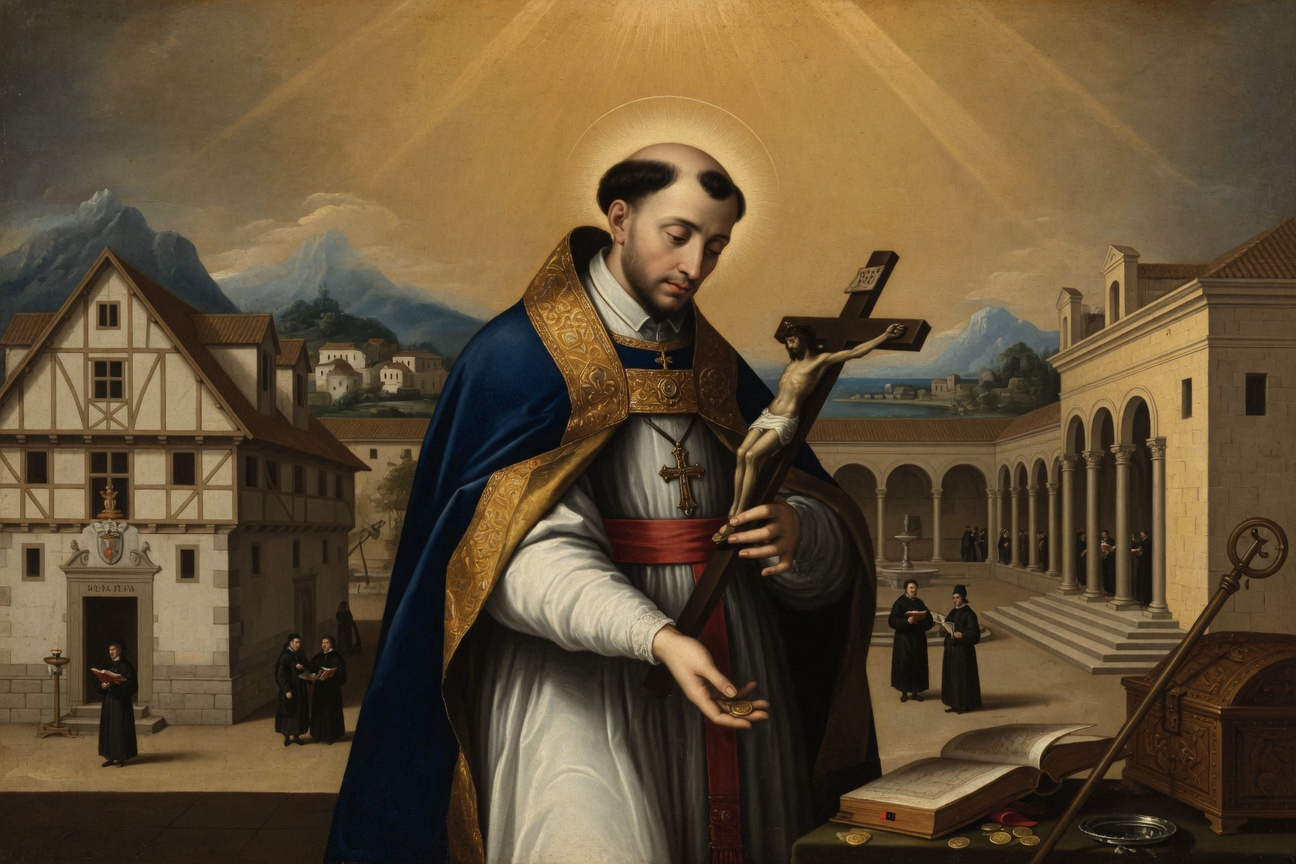
A Spanish magistrate appointed Archbishop of Lima in the 16th century, Toribio dedicated his life to the evangelization of Peru and the defense of the Indians against colonial abuses. He tirelessly traveled his vast diocese, reformed the clergy through synods, and founded numerous charitable institutions. He is considered the great restorer of piety in Latin America.
Guided reading
8 reading sections
SAINT TORIBIO OR TURIBIUS, ARCHBISHOP OF LIMA
Youth and formation in Spain
Born in 1538 in Spain, Toribio manifested early a great piety and active charity before pursuing his studies in Valladolid and Salamanca.
Saint Toribio or Turibe Saint Toribio ou Turibe Archbishop of Lima and reformer of the Church in Peru. , second son of the lord of Mogrovejo, in Spain, was born on November 16, 1538. From his childhood, he showed a decided taste for virtue and an extreme horror of sin. Having one day met a poor woman transported with anger on the occasion of a loss she had just suffered, he spoke to her in the most touching manner about the fault she was committing, and gave her, to appease her, the value of the thing she had lost. He had a tender devotion to the Blessed Virgin; every day he recited her office with the rosary, and he fasted every Saturday in her honor. While he attended public schools, he would set aside a portion of his dinner, although very frugal, to assist the poor with it.
He carried the austerities of mortification so far that one was obliged to moderate his zeal. He began his higher studies in Valladolid, and went to complete them in Salamanca.
Magistracy in Granada
Noticed by King Philip II, he served with integrity as president of the tribunal of Granada for five years.
King Philip II, wh Le roi Philippe II King of Spain involved in the sack of Saint-Quentin. o knew him early on, held him in particular regard. He rewarded his merit with distinguished positions, and made him president or chief magistrate of Granada. T he Sain Grenade City under Moorish rule of which he was bishop and where he was martyred. t fulfilled this office for the space of five years with an integrity, prudence, and virtue that earned him general esteem. It was in this way that God prepared the paths for his elevation in the Church.
Call to the Episcopate in Peru
Despite his humility and his reservations as a layman, he is appointed Archbishop of Lima to reform a Church in crisis.
The unfortunate state of religion in Peru required a pastor who was truly animated by the spirit of the Apostles; and this pastor, grace had formed in the person of Turibe. The Archbishopric of L ima having become archevêché de Lima Capital of Peru and the saint's primary place of residence. vacant, he was appointed to it by the king. Never perhaps was a choice more universally approved. Turibe was regarded as the only man capable of remedying the scandals that hindered the conversion of the infidels. The Saint was dismayed upon learning the news of his nomination: he threw himself at the feet of his crucifix, and there, melting into tears, he prayed to God not to allow him to be burdened with a weight that could not fail to crush him. He wrote to the king's council letters in which he represented his incapacity with the strongest colors; he then moved on to the canons of the Church, which expressly forbid raising laymen to the episcopate; but no regard was paid to his letter, and he had to give his consent. His humility, however, did not remain without reward; it was for him the source of those abundant graces whose effect was later manifested in the exercise of his ministry.
Arrival and state of the diocese
Arriving in 1581, he discovered an immense territory marked by the abuses of the conquerors and civil disorder.
Turibius wished to receive the four minor orders on four different Sundays, in order to have time to perform their functions; he then received the other orders, and was consecrated bishop. He embarked without delay for Peru, and landed near Lima in 1581. He was then in the forty-third year of his age. The diocese of Lima extends for one hundred and thirty leagues along the coast, and includes, besides several cities, an innumerable multitude of villages and hamlets scattered over the double chain of the Andes, which are counted among the highest mountains in the world. Some of the European leaders, who were the first to conquer this country, had allowed themselves to be led by the impulses of immoderate ambition and insatiable avarice; they had stripped themselves of all human feeling and had treated the savages more as tyrants than as conquerors. The country was then engulfed by the fire of civil wars and domestic dissensions. Everywhere there was nothing but cruelty and perfidy, treachery and disorder. In vain did the court of Spain try to oppose the evil: it had taken such deep roots that it appeared incurable.
Reforms and pastoral visits
He tirelessly traveled the Andes, organized synods, and defended indigenous populations against the oppression of governors.
The holy Archbishop was moved to tears at the sight of so many evils, and he resolved to undertake everything to stop their course. Consummate prudence, joined with an active and vigorous zeal, smoothed out all difficulties for him. Little by little, he succeeded in eradicating public scandals and establishing the reign of piety upon the ruins of vice. Immediately after his arrival, he undertook the visitation of his vast diocese. It would not be possible to give a fair idea of the fatigues and dangers he had to endure. He was seen climbing steep mountains, covered in ice or snow, in order to bring words of consolation and life into the poor huts of the Indians. Often he traveled on foot; and as apostolic labors only bear fruit insofar as God seconds them, he prayed and fasted incessantly to draw divine mercy upon the souls entrusted to his care. He placed learned and zealous pastors everywhere, and provided the help of instruction and the sacraments to those who inhabited the most inaccessible rocks. Persuaded that fidelity to discipline greatly influences morals, he made it one of the important objects of his solicitude. He decreed that in the future, diocesan synods would be held every two years and provincial synods every seven years. He was inflexible regarding the scandals of the clergy, especially when it came to avarice. As soon as the rights of God and neighbor were harmed, he took up their defense without regard for the status of the persons; he showed himself to be both the scourge of public sinners and the protector of the oppressed. The firmness of his zeal stirred up persecutions against him from the governors of Peru, people who, before the arrival of the virtuous viceroy Francisco de Toledo, did not blush to sacrifice everything to their passions and their vice-roi François de Tolède Viceroy of Peru mentioned for his virtue. private interests. He opposed them only with gentleness and patience, without, however, relaxing anything of the holiness of the rules; and as some bad Christians gave the law of God an interpretation that favored the disordered inclinations of nature, he represented to them, following Tertullian, that Jesus Christ "called Himself the truth, and not custom," and that at His tribunal our actions would be weighed, not in the false balance of the world, but in the balance of the sanctuary. With such conduct, the holy Archbishop could not fail to eradicate the most inveterate abuses: thus, one saw them almost all disappear. The maxims of the Gospel prevailed; and they were practiced with a fervor worthy of the first centuries of Christianity.
Foundations and devotion
He founded seminaries and hospitals, devoting himself body and soul during plague epidemics and learning local languages to evangelize.
Turibius, to extend and perpetuate the work of his zeal, founded seminaries, churches, and hospitals, without wishing to allow his name to be inserted in the deeds of foundation. When he was in Lima, he visited the poor sick in the hospitals every day; he consoled them with paternal kindness and administered the sacraments to them himself. When the plague attacked a part of his diocese, he deprived himself of his own necessities in order to provide for the needs of the unfortunate. He recommended penance as the only means to appease the irritated heavens; he attended processions, dissolving in tears; and with his eyes fixed on a crucifix, he offered himself to God for the preservation of his flock. To these acts of religion, he added extraordinary prayers, vigils, and fasts, which he continued as long as the plague made its ravages felt.
He faced the greatest perils when it was a question of procuring the smallest spiritual advantage for a soul. He would have liked to give his life for his flock; and he was constantly in the disposition to suffer everything for the love of Him who redeemed men by the shedding of His blood. When he learned that poor Indians were wandering in the mountains and deserts, he entered into the sentiments of the Good Shepherd and went to seek these stray sheep. The hope of bringing them back to the fold sustained him in the midst of the fatigues and dangers he was obliged to endure. He was seen traveling without fear through frightful solitudes inhabited by lions and tigers. He visited his diocese three times. The first of his visits lasted seven years, the second five, and the third a little less. The conversion of an innumerable multitude of infidels was the fruit of it. The Saint, while on the road, occupied himself either in praying or in conversing about spiritual things. His first care, upon arriving anywhere, was to go to the church to pour out his heart at the foot of the altars. The instruction of the poor sometimes kept him for two or three days in the same place, even though he lacked the most necessary things for life there. The most inaccessible places were honored by his presence. In vain did they represent to him the dangers to which he was exposing his life; he replied that, Jesus Christ having descended from heaven for the salvation of men, a pastor should be disposed to suffer everything for His glory. He preached and catechized with indefatigable zeal; and it was to be in a state to better fulfill this important function that he learned, at a very advanced age, the different languages spoken by the savages of Peru. He said Mass every day with angelic piety, making a long meditation before and after this great action. He usually went to confession every morning to purify himself more perfectly from the slightest stains. The glory of God was the end of all his words and all his actions, which made his prayer continuous. Nevertheless, he still had marked hours for prayer; then he would withdraw in private and treat with God of his needs as well as those of his flock. In these moments, a certain exterior radiance shone upon his face. His humility did not yield to his other virtues: hence this extreme care to hide his mortifications and his other good works. His charity for the poor was immense; his liberality embraced them all indiscriminately. He was, however, particularly interested in the needs of the shamefaced poor.
The Legislative Work
His conciliar decrees became references for the Church, both in America and in Europe.
Our Saint had the glory of renewing the face of the Church in Peru; and if he was not its first apostle, he was at least the restorer of piety, which had been almost generally extinguished there. The decrees issued by the provincial councils held under him will forever be authentic monuments of his zeal, his piety, his knowledge, and his prudence. They have been regarded as oracles, not only in the New World, but also in Europe and in Rome itself.
Death and canonization
He died in Santa in 1606. His body was found intact and he was canonized in 1726 after numerous miracles.
Turibius fell ill in Santa, a city one hundred and ten leagues from Lima: he was then occupied with the visitation of his diocese. He predicted his death and promised a reward to whoever would be the first to tell him that the doctors despaired of his life. He gave his servants everything that served his use; the rest of his goods were bequeathed to the poor. He wished to be carried to the church to receive the holy Viaticum there; but he was obliged to receive Extreme Unction in his bed. He continually repeated these words of Saint Paul: "I desire to be freed from the bonds of the body, to be reunited with Jesus Christ." In his final moments, he had those around his bed sing these other words: "I rejoiced at what was said to me: We shall go into the house of the Lord." He died on March 23, 1606, saying with the Prophet: "Lord, into your hands I commend my spirit." The following year, his body was transported to Lima, and it was found without any mark of corruption. The author of his life and the acts of his canonization report that during his lifetime he raised a dead man and cured several illnesses. After his death, several miracles were performed through the virtue of his intercession. Turibius was beatified in 1679 by Innocent XI, and canoniz ed in 1726 Innocent XI Pope who authorized the office of Saint Hedwig on October 17. by Benedict XIII.
Saint T oribio, als Benoît XIII Pope who established the Institute as a religious Order in 1725. o called Saint Thorive, is depicted giving alms to the poor. From his youth in Spain, he had received the name of father of the poor; but having become archbishop, he set no more limits to his alms, he willingly called the poor his creditors. — He is particularly honored in Peru.
Godescard drew this life, which we borrow from him, from the Acts of the canonization, and from the life of the holy bishop of Lima, by Cyprian de Herrera.
Annexes & related entities
Structured data for exploration: events, miracles, quotes, places, attributes, patronages, and important entities cited in the text.
Key Events
- Born on November 16, 1538, in Spain
- Studies in Valladolid and Salamanca
- President or chief magistrate of Granada for five years
- Appointment to the Archdiocese of Lima by Philip II
- Arrival in Peru in 1581
- Three major pastoral visits of the Diocese of Lima
- Foundation of seminaries, churches, and hospitals
- Died in Santa in 1606
Miracles
- Resurrection of a dead person
- Multiple healings during his lifetime
- Body found incorrupt one year after his death
- Posthumous miracles through his intercession
Quotes
-
Jesus Christ called Himself the truth, and not the custom
Attributed by the text to Tertullian, cited by the Saint -
Lord, into your hands I commend my spirit
Last words