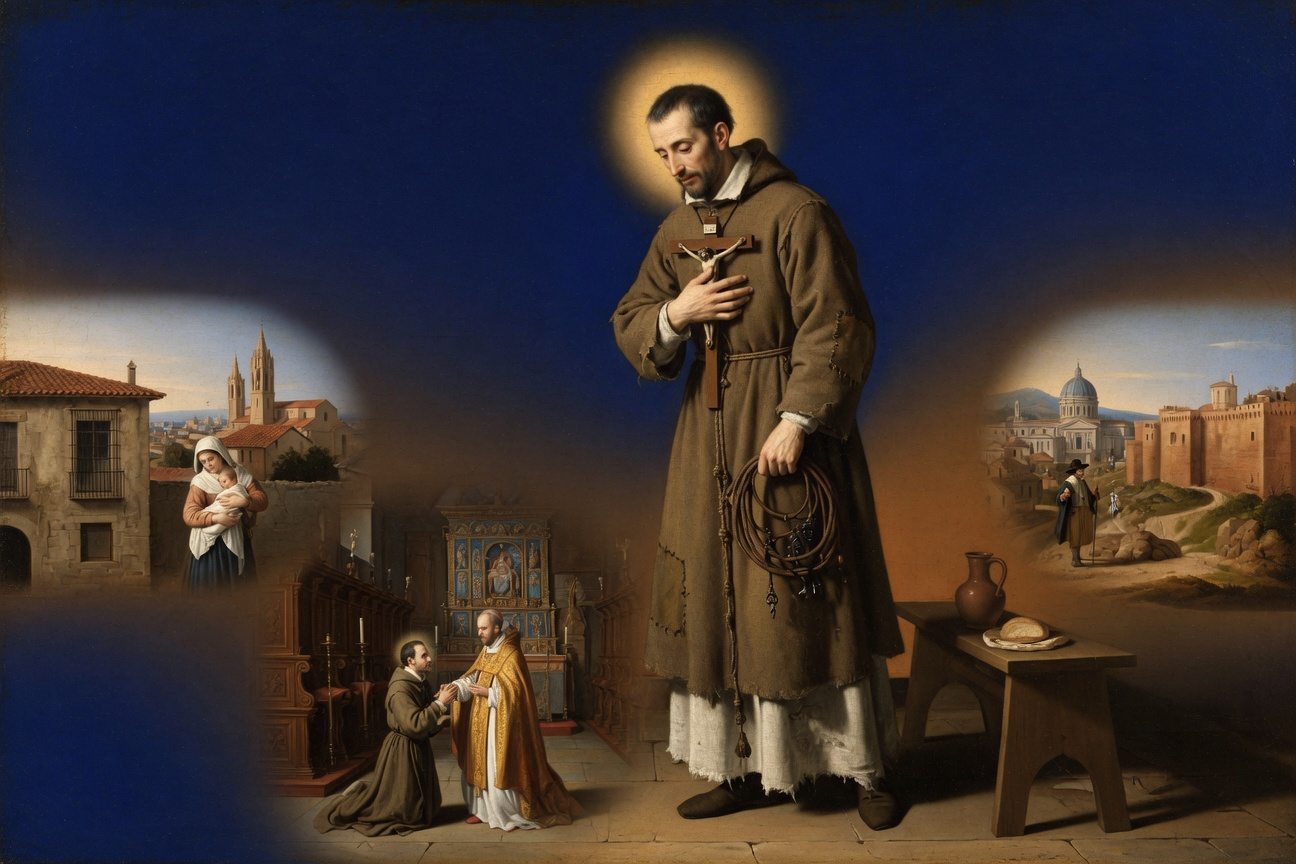
A 17th-century priest from Barcelona, Joseph Oriol distinguished himself by extreme austerity, living on bread and water and dedicating himself entirely to the poor and the sick. After a journey to Rome and an aborted mission attempt in Marseille, he returned to Barcelona where he performed numerous miracles and prophecies. He died in 1702, venerated for his holiness and inexhaustible charity.
Guided reading
6 reading sections
BLESSED JOSEPH ORIOL (1702).
Youth and formation
Born in Barcelona in 1650, Joseph Oriol grew up in piety and poverty before becoming a doctor and priest in 1675.
Joseph Oriol was born in Barcel Barcelone City where he worked as a shoemaker and entered religious life. ona in 1650; he lost his father while still in the cradle: fortunately, the shoemaker whom his mother remarried was a pious man who loved the orphan as his own son.
Entrusted early on to the care of the chaplains of Santa Maria del Mar, Jos Sainte-Marie-la-Mer Church or religious institution where Joseph was an altar boy. eph performed the duties of an altar boy while learning to read and write; his piety already attracted notice and attention, for he often spent long hours in prayer before the Blessed Sacrament. Through the care of the chaplains, who thought of making him a priest later on, he attended university courses. His mother had fallen into poverty following the death of her second husband; he found refuge with his nurse, a poor woman of the people, but very attached to the child she had held at the baptismal font. The conduct of Joseph Oriol was exemplary; loved by his companions and cherished by his masters, he was only seen going out to go to church or to attend university classes. His life passed in this way for seven years. He was visited by an illness from which God cured him suddenly without the aid of medicine. In 1674, he received the title of doctor, and in 1675 he was raised to the priesthood. To relieve his mother, he became a tutor.
Asceticism and mortifications
Following a miracle, he adopted a life of extreme austerities, nourishing himself only on bread and water and practicing flagellation.
in a powerful house; the exemplary and penitent life he led there caused him to be considered and venerated as a saint. At twenty-seven, following a miracle by which God made him understand that he was far from perfection, he vowed himself to a continual fast that lasted until the end of his life: bread and water taken in small quantities, and towards evening, were his only nourishment. His austerities could not remain hidden, and this was often for him in the streets of Barcelona the occasion for insults and outrages which rejoiced his heart. The linen he wore was coarse and covered rough breeches; he mastered his flesh with cruelty, flagellating himself until he bled, sleeping only two hours each night and on a chair.
Pilgrimage and Roman Benefice
After a pilgrimage to Rome, Pope Innocent XI granted him a benefice in Barcelona, the entire income of which he donated to the poor.
In 1686, he lost his mother; freed by her death from the care of providing for her, he set out for Rome. He made the journey on foot, and nothing could express the joy he felt while visiting the tombs of the Apostles and the sanctuaries of the Eternal City. In 1687, after a stay of several months in Rome, Innocent XI granted him a be nefice in Barcelone City where he worked as a shoemaker and entered religious life. Barcelona; he therefore returned to his native city, where he continued to live in the most complete poverty. He had taken a small room on the top floor of a house, in which the only furnishings were a crucifix, a table, a bench, and a few books; that was enough for him. As for the income from his benefice, it went entirely into the hands of the poor. His solicitude for the suffering members of Jesus Christ extended to the other world, and he ensured that Masses were said for the repose of their souls.
Ministry and desire for mission
A devoted confessor and instructor, he attempted to leave for the mission field for martyrdom but returned to Barcelona by divine command after an illness in Marseille.
The time he did not give to the poor or to the church was devoted to hearing confessions. He guided many souls in the ways of the highest perfection; he was reproached for being too austere in his direction, for allowing his penitents mortifications that harmed their health; upon this accusation, the bishop forbade him from hearing confessions, but the Saint announced that this would last only a short time; indeed, the bishop died soon after, and his successor restored all his powers to him. He still found the means to instruct young children and to evangelize soldiers, whom he won over with his gentleness and affection. Suddenly, he felt seized by the desire for martyrdom and left Barcelona without notifying anyone, to go and work for the conversion of the infidels. Two priests who met him had great difficulty making him understand that such an undertaking required reflection, and in bringing him back with them. When the people learned what had just happened, they gathered in a crowd around him to beg him not to abandon them, but his resolution was unshakable; he made his will and left for Rome, in order to place himself at the d ispo Rome Birthplace of Maximian. sal of the Propaganda. He had no resources with him, but Providence provided for the few needs of its servant; he fell ill in Marseille. The Blessed Virgin appeared to him and told h im that G Marseille Birthplace of the saint. od , content with h La Sainte Vierge Mother of Jesus, entrusted to the care of John at the foot of the cross. is sacrifice, ordered him to return to Barcelona to devote the rest of his life to the care of the sick and their healing. He was 47 years old.
The Thaumaturge of Barcelona
His life was marked by numerous miracles, healings, and gifts of prophecy, attracting crowds from afar to seek his help.
From then on, his life was nothing but a perpetual miracle; all of nature seemed to obey him. The boat on which he had embarked to return to his native city was assailed by a frightful storm; the Saint made the sign of the cross over the sea, and the winds abated, and the waves calmed. During this short voyage, the sailors often saw him in ecstasy, raised several feet above the deck of the boat. When he returned to Barcelona, the joy was general; everyone blessed God to see the Saint back; the poor, especially, shed tears upon seeing their protector again. He performed several miracles in succession, the report of which spread through the city, and the sick flocked to him to receive healing for their infirmities; his reputation spreading more and more, people came to visit him from more than two hundred leagues away. Before laying his hands on those who implored relief from their ailments, he would give them a short exhortation, and urge those who were in a state of mortal sin to go to confession first and return afterwards. Miracles multiplied in the footsteps of Joseph Oriol, and one would have to write a volume if one wished to give the details of them.
He had a thousand ingenious ways of hiding his miracles and ensuring that their cause was attributed to anything other than his holiness. His confessor having forbidden him to perform miracles in the church because of the tumult that resulted, the Saint obeyed, and would no longer perform a single one, until that same confessor, having broken his thigh, was obliged to return to the Saint the permission he had taken away. The demon, jealous of the servant of God, and having been unable to win a victory over his soul, began to mistreat his body. The Saint emerged several times all bloody from the hands of his enemy. God granted Joseph Oriol, along with the gift of miracles, the gift of prophecy; he predicted several events that were fulfilled to the letter; he announced the hour of his death.
Death and beatification
He died in 1702 while singing the Stabat Mater. His reputation for holiness led to his beatification by Pius VII in 1806.
The illness that was to lead him to the grave took hold of him on March 8, 1702. He wished to die poor as he had lived; during the fifteen days he suffered, his friends did not leave him for an instant, and as he saw them weeping, he strove to console them, promising to love them in heaven even better than he had loved them on earth. After receiving the last sacraments on the 22nd, he asked that the Stabat Mater be sung to him, and expired while fixing his eyes on the crucifix.
He was fifty-two years and four months old (March 23, 1702). The crowd that rushed to see him on his deathbed was such that it was very difficult to contain them. His funeral was magnificent, but it was necessary to close the church to proceed with his burial. All the objects that had belonged to him had been shared out like relics. Pius VII beatified Joseph Oriol on May 15 Pie VII Pope who authorized the cult of Blessed Rainier. , 1806.
Various collections of Lives of Saints.
Annexes & related entities
Structured data for exploration: events, miracles, quotes, places, attributes, patronages, and important entities cited in the text.
Key Events
- Born in Barcelona in 1650
- Ordination to the priesthood in 1675
- Vow of perpetual fasting at the age of 27
- Pilgrimage to Rome on foot in 1686
- Obtained a benefice in Barcelona from Innocent XI in 1687
- Attempted departure for the missions to non-believers and illness in Marseille
- Return to Barcelona and life dedicated to miracles and the sick
- Died on March 23, 1702, at the age of 52
- Beatification by Pius VII on May 15, 1806
Miracles
- Sudden healing of an illness without medical aid
- Calming of a storm at sea with a sign of the cross
- Levitation and ecstasies above the deck of a boat
- Multiple healings of the sick through the laying on of hands
- Healing of his confessor's broken thigh
- Gift of prophecy and announcement of the hour of his death