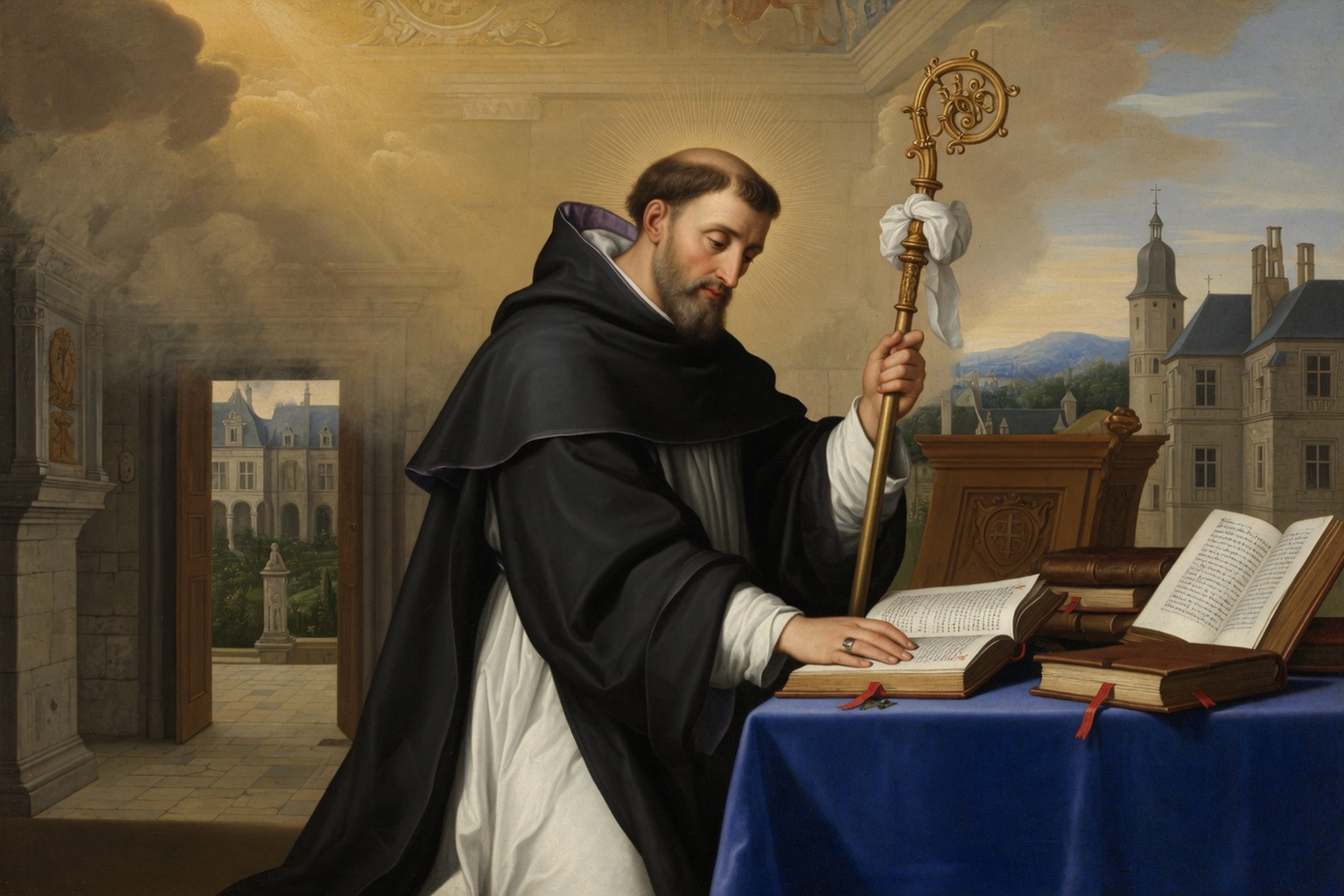
Venerable Louis of Blois
Blosius
Abbot of the Benedictine monastery of Liessies
A former page to Charles V, Louis de Blois renounced court life at fourteen to enter the Abbey of Liessies. Upon becoming abbot, he reformed his monastery and composed numerous treatises on mystical spirituality that achieved immense success. He remains famous for his humility, having refused the highest ecclesiastical dignities to dedicate himself to prayer and the poor.
Guided reading
7 reading sections
THE VENERABLE LOUIS DE BLOIS
ABBOT OF THE BENEDICTINE MONASTERY OF LIESSIES
Youth at the Imperial Court
Born in 1506 into a noble family of Hainaut, Louis de Blois became a page at the court of Charles V, where he preserved his piety despite the worldly environment.
At the time when schism and heresy were wreaking the most havoc in the Church of Jesus Christ, there lived in Belgium a man of eminent holiness, who, after spending his early years at the court of Charles V in perfect innocence, went to bury himself, while still young, in the abbey of Liessies. This is the venerable Louis de Bl ois, who later Louis de Blois Author cited in the epigraph of the text. became abbot of that monastery. He was the son of Adrien de Blois, lord of Jumigny, who traced his origin to the lords of Châtillon and the counts of Blois. His mother, Catherine de Barbançon, a noble lady of Don-Stienne, near Beaumont in Hainaut, gave birth to him in that same castle in the month of October 1506. He received, like his five brothers and three sisters, an excellent education, and distinguished himself from his earliest years by a great gentleness of character. The innocence of his conduct and his piety led many people to think that he would later become a great servant of God. Sent to court as a page to the young Archduke Charles, later Charles V, Louis de Blois knew how to preserve all the integrity of his virtue there. He also shone there by his chivalrous qualities and those amiable gifts of nature that attached hearts to him. The young archduke, in particular, vowed him a friendship that only grew with the years. His parents, who placed great hopes in him, were flattered by the testimonies they received of their son's conduct. They were already forming brilliant plans for his future when a providential accident came to give a new direction to the young courtier's thoughts. One day, Louis de Blois received a head wound, for which he had to undergo a painful operation. The surgeon having asked him what shape he wished to be given to the incision that had to be made in the flesh: "the cross of Burgundy," the young knight immediately replied. This remark made an impression on the people who were near him: Louis himself could not help but notice it, as if this answer, in which vanity had its part, had revealed a secret design of heaven. Be that as it may, it is certain that an astonishing change then took place in his feelings and thoughts. His soul, still pure and innocent, began to understand all the vanity of the things of the world and the happiness one tastes in renouncing them for God. These salutary reflections purifying more and more what the contact with the world might have left of worldly ideas in his mind, Louis de Blois soon took the resolution to leave the court, and, with the permission of his parents, to retire to the monastery of Liessies. He was only fourteen years old when he made this courageous determination. His fidelity to grace was promptly rewarded by special favors from heaven. Thus he was seen, in a short time, to make rapid progress in virtue. Everyone admired his fervor in the fulfillment of the duties of religious life, and the air of happiness and intimate peace that shone in his eyes. The abbot of Liessies, who had received his new disciple like an angel sent from heaven, did not doubt that his community would one day derive precious advantages from his presence. He entrusted him in a very special way to Dom Jean Meurisse, master of novices, who made him advance by leaps and bounds in the ways of perfection. The novitiate finished, Louis de Blois was sent to Louvain to pursue solid studies, which would put him in a position to render important services to the Church. He met the most distingui shed pr Louvain Birthplace of the saint in Belgium. ofessors at the university of that city, and successfully followed the courses of philosophy and theology under their guidance. Latin, Greek, and Hebrew became equally familiar to him, and he delved into the works of the most skillful doctors and the writings of the holy Fathers. The piety of the young religious constantly put him on guard against that dryness of heart, that restless curiosity, and that immoderate desire for knowledge, which so often become a pitfall for the best minds. Louis de Blois avoided this by applying himself with care to prayer and other spiritual exercises, which maintained and developed more and more within him the spirit of Jesus Christ.
Monastic Vocation and Formation
Following a symbolic injury, he left the court at fourteen for the Abbey of Liessies, then pursued brilliant studies in theology and ancient languages at Louvain.
The Abbot of Liessies continued to follow in his thoughts the young disciple sent to Louvain, about whom he received the most flattering reports. Feeling that the infirmities of age would soon no longer allow him to fulfill all the duties of his office, he thought of requesting a coadjutor. The disposition of his monks in favor of Louis de Blois was so well known to him that he did not fear proposing him to them. All, even the oldest, gave their vote to the young religious, whom the nobility of his birth, his learning, and even more his virtue, rendered the most capable of directing the community in these difficult times. The humble disciple, upon learning this news in Louvain, was as if struck down. Dom Meurisse even deemed it necessary to write him a letter to console and encourage him, by showing him all the good he could do in the office imposed upon him. Louis de Blois remained two more years in Louvain to perfect himself in the ecclesiastical sciences; but upon the death of the venerable Abbot Grippe, which occurred on March 2, 1530, the monks begged him to come among them. They then renewed in his presence the election they had already made; and a few months later, the venerable Louis de Blois having been ordained a priest, the entire community attended his first Mass and the abbatial blessing he received the following day, November 13, 1530.
Election as Head of Liessies
Elected coadjutor by his peers despite his young age, he succeeded Abbot Grippe in 1530 and received the abbatial blessing after his priestly ordination.
The holiness of the new abbot soon became apparent to his brothers, who never ceased to admire the combination of so many virtues and qualities united in his person. This favorable disposition encouraged him in the plan he had conceived to establish a reform, by cutting away certain abuses that the weakness of some of his predecessors as abbots, and especially the continual wars of that era, had caused. As these wars often forced the religious to seek refuge in other lands, it was impossible for discipline not to suffer greatly. At that very moment, war was breaking out again between Francis I and Charles V; but this time, Providence allowed it to contribute to supporting the projects of the wise abbot of Liessies. Indeed, having retired to Ath with three religious willing to embrace the reform, he soon saw the other fugitive religious flocking from Mons, where they had taken refuge. All asked to follow, in its primitive rigor, the Rule of Saint Benedict, subject to some modifications that seemed n ecessary to saint Benoît Founder of the Benedictine Order, cited as a chronological reference point. them. Louis de Blois, wishing on one hand to restore to the community of Liessies its original regularity, and fearing on the other hand to demand more than he could obtain, asked the Lord insistently to deign to enlighten him with His light. He also consulted wise persons filled with the spirit of God, who answered him that it would be better to take a suitable middle path for his reform, leaving certain more arduous burdens to individual fervor. The worthy abbot, always disposed to follow the judgment of others rather than his own, yielded to this advice. Shortly after, he returned, full of joy, to Liessies with his religious, who resumed the exercises of their institute with new ardor. It was to further increase this good disposition that he then composed spiritual treatises, filled with the spirit of God and an unction so sweet that it is impossible, while reading them, not to feel touched and stirred to make the most generous sacrifices.
Restoration of the Rule
Taking advantage of an exile forced by the war between Francis I and Charles V, he established a balanced reform of the Benedictine rule within his community.
The first of these works is titled: *The Mi rror of Religious*. Und Le Miroir des Religieux A major work by Louis de Blois on monastic life. er the name of Abbot Dacrien, that is to say, one who weeps, who groans, the author deplores the misfortune of a lukewarm religious who is negligent in the fulfillment of the duties of his state; at the same time, he indicates the virtues and interior dispositions that make a religious worthy of his vocation. The second work is entitled: *Rule of the Spiritual Life*. The Venerable Louis de Blois gives therein the wisest advice for overcoming various temptations, for walking holily in the ways of God, and for uniting oneself closely to Him through the exercises of the spiritual life. His other principal works bear the following titles: *The Conclave*; — *The Recreation and Sacred Retreat of the Faithful Soul*; — *The Institution and the Spiritual Pearl*; — *The Manual of the Little Ones*; — *The Rule of Him Who Is Still a Novice in the Ways of the Spirit*; — *The Consolation of the Pusillanimous*; — *The Collyrium of Heretics and the Torch to Enlighten Them*. Furthermore, among the works of the Venerable Louis de Blois, one finds meditations, affections, and prayers, in which the most suave piety breathes. One may judge by this single citation, taken from the preamble of the statutes he gave to his community, and in which he seeks to show the advantages of the monastic life. "Happy," he exclaims, "are those to whom Jesus speaks to the heart, and to whom He says: Come, let us go out, let us go into a desert place! Happy are those whom the Lord transports from the vast sea of the world, from the midst of its innumerable reefs, to the port of religious life! There, life is peaceful and without dangers; there abounds peace, tranquility, and the joy of the Holy Spirit; there, without any solicitude for passing things, men serve freely, day and night, the immortal King of the ages. A single thought occupies them, that of pleasing God by a faithful obedience to His will, by a sweet assiduity to holy prayers, by the exercise of pious readings, and the effusion of tears in which the soul is purified. Everything is piety, everything is suavity in a community of religious who live according to their rules. One breathes there the delicious perfume of all the virtues: the roses of charity shine there with their crimson brilliance, the lilies of chastity raise toward heaven their heads of dazzling whiteness, and the violets, symbols of humility, flourish there and spread their suave odors. There, no tumult, no confusion; far from this sweet and amiable solitude are quarrels and dissensions; there also, every day, courageous athletes struggle in the arena of spiritual combat and win the victory over their enemies. The angels of heaven fly with rapidity to be the witnesses of this struggle, and to fortify the soldiers of Jesus Christ. Happy, therefore, are those who, fleeing the storms of the century, have retired into the safe and pleasant port of religious life, because, after having passed the rest of their days in the joy of the Holy Spirit, solely occupied with the service of God, they will receive at death the inestimable reward of the heavenly kingdom and will enjoy it eternally."
A Master of the Spiritual Life
A prolific author, he composed numerous mystical and ascetical treatises, including the Mirror for Monks, aimed at guiding souls toward union with God.
There was something even more touching and persuasive than the words and writings of the Venerable Louis de Blois, and that was the example of his virtues and the fidelity with which he fulfilled even the smallest observances of the rule. He presided over all the community's exercises and inspired feelings of devotion by his presence. Meditation was his delight, and during prayer, he was so absorbed in God that it seemed his soul had penetrated into the heavens. Attentive to taking advantage of all circumstances and means to advance in perfection and maintain himself in the spirit of faith, the venerable abbot went to the first Fathers of the Society of Jesus in Louvain to perform, under their guidance, the spiritual exe Compagnie de Jésus Religious order to which Peter Canisius belonged. rcises of Saint Ignatius. He vowed a sincere affection and entire devotion to these religious; thus, not only did he honor them with his friendship and favor their projects, but he also took up their defense before the great and in the councils of princes. A letter he wrote at that time was long preserved in Louvain, in which he victoriously and energetically refuted the numerous enemies that the Society already encountered at its origin. This attachment of the Venerable Louis de Blois for the Jesuit Fathers was communicated to his religious, who always maintained relations of a holy and touching confraternity with the Order of Saint Ignatius. There is, above all, one circumstance that, in a work of this nature, must be pointed out: the Abbey of Liessies was, a little later, like the cradle of the important work of the Bollandists. It is, in fact, in its magnificent and rich library that Fathers Rosweyde and Bolland began the wo Bollandistes A society of Jesuit scholars who publish the Acta Sanctorum. rks that were to give birth to this truly admirable undertaking. Of all the abbeys in northern France, that of Liessies was the richest in passionaries, in manuscript lives of the Saints, and in all kinds of precious works. It owed these literary treasures above all to Louis de Blois, who sought, by all means in his power, to develop piety in the hearts of his disciples. Not content with having collected the acts of a great number of Saints, he also procured many of their precious relics and had a magnificent chapel built to preserve them religiously.
Intellectual and Hagiographic Influence
A friend of the Jesuits and a patron of science, he established an exceptional library at Liessies that would serve as a foundation for the work of the future Bollandists.
Charles V had never forgotten, upon the imperial throne, the young page who had grown up before his eyes when he was still only Archduke of Austria. Throughout his life, he maintained for him a respectful esteem and a particular benevolence, which manifested itself in many circumstances. When the bishopric of Cambrai became vacant upon the death of Robert de Croï, he wished to appoint the Abbot of Liessies to it; but Louis de Blois insisted so strongly that this project had to be abandoned. Maximilien de Berghes, who was bound to him by a close friendship, was then raised to this dignity. Later, the Emperor, to give the worthy abbot a new proof of his benevolence, offered him the direction of the famous Abbey of Saint-Martin of Tournai; but he refused again, and even went to Brussels to see Charles V, "to ask him to live and die in the Abbey of Liessies." He continued to live there, in fact, in the fulfillment of all the duties of his holy state. Witness to the disorders and sacrilegious impieties committed everywhere by the Calvinists of the Low Countries, he did not cease to groan before the Lord over these excesses. At the same time that he composed works in which he refuted their errors, he worked to bring back into the fold the sheep that had strayed from it. Among others thus withdrawn from heresy by his care, a noble lady, his relative, is cited, to whom he addressed a strong and touching letter that is found in his works. The biographer of the venerable abbot also reports that a powerful lord, having been condemned by Mary, Governess of the Low Countries and sister of Charles V, to an honorable imprisonment in the monastery of Liessies, was so touched by the discourses of Louis de Blois, and especially by his conduct, that he abjured his errors and became from that day a fervent Catholic. The abbot, already happy to have restored the faith to this illustrious personage, wished also to restore his freedom. He requested it from the Governess, who not only welcomed his request but left the prisoner his goods and dignities, which, according to the laws of the empire, he deserved to lose. The Abbey of Liessies had thus become a place where all holy works were accomplished. Spiritual charity was exercised there in a thousand ways; bodily charity was no less dear to all hearts, and the name of Father of the Poor, given throughout the country to the venerable Louis de Blois, says enough about the generosity with which he distributed his alms into the bosom of the unfortunate. "Let there be no greed," he said, "in men consecrated to God, for it is recognized that it has overturned discipline in many communities; let there be no sordid and harsh tenacity either, but let alms be given with charity, according to the means of the monastery." The conduct of the worthy abbot corresponded to these words, so much so that the monastery of Liessies was called everywhere the Asylum of the Poor.
Defender of the Faith and Father of the Poor
Refusing episcopal honors, he fought the Calvinist heresy through his writings and distinguished himself by his immense charity toward the needy.
"My beloved sons," says the Venerable Louis de Blois somewhere in one of his works, "you who have embraced the sweet yoke of the Lord, I pray you, remember your vocation; flee iniquity, despise vanity. Consider the world attentively; it waxes and wanes: nothing in it is stable; like dust dispersed by the wind, so the world and its concupiscence vanish. Consider that the present life is but a vapor that dissipates promptly, that all flesh is like grass and its glory soon disappears." These words, coming from the mouth of a powerful man of the world whom grace had touched and enlightened, will make a deep impression on our hearts. They tell us clearly enough that all earthly goods must never make us lose sight of the more precious goods of eternity; that we must use the former simply, but that the latter must be the object of our most ardent desires.
De Stand, Jan. 7; Lad., *Bimeli opera*, summarized by Abbé Deschamps.
Annexes & related entities
Structured data for exploration: events, miracles, quotes, places, attributes, patronages, and important entities cited in the text.
Key Events
- Born at the Château de Don-Stienne in October 1506
- Page at the court of Archduke Charles (Charles V)
- Head injury and decision to enter religious life at age 14
- Entered the Abbey of Liessies
- Philosophy and theology studies in Louvain
- Election as coadjutor and then abbot of Liessies in 1530
- Reform of the Abbey of Liessies
- Refusal of the bishopric of Cambrai and the abbey of Saint-Martin of Tournai
Miracles
- Conversion of a powerful heretical lord imprisoned at Liessies
Quotes
-
The Cross of Burgundy
Response to the surgeon during his head operation -
Blessed are those whom the Lord transports from the vast sea of the world... to the harbor of religious life!
Statutes of the community of Liessies