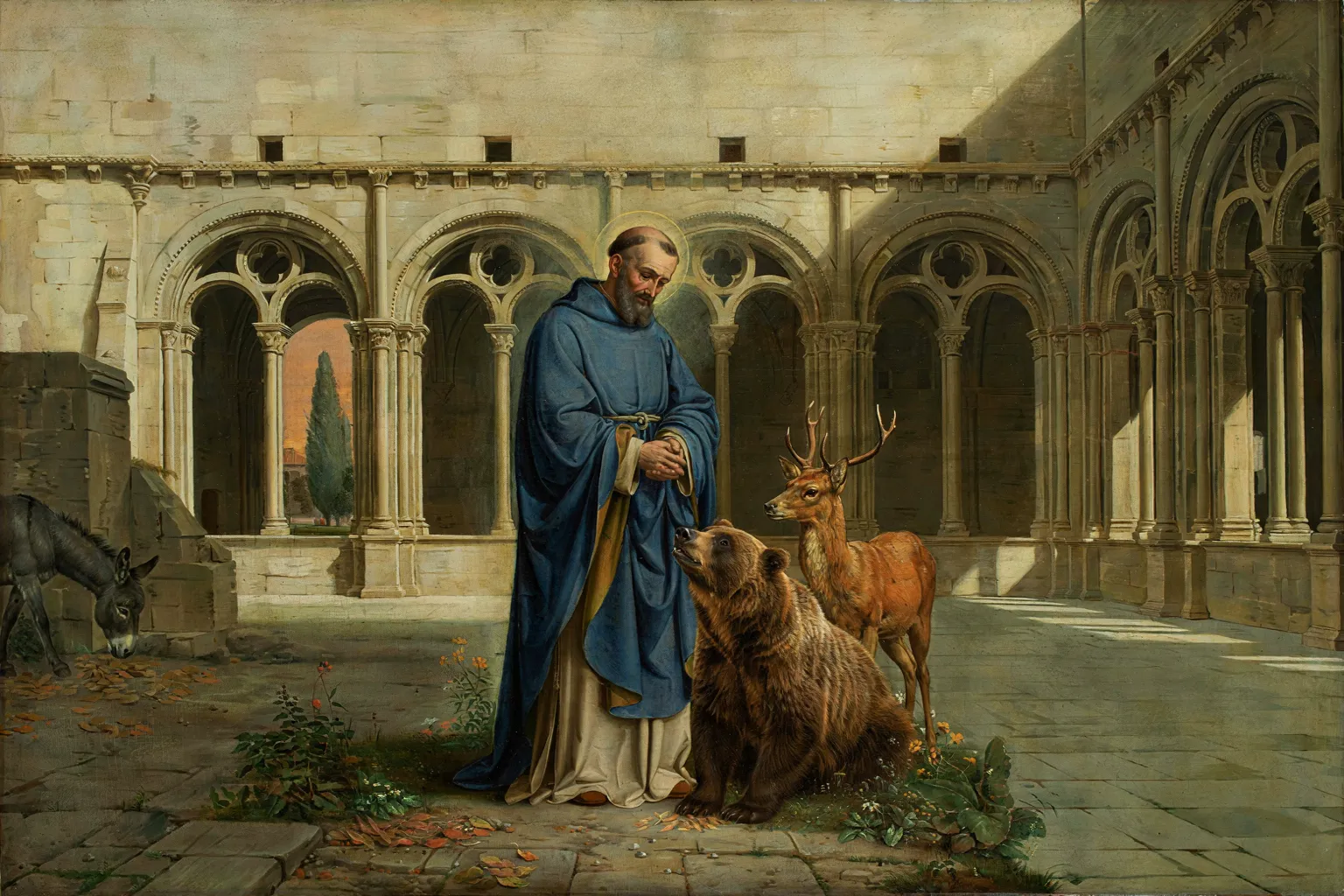
Born in Upper Picardy to a noble family, Humbert became a priest in Laon before following Saint Amand to Rome. He dedicated his wealth to the Abbey of Maroilles in Hainaut, where he spent his final days in prayer and humility. He is traditionally depicted with a bear and a stag in memory of legendary miracles.
Guided reading
6 reading sections
SAINT HUMBERT OF MAROLLES OR MAROILLES,
PRIEST AND RELIGIOUS (682).
Youth and clerical formation
Humbert was born into a noble family of Picardy and was consecrated very early to the service of God by his parents in Laon.
Humbert Humbert Monk and benefactor of the Abbey of Maroilles in the 7th century. was born at Mézières, on the Oise river, in the province which has since been called Upper Picardy, near the borders of Vermandois and Thiérache, two leagues from Saint-Quentin. His father and mother were Évrard and Popite, both of a very distinguished race among the French nobility; and the virtue of Évrard was such a great example in the world that he received the title of Blessed. From his childhood, Humbert appeared to be possessed of a singular grace that led him to good before he could have knowledge of evil. His parents, seeing that he breathed only piety and that he devoted himself to God of his own accord, had no scruples about destining him for the service of the altars. It was with this view that they later took him to a monastery in Laon, where he received the clerical tonsure; and they placed him in a monastery in the city, in order to have him instructed in piety and letters. He completed his course of studies and was raised to the priesthood in the same house. He continued to remain for some time in the monastery of his ordination, and he continued to give the religious great examples of humility, mortification, and detachment, until the death of his parents obliged him to go and dispose of the inheritance they had left him. He left the city of Laon with the blessing of the bishop and the permission of the superiors of the monastery, and returned to Mézières, where he led a very retired life. Shortly after, he received into his home Saint Amand, who ha d just resi saint Amand Spiritual advisor to Gertrude. gned from his bishopric of Maastricht, and who was passing through on his way to Rome with Nicaise, a monk of his abbey of Elnon, who later bore his name. He followed them to Italy; and his piety appeared so satisfied by this first pilgrimage he made to the tombs of the Apostles and martyrs, that it is claimed he undertook a second one later to Rome, where it is added that he offered to the Roman Church the lands he possessed; but that the Pope orde red him le Pape Sovereign pontiff who advised Humbert to found a pious house. to use them instead to found some pious and charitable house in his own country.
Pilgrimages and meeting with Saint Amand
After the death of his parents, he accompanied Saint Amand to Rome and decided, on the advice of the Pope, to devote his property to a pious foundation.
Upon returning from this second journey, he went to see Saint Amand at his monastery of Elnon, on the Scarpe; and, after having maturely deliberated with him on the place he should choose to serve God in retreat, he withdrew to the monastery of Marolles, located in Hainaut, in the diocese of Cambrai, on the small river Helpres, which flows from there into the Sambre. It was a house recently built by Count Rodobert or Chonebert, in the land of which he was lord, and which was called the canton of Famart or Famars, perhaps because of some ancient temple erected to the god Mars in those parts. Having proposed to end his days in this monastery of Marolles, Humbert gave to it in perpetuity the greater part of the land of Mézières-sur-Oise, by a deed from the year 671, dated in the twelfth year of King Childeric II. Such a considerable donation brought such an increase to the monastery that many, forgetting its initial foundation made sixteen or seventeen years earlier, became convinced that Saint Humbert was its foun der. It was t saint Humbert Monk and benefactor of the Abbey of Maroilles in the 7th century. here that our Saint finished sanctifying himself in silence, retreat, penance, and prayer, without leaving except to sometimes give himself the consolation of going to see Saint Aldegonde, abbess of Mau beuge, with whom sainte Aldegonde Daughter of Walbert and Bertille. he was in a very close union of charity and prayer. It is believed that he was abbot or superior of Marolles: he at least had disciples, in whose arms he died, around the year 682, on March 25.
Retirement and donation to Maroilles
Humbert retires to the monastery of Maroilles in Hainaut, to which he bequeaths his lands of Mézières, thus fostering the development of the abbey.
They embalmed his body with rich perfumes, and buried him in a chapel that he had built. The cult of Saint Humbert was publicly established as early as the time of Lou is the Pious, who q Louis le Débonnaire King of the Franks who made Aldric his advisor and commander of the palace. ualified him as a Saint in a patent. The martyrologies of the Low Countries, France, and Germany mark his principal feast day on March 25, the day of his death, and that of his translation on September 6.
Death and establishment of the cult
He died in 682 and his cult was officially recognized as early as the reign of Louis the Pious.
M. Desmelles, parish priest of Maroilles, has transmitted to us the following note on the relics of Saint Humbert:
History of the relics
The saint's relics, notably his head, have been preserved through the centuries and saved from revolutionary desecrations.
"The church of Maroilles possesses the head of Saint Humbert. Wishing to see it closely, I opened the reliquary in the presence of two witnesses. I found, besides the perfectly preserved head, two ribs and the bone of a thumb, the authenticity of which is attested by a parchment act signed by all the relics of the abbey, and provided with the seal of the abbots of Maroilles, Le Cateau, and Liessies. With the permission of His Lordship, I disposed of the thumb bone in favor of the church of Estaires, and of a rib in favor of the church of Romeries, of which Saint Humbert is the Patron.
"The reliquary, which contains the head of Saint Humbert, is the same one that existed before the Revolution. It was taken to Avesnes, with the other objects of the Church, the most precious remains of its ornaments in silver and precious stones, then thrown away as one does a piece of wood. Religious men who followed these pious riches to save them from profanation gathered the reliquary, kept it hidden during the turmoil, and returned it to the Church...
"The altar of Saint Humbert is often visited by parishioners and strangers. On September 7, the day of the patronal feast, the church is visited all morning starting at three o'clock in the morning."
Iconography and legends
Although no miracles are officially recorded, tradition depicts him with a bear and a stag, symbols of his mastery over nature.
"The breviary does not report any miracle that Saint Humbert performed during his life or after his death.
"Saint Humbert is always represented with a bear and a stag at his side. It is said that, during a journey he made to Rome, a bear devoured the donkey that was carrying his luggage and that, as punishment, the bear was condemned to carry the provisions. The presence of the stag is justified by saying that a pursued stag went to lie down beside Saint Humbert while he was praying in his oratory and that, out of respect for the holy man, the hunters spared the poor animal."
According to Baillet and local notes.
Annexes & related entities
Structured data for exploration: events, miracles, quotes, places, attributes, patronages, and important entities cited in the text.
Key Events
- Born in Mézières-sur-Oise
- Clerical tonsure and studies in Laon
- Ordination to the priesthood
- Journeys to Rome with Saint Amand
- Donation of his lands to the Abbey of Maroilles in 671
- Retreat at the monastery of Maroilles
Miracles
- A bear devours his donkey and is condemned to carry his luggage
- A hunted stag finds refuge with him and is spared by the hunters