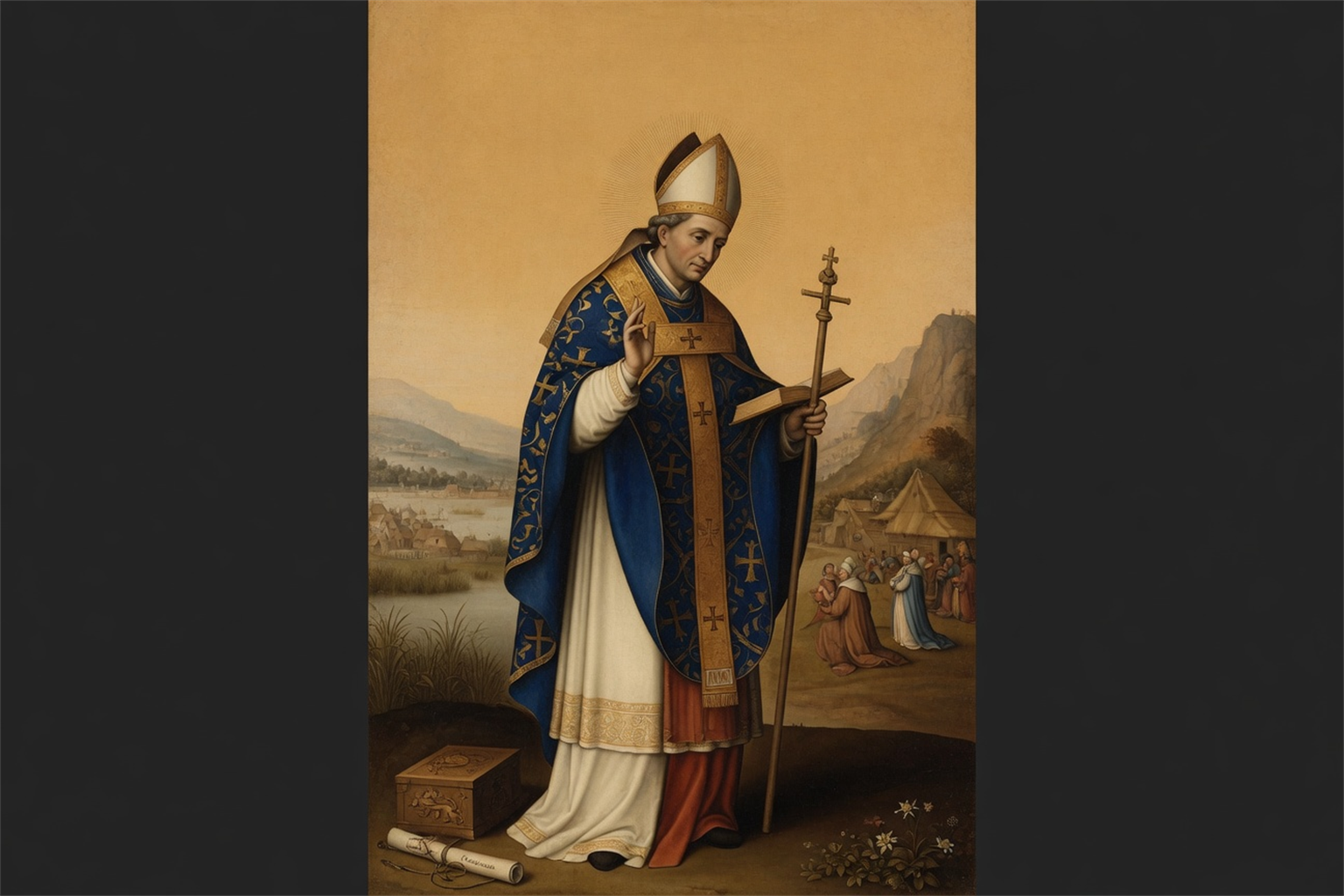
Saint Valentine of Passau
APOSTLE OF THE TYROL
Bishop of Passau, Apostle of the Tyrol
A 5th-century missionary bishop, Valentine left the Netherlands to evangelize Passau. After receiving his mission and consecration from Pope Leo the Great, he was driven out by the Arians and retired to the Tyrol, where he founded a community and converted many populations. He died in Mais and his relics rest today in Passau.
Guided reading
6 reading sections
SAINT VALENTINE, BISHOP OF PASSAU
APOSTLE OF THE TYROL
Call to mission and journey to Rome
Valentine leaves the Netherlands to evangelize the banks of the Danube, but first seeks apostolic legitimacy from Pope Leo I in Rome.
Saint Valentin Saint Valentin Missionary bishop and apostle of Tyrol in the 5th century. e paved the way for Saint Severinus, apostle of Noricum, which the latter traversed with success after the death of our Saint. Armed with the divine word, he left the seashore, coming, in all appearance, from the Netherlands, to bring the light of the Gospel to the inhabitants of the banks of the Inn and the Danube. His zeal for the salvation of souls, and also the love of his compatriots, drew him to Passau, which was a colony of Batavians. But, reflecting that he had no other mission than that which he had given himself, he remembered the instructions of Saint Paul: "How shall the preachers preach unless they are sent?" He therefore went to the Vicar of Jesus Christ, so that he might, in undertaking this work, be guided entirely by the orders of the great Apostle of the Gentiles. Saint Leo the n occupied Saint Léon Pope whose body was transferred by Sergius to a new mausoleum. the seat of Saint Peter (440-471).
Setbacks in Passau and consecration
After an initial failure in Passau, Valentine returns to Rome where the Pope encourages him, consecrates him bishop, and orders him to persevere.
Upon leaving Rome, our Saint went directly to Passau and began to preach the doctrine of Jesus Christ to the inhabitants of that place. 445. But his words were not heeded, which afflicted him so deeply that he resolved to plant the standard of the cross elsewhere, and to seek new instructions from the common Father of Christendom. Leo, surprised by such a prompt return, replied to the Saint who had explained his motives: "Proclaim the word; whether you are well or ill received, persevere; if you succeed in overcoming yourself, in remaining and softening the ferocity of this long-recalcitrant people, you will reap the finest fruits of your labors. But if a third attempt should fail, I permit you, and I order you, by virtue of my apostolic power, to go to other peoples to announce the holy faith." Having said these words, he laid his hands upon him, consecrated him bishop, and sent him back fortified by his blessing.
Apostolate in the Alps and miracles
Driven from Passau by the Arians, he evangelized the Grisons and the Tyrol, settled in Mais, and performed numerous miracles in Italy.
Soon Valentine reappeared in Passau; his voice rose with new strength to proclaim the word of God; but this time again it resounded in the wilderness. The inhabitants of this region, composed of Arians and pagans, rose up against him, insulted him, mistreated him, and drove him from the country. Shaking the dust from his feet, he went to the Grisons, where he was welcomed with joy by the populations who hastened to embrace Christianity. He finally arrived in the mountains of the Tyrol and spread the seed o montagnes du Tyrol Mountainous region evangelized by the saint of whom it is the patron. f the kingdom of God in the Vintschgau valley, where he found fertile soil in the midst of the mountains. He stopped at Mais, not far from M eran Maïs Place of residence and initial burial near Meran. , and had the consolation of seeing an abundant harvest grow around him. Several times he even advanced toward Italy, leaving traces of his good deeds wherever he went, converting and baptizing a great number of people. In the provinces of Italy, he brought back a great number of Jews and Arians to the paths of truth. God accompanied his preaching with the power of miracles, which struck many pagans and heretics with astonishment and won them over to a religion that grants such great powers to its ministers.
Contemplative life and community
The saint leads a life of intense prayer in his cell at Neuburg and founds a community of priests led by his disciple Lucille.
Valentin spoke with an unction that was impossible to resist, and which often drew even the most lukewarm soul toward conviction. But the amenity and charm of his private life equaled the zeal and perseverance with which he proclaimed the holy doctrine. In order to continually preserve that life of the soul which too often withers without the divine dew, he devoted a large part of the night, and all that he could steal from the day, to prayer and contemplation; for this purpose, he built himself a small cell where, far from the tumult, he could lose himself in his pious meditations without being disturbed. This cell, which is located in the castle of Neuburg, is still shown today under the name of Saint Valentin's chamber.
Valentin also founded a community of priests, who were subject to a common rule and who assisted him in his apostolic labors. Saint Lucille, his disciple, expressly names him hi s abbot. Afte Saint Lucille Disciple of Valentine and future collaborator of Saint Severinus. r the death of his master, Lucille associated himself with Saint Severin and faithfully helped him in the work of conversion. And when Saint Severin had in his turn passed to a better life, this old man, laden with years, was still seen at the head of a convent near Vienna.
Passing and cult of the relics
Dying in the middle of the 5th century, his body was first buried in Mais before being transferred to Trento and finally to Passau.
Saint Valentine died on January 3rd. However, the year of his death is uncertain; some say 440, others 442; there are even those who say 470: what is certain is that by 474 he was no longer alive. His disciples buried his body in the church he had built in Mais, which became very famous throughout Raetia. When Mais fell into the power of the Lombards, the Saint's bones were transferred to Trento, and subsequently to Passau along with those of Saint Corbinian, Bishop of Freising; th saint Corbinien Bishop of Freising whose relics were translated with those of Valentine. ey were placed between two walls in the Cathedral of Saint Stephen. Later, God inspired some pious souls with the thought of rendering more honor to these sacred remains: they were exhumed and transferred near the bishop's throne. His feast is celebrated on January 7th; the Roman Martyrology names him on October 29th with the title of confessor.
Legacy and Patronage
Saint Valentine is honored as the patron of Tyrol and Passau, associated in popular piety with other great Germanic saints.
Saint Valentine is the patron of Tyrol and the diocese of Passau. Popular devotion in Germany has always associated his name with those of three other famous saints: Saint Rupert of Salzburg, Saint Quirinus of Siscia, and Saint Anthony the Great. The significant name of Messengers to God designates all four of them to the trust of the people.
A beautiful and romantic valley of Tyrol, also including the Munster and the Passeyer-Thol, and extending from Glurns to Meran, being 9 German miles long by half a mile wide. See Legenden Heiliger Gottes und verehrter Londenystranen in Grabreich, p. 3.
Annexes & related entities
Structured data for exploration: events, miracles, quotes, places, attributes, patronages, and important entities cited in the text.
Key Events
- Arrival in Passau from the Netherlands
- Journey to Rome to visit Pope Saint Leo the Great
- Episcopal consecration by Pope Leo
- Expelled from Passau by Arians and pagans
- Evangelization of the Grisons and Tyrol (Vinschgau Valley)
- Foundation of a community of priests
- Died in Mais on January 3
Miracles
- Power of miracles accompanying his preaching to convert pagans and heretics
Quotes
-
How will the preachers preach unless they are sent?
Saint Paul (cited in the text)