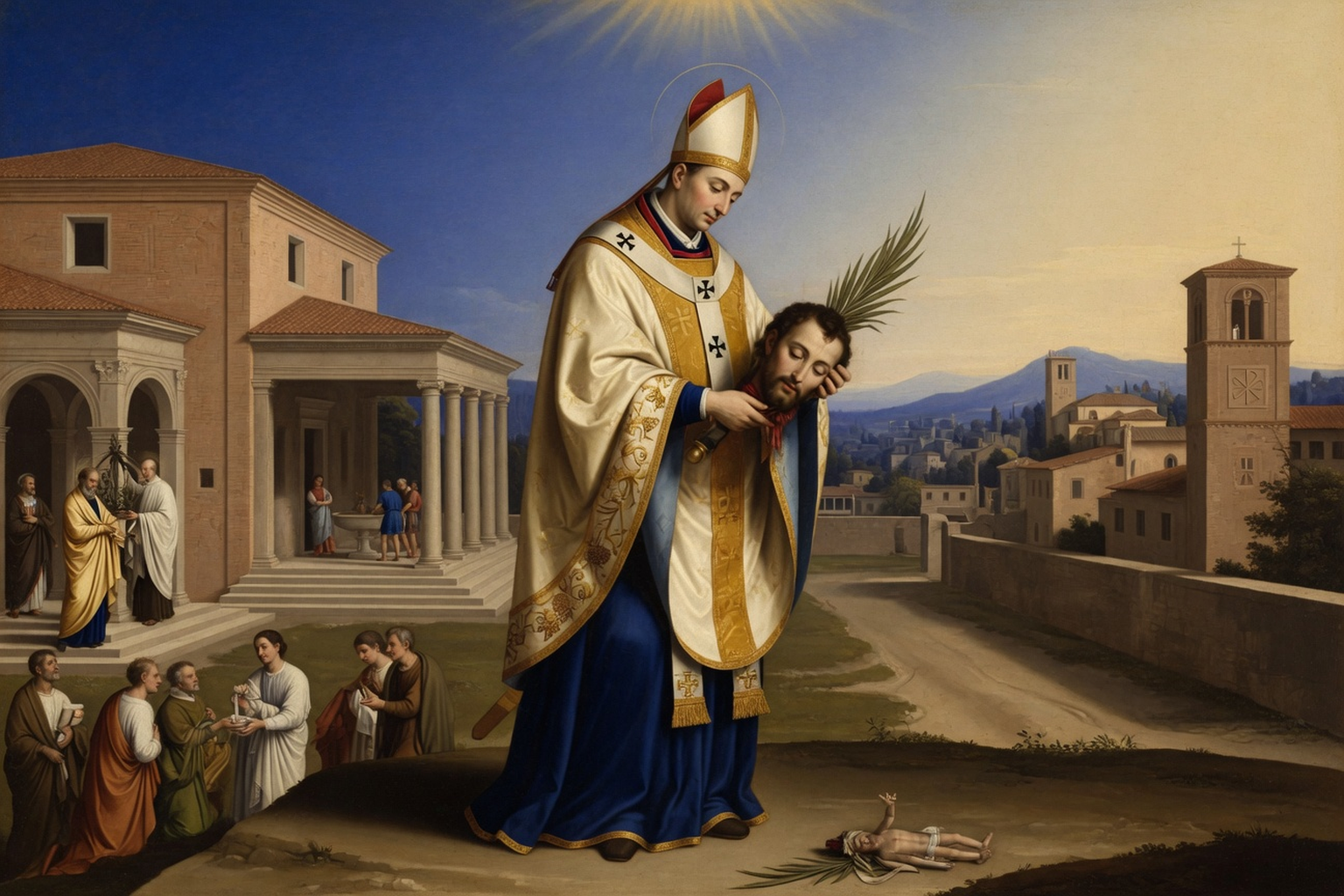
Originally from Rome and a disciple of Saint Peter, Lucien was sent by Pope Saint Clement to evangelize the Beauvaisis in the 1st century. Accompanied by Maxien and Julien, he converted thousands of pagans before being beheaded on the hill of Montmille. Tradition recounts that he carried his head to the site of his burial, where a famous abbey was later erected.
Guided reading
9 reading sections
SAINT LUCIEN, FIRST BISHOP OF BEAUVAIS
Roman origins and formation under Peter
Son of the consul Lucius in Rome, Lucien was converted by the apostle Peter, who changed his name and made him his disciple and interpreter during his travels in the Orient.
Died in the second half of the first century. — Popes: Saint Peter; Saint Clement. — Roman Emperors: Caligula; Domitian.
Remember your spiritual leaders who have spoken the word of God to you, and considering the end of their life, imitate their faith.
Epistle to the Hebrews, XIII, 7.
Here is another Saint L ucien, older saint Lucien Missionary companion of Saint Quentin. than the one the Church commemorated yesterday. After having long accompanied the prince of the Apostles on his travels for the propagation of the faith, he came to enlighten France with the admirable light of the Gospel. He was a native of Rome, son of the consul Lucius, and was converted and baptized by the same Saint Peter, during the very first journey he made to this capital city of the world to combat Simon Magus. He was called Lucius like his father; but, by a happy prognosis that he would be a star whose splendor would illuminate the entire house of God, the Apostle increased his name by two letters, naming him Lucianus, just as God had Lucianus Missionary companion of Saint Quentin. increased that of Abram by calling him Abraham.
Our neophyte gave himself entirely to the prince of the Apostles, considering himself very fortunate to follow him everywhere as his humble disciple; indeed, he accompanied him on the journey he made to the Orient to obey Emperor Claudius I, who ordered that all Jews must leave Italy, as is reported in the Acts of the Apostles; he followed him again when he returned to Rome under Emperor Nero, in order to combat Simon Magus once more. In all these places, the blessed Lucien served as an interpreter for Saint Peter to converse more easily with the Latins, whose language he knew perfectly.
The mission sent by Pope Clement
Consecrated bishop by Saint Clement, Lucien is sent to evangelize the Gauls alongside Saint Denis and Saint Saturnin.
At the moment chosen by God for the conversion of the regions situated between the Seine and the Somme, Pope Saint pape saint Clément Pope who sent Nicaise on a mission to the Gauls. Clement consecrated Lucien as bishop, and
sent him into the Gauls, wit saint Denis Martyr and apostle of the Gauls for whom Genevieve had a church built. h Saint Denis, Saint Saturnin, Saint Rieul, and several other generous confessors... "Go," the Pontiff said to them, "intrepid soldiers of Jesus Christ. As the Lord was with the Apostles, so shall He be with you."
Although the Gauls were the theater where our missionaries were to deploy their zeal, Denis and his companions did not fail to scatter the divine seed of the Gospel along their path; but the demon, seeing his empire threatened, stirred up the fury of the Gentiles against them. Lucien was the first to be subjected to persecution: as he was preaching in a place near the city of Parma, he was captured, overwhelmed with mistreatment, and thrown into a dark prison. He entered it blessing the Lord, and full of the consoling hope of soon being delivered. His prayers and his trust earned him prompt relief; during the night, pious Christians, whom the Church already counted in that region, restored his freedom. Reunited with his companions, Lucien continued his journey, continuing to announce the word of Jesus Christ to the peoples. Before leaving Italy, our courageous Apostles converted a multitude of pagans in Pavia, where they stayed for some time, and in several other countries that were witnesses to their preaching and their virtues.
From this land fertilized by their sweat, the Spirit of God guided them toward the shores of the Gauls. After a fortunate voyage, they arrived at the port of the city of Arles. The inhabitants of this city, hoping to see the wonders of mercy renewed, of which Saint Trophime had already been for such a high idea of his virtues, that he called him his most holy colleague. Saint Odo was regarded as one of the lights of his century. He was tasked with responding, in the name of the bishops of France, to the objections that the Greeks were making to the Latin Church.
Critical analysis of the episcopal title
The author discusses the historical and liturgical sources confirming Lucien's status as the first bishop of Beauvais, despite certain mentions qualifying him as a simple priest.
2° Formerly, the bishops of Beauvais, before taking possession of their see, would go to spend a night in the abb ey near the tomb of Saint Lucien, thereb abbaye auprès du tombeau de saint Lucien Benedictine abbey founded on the tomb of the saint. y indicating that they regarded themselves as his successors. We cannot doubt that this was indeed the motive that led them there; in 1357, one of them, Philippe d'Alençon, having neglected to go there, the Abbot of Saint-Lucien reminded him that, out of respect for Saint Lucien, who was the first bishop of Beauvais, he should conform to this holy custom. Philippe replied that he did not wish, by his example, to lead his successors to derogate from an ancient custom.
3° All the authors who have drawn up the catalogue of the bishops of Beauvais begin it with Saint Lucien. Let us cite here only Robert, the authors of the Gallia christiana, Girard, Bannier, A. de Mouchy, Lobel, Louvet, Simon, Hermand, Dunally, Danse, Delettre, etc. The oldest martyrologies used by the Church of Beauvais, even those of Usnard, designate the Saint with these words: Lucianum episcopum. Such was also the constant usage of the diocesan liturgy.
4° The Saint's vestments, found in the year 1361 under an altar of his abbey, had the form of episcopal garments. The solemn feast of their invention has been celebrated until recent times.
5° Thus, we shall add, the representative of paintings, statues, seals, and very ancient bas-reliefs; under this title, a great number of churches, both in our diocese and in others, have honored him, and still honor him today.
As for the manuscript breviaries where the qualification of priest is added to the name of Saint Lucien, they have no authority here: they were copied without control, before the invention of printing, from a Life of the Saint that was much shorter, composed by an anonymous monk who claimed to have written it under the dictation of Saint Lucien; but these books were never in use for the public office of the cathedral. The legend, says M. Delettre, which constantly served for the public office of the cathedral under our first pontiffs, gave Saint Lucien the name of bishop. (Delettre, Histoire du diocèse de Beauvais, vol. IV, p. 81.)
To explain how Usnard and some ancient authors could attribute the qualification of priest to Saint Lucien, let us recall that in the first centuries, this name was indiscriminately given to bishops and priests. Commune sacerdotis, says Baronius, alias fovet vocabulum tum Aposto lis quam Baronius Cardinal and hagiographer who fixed the feast day on October 8. cæteris inferioris ordinis sacerdotibus. (Ann. LVIII, n. 10.) The difficulty seems greater concerning the Roman Martyrology, which has kept the title of priest for Saint Lucien. But the same Baronius, one of the principal correctors of the Martyrology, did not hesitate to use the word episcopus when, subsequently, he wrote his annals. Dum suas parion annales conscriberet, certior de S. Luciani episcopato post maturum examen factus, priorem suam sententiam deseruit ac retrostunit, ad annum XIV, n. 7, hæc referens... Clemens, ut Petri successor... Plures ordinavit episcopos... nempe... Lucianum Bellovacensibus... Item ad annum XVIII, n. 11. Eadem persecutione (Domitiani) grassante in Galliis itidem Lucianus episcopus Bellovacensis, Maximus et Julianus presbyteri accisi sunt. (Ex elucidationibus præviis circa proprium Bellov.)
Let us conclude, therefore, that the ancient and constant tradition, which honors in Saint Lucien our apostle and our first bishop, remains unshakable. (Abbé Sabatier, priest of the diocese of Beauvais, in his hagiography, p. 7 et seq.)
The Apostolate in the Beauvaisis
Lucien established himself in Beauvais, struggling against paganism and the Druids, and joined two priests, Maxien and Julien, to assist him in his mission.
them the source, welcomed them with generous kindness. Their charity was not long in being rewarded: God filling them with His graces, a great number of them renounced the worship of idols and became Christians. Rieul, well worthy of succeeding Saint Trophime, remained at their head, and his companions headed toward the field that the father of the family had assigned for their labors. Saturnin took the road to Toulouse, and Denis, accompanied by Lucien, came to evangelize Paris, the principal center of the errors and vices of paganism in Gaul.
However, the Lord did not permit Lucien to remain long associated with the apostolate of Denis: soon, He sent him to work for the conversion of the inhabitants of the Beauvaisis.
This region was then under the power of the Romans; but a century and a half of oppression had not been able to make it accept foreign domination. Its conquerors were not unaware of this: thus, they maintained a strong garrison in Beauvais to suppress any attempt at revolt. Enemies of Christianity, which condemned their prejudices, their customs, and their passions, they were a powerful obstacle to the mission of our Saint. Lucien was to encounter difficulties of another kind in the state of the country he had to traverse, in the ignorance and coarseness of the ancient Gauls, and finally in the bloodthirsty fanaticism of the Druids.
The Beauvaisis was covered, in large part, by thick forests and impassable marshes. There was little cultivated land. A portion of its inhabitants lived in the woods, where they had built themselves miserable huts; the others lived in towns or villages situated along the main watercourses. One would have difficulty forming an idea of their intellectual and moral degradation. The discoveries that have taken place on this territory show us the religion of the conquerors mixed with that of the conquered: statues of Mercury and Ceres have been found there, as well as stones of great dimension, intended to receive the blood of human victims. Such was the land that our Saint had to clear; such were the men whose beliefs and morals he had to change.
Lucien chose Beauvais as the center and seat of his mission. Full of hope in the Beauvais City and diocese of the saint's origin. divine assistance promised by the Savior to His Apostles, he undertook his work of salvation with a courage superior to all difficulties and all perils. Addressing both Romans and Gauls at the same time, he spoke to them with the authority of a heavenly envoy. He showed them the vanity of their idols, the superstition of their worship. He announced to them the God who is the creator of heaven and earth, and Jesus Christ, His Son, God Himself, savior and redeemer of the world. To the vices of the pagan religion, he opposed the virtues of Christianity; to selfishness, charity; to the spirit of vengeance, the law of forgiveness; to the outbursts of hatred, evangelical gentleness; to the disorders of morals, the wonders of chastity; to greed, finally, detachment from the things of the earth. No obstacle stopped the momentum of his zeal; no resistance made him suspend the course of his missions. Offering himself to divine justice as a victim of expiation for the sins of this poor people, he mortified his body with all sorts of austerities: water, roots, and a little bread composed his entire diet; but, say his Acts, the power of God sustained him, and the grace of Jesus Christ gave him an invincible strength.
Charity, selflessness, patience, and the gentleness of the Saint opened the door of hearts to him. Miracles, and above all the grace of the Savior, came to complete the conversions that his examples and his discourses had prepared: at his voice, demons took flight, and the sick recovered their health.
In a short time, Lucien won a great number of souls to Jesus Christ. His glorious conquests were so rapid that soon he could not, despite the activity of his zeal, provide alone for the spiritual needs of the new Christians. But He who knows how to draw light from darkness raised up for him two faithful ministers from the midst of this people. Lucien, having noticed a lively faith and an ardent charity in Maxien and Julien, young men recently entered into the fold of the Lord, conferred the priestho od upo Maxien Martyr companion of Saint Lucian. n th em and Julien Greek deacon, brother of Saint Julius and missionary in Northern Italy. admitted them to share in his labors.
The Saint did not confine his apostolate within the walls of Beauvais; he traveled through the villages, the hamlets, and the most inaccessible retreats. From all sides, his preaching, his examples, and his miracles dealt mortal blows to idolatry. The statues and temples of the false gods were overturned, and, on the ruins of the altars consecrated to the demon, oratories were raised which gave birth to parishes of vast extent. Among the number of countries evangelized at this time, we must place Montmille, Breteuil, and Ourcel-Maison.
After having made the name of the Savior known in various parts of the region, Lucien would come back to Beauvais to resume the course of his preaching. He would again address the pagans whose hearts grace had not yet touched, and worked to strengthen and protect his children in Jesus Christ against all danger. According to an ancient tradition, he had chosen for his dwelling, or perhaps only for the celebration of the holy mysteries, a house situated near the site later occupied by the collegiate church of Saint-Nicolas.
Lucien retained, even into his old age, great vigor of body and mind: the hand of God visibly sustained him in his incessant struggle against idolatry. He still drew new strength and consoling encouragement from his meetings with the missionaries who were evangelizing the neighboring peoples. In ancient times, the route by which Saint Denis came to visit him was pointed out. After the death of that illustrious martyr, Saint Rieul, apostle of Senlis, also came sometimes to edify his piety at the spectacle of the virtues of Lucien.
The martyrdom at Montmille
Pursued by the envoys of the prefect Julian, Lucian is arrested at Montmille where he is beheaded after witnessing the massacre of his companions.
With the help of his two young and courageous ministers, the Saint changed the face of the Beauvaisis in a few years. A multitude of idolaters came to know and bless the adorable name of Jesus Christ. But soon the demon, seeing his cult threatened and his altars destroyed, inspired the pagan priests with his hatred against the author of his defeat; the prefect Julian served as an instrument for the execution of his treacherous projects against Christianity. Having learned of the conquests of the Gospel in the Beauvaisis, Julian resolved to put an end to them. Jealous of following in the footsteps of Fescennius, who had shed the blood of Saint Denis and his companions on the hill of Montmartre, he sent Latinus, Jarius, and Antor in search of Lucian with the order to make him apostatize, or, if they could not, to put him to death. Some satellites, enemies of the Christian name, served as their escort.
Miraculously warned of the dangers that threatened him, as well as his disciples, Lucian gathered the Christians of Beauvais and strongly exhorted them to remain faithful to Jesus Christ. Following the Acts of his life attributed to Saint Odo, he spoke to them in these terms: "Beloved brothers and sons, God wills that I soon separate from you. Remain firm in your faith. Let neither the threats of princes, nor their flatteries and promises, make you forget the holy religion you have embraced." Then, lifting his eyes to heaven, he added: "I give thanks to you, O Jesus Christ, my master, Son of the living God, who, after associating me with the apostolate of the blessed Denis, now associate me with his martyrdom." He then left the city and headed toward a hill named Montmill Montmille Site of the first monastery dedicated to the saint. e, about an hour's walk from Beauvais. Maxian and Julian accompanied him, ready to give, like him, their lives for the faith. In moving away thus, the three magnanimous confessors were not obeying any feeling of fear: they were yielding to a force from above, which led them toward the place of their martyrdom. In going to meet their torment, they did not cease to pray and speak of the God who was to be their reward.
Scarcely had they arrived at Montmille than they saw themselves surrounded by the Christians of the neighborhood and a crowd of pagans eager to receive, from the mouth of Lucian, the nourishment of the divine word.
The emissaries of Julian, not having found our saint in Beauvais, directed their course precipitously toward the hill of Montmille, which was indicated to them as the place of his retreat. They encountered him evangelizing a great multitude gathered around him. Maxian and Julian were at his side: after having shared his labors, they were also to share his glory. The life of Saint Lucian, which we have already cited, and from which we have borrowed a part of our narrative, recounts the final moments of these invincible witnesses of Jesus Christ in the following manner.
Latinus, Jarius, and Antor first seized the two faithful co-workers of Lucian and placed them in the alternative of sacrificing to idols or perishing by the sword.
They replied with firmness: "We will not sacrifice to gods who are the work of the hands of men. We adore only one Lord, Jesus Christ, Son of the living God, for whose religion we are ready to die." Scarcely had Maxian and Julian finished these words than their heads fell under the blows of the assassins. By massacring the generous companions of his apostolate in the presence of Lucian, these wretches had the hope of shaking his courage and his faith; but this spectacle only inflamed his desire to receive the palm of martyrdom. Having then approached the Saint, they spoke to him in these terms: "You are accused of seducing the people with your sorcery: your guilty speeches dissuade them from sacrificing to our gods, contrary to the orders of the emperor and the Roman senate." Lucian replied with calm: "I do not use sorcery... I show the people the way of truth; I make known to them Jesus Christ, my master, who came into this world to redeem his creature and turn it away from the cult of demons... Jesus Christ deigned to die on the cross for the salvation of all; to him alone we owe fidelity, obedience, and love." — "How," reply the envoys of Julian, "do you wish to regard as God a man who suffered death and was attached to an ignominious cross?" — "Although you are unworthy," continued Lucian, "to hear the secrets of the Most High, I will reveal them for the sake of the multitude that surrounds us: the Son of God, God himself and co-eternal with his Father, willed, after the sin of the first man, to be born of a virgin to redeem the human race. From impassible as he was in the bosom of his Father, he became passible out of love for us. In order to deliver us from eternal death, Christ, true Son of God and true Son of man, obeyed his Father even to the death of the cross. If, while remaining Son of God, he had not condescended to become Son of man, the human race could not have obtained the pardon of its faults; the door of eternal life would have been closed to sinners."
Irritated by this language, the persecutors accused Lucian of pride and madness, threatened his old age with the most cruel torments, and with a death similar to that of his companions if he did not consent to sacrifice to their gods. Then, to give the appearance of a regular judgment to the sentence they were about to pronounce, they sat down and made him undergo the following interrogation:
"What is your name," they said to him, "and what is your condition?" — "My parents," replied the athlete of Christ, "had given me the name Lucius; since I received a new life through baptism, I am called Lucian. As for my condition, I am a Roman citizen... but, however noble that title may be, I bear another even more noble: that of servant of Jesus Christ." — "We know well," replied these iniquitous judges, "that you are a magician and a seducer... If you are a Roman citizen, why are you foolish enough to despise gods that the emperor, the senate, and the entire universe venerate?" Lucian continued thus: "Since I have known Jesus Christ as my Lord, I have renounced the cult of the pagans. As for you, as you are still chained by superstitious practices, your ears cannot hear my words, your spirit cannot understand them. By forcing reasonable creatures to sacrifice to the demon and to idols formed by the hands of men, the emperor, the senate, and you show well of what blindness infidelity is the source."
Unable to bear any longer the insult offered to the emperor and their gods, Latinus, Jarius, and Antor ordered that the Saint be beaten with rods.
During this torment, Lucian did not cease to repeat: "I believe with my heart and I confess with my mouth that Jesus Christ is the Son of God." This courageous profession of faith in the midst of torments was followed by a sentence that condemned Lucian to perish by the sword.
Happy to fertilize with his blood the soil he had come to populate with Christians, the intrepid confessor offered himself to the executioner, who severed his head.
The miracle of cephalophory
After his beheading, Lucien rises and carries his head to the gates of Beauvais to designate the place of his burial.
When the Saint's body was laid upon the ground, all those present, even the criminals who were the authors of his death, saw him surrounded by light, and a voice was heard saying: 'Courage, good and faithful servant, who did not fear to shed your blood for me; come receive the crown that has been promised to you.' At the same time, as it is written in the Acts of his martyrdom, Lucien rose, took his head in his hands, and walked toward the city of Beauvais. Having crossed the Thérain river at Miauroy, he stopped about a quarter of a league from Beauvais, seemingly indicating the location where he wished his body to be interred. There, pious faithful gave him an honorable burial, while the same duties were rendered to his glorious co-workers on the hill of Montmille. The angels themselves, several authors say, attended the Saint's funeral and perfumed the air with celestial scents. This persecution, far from weakening Christianity in the Beauvaisis, gave it new strength. At the sight of the miracles that followed the execution of Lucien and his companions, five hundred people attested by their conversion to the fruitfulness of the martyrs' blood. Before his death, the blessed one had already won about thirty thousand for the Savior.
Foundation of the abbey and royal cult
King Chilperic I founded a basilica and a monastery on the saint's tomb in the 6th century, following an apparition of Lucien to Saint Evrou.
## CULT AND RELICS OF SAINT LUCIEN OF BEAUVAIS.
Hardly had the blessed remains of Lucien been laid in the earth when the Christians went to venerate him: at their head, we see Saint Romana, who was herself to shed her blood for the faith. Soon the end of the persecution allowed for the construction of a church over his tomb, to which the names of Saint Peter and Saint Lucien were given. Until the 5th century, the time of its destruction, this church was served by virtuous and zealous priests, who lived in community under the direction of the bishops of Beauvais, and spread out into the countryside to exercise the holy ministry.
The pious and zealous King Childebert had resolved to raise this edifice from its ruins; he had even allocated the revenues of his properties in Bulle for this purpose, but, for reasons whose nature is difficult to know today, his project could only be executed by Chilperic I, in 583.
I t was at the Chilpéric Ier King of the Franks praised by Fortunatus. solicitation of Dodon, Bishop of Beauvais, and of Saint Evrou, that Chilperic founded a new basilica and a monastery, at the very place that had served as the cradle of Christianity in the Beauvaisis; a charter signed by his hand and dated to the 22nd year of his reign thus sets out the motives that determined him to grant their request: "Already our ancestors," it is said therein, "have allocated to the same destination several of their properties located in the Beauvaisis... On the other hand, the apparition of Saint Lucien to our beloved Evrou, the order he gave him to remove from Montmille and to place near his tomb the body of the blessed Maxian,
and finally the miracles performed after the execution of this order, are all motives that press us to re-establish the church of the martyrs!"
Happy to have obtained this act of royal authority, Dodon and Saint Evrou immediately began the work. A few years later, on October 16, Dodon consecrated the new church which he placed, like the old one, under the invocation of Saint Peter and Saint Lucien, and Saint Evrou took charge of the monastery. This solicitude for the glory of our patron saints revived the confidence of the faithful. The wonders due to their intercession increasing it still further, the influx of pilgrims to the Abbey of Saint-Lucien became very considerable, especially in the time of Saint Angadrienne who often went there to pray. Gratitude and faith adorned this sanctuary with great magnificence. Saint Eligius devoted his talent to making reliquaries for our martyrs, and himself deposited their precious relics there.
Time, far from weakening the cult rendered to these illustrious confessors of the faith, gave it a new luster. In the 9th century, Rabanus Maurus, Archbishop of Mainz, attests that many miracles were performed at their tomb. Already the author of the life attributed to Saint Odo had recounted the same thing in these terms: "There, the sick are healed, the blind see, the lame walk, the possessed are delivered, and, what is even more wonderful, the bonds of sinners are broken."
Medieval Splendor and Translations
In the 13th century, the relics were transferred into rich shrines in the presence of Saint Louis and several kings and bishops.
At the beginning of the 11th century, a few days before Pentecost, a light suddenly shone in the abbey church, and some of the garments that Saint Lucien wore at the moment he was put to death were discovered under the altar.
In the year 1261, under the pontificate of Guillaume de Grès, the relics of the three martyrs were placed in new shrines, with a solemnity whose grandeur and pomp the historians of the Beauvaisis delight in recounting. Jean de Toiral, abbot of Saint-Lucien, had just been authorized by Pope Alexander IV to wear the ring, the crozier, and the miter, and to confer the tonsure and minor orders upon his religious. Wishing to manifest his gratitude toward the glorious Patron, in consideration of whom he had obtained such a flattering privilege, he had a new shrine made, as precious for the beauty of the workmanship as for the richness of the material, in order to deposit therein the venerated remains of the holy Pontiff. It was six feet long, two wide, and three high; its shape was that of a church supported by flying buttresses. A pyramid, ending in a spire that was hollowed out and chiseled with extreme delicacy, rose three feet above the roof. Twelve niches containing statuettes of the twelve Apostles adorned the exterior walls of this graceful edifice. The roof was covered with embossed plates, where Saint Lucien could be seen represented in pontifical vestments. Jean de Toirac had not forgotten the companions of our apostle: two other shrines of the same type were intended for the bodies of Saint Maxien and Saint Julien. The translation of the martyrs' relics into these splendid shrines took place on Quasimodo Sunday. It was presided over by Guillaume de Grès, Bishop of Beauvais, accompanied by Robert, Bishop of Senlis, and Bernard, Bishop of Amiens.
Pierre de Vessencourt, Abbot of Saint-Germer, Gilbert, Abbot of Lannoy, Arnoulf, Abbot of Beaupré, and Robert de Royaumont were present, as were the abbots of Beaubec, Saint-Ouen, Saint-Acheul, and several others. Saint Louis, King of France, further enhan ced the pom Saint Louis King of France who visited the relics of Saint Hildevert. p of this feast by coming to take part in it with Thibaud, King of Navarre, Philippe, heir presumptive to the crown of France, Philippe, eldest son of Baldwin, Emperor of Constantinople, and several lords of high nobility.
The memory of this translation was consecrated by a solemn feast, which was formerly celebrated in the abbey of Saint-Lucien under the name of the Feast of the Holy Bodies.
Besides the shrines of which we have just spoken, the monastery possessed others still: a fourth contained the heads of the martyrs, a fifth one of the arms of Saint Lucien, and a sixth, finally, his garments. His pastoral ring was kept in a special reliquary. During the Octave of the main feast, which took place on January 6, and during the entire month of May, these shrines, adorned with flowers, were exposed for the veneration of the faithful.
Revolutionary destruction and renewal
After the destruction of the relics and the abbey in 1793, the cult was restored in the 19th century through the creation of a seminary and the re-establishment of the pilgrimage.
The bishops of Beauvais have always shown great piety toward the holy Founder of the church of Beauvais. For several centuries, they would not take possession of their see until they had gone to the monastery bearing his name to solicit his prayers and support; they would spend the night preceding their installation there. The next day, before leaving for their episcopal city, they would prostrate themselves before his relics, and then, dressed in pontifical vestments and barefoot, would go to receive the confirmation of their temporal power at the city gate, and the recognition of their spiritual authority at the cathedral. Each year they came to this abbey to perform the solemn blessing of the palms. During their episcopate, they continued to show him all their solicitude, attentive to defending his property, and above all to maintaining piety and the regular life there. They wished that after their death their remains would rest in the shadow of his altars.
The burial of Saint Lucien near Beauvais did not cause the hill watered by the blood of our martyrs to be forgotten. In the early days, the faithful built an underground chapel there, where they went to strengthen their faith and learn not to be ashamed of the cross of Jesus Christ. Later, a church dedicated to Saint Maxien rose above this crypt, and the monks of Saint-Lucien added a priory to it. After the translation of the bodies of Saint Maxien and Saint Julien to the tomb of the apostle of the Beauvaisis, the glorious theater of their martyrdom was no less honored. Especially at the time of mid-Lent, Montmille saw a large crowd of pilgrims arrive. To encourage and reward their devotion, in the year 1122, Godefroi I, Bishop of Beauvais, granted in perpetuity an indulgence equivalent to a quarter of the canonical penance to all the faithful who, after having confessed their sins, would visit the priory church on the fourth Sunday of Lent.
These powerful protectors were not only honored in the monastery of Saint-Lucien and on the hill of Montmille: the entire Beauvaisis invoked them. Their cult crossed the limits of the diocese and even of France. The clergy, the faithful, and the great solicited the favor of possessing some of their precious relics. During the famous translation of the 13th century, three bones, one of Saint Lucien, another of Saint Maxien, and the third of Saint Julien, were granted to King Saint Louis, who deposited them in the church of the Mathurins in Fontainebleau. The abbey of Corbie, in Picardy, the Sainte-Chapelle in Paris, and the monastery of Saint-Faron-lez-Meaux prided themselves on possessing a large portion of them.
Those that were venerated at the abbey of Saint-Lucien and at the cathedral of Beauvais had escaped the rapacity of the English, the pillaging of the Burgundians, and the sacrilegious fury of the Protestants; but they could not be saved from the vandalism of the revolutionaries of the last century; on November 20, 1793, they were consigned to the flames in the square of the church of Saint-Pierre. Today, only fragments of the relics of Saint Lucien and his companions remain at the cathedral, in the church of Montmille, in that of Méri, and in a few parishes that have Saint Lucien as their patron; but nowhere does an insigne relic remain. The basilica and the monastery of Saint-Lucien have in turn disappeared under the hammer of the demolishers. However, to soften the bitterness of our regrets, God has permitted that, not far from their ruins, a pious establishment, the minor diocesan seminary of Saint-Lucien, has come to revive the name and perpetuate the apostolate of the first Pontiff of Beauvais.
If impiety was able to annihilate the relics and the tomb of our martyrs, it was not given the power to destroy their cult: it is still alive in the memory and above all in the hearts of the inhabitants of the Beauvaisis. Monseigneur Gignoux gave it a salutary impulse by re-establishing the pilgrimage of Montmille, which the Revolution had interrupted. By virtue of the precious favors with which His Holiness Pius IX enriched this pilgrimage, the faithful who, from the Friday of the third week of Lent, the day of the great pilgrimage, until the Saturday of the following week, visit the church of Montmille, may gain a plenary indulgence for their faults. To be entitled to this benefit, they must worthily receive the sacraments of Penance and the Eucharist, and pray for some time in this church for the intentions of the Sovereign Pontiff. Another indulgence of three hundred days is granted, once during the week, to all pilgrims who pray in this same church with sincere regret for their sins. The Holy Father permits these indulgences to be applied to the souls in Purgatory. To these indulgences, Monseigneur Gignoux has deigned to add one of forty days for Christians who, on any other day of the year, visit this sanctuary and pray there with recollection.
In Beauvais, Saint Lucien is venerated as the apostle, the first bishop, and the principal patron of the diocese, and his feast is solemnized on January 8 along with that of his illustrious companions. On the Friday after the third Sunday of Lent, a second feast is celebrated in his honor to recall the memory of the translation that took place in the time of Saint Louis. Finally, on October 16, the dedication of the abbey church raised over his tomb by the care of Dodon and Saint Évrou is commemorated.
The Martyrologies of Bede, Ado, and Usuard make honorable mention of Saint Lucien on the eighth of January, particularly that of Rome; as does Peter the Venerable, Abbot of Cluny. We know that a Saint Lucien is mentioned in the Acts of the saints Crispin and Crispinian on October 25; and on the last day of the same month, in the life of Saint Quentin, where it is said that this Lucien was sent to Beauvais; but as these suffered under Diocletian, about two hundred years after our Saint, who was the first bishop of this city, Cardinal Baronius very reasonably estimates that there may be two Saints of a similar name in the same city; which is neither impossible nor without precedent. — See also Les Saints de Beauvais, by Father Svbatier.
Annexes & related entities
Structured data for exploration: events, miracles, quotes, places, attributes, patronages, and important entities cited in the text.
Key Events
- Conversion and baptism in Rome by Saint Peter
- Accompanied Saint Peter to the East and to Rome
- Episcopal consecration by Pope Saint Clement
- Evangelization mission in Gaul with Saint Denis
- Evangelization of the Beauvaisis and foundation of the church of Beauvais
- Martyrdom by beheading on the hill of Montmille
- Cephalophory: walked with his head to his burial site
Miracles
- Cephalophory after his beheading
- Healing of the sick and the blind
- Deliverance of the possessed
- Celestial light surrounding his body after death
Quotes
-
I am a Roman citizen... but, however noble that title may be, I bear another even nobler: that of servant of Jesus Christ.
Acts of the Martyrdom