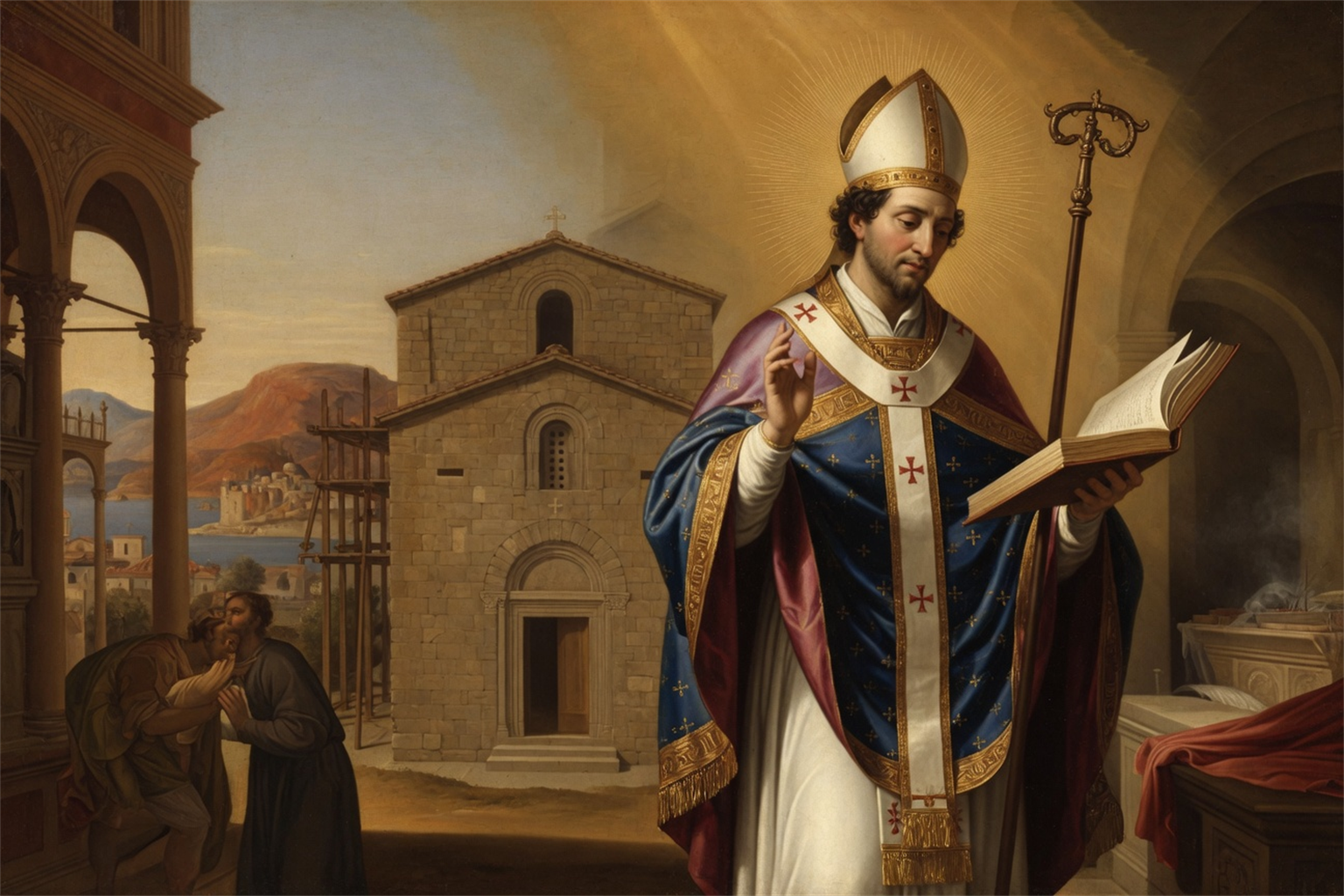
Saint Patient of Metz
Bishop of Metz
Originally from Asia Minor and a disciple of Saint John the Evangelist, Saint Patient became the fourth bishop of Metz in the 2nd century. He built a basilica dedicated to the Apostles which served as a cathedral until the invasions of Attila. His relics, long kept at Saint-Arnould, were dispersed during the Revolution.
Guided reading
4 reading sections
SAINT PATIENT, BISHOP OF METZ (2nd century).
Origins and Apostolic Mission
Originally from Asia Minor and a disciple of Saint John the Evangelist, Patient was sent to Metz to become the fourth bishop of the city.
Saint Patient Saint Patient Fourth bishop of Metz, of Greek origin and a disciple of Saint John. was born in Asia Minor; he came from a notable and wealthy Greek family. Saint John the Evangelist, apo Saint Jean l'Évangéliste Saint to whom Zita had a great devotion. stle of that region, converted him to the faith, withdrew him from the world, and attached him closely to Our Lord. Ancient tradition adds that he decorated him with the episcopal dignity and sent him to announce the Gospel to the land of M Metz City where the saint received his theological training. etz. He was the fourth bishop to govern this church, nourishing it with the bread of life and illustrating it through his glorious works. As the churches erected by Saint Clement were not sufficient for the multitude of the faithful, he himself built a new one outside the city walls, which he dedicated to the holy Apostles, and especially to Saint John. Long one of the most magnificent in the province, this basilica bore the title of cathedral until its destr uction Attila Leader of the Huns responsible for the destruction of Besançon. by Attila in 451. Saint Patient was buried there when, after fourteen years of episcopate, he flew into the bosom of God to receive the reward for his merits and his labors.
Critical analysis of the tradition
The historicity of his mission by Saint John is debated by the Bollandists and Paul the Deacon, although his Greek origin remains plausible.
To this legend from the Metz breviary, we believe we must add the following notice sent to us by Father Noël, director at the major seminary:
— Saint Patient, Bishop of Metz. Our chronicles make him Greek by origin, sent by Saint John the Evangelist at a time when the Church of Metz, after having been governed successively by Saint Celestius and Saint Felix, the two companions of Saint Clement, the first bishop of Metz, had remained without a pastor. Paul the De Paul, diacre Historian and poet, author of the epitaph of Fortunatus. acon, the oldest known historian of the bishops of Metz, does not speak of this mission of Saint Patient by Saint John the Evangelist; he contents himself with naming him, while including him in a sentence of praise common to several successors of Saint Clement. The Bollandists even reject this mission as implausible, which is moreover difficult to reconcile with the chronology of the bishops of Metz. However, this tradition, although unlikely in itself and altered by circumstances that seem to deserve little confidence, should not be entirely abandoned. It could well have its foundation in the Greek origin of Saint Patient, who may have been a disciple of Saint John, and come, after the death of his master, like several Orientals, to evangelize the regions of the West. His name is not a real difficulty: for Asia Minor had become a province of the empire for long enough that Roman families could have been settled there while retaining their Latin names.
The Basilica of Saint John
Saint Patient had a basilica built outside the walls, which served as a cathedral until its destruction by Attila in 451.
— Saint Patient built outside the walls, under the invocation of the twelve Apostles and especially Saint John the Evangelist, a church where he was buried. This church later became the magnificent abbey of S aint-Arnould, Saint-Arnould Former church founded by Patient, which became a royal necropolis. the burial place of the kings and nobles of Austrasia, and later of the princes and princesses of the Carolingian family. The Basilica of Saint John served as a cathedral until its destruction in 451 by the army of Attila. It was rebuilt after this disaster; but as the bishops of Metz had withdrawn to Saint-Étienne, the only religious edifice spared by the Huns, it was left to a few clerics who served it until about the middle of the 10th century, the time when Bishop Adalberon I introduced the Benedictines there, whom he brought from the abbey of Gorze. The bishops of Metz nevertheless preserved for the ancient church, founded by Saint Patient, some vestiges of its former dignity. In the 12th century, they still solemnly performed the blessing of the palms there. The Basilica of Saint John was, according to tradition, decorated with all the magnificence of the art of ancient times. Marble columns supported the building; the entablatures and the pavement were made of mosaics of the same material. The capitals were decorated with precious stones, which, exposed to the rays of the sun or the light of lamps, cast a marvelous radiance. The entire interior was adorned with precious paintings, enhanced with gold and silver. These marbles had undoubtedly been taken from the amphitheater and other public buildings erected in Metz and its surroundings by the Romans. Legend attributed these sumptuous decorations to the ancient church of Saint Patient; but it is more probable that these are memories of the Carolingian edifice, raised on ruins, which subsisted until the 11th century (1049), when the basilica of the Middle Ages was erecte d, cons Léon IX Pope who visited the saint's sepulchre in 1049. ecrated by Leo IX, and which itself disappeared during the fam ous siege of Charles-Quint Emperor involved in the wars leading to the destruction of the convent. Metz by Charles V in 1552.
Translation and loss of relics
His remains were transferred to a silver shrine in 1193 before being dispersed or melted down in 1701.
Burchard, abbot of Saint-Arnould, performed the translation of the body of Saint Patient in 1193, and placed it in a silver shrine, made with the liberality of Emperor Conrad III. In 1701, the s hrine of Saint Patient chasse de saint Patient Silver reliquary containing the saint's remains. was transported to the Mint to be melted down, and the precious relics it contained were subsequently sacrilegiously dispersed.
Annexes & related entities
Structured data for exploration: events, miracles, quotes, places, attributes, patronages, and important entities cited in the text.
Key Events
- Converted by Saint John the Evangelist in Asia Minor
- Elevation to the episcopal dignity
- Evangelization mission in the Metz region
- Construction of a church dedicated to the holy Apostles outside the walls of Metz
- Translation of his body in 1193 by Abbot Burchard
- Dispersion of relics in 1701