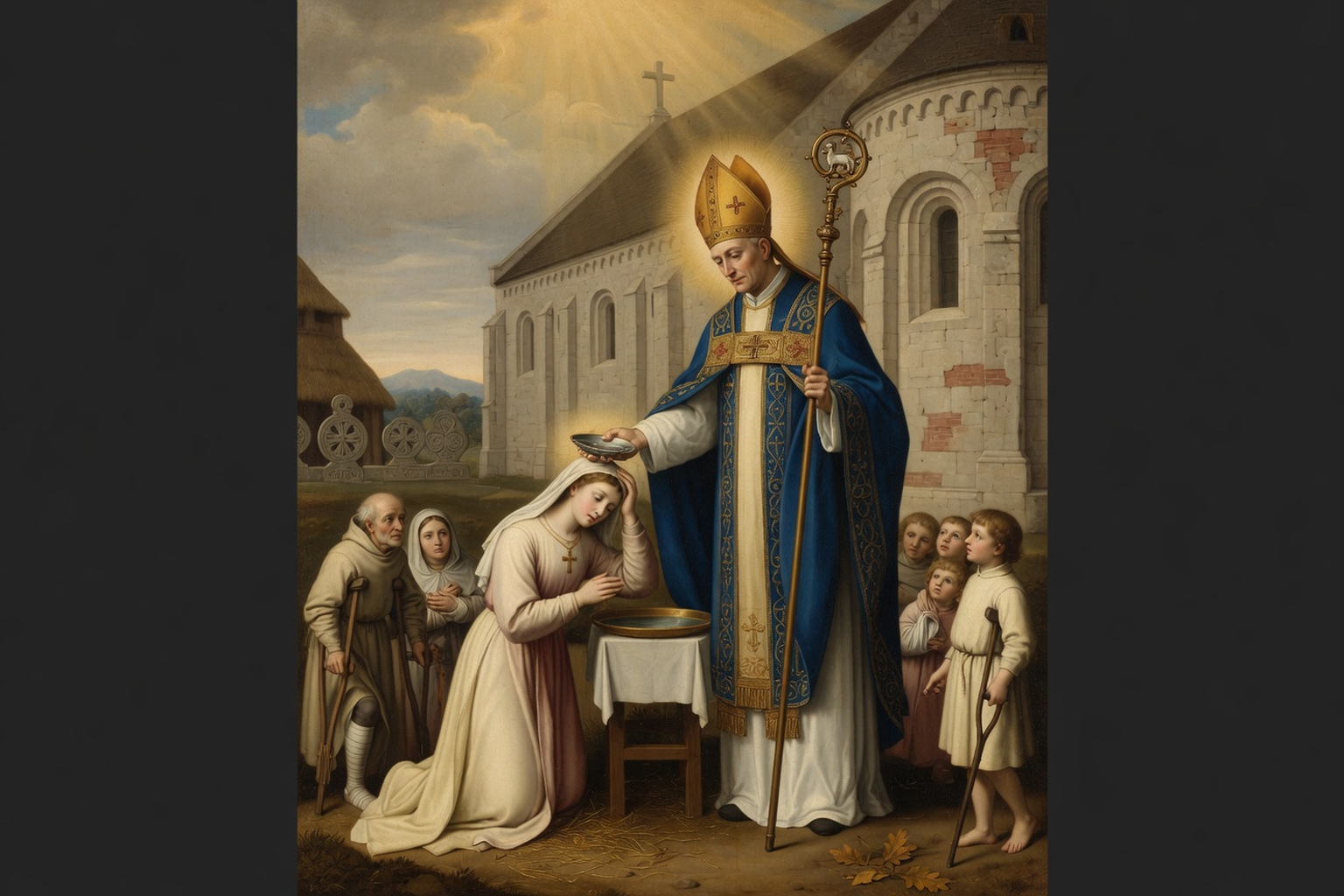
A missionary bishop of the 8th century, Erhard evangelized Bavaria and established his see in Regensburg. He is famous for baptizing Saint Odile, miraculously restoring her sight, and for founding the monastery of Niedermünster. His origin, disputed between Ireland and Germania, illustrates the role of Irish monks in the evangelization of Central Europe.
Guided reading
5 reading sections
SAINT ERHARD, EBERHARD OR EVRARD,
MISSIONARY BISHOP IN GERMANY (8th century).
Iconography and miracles
Saint Erhard is traditionally depicted baptizing Saint Odile, restoring her sight, and surrounded by the infirm. He is invoked in Germany for the protection of livestock.
The representations given of Saint Erha rd in German saint Erhard Bishop of Regensburg who baptized Odile. y recount the only known details of the life of this missionary bishop. Let us say, therefore, that he has been depicted:
1. Baptizing S aint Odile of Alsace, sainte Odile d'Alsace Alsatian saint born blind, baptized by Erhard. and at the same time restoring her sight, for she was born blind; 2nd, surrounded by cripples who come to ask for his blessing to be healed. He is invoked in Germany against epizootics.
Origins and chronology
Erhard's origins are debated between Narbonne, Bavaria, and Ireland. His death is estimated to be in the first half of the 8th century, in connection with Saint Hydulph and Saint Odile.
His life is poorly clarified; that of Saint Albert, his companion, is even more so.
Erha rd, wh Erhard Bishop of Regensburg who baptized Odile. ose name, Eer, honor, hard, strong, signifies powerful in glory, was Narbonnese by his family, Nervian, that is to say Bavarian, by his education, and Irish by his origin; this is at least what the author of the first life inserted by the Bollandists says. But the Germans protest against an Irish origin, given that the name Erhard is entirely Germanic and in no way Celtic. The time at which he died is just as controversial. We believe we can fix the time of his departure for heaven in the first half of the 8th century (700-750). Here are our reasons: He is said to be the brother of Saint Hydulph, Bishop of Tr ier, whose lif saint Hyduphbe Bishop of Trier and presumed brother of Saint Erhard. e we provide on July 11; it is said, on the other hand, that he baptized Saint Odile. Now, the former died in 707, and the latter in 720: it is therefore probable that he did not survive the latter by more than thirty years, and the former by more than forty-three years, if indeed he survived them at all.
Mission and foundations in Bavaria
A missionary bishop, he evangelized Bavaria and Regensburg. He founded the monastery of Niedermünster where he resided.
What appears to be certain to our neighbors across the Rhine is that Saint Erhard was the brother of Saint Hydulph; that he was a regional bishop; that he evan gelized Bavière Region of the saint's birth. Bavaria and in particular the di ocese of R Ratisbonne Episcopal see occupied by Albert. egensburg; that h e resided at Niedermanster Convent of nuns founded by Saint Erhard. Niedermünster and founded there the convent of nuns of that name, also called for this reason the monastery of Our Lady and of the holy confessor Erhard. The tradition of the Church of Regensburg, the historians of Bavaria, particular biographies, and other data are in agreement in this regard. As for Saint Albert, since no other saint of that name is known to have had relations with Saint Erhard, apart from Saint Albert, Bishop of Cashel in Ireland, if we hold to the opinion of the Germans, who claim Erhard as the brother of Saint Hydulph and as their compatriot, we must say that Albert was simply the companion and not the brother of Saint Erhard.
The influence of the Irish monks
The author proposes a synthesis: Erhard and his companion Albert were likely Bavarians trained in Ireland before returning to evangelize the Germanic lands.
We believe that one could reconcile all these claims by admitting that these bishops, born in Bavaria, went to Ireland to be trained in the monastic life, as was widely practiced in the 8th century; that their merit led to one being given the see of Ardagh, and the other that of Cashel; that, following the impulse of their zeal and also the example of the missionary monks of their time, they took the road back to Germany; that they evangelized particularly Bavaria and the Abaon, with the title of regional bishops.
M. de Montalembert and M. Ozanam demo M. de Montalembert Historian cited for his work on Irish monks. nstrate very well the role of missionaries devolved to the Irish among the Germanic races; and in fact, from the 5th to the 11th century, the Irish monks were not only the missionaries of Europe, they also excelled, through their learning, in training evangelical workers.
Sources and references
Sources include the Bollandists, Geschier's Dictionary of Theology, and Rader's works on holy Bavaria.
See also Acta Sanctorum, vol. 1 of Jan., p. 533 et seq. — the Dictionnaire de Théologie by Geschier, art. Erhard and Ratisbonne; — Father Rader, Bavaria sancta, etc.
Annexes & related entities
Structured data for exploration: events, miracles, quotes, places, attributes, patronages, and important entities cited in the text.
Key Events
- Monastic training in Ireland (hypothesis)
- Episcopate in Ardagh (hypothesis)
- Evangelization mission in Bavaria
- Baptism of Saint Odile of Alsace
- Foundation of the Niedermünster convent in Regensburg
Miracles
- Restores sight to Saint Odile during her baptism
- Healing of the crippled
Quotes
-
Erhard, whose name, Eer, honor, hard, strong, means powerful in glory
Source text